
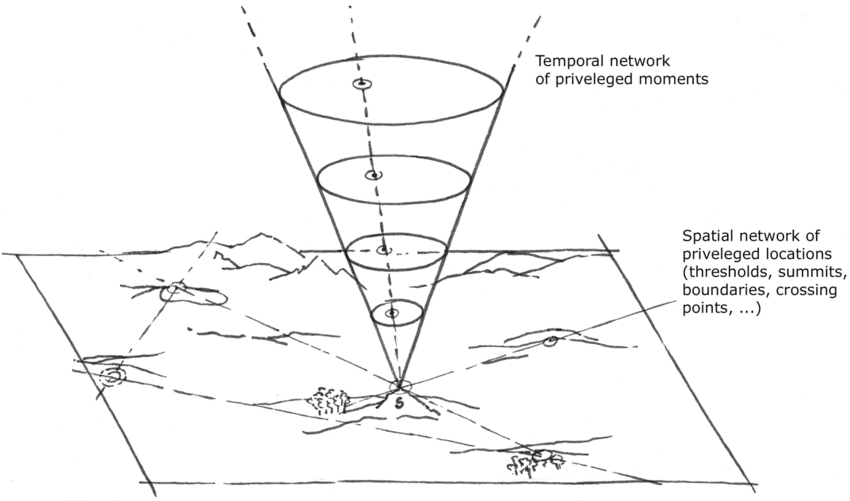
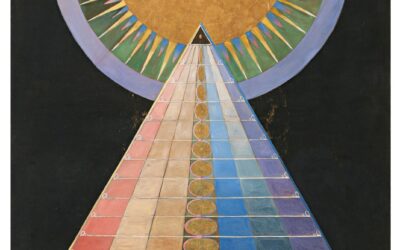
This drawing borrows the shape of Bergson’s cone, its tip meeting a plane, and relabels the parts as networks of privileged moments in time and privileged places in space. Credited to Simon O’Sullivan, from David Burrows and Simon O’Sullivan, Fictioning (Edinburgh University Press, 2019).5
Duration (durée) is Henri Bergson’s name for time as it is lived rather than measured: a continuous flow in which each moment carries the past forward, the way the notes of a tune melt into one another. He set it out in his 1889 doctoral thesis, Time and Free Will, arguing that clock time is really space in disguise, a line of identical units laid side by side.
Read alongside his second book, Matter and Memory (1896), duration offers a clear way to understand why trauma does not feel past. An overwhelming experience that the self has not taken in survives the way Bergson said habits survive: as a readiness of the body that “no longer represents our past to us, it acts it.” It has not become a recollection, whose essence, he wrote, “is to bear a date.”1 Therapy, read this way, is the slow work of letting that experience rejoin the flow of a life, so that it can be remembered instead of relived.
What Bergson meant by duration
Bergson wrote the thesis between 1883 and 1887 while teaching at the lycée in Clermont-Ferrand. It appeared in 1889 as Essai sur les données immédiates de la conscience.2 Its central move is a distinction between two kinds of multiplicity. Material objects can be counted because they sit side by side in space; states of consciousness permeate one another, and counting them smuggles space back in. When we picture time as a row of moments, Bergson argued, we have built “a fourth dimension of space, which we call homogeneous time.”2
Lived time is something else, and his definition is worth quoting whole: “Pure duration is the form which the succession of our conscious states assumes when our ego lets itself live, when it refrains from separating its present state from its former states.” His example is a melody. We hear the notes one after another, yet we hear them in one another, as a whole whose parts “permeate one another.”2 Nothing in a lived moment is a detachable unit.
The question is old. In Book XI of the Confessions, Augustine wrote, “What then is time? If no one asks me, I know: if I wish to explain it to one that asketh, I know not,” and he placed past, present and future in the soul as “a present of things past, a present of things present, and a present of things future.”3 Augustine’s turn inward belongs to the prehistory of depth psychology. Bergson’s contribution was to insist that inner time is not a smaller copy of clock time but a different kind of thing: qualitative, continuous and cumulative.
The freedom in the title follows from this. An act is free when it springs from the whole person, and freedom “admits of degrees,” because not every state blends into the rest of the self.2 That point matters for trauma, as the section below shows.
Creative Evolution (1907) carried duration into biology. “If I want to mix a glass of sugar and water, I must, willy nilly, wait until the sugar melts,” Bergson wrote; that wait “is no longer something thought, it is something lived.”4 The book also named the élan vital, the impulse he believed ran through evolution. Nothing in this article leans on that idea.
Matter and Memory: two ways the past survives
For therapists the important book is the second. Drawing on the clinical literature of its day on aphasia and brain lesions, Matter and Memory states its hypothesis plainly: “The past survives under two distinct forms: first, in motor mechanisms; secondly, in independent recollections.”1
His example is a lesson learned by heart. Repeat it enough and you can recite it without thinking. That memory “has all the marks of a habit” and is stored “in a closed system of automatic movements.” You can also remember the third time you read the lesson, with the room and the circumstances around it. That memory differs in kind: “It is like an event in my life; its essence is to bear a date, and consequently to be unable to occur again.” Habit memory, by contrast, “no longer represents our past to us, it acts it.”1
Bergson drew the relation between the two as an inverted cone. The base, AB, holds the totality of recollections and “remains motionless” in the past. The tip, S, is the present, where “the image of the body is concentrated,” and it continually touches a moving plane, P, which is “my actual representation of the universe.” In ordinary life the two memories “lend each other a mutual support.” He put the underlying point more starkly: “every perception is already memory. Practically we perceive only the past, the pure present being the invisible progress of the past gnawing into the future.”1
He also described what happens when the balance tips. A person who answers every stimulus with an immediate reaction is “a man of impulse”; one who lives in the past for the pleasure of living there is “a dreamer.” Between them lies “a memory docile enough to follow with precision all the outlines of the present situation, but energetic enough to resist all other appeal.”1 In trauma work that is roughly the goal: remembering without being pulled under.
Some of this has held up and some has not. Since about 1980, memory research has separated memory available to conscious recollection from memory that is not, such as skills and habits, and tied them to different brain systems.6 Bergson’s two memories look a great deal like that division. His further claim, that “lesions of the brain may affect these movements, but not these recollections,”1 has not held up. The same research tied conscious recollection to the hippocampus and related structures, and amnesic patients with damage there could no longer reliably lay down new memories of facts and events, the dated, personal kind he thought the brain did not hold, even as they went on learning skills.6
Why trauma feels like it is still happening
Bergson never wrote a theory of trauma, so what follows is a reading. He came close in Time and Free Will, though, when he described states that never join the flow of the self. He wrote that “a suggestion received in the hypnotic state is not incorporated in the mass of conscious states, but, endowed with a life of its own, it will usurp the whole personality when its time comes.” An education taken in without being digested leaves “a parasitic self which continually encroaches upon the other.” The remedy he names is assimilation: “suggestion would become persuasion if the entire self assimilated it.”2
His exact contemporary Pierre Janet was working on the same problem from the clinic. Both men were born in 1859 and trained at the École Normale Supérieure, and Janet’s L’automatisme psychologique appeared in 1889, the same year as Bergson’s thesis. As Bessel van der Kolk and Onno van der Hart summarize his findings, traumatic memories “may be expressed as sensory perceptions, affect states, and behavioral reenactments” rather than as stories a person can tell.7 Janet’s theory of dissociation and Bergson’s habit memory describe the same thing from two sides: a past that is performed rather than recalled.
Current trauma research says something similar. Anke Ehlers and David Clark’s cognitive model holds that PTSD persists when the trauma is processed in a way that produces “a sense of serious, current threat,” partly because the memory is poorly elaborated and contextualized while being strongly primed for perception.8 Re-experiencing symptoms, Ehlers and colleagues later wrote, are usually sensory impressions and emotional responses that “appear to lack a time perspective and a context,” and when people with PTSD deliberately recall the worst moments, they often fail to access what happened next, the very information that would correct the impressions formed at the time.9 Chris Brewin’s dual representation theory draws a similar line between sensation-bound and contextualized memory representations.10
In Bergson’s terms, the flashback is memory that has lost its date. It arrives at the tip of the cone as perception and action, without the context that would tell the person it belongs to the past. This is also why “it was a long time ago” rarely helps. The person knows the date as a fact. What has not happened is the assimilation Bergson described, in which “the whole history of the person” is reflected in an experience instead of the experience standing apart from it.2
From Bergson to the psychiatry of lived time
The most direct clinical heir was the psychiatrist Eugène Minkowski, who knew Bergson personally. In 1926 Minkowski published “Bergson’s Conceptions as Applied to Psychopathology” in the Journal of Nervous and Mental Disease,11 and in 1933 Le temps vécu, translated in 1970 as Lived Time, which reads psychopathology through the patient’s experience of time.12 One of his case studies, first published in 1923, was translated for Existence (1958), the anthology of European existential psychiatry that Rollo May edited with Ernest Angel and Henri Ellenberger.13
The line runs into current phenomenological psychiatry. Thomas Fuchs distinguishes implicit time, lived without reflection and carried by the body and by being in sync with others, from explicit time, which appears when inner time slows or speeds up relative to the world. He describes melancholic depression as usually triggered by a desynchronization from the social environment that deepens into an inhibition of the drives and feelings that carry a life forward.14 That is Bergson’s duration seen from the place where it stalls.
What this looks like in therapy
A Bergsonian view does not add a new technique. It changes what a clinician listens for. The question is not only “what happened?” but “is this being remembered, or being done?” A tightening jaw, a held breath, a sudden flatness or a reflexive apology can be the past acting through the body in the present session. Noticing that, gently and in the moment, can be the first step in giving the experience a date.
Most trauma work then moves between two tasks Bergson would recognize. One is staying anchored in the present, with enough safety in the room that recollection does not tip into reliving. The other is letting the memory gather context: what came before, what came after, what the person knows now. Ehlers and colleagues build this into cognitive therapy for PTSD by adding updating information (“I know now …”) to the worst moments of the memory and by training people to tell the harmless triggers of “now” from the stimuli of “then.”9 In EMDR therapy, the person holds the memory in mind while following eye movements or another bilateral stimulus, a different route to a similar aim.
The evidence is clearest for a few approaches. A 2020 systematic review and meta-analysis of 114 randomized trials found robust evidence for trauma-focused cognitive behavioral therapies and for EMDR, with Cognitive Processing Therapy, Cognitive Therapy and Prolonged Exposure showing the strongest evidence among the cognitive behavioral variants.15 Somatic and parts-based methods have a thinner research base, and clients deserve to hear that. Where they help, they fit the same frame: parts-based therapy works with something like Bergson’s parasitic self, a cluster of feeling and reflex never taken into the whole, and somatic therapy works at the tip of the cone, where memory becomes posture and reflex.
Eugene Gendlin’s felt sense, the bodily and not-yet-worded sense of a whole situation, is a later cousin of Bergsonian intuition; Gendlin’s path from philosophy into psychotherapy is worth reading next to Bergson. Both point to the same skill: slowing down enough for something lived to find words before it is forced into a story.
None of this erases a memory, and that is not the aim. When the work goes well, the event is still there, but it has a date. It sits at the base of the cone with the rest of a life, available to be recalled and no longer waiting to be relived.
Bergson’s life: a checked timeline
- 1859: Born in Paris on 18 October to a Polish father and an English mother, both Jewish.16
- 1878 to 1881: École Normale Supérieure, entering in the same year as Jean Jaurès, with Émile Durkheim a year behind; second place in the 1881 agrégation in philosophy.16
- 1881 to 1888: Teaches in Angers, then from 1883 in Clermont-Ferrand. His first scholarly article, in 1886, concerns unconscious simulation under hypnosis.16
- 1889: Doctorate; Time and Free Will.
- 1891: Marries Louise Neuberger, a cousin of Marcel Proust.
- 1896: Matter and Memory.
- 1900 to 1907: Chair of ancient philosophy at the Collège de France, then modern philosophy from 1904; Laughter (1900); Creative Evolution (1907), which makes him famous far beyond philosophy.16
- 1913 to 1914: Lectures at Columbia; presides over the Society for Psychical Research; elected to the Académie française.16
- 1917: French government emissary to President Wilson.16
- 1919: Mind-Energy; withdraws from teaching.16
- 1922: Presides over the League of Nations’ International Committee on Intellectual Cooperation; debates Einstein in Paris on 6 April; publishes Duration and Simultaneity.16
- 1928: Receives the 1927 Nobel Prize in Literature, held over a year, “in recognition of his rich and vitalizing ideas and the brilliant skill with which they have been presented.”17 Severe arthritis is already forcing him out of public life.16
- 1932: The Two Sources of Morality and Religion, his last major book.16
- 1937: His will says he would have converted to Catholicism had he not seen a wave of antisemitism building, and that he did not want to leave the persecuted.16
- 1940 to 1941: Refuses the Vichy government’s offer of exemption from its antisemitic laws; dies in occupied Paris in early January 1941, aged 81.16
The 1922 debate was about duration itself: Bergson accepted relativity as physics but denied it could account for lived time, and Einstein answered that the time of the philosophers does not exist.18 Presenting Einstein’s Nobel Prize that December, Svante Arrhenius noted that “the famous philosopher Bergson in Paris has challenged this theory.”19 Bergson’s reputation faded after the Second World War and revived with Gilles Deleuze’s Bergsonism in 1966.16
If the past keeps arriving as though it were the present, therapy can work with that, at a pace you set. Our clinicians in Hoover work with dissociation and trauma and with the existential questions of time, loss and meaning that often sit beneath them. Read more there or contact us when you are ready.
References
- Bergson, H. (1929). Matter and memory (N. M. Paul & W. S. Palmer, Trans.). George Allen & Unwin. (Original work published 1896). https://archive.org/details/matterandmemory00berguoft
- Bergson, H. (1913). Time and free will: An essay on the immediate data of consciousness (F. L. Pogson, Trans.). George Allen. (Original work published 1889). https://www.gutenberg.org/ebooks/56852
- Augustine. (2002). The confessions of St. Augustine (E. B. Pusey, Trans.). Project Gutenberg. (Original work written ca. 397–401). https://www.gutenberg.org/ebooks/3296
- Bergson, H. (1911). Creative evolution (A. Mitchell, Trans.). Henry Holt. (Original work published 1907). https://www.gutenberg.org/ebooks/26163
- Burrows, D., & O’Sullivan, S. (2019). Fictioning: The myth-functions of contemporary art and philosophy. Edinburgh University Press. https://doi.org/10.1515/9781474432412
- Squire, L. R. (2004). Memory systems of the brain: A brief history and current perspective. Neurobiology of Learning and Memory, 82(3), 171–177. https://doi.org/10.1016/j.nlm.2004.06.005
- van der Kolk, B. A., & van der Hart, O. (1989). Pierre Janet and the breakdown of adaptation in psychological trauma. American Journal of Psychiatry, 146(12), 1530–1540. https://doi.org/10.1176/ajp.146.12.1530
- Ehlers, A., & Clark, D. M. (2000). A cognitive model of posttraumatic stress disorder. Behaviour Research and Therapy, 38(4), 319–345. https://doi.org/10.1016/S0005-7967(99)00123-0
- Ehlers, A., Hackmann, A., & Michael, T. (2004). Intrusive re-experiencing in post-traumatic stress disorder: Phenomenology, theory, and therapy. Memory, 12(4), 403–415. https://doi.org/10.1080/09658210444000025
- Brewin, C. R., Gregory, J. D., Lipton, M., & Burgess, N. (2010). Intrusive images in psychological disorders: Characteristics, neural mechanisms, and treatment implications. Psychological Review, 117(1), 210–232. https://doi.org/10.1037/a0018113
- Minkowski, E. (1926). Bergson’s conceptions as applied to psychopathology. Journal of Nervous and Mental Disease, 63(6), 553–568. https://doi.org/10.1097/00005053-192606000-00001
- Minkowski, E. (1970). Lived time: Phenomenological and psychopathological studies (N. Metzel, Trans.). Northwestern University Press. (Original work published 1933)
- Minkowski, E. (1958). Findings in a case of schizophrenic depression (B. Bliss, Trans.). In R. May, E. Angel, & H. F. Ellenberger (Eds.), Existence: A new dimension in psychiatry and psychology (pp. 127–138). Basic Books. (Original work published 1923). https://doi.org/10.1037/11321-004
- Fuchs, T. (2013). Temporality and psychopathology. Phenomenology and the Cognitive Sciences, 12(1), 75–104. https://doi.org/10.1007/s11097-010-9189-4
- Lewis, C., Roberts, N. P., Andrew, M., Starling, E., & Bisson, J. I. (2020). Psychological therapies for post-traumatic stress disorder in adults: Systematic review and meta-analysis. European Journal of Psychotraumatology, 11(1), Article 1729633. https://doi.org/10.1080/20008198.2020.1729633
- Lawlor, L., & Moulard-Leonard, V. (2025). Henri Bergson. In E. N. Zalta & U. Nodelman (Eds.), The Stanford encyclopedia of philosophy. https://plato.stanford.edu/entries/bergson/
- Nobel Prize Outreach. (n.d.). The Nobel Prize in Literature 1927: Summary. NobelPrize.org. https://www.nobelprize.org/prizes/literature/1927/summary/
- Canales, J. (2015). The physicist and the philosopher: Einstein, Bergson, and the debate that changed our understanding of time. Princeton University Press. https://doi.org/10.1515/9781400865772
- Arrhenius, S. (1922, December 10). Award ceremony speech: The Nobel Prize in Physics 1921. NobelPrize.org. https://www.nobelprize.org/prizes/physics/1921/ceremony-speech/











0 Comments