
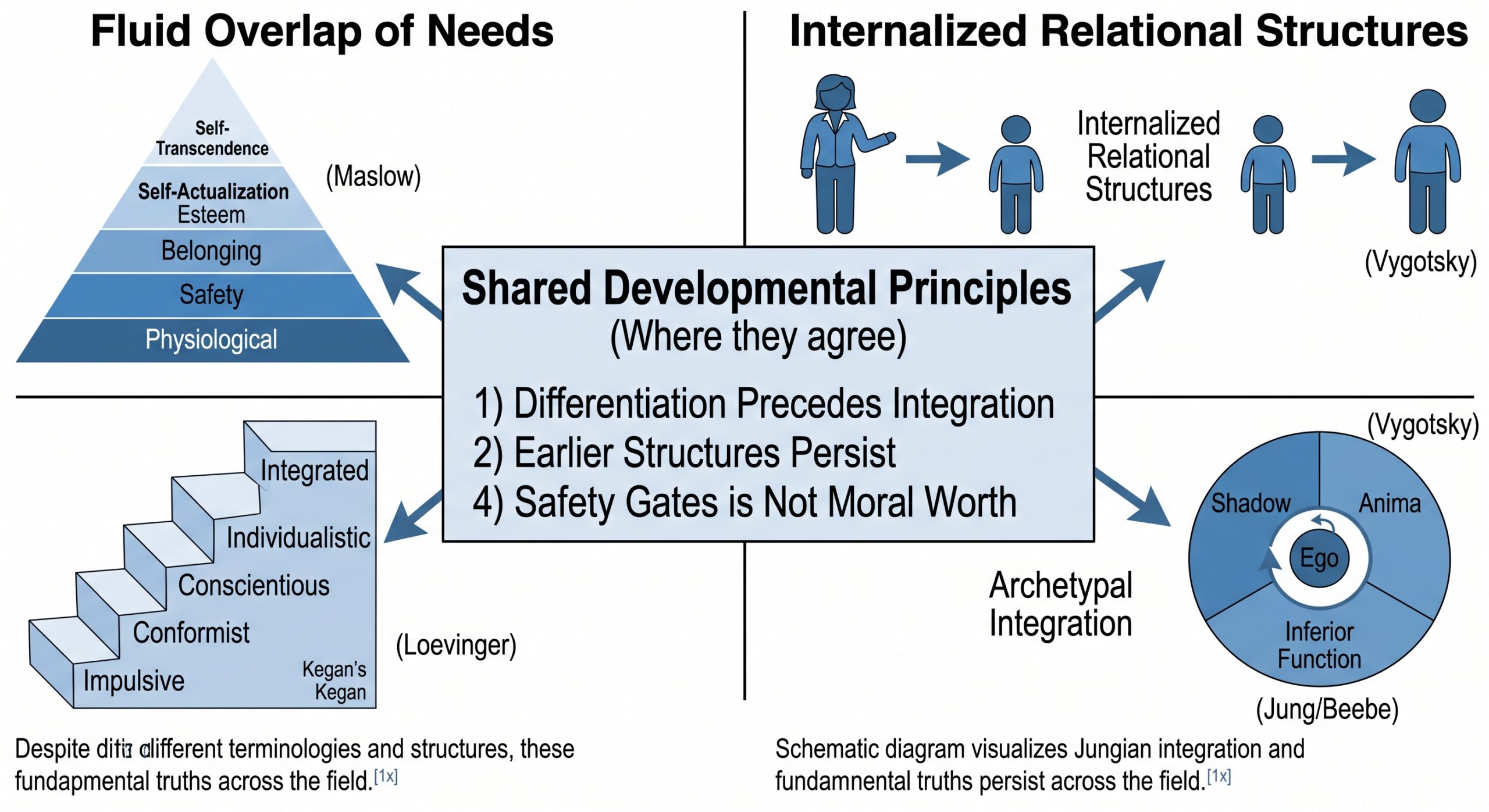
Every generation of psychologists seems to arrive at the same instinct: that the mind develops in stages, that those stages stack, and that the stack means something. Maslow drew needs. Erikson drew crises. Kohlberg drew moral reasoning. Loevinger drew the ego. Wilber drew almost everything at once. Students meet these models one at a time, usually in different courses, and rarely get to see them side by side — which is a shame, because the interesting part isn’t any single hierarchy. It’s what happens when you lay them over each other and watch where they agree, where they contradict, and where they quietly smuggle in a value judgment about what a good human being looks like.
This is a comparison of the major hierarchical models in psychology: what each one actually claimed, what the evidence says, and what survives once you strip away the classroom version.
The pyramid Maslow never drew
Start with the most famous, because almost everything students are taught about it is wrong.
Abraham Maslow’s 1943 paper “A Theory of Human Motivation” proposed that human needs fall into categories — physiological, safety, belonging, esteem, self-actualization — and that lower needs generally press harder when unmet. That’s it. He did not draw a pyramid. He explicitly wrote that the hierarchy was not rigid, that needs overlap, that a person could pursue several at once, and that reversals were common. The pyramid diagram appeared later, in management literature in the 1960s, and it stuck because it was easy to put on a slide.
Maslow also kept revising. Late in his life he added self-transcendence above self-actualization, arguing that the fullest expression of a person wasn’t self-fulfillment but a movement beyond the self entirely — toward service, the sacred, or what he called peak experience. That revision almost never appears in textbooks, and it changes the shape of the whole theory. We covered the full arc of his work and the distortions it picked up along the way in Abraham Maslow’s Enduring Legacy.
Strength: it names something real. People in danger don’t pursue meaning. Clinically this matters enormously — you cannot do insight work with someone whose housing is unstable.
Weakness: as an empirical claim about need ordering, it has never held up well. Cross-cultural work finds the sequence varies, and people routinely sacrifice safety for belonging or meaning. The hierarchy describes a tendency, not a law.
Erikson: crisis instead of need
Erik Erikson replaced needs with tensions. Each of his eight stages poses a conflict — trust versus mistrust, autonomy versus shame, identity versus role confusion — and each resolution leaves a residue that shapes the next. Unlike Maslow, Erikson ran his model across the whole lifespan, including old age, which was unusual for the time.
Two things make Erikson more useful clinically than he’s given credit for. First, resolution is never total. You don’t “finish” trust; you carry a ratio forward. Second, the stages can be revisited. A midlife divorce can reopen identity. A late diagnosis can reopen autonomy. We’ve written on both the psychosocial stages and identity formation and on Erikson’s broader legacy in developmental psychology.
Strength: the lifespan scope, and the honesty that development is never clean.
Weakness: the stages are descriptive rather than testable. Erikson’s evidence base was clinical observation and biography, not measurement.
Piaget and Vygotsky: the cognitive fork
Jean Piaget built the most rigorously staged model of the lot — sensorimotor, preoperational, concrete operational, formal operational — and unlike most stage theorists he actually demonstrated the transitions experimentally. A four-year-old genuinely cannot conserve volume. Show them the tall glass and the wide glass and they will tell you the tall one has more. That’s not opinion.
What Piaget got wrong was timing and universality. Later researchers found children capable of operations earlier than he claimed when the task was framed in familiar terms, and formal operational thought turns out to be far from universal in adults. His account of cognitive development remains the scaffolding everyone else builds on, even where it’s been corrected.
Lev Vygotsky offered the sharpest alternative, and it’s the one that matters most for therapy. Where Piaget saw a child constructing knowledge largely alone, Vygotsky saw development as fundamentally social — capacities appear first between people and only later inside the individual. The zone of proximal development describes what a person can do with help but not yet alone, which is, when you think about it, a precise definition of what a therapist does. Vygotsky’s significance has grown steadily as the field has moved toward relational models.
The fork matters: Piaget’s hierarchy is internal and maturational. Vygotsky’s is relational and mediated. Nearly every later stage theory inherits one assumption or the other, usually without saying which.
Kohlberg, and the critique that reshaped the field
Lawrence Kohlberg extended Piaget into moral reasoning: six stages across three levels, from avoiding punishment up to universal ethical principles. He assessed it by presenting moral dilemmas and scoring the reasoning rather than the answer, which was genuinely clever.
The problem was the sample. Kohlberg’s original longitudinal study followed 72 boys. Carol Gilligan, who worked with him, argued in In a Different Voice that the scoring system systematically ranked an ethic of care below an ethic of justice, and that this reflected whose reasoning had been studied rather than a real developmental ceiling. The debate that followed has never fully settled, but it permanently changed how developmental psychology thinks about the neutrality of its own instruments.
Strength: the method — score the reasoning, not the conclusion — is still good practice.
Weakness: a hierarchy built from a narrow sample will encode that sample’s values and call them maturity. This is the single most important caution for anyone reading stage theory.
Loevinger and Kegan: the ego learns to see itself
Jane Loevinger’s ego development model is the most empirically careful of the adult hierarchies, largely because she built a real instrument to measure it — a sentence completion test scored against defined stages. Her sequence runs from impulsive through conformist, conscientious, individualistic, autonomous, and integrated. What develops isn’t intelligence or morality but the complexity of the frame a person uses to organize experience.
Robert Kegan sharpened this into something genuinely useful. His subject-object theory holds that development happens when something you were embedded in becomes something you can look at. At one stage your relationships have you; at the next, you have your relationships. The move is always the same shape: what was subject becomes object.
This is, more or less, a formal description of what insight-oriented therapy does. A client who says “I am anxious” is embedded. A client who says “there’s an anxious part of me that shows up when I’m criticized” has made anxiety an object. That shift is the work — and it’s why parts-based approaches can produce movement where insight alone stalls.
Strength: measurable, adult-focused, and clinically legible.
Weakness: slow. Loevinger’s stages move over years, and most people stabilize well before the top of the scale. Therapies promising rapid stage advancement are selling something.
Neumann: consciousness as a mythological sequence
Erich Neumann’s The Origins and History of Consciousness (1949) is the strangest entry here and the one most worth a student’s time. Neumann argued that the development of individual consciousness recapitulates a mythological sequence found across cultures: an undifferentiated beginning, an engulfing maternal phase, a separation of opposites, and a hero’s struggle to establish an independent ego.
Taken literally as history it’s indefensible. Taken as a phenomenology of how differentiation feels — the terror of separation, the pull back toward fusion, the aggression required to individuate — it’s uncomfortably accurate, and it maps onto clinical material in ways more sober models don’t. We’ve written both a review of the book itself and a broader look at Neumann’s archetypal psychology.
Jung: the model that refuses to be a hierarchy
Here’s where the comparison gets interesting. Jung’s individuation is the odd one out, because it isn’t a ladder at all.
Individuation doesn’t ascend. It circles. The task isn’t to transcend earlier stages but to integrate what was split off — the shadow, the contrasexual, the inferior function. Movement is toward wholeness rather than height, and the material you most need is usually the material you’ve been climbing away from. Jung’s own metaphor was the spiral: you return to the same point at a different level.
This is a direct structural challenge to every other model on this page. If Kegan says development means making the old frame an object, Jung says development means going back for what the frame excluded. Both can be true; they describe different motions. For the fullest treatment see Carl Jung: Explorer of the Soul, and for the process itself, the labyrinth as a model of individuation and Murray Stein’s account of its architecture.
Edward Edinger pushed this furthest with the ego-Self axis — the idea that development is a repeated cycle of inflation and alienation between ego and Self, rather than a single ascent. Edinger’s model is closer to a pendulum than a staircase. And Michael Fordham did the necessary work of reconciling Jung with actual child development research in his integration of developmental and analytical psychology.
Beebe: hierarchy inside the personality
John Beebe’s eight-function model deserves mention because it applies hierarchy in a different direction — not across time, but within a single psyche at any moment. Beebe proposed that the cognitive functions occupy archetypal positions: the dominant function carries the hero, the inferior carries the anima or animus, and the shadow functions carry the trickster, the demon, and so on.
Whatever you think of type theory’s empirical standing, the structural insight is sound: parts of a personality have different status, and the low-status parts behave the way low-status things always behave — they get projected, they erupt under stress, and they carry the material the dominant function refuses. The Beebe model is worth knowing even if you never use a type indicator.
Polyvagal theory: hierarchy in the nervous system
Stephen Porges’ polyvagal theory is explicitly hierarchical, and it’s the only model here grounded in phylogeny. Three systems, laid down in evolutionary order: the dorsal vagal shutdown response (oldest), sympathetic mobilization, and ventral vagal social engagement (newest, mammalian). Under threat, we lose them in reverse order — social engagement first, then mobilization, then collapse. Porges borrowed the principle from John Hughlings Jackson, who described the same dissolution pattern in neurology a century earlier.
Clinically this is the most immediately usable hierarchy on the list, because it tells you where a person is and what’s available to them right now. Someone in dorsal collapse cannot access insight, and asking them to reframe a thought is asking for something the nervous system has taken offline. See the biology of safety, and glimmers for the practical application.
Honest caveat: the theory has serious critics. Paul Grossman and others have challenged several of its physiological claims, particularly around the evolutionary account of respiratory sinus arrhythmia. The clinical framework has proved more durable than the biology it was built on, which is worth saying plainly rather than glossing over. We look at the mythological reading of it in your nervous system as a storyteller.
Wilber: the hierarchy of hierarchies
Ken Wilber’s integral model attempts to stack all of the above into a single framework — quadrants, levels, lines, states and types — arguing that different theories describe different developmental lines that can progress at different rates. Someone can be cognitively advanced and morally stunted, which most single-line models can’t account for.
That’s the real contribution, and it’s a good one. The lines idea dissolves a lot of pointless argument between stage theorists. His other durable contribution is the pre/trans fallacy: the observation that pre-rational and trans-rational states can look similar from the outside, and that both mystics and psychotics get misfiled as a result.
The weakness is scope. Wilber synthesizes across fields faster than any one person can verify, and the model is largely unfalsifiable. Read him for the organizing questions rather than the answers. We cover the integral vision and, more usefully for students, where his ideas actually come from.
What they agree on
Strip the vocabulary and four claims survive across nearly every model:
Differentiation precedes integration. You have to separate things before you can hold them together. Piaget, Neumann, Kegan and Jung all say this in different languages.
Earlier structures persist. Nothing is outgrown, only subsumed. This is why regression under stress is universal and not pathological in itself.
Safety gates complexity. Maslow said it in terms of needs, Porges in terms of the vagus, Vygotsky in terms of scaffolding. Threat collapses the available range.
Development is not moral worth. Every theorist on this list said so, and the field ignored nearly all of them. A later stage means more complexity, not more virtue — and the history of Kohlberg’s sample is a permanent reminder of what happens when that distinction slips.
Where they break
The models divide on one question: does development mean going up, or going back for what you left?
The ascent models — Maslow, Kohlberg, Loevinger, Kegan, Wilber — treat earlier stages as scaffolding to be built past. The return models — Jung, Neumann, Edinger, and most depth psychology — treat earlier material as unfinished business that will keep surfacing until it’s integrated.
In practice, therapy needs both. A client who has never differentiated needs the ascent. A client who is highly differentiated and hollow needs the return. Diagnosing which is which is most of the clinical skill, and no hierarchy will do it for you.
For students
If you’re writing about this, three things will make your work better than most of what’s published:
Name the evidence base. Kohlberg had 72 boys. Loevinger had a validated instrument. Neumann had mythology. These are not equivalent claims and shouldn’t be cited as though they were.
Ask whose maturity is being described. Every hierarchy encodes a value. Find it and say what it is.
Watch for the pyramid problem. Maslow’s shape was invented by someone else and then attributed to him for eighty years. Check whether the diagram you were taught is actually in the source.
Our fuller writing on individual figures — Adler, Horney, Winnicott, Frankl, Hillman — goes deeper on each than a comparison piece can.
The next article in this series looks at theories of development specifically: their influence, their strengths and weaknesses, and what has actually survived contact with evidence. A third will take the stages themselves and read them through several lenses at once.












0 Comments