
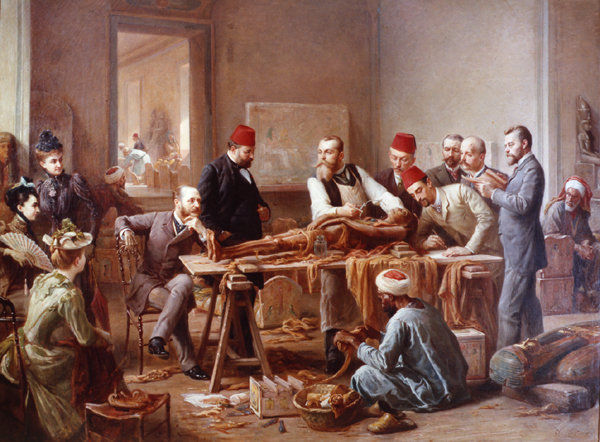
A mummy is a human or animal body whose soft tissue has been preserved, either deliberately by embalming or naturally by dry sand, ice, cold or the acid water of a peat bog. Mummies matter psychologically because they show how differently cultures answer one question: what do we owe the bodies of our dead, and can the bond with them continue after death?
Key takeaways
- A mummy is a body whose soft tissue survives, either through deliberate embalming or through natural conditions such as dry sand, ice or peat bogs.
- The Chinchorro of coastal Chile and Peru made artificial mummies around 5000 BCE, roughly two thousand years before Egyptian embalmers began.
- Egyptians preserved the body so the ka and ba had an anchor, and each mummy was ritually identified with the god Osiris.
- The horror-film mummy grew out of Victorian fiction and the Tutankhamun curse story, and it obscures what mummification meant to the cultures that practised it.
- Mummification is some of the oldest evidence of continuing bonds, the idea that healthy mourners keep a changed relationship with the dead.
What is a mummy, and how old is the practice?
Mummies have held the human imagination for centuries because they put death in front of us with a face still on it. The physician and palaeopathologist Arthur Aufderheide, who examined thousands of preserved bodies, defined a mummy simply as a corpse whose soft tissues survive, and he divided them into two broad groups: anthropogenic mummies, made on purpose by people, and spontaneous mummies, produced by the environment alone.1 The second group is far older and far more common than most people assume.
The deliberate practice is also older than Egypt. The earliest known artificial mummies come from the Chinchorro fishing people of the Atacama coast, and Egypt’s own tradition grew out of bodies that first dried naturally in desert graves. Looking at mummies through history, anthropology and cultural studies together shows something no single discipline shows alone: preserving the dead has rarely been about the body as an object. It has been about keeping a relationship, a status or a story alive, and about how a community holds its grief and its fear of death.
How did the mummy become a horror icon?
Western fascination with Egyptian mummies is older than the movies. In the nineteenth century, mummies were unwrapped as public entertainments in London, and Jane Loudon’s novel The Mummy! (1827) imagined one revived in the twenty-second century. The scholar Jasmine Day calls the long Anglo-American obsession “mummymania” and traces how it shaped everything from museum displays to children’s books.2
Howard Carter’s opening of Tutankhamun’s tomb in November 1922 turned that fascination into a global craze. When his patron, Lord Carnarvon, died in Cairo in April 1923, newspapers spread the story of a pharaoh’s curse. Roger Luckhurst has shown that the curse story did not begin in 1922: it grew out of Victorian fiction such as Louisa May Alcott’s “Lost in a Pyramid; or, The Mummy’s Curse” (1869) and out of rumours attached to objects in the British Museum.3
The mummy in fiction and film
In literature and film the mummy usually rises to take revenge or to reclaim a lost love. Arthur Conan Doyle’s story “Lot No. 249” (1892) has a mummy reanimated as a weapon, and Bram Stoker’s novel The Jewel of Seven Stars (1903) builds a plot around the attempted resurrection of an Egyptian queen. Universal’s The Mummy (1932), directed by Karl Freund, cast Boris Karloff as Imhotep, a priest who has waited thousands of years for his beloved to return. Hammer Films remade the story in 1959 with Christopher Lee, and Stephen Sommers revived it as an action film in 1999. Alongside the vampire and the werewolf, the mummy became one of the classic monsters, and like them it lives on in nightmares as well as on screen, where monsters in dreams often carry what a dreamer cannot yet face.
Stereotypes and a more respectful view
The film scholar Antonia Lant has described how early cinema “contracted Egyptomania,” borrowing Egypt as a ready image of mystery, darkness and exotic danger. The cost was a cartoon of a real civilisation. The shambling, bandaged monster of sequels such as The Mummy’s Hand (1940) has little to do with how Egyptians understood their dead, who were meant to be transfigured and alive in the next world, not trapped and vengeful.
Museums have spent the last few decades correcting that picture. In the United States, the Native American Graves Protection and Repatriation Act of 1990 requires museums to return many Native human remains to descendant communities. Many museums now speak of a “mummified person” rather than “a mummy” and explain the beliefs behind the preparation. Those changes ask visitors to see a person who was once loved and mourned, not a prop, and they treat each preserved body as evidence of a very old human wish to keep life and memory beyond death.
Why did the ancient Egyptians mummify their dead?
For the Egyptians, the body was one of several parts of a person that had to survive for the dead to live on. The ka was the life force that received food offerings, and the ba, often drawn as a human-headed bird, could travel by day and return to the body at night. If the body perished, those parts lost their anchor.4 Egyptologist Jan Assmann argues that Egyptian funerary religion was, at heart, a long project of reassembling the dead person after death had scattered them, physically, socially and spiritually.5 The gods involved in that project are described in Egyptian mythology.
How mummification worked
The full process, at its most elaborate in the New Kingdom (about 1550 to 1070 BCE), took around seventy days. Embalmers removed the brain, usually through the nose, and took out the lungs, liver, stomach and intestines through a cut in the left side. The organs were dried and placed in canopic jars, while the heart, thought to be the seat of thought and memory, was normally left inside. The body was packed in natron, a natural salt that draws out water, for about forty days, then cleaned, anointed and wrapped in many layers of linen.4 Chemical analysis by Stephen Buckley and Richard Evershed of mummies spanning about 2,000 years found that the embalming balms were mixtures of fats and oils, beeswax, plant gums and conifer resins, which grew more complex over time.6
Becoming an Osiris
Each step had ritual meaning. Priests recited spells over the body, and amulets were tucked into the wrappings: the scarab over the heart and the wedjat, the eye of Horus, for protection and wholeness, an image discussed in the sacred gaze in ancient art. The dead person was addressed as “the Osiris” followed by their own name. In myth, Osiris was murdered and dismembered by his brother Seth, gathered and wrapped by Isis and Nephthys, and restored to life as king of the dead, so the embalmers were re-enacting his story on every body.5 James George Frazer later made Osiris a centrepiece of The Golden Bough, reading him as a dying and reviving god of the grain. The seventy days also form what the anthropologist Victor Turner would call a liminal period, a threshold time in which the dead person is neither fully gone nor yet transformed.
Tombs, grave goods and the bond with the living
Coffins, inscribed wrappings, the Book of the Dead and the “Opening of the Mouth” ceremony, performed at the tomb to restore the senses of the mummy, protected and guided the dead. Grave goods supplied the next life: food, clothing, furniture and small figures called shabtis, who would do the deceased’s farm labour in the fields of the afterlife.4 Egyptian thought held both a cyclical time of renewal, like the daily rising of the sun, and an unchanging eternity of the god Osiris.5
Preservation also kept the dead inside the family. Relatives brought offerings to tomb chapels and spoke the offering formula aloud, and some wrote “letters to the dead” on bowls left at the tomb, asking a deceased parent or spouse for help or protection.5 The mummy was a way of keeping a relationship, not only a body.
Mummies in the Americas: Andean and Mesoamerican traditions
Mummification was not limited to Egypt. The Chinchorro, a fishing and gathering people of the coast of what is now northern Chile and southern Peru, began making artificial mummies around 5000 BCE, about two thousand years before the Egyptians did. Naturally dried Chinchorro bodies are older still, going back to roughly 7000 BCE.7 Bernardo Arriaza’s seriation of the burials describes several styles over time. In the “black mummies,” the body was taken apart and defleshed, the skeleton was reinforced with sticks and reeds, and the whole was rebuilt with plant fibre, covered in ash paste or clay, and painted with manganese. Later “red mummies” were opened with smaller cuts, packed, and painted with red ochre, often with a wig and a clay face mask.78 Chinchorro mummies include infants and fetuses as well as adults, which suggests a care for every member of the group rather than only for rulers. UNESCO listed the Chinchorro sites as World Heritage in 2021.
In the Andean highlands, the Inca kept the mummies of their rulers, called mallqui, in their palaces. Royal mummies had attendants, were offered food and drink, were consulted on important matters and were carried out for festivals in Cusco. The Inca also left children as high-altitude sacrifices, the capacocha, and the cold preserved several of them, including the three children found on Llullaillaco in Argentina in 1999.1
Mesoamerica is different. The Maya and Aztec did not have a systematic mummification practice: Aztec rulers were usually cremated, and Maya royal bodies were laid in tombs and decomposed. What the Maya did do was treat royal remains as sacred. The tomb of K’inich Janaab’ Pakal, ruler of Palenque who died in 683 CE, found by Alberto Ruz Lhuillier in 1952 inside the Temple of the Inscriptions, held his body under a carved lid, covered in red cinnabar and wearing a jade mosaic mask. James Fitzsimmons has shown that Classic Maya kings’ tombs were often re-entered years later, their bones painted or rearranged, and that dead rulers were treated as ancestors who still took part in the life of their city.9 Across the Americas, as in Egypt, keeping the body kept the dead person’s essence connected to the living community.
What are bog bodies and glacier mummies?
Many mummies were never meant to exist. These natural mummies, often found by accident, offer a direct view of individual lives from times that left no writing.
Bog bodies
Bog bodies are preserved in the acidic, cold, oxygen-poor water of peat bogs, where a substance from sphagnum moss tans the skin like leather and often dissolves the bones. Hundreds have been found across northern Europe, especially in Denmark, Germany, the Netherlands, Britain and Ireland.1 The two best known are Danish. Tollund Man, found by peat cutters near Silkeborg in 1950, lived in the fourth century BCE and still wears a pointed skin cap and the braided leather noose that killed him. Grauballe Man, found in 1952, lived in the third century BCE and had his throat cut. Their skin, hair and even stomach contents survive, so researchers can study their last meals, health and appearance.
The archaeologist P. V. Glob, who excavated both, argued in The Bog People (Danish 1965, English 1969) that many were ritual sacrifices offered to a fertility goddess, linking them to the Roman historian Tacitus’s account of the goddess Nerthus. Others may have been executed criminals.10 Karin Sanders traces how these bodies then entered poetry and art, most famously in Seamus Heaney’s bog poems, where they became mirrors for violence in Heaney’s own Ireland.11 In that sense the bog is also a picture of what a psyche keeps, the idea behind somatic archeology: what is buried is preserved, not erased.
Ötzi the Iceman
Glacier mummies show the same thing at higher altitude. Ötzi the Iceman was found by two hikers on 19 September 1991 in the Ötztal Alps, on the border between Austria and Italy, just on the Italian side, and now rests in the South Tyrol Museum of Archaeology in Bolzano. He lived around 3300 BCE. He was found with his clothing, a copper axe, a bow, a quiver of arrows and a small fire-making kit, which let Konrad Spindler and later researchers reconstruct his life and Copper Age culture in detail.12 An arrowhead was found lodged in his left shoulder in 2001, and CT scans later showed it had torn an artery, so he most likely bled to death within minutes.13 Whether through sacrifice, execution or murder, natural mummies keep reminding us of the complicated ties between life, death and society in early cultures, and they keep drawing new research and public attention.
What does the mummy symbolize?
In all its forms, the mummy stands for the human fascination with death, immortality and the afterlife. It is a body held at the edge between life and decay, and that edge is exactly where its psychological power lies. In the Egyptian frame, the wrapped body points forward to rebirth, the Osiris pattern of dismemberment, gathering and renewal. In the horror film, the same image points backward: the past refuses to stay buried and comes back for us.
Depth psychology reads both images. In Jungian terms, the mummy is an image of the shadow when it returns as a monster: what we have sealed away, wrapped up and refused to look at. In its Egyptian setting it carries the archetype of death and rebirth, the same pattern Jungians find in myths of descent and return, which is why myths are public dreams and dreams private myths. The anthropologist Ernest Becker argued in The Denial of Death (1973) that much of culture is a project for outliving the body, and terror management theory later tested how reminders of death push people to cling to meaning and legacy. The mummy is that project made literal: the wish to transcend mortality and leave something of ourselves for those who come after.
Mummies, grief and continuing bonds
The mummy also speaks to grief. For much of the twentieth century, Western psychology followed Sigmund Freud‘s “Mourning and Melancholia” (1917) in treating grief as the work of letting go: the mourner gradually withdraws attachment from the dead and reinvests it in the living. Stage models popularised by Elisabeth Kübler-Ross were often read the same way, as a road toward closure.
In 1996, Dennis Klass, Phyllis Silverman and Steven Nickman challenged that view in Continuing Bonds. Drawing on bereaved parents, widows, children and cross-cultural material, they argued that healthy mourners often keep an ongoing inner relationship with the dead, talking to them, carrying their values, sensing their presence, and that this bond changes rather than ends.14 Klass later stressed that these bonds are shaped by culture and community, not only by the individual mind.15
Read this way, mummies are some of the oldest evidence of continuing bonds. Egyptian families wrote letters to their dead, the Inca gave their rulers seats at festivals, and Maya kings were visited in their tombs. Modern mourners keep a voicemail, a sweater or a grave they talk to, and the Southern habit of keeping the dead close shows up in Alabama’s ghosts. When a culture, or a family, has no room for that bond, grief can become isolating, the problem named disenfranchised grief.
How does mummy imagery show up in therapy?
At Taproot we often meet the mummy in two forms. The first is grief that has been preserved rather than lived: a bedroom kept exactly as it was, a loss no one in the family is allowed to mention, sorrow wrapped tight so it can be carried without being felt. We do not treat the wish to stay connected to the dead as a symptom. We help a person find a form of the bond that lets them live, the way Egyptian ritual moved the dead from the embalming house into a relationship the family could sustain.
The second form is the past that comes back. Trauma often behaves like the film mummy: sealed away, then returning at night, in the body or in a reaction that seems out of proportion. Dream images of tombs, wrapped bodies, mummies or being buried alive are worth slowing down with, and using mythology in therapy gives a client a larger story, such as Osiris gathered and restored, to hold what has felt like coming apart. Because so much of what is sealed away is held physically, we pair that symbolic work with body-based trauma methods such as Brainspotting, which helps the nervous system process what words alone have not reached.
Every culture that preserved its dead was doing grief work in its own way: tending, remembering and renegotiating a relationship that death had changed. If an old loss or a buried memory has started to rise, Jungian therapy at Taproot offers a place to unwrap it slowly and find what it is still asking of you.
Frequently asked questions
Who made the oldest mummies in the world?
The oldest known artificial mummies were made by the Chinchorro, a fishing people of the coast of northern Chile and southern Peru, beginning around 5000 BCE. Naturally preserved Chinchorro bodies go back to about 7000 BCE. That is roughly two thousand years before Egyptians began deliberately mummifying their dead.
How long did Egyptian mummification take?
At its most elaborate, Egyptian mummification took about seventy days. Embalmers removed the brain and most internal organs, left the heart in place, dried the body in natron salt for around forty days, then anointed it with oils and resins and wrapped it in linen with protective amulets before burial.
Is the mummy’s curse real?
No. The mummy’s curse is a story, not a historical event. It became famous after Lord Carnarvon, who funded the opening of Tutankhamun’s tomb, died in 1923, but historian Roger Luckhurst traces it to Victorian fiction such as Louisa May Alcott’s 1869 tale and to rumours around British Museum objects.
What is a bog body?
A bog body is a human corpse naturally preserved in a peat bog, where cold, acidic, oxygen-poor water and compounds from sphagnum moss tan the skin and slow decay. Famous examples include Tollund Man and Grauballe Man from Iron Age Denmark, many of whom appear to have been sacrificed or executed.
What does a mummy mean psychologically?
Psychologically, the mummy can stand for what is sealed away and returns, a Jungian shadow image, and for death and rebirth, as in the Egyptian Osiris myth. It also reflects continuing bonds in grief: the human wish to keep a relationship with the dead rather than simply let them go.
Related reading
- Holy Wood: The Intersection of Forestry and Mythology
- The Symbolism of The Pomegranate
- The Chrysanthemum and The Sword: Guilt, Shame, and Cultural Trauma in Psychotherapy
- The Iron Consul: George B. Ward, the Psychology of Order, and the Roman Dream of Birmingham’s Mountain Prophet
- Can Jungian Archetypes be Evidence-Based?
- Marshall McLuhan: The Medium is the Message
References
- Aufderheide, A. C. (2003). The scientific study of mummies. Cambridge University Press.
- Day, J. (2006). The mummy’s curse: Mummymania in the English-speaking world. Routledge.
- Luckhurst, R. (2012). The mummy’s curse: The true history of a dark fantasy. Oxford University Press.
- Ikram, S. (2003). Death and burial in ancient Egypt. Longman.
- Assmann, J. (2005). Death and salvation in ancient Egypt (D. Lorton, Trans.). Cornell University Press.
- Buckley, S. A., & Evershed, R. P. (2001). Organic chemistry of embalming agents in Pharaonic and Graeco-Roman mummies. Nature, 413(6858), 837-841. https://doi.org/10.1038/35101588
- Arriaza, B. T. (1995). Chinchorro bioarchaeology: Chronology and mummy seriation. Latin American Antiquity, 6(1), 35-55. https://doi.org/10.2307/971599
- Aufderheide, A. C., Muñoz, I., & Arriaza, B. (1993). Seven Chinchorro mummies and the prehistory of northern Chile. American Journal of Physical Anthropology, 91(2), 189-201. https://doi.org/10.1002/ajpa.1330910205
- Fitzsimmons, J. L. (2009). Death and the Classic Maya kings. University of Texas Press.
- Glob, P. V. (1969). The bog people: Iron-Age man preserved (R. Bruce-Mitford, Trans.). Cornell University Press.
- Sanders, K. (2009). Bodies in the bog and the archaeological imagination. University of Chicago Press.
- Spindler, K. (1994). The man in the ice: The discovery of a 5,000-year-old body reveals the secrets of the Stone Age. Harmony Books.
- Pernter, P., Gostner, P., Vigl, E. E., & Rühli, F. J. (2007). Radiologic proof for the Iceman’s cause of death (ca. 5’300 BP). Journal of Archaeological Science, 34(11), 1784-1786. https://doi.org/10.1016/j.jas.2006.12.019
- Klass, D., Silverman, P. R., & Nickman, S. L. (Eds.). (1996). Continuing bonds: New understandings of grief. Taylor & Francis.
- Klass, D. (2006). Continuing conversation about continuing bonds. Death Studies, 30(9), 843-858. https://doi.org/10.1080/07481180600886959

0 Comments