
A Look Back: Three Chapters from The Running Wild Anthology Number One
About ten years ago, when I was just starting out as a social worker, I wrote a series of interconnected stories. At the time, it was simply a way for me to process the heavy, often unseen realities of the people I was working with. I eventually put the manuscript away and, as the years went by, mostly forgot it even existed.
Recently, those stories found a home. They were published as a novella in The Running Wild Anthology Number One.
Revisiting this work a decade later has been an interesting experience. It’s a time capsule of my early career—a look at the quiet tragedies, the systemic failures, and the strange, unfiltered moments of humanity that define social work, written before I had developed the callouses required to stay in the field.
Below are three chapters from that novella, focusing on Mr. Howell, Ben, and Mike.
If these excerpts resonate with you, or if you are interested in reading the rest of the story alongside work from several other authors, you can find the full book here: The Running Wild Anthology Number One. (Please note: This is an Amazon affiliate link, which means using it helps support my work at no additional cost to you).
Excerpt from the Spider and the Birdhouse, by Joel Blackstock:
Mr. Howell
“Hello Mr. Howell,” I say, and he turns towards the sound of my voice. There is a thing the tall grass will do when the sun hits directly behind it. When you are at the bottom of a hill, like I am now, looking up at the grass in front of the sun, the brightness magnifies the smallest parts until they are all visible. The things that I usually could not see, even from up close, gleam from afar and fill my vision. Each floret, each anther, becomes gilded and in focus.
“Hell of a day, hell of a day young man,” Mr. Howell smiles as he starts to ramble. There are Masonic rings on his fingers, and grubby Soviet badges on his jacket. It’s well cut, but grubby and sweat-bleached. “Do ya, do ya, do ya know what kind a day it is?” he asks me. “Do you know that God is good?” I stand still and watch him while he enunciates each word semi-clearly, volume and interest shifting up and down oddly on each word. “Jesus knows, that’s right. You a good man,” he beams, “sees I’s an old man.”
“Mr. Howell, are you ready to shop today?” I ask him.
“I’m a travellin’ man, from the east to the west, you a young man.” The enraptured rambling continues. “Do you know that?” he asks me, looking to the wrong place down the hill. “He knows, he sees all things”—he looks at me now—“That’s right, you know.”
High noon summer sun illuminates the white marble swirl of cataract over both of his eyes. Mr. Howell sits in his chair on the grass on the hill outside of his apartment. The view is unexpectedly phenomenal in such a bleak part of the city, but it’s hot. He can’t see it. I often wonder why he comes up here.
“Do you know if they’ve closed the store yet, Mr. Howell?” I ask. I’m tired.
“Close the book, closed the gates to heaven and hell,” he tells me earnestly. Sweat on his forehead, sweat on mine. “The door is closed, but he shall open it unto us, unto you and me.” More grinning.
“Mr. Howell, the store with your tab, have they moved yet?” I try again.
“The stone lions, they will awake on that day.”
It’s useless.
“All the rocks and the hills and the trees too, they will awake when he opens that door.” He looks back over to the left of me. “You and I knows that, we’s good people you and me is,” he tells me confidently.
“Come on Mr. Howell, please get in the car.” I have to help him to the door.
He beams and looks at the pylons of concrete from the highway construction rising up from newly overturned red clay. They slowly inch their way on their inevitable collision course with his island of the city and against his apartment. He surveys all of it, beaming and rambling. The feral dogs by the highway overpass bristle when I pass, but don’t bark or bother me today. There are more and more of them appearing outside his apartment where there are a couple of ancient shade trees left in the sea of grass and heat. They too are refugees from the progress our city is making. He surveys all of it, smiling. I wonder often what he sees, with the cataracts, with the pins, with the blindness.
By some miracle, Mr. Howell still lives alone. His apartment is relatively ordered, but the bugs are entrenched. He can’t see them. He won’t let us in to treat them. He has lived in the apartment for longer than we will ever know.
“I don’t want to get that injection no more young man,” he tells me.
“Mr. Howell, you have to get your injection every month,” I tell him. “That’s what keeps you out of the hospital, that’s what lets me come see you to take you to the store.” He looks dejected.
“The nurses keep leaving pieces of the needle in my body,” he scowls. “It speaks to me. The metal will talk to you, you know,” he says contemplatively while staring to the left of where I am. “Metal will do that when it’s in your body,” he says, squinting earnestly.
There is a flat field of red clay and some rubble when we get to the store. Some grass is growing, but it won’t grow for long. Eight lanes will blaze above it soon and block out all the sunlight forever. They will blaze at eighty miles an hour into a future a million years away from where this man has shopped for the past thirty years. A concrete and steel tentacle writhes its way across the land.
There are concrete plugs on the gas pumps.
“One second young man. I’ll be right back,” Mr. Howell tells me, smiling.
“Mr. Howell, the store is gone,” I tell him. “They’ve torn it down. We are going to have to put you on the food distribution list.”
“One second young man. I have to get my groceries and I’ll be right back,” he tells me again.
I turn around and look at him closely in the backseat. He sits like he is being pulled by a chariot. His grey hair spills out on all sides of his head like a mane. His eyes look in different directions and weep, but he beams. The lining of the back seat of my car is stained, and it smells bad. Mr. Howell sits up with his white gloves that he always wears to the store; he takes his cane with the Masonic cross from across his knees.
“Mr. Howell, they tore down the store for the highway,” I tell him firmly. “Mr. Kim is gone. Your tab is gone.” His expression doesn’t change. “We are going to have to bring groceries out to your house each week instead of taking you shopping.” He looks out across the debris and opens his door.
“One second young man, I’ll be right back,” he tells me in a reassuring way and he stands up.
I watch him walk up to the gap in the concrete where the glass door used to be. LED lighting and a door chime were here, but not anymore. He walks through the clay slowly; it sticks to his polished wingtip boots. He wears a trail through it where the aisles of the store used to be. He gestures to the air. Here was Vienna sausage, here was bologna, here was white bread, here was American cheese, here was Mr. Kim with a warning about belatedness and the new monthly tab, here was the hand of God from heaven palm-print down across the store back into the pelagial and iron oxide dust from which we came. He has had the aisles of the store memorized for two decades now.
Mr. Howell looks in awe when he walks back to the car. He carefully scrapes the layer of mud off his wingtips onto his cane and coils it violently at the woods until it is flecked away into nothing and the cane is clean. His eyes stare off into different directions flatly.
“God has spoken here,” he tells me. “God has made a speaking across this place today.”
I try and go over the grocery plan with him again. We don’t have any more time for a case manager to take him on the highway to a Walmart. There are few smaller stores left. Even if we didn’t have limited time, he probably couldn’t learn the layout and rhythm of a new store. In a world with infinite time, I suppose he could learn a new store. As impaired as he is, he continues to function independently. Master of a world that I can’t see. Even so, we just don’t have the amount of time he requires to help him live the way he is used to.
One day, not far away, the highway will pass over his apartment as well. It will lead to a new place away from here, away from bugs, from a sun-bleached Maker’s Mark bottle, from paper peeling off composite board backing of awards from a Masonic lodge that is gone; away from a cracked screen door with a rusted hook, away from scared dogs, away from the hill with the tall grass. It will lead, away, to a different sort of place.
Maybe in that place he will be the one who’s tired and sad, and I will be the one who can talk to God. A place where red clay becomes a horn of plenty. Where bologna and American cheese fall from heaven. Where people like me are lost and people like Mr. Howell are found. A world where we do not have to choose between a store or a highway, or a house for an old man. Where sleeping stone lions could awake outside stadiums in the derelict parts of town, and sing. A world where hot dogs tell you how to cook them and metal speaks to you from your blood. A place where the tri-color Jesus from the WHERE WILL YOU SPEND ETERNITY billboard makes eye contact and reaches down to hold us in his arms, love us, and give us peace. A place that is far away.
Ben
The lights in my house are always on. I live in a bad neighborhood, and I am in the process of changing into a good one. Things change, like neighborhoods and people and stories. That’s just the conceit of the joke, though, I think. It’s just a trick of the light, carnival sleight of hand, heat on a long highway, a scared old man having a different perspective while still a child.
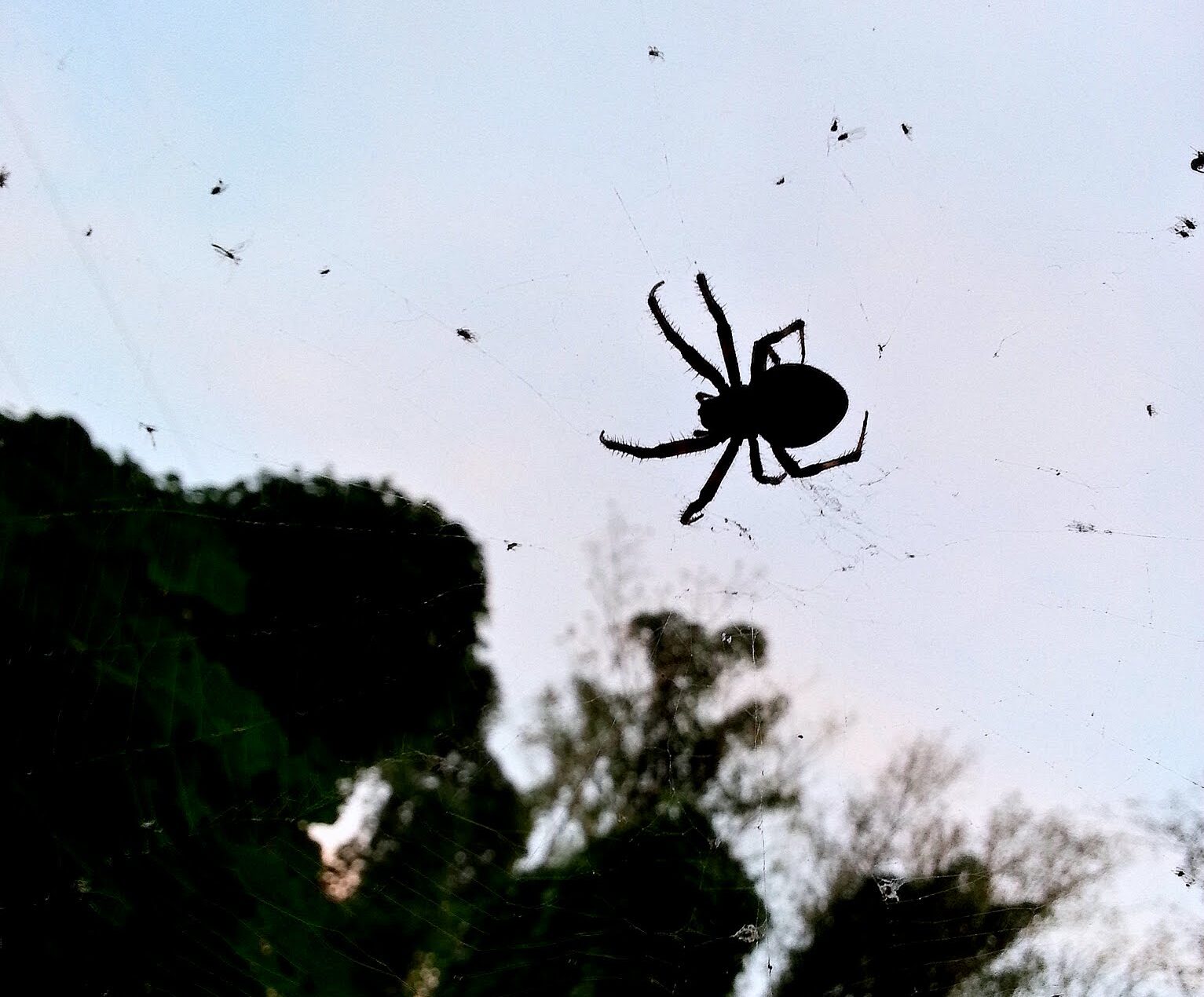
Everywhere that I have ever lived, when it is just about fall, there is a species of fat brown spider that will spin a large piriform web by my porch light. It has happened in several houses. This species has an enormous abdomen that is so wide it is almost totally opaque, even when directly against the sun or a porch light. Only the extreme edges will glow bright orange and eclipse-like, where its membrane and insides are thin. This spider has thick hairs that gleam in porch lights and under the moon, distinct and sharp. Someone told me once that spiders can “hear” things with their hairs. I sometimes wonder what the experiment was that taught mankind that spider hairs could hear.
The same variety of spider has spun its web again while I was working. Inside I smell smoke, fairly strong, and know that I am not alone. It is comforting, like incense from a silly ritual I partake in occasionally. I’ve heard that smell is tied to emotional memory closer than any other sense is. I wonder sometimes what the experiment was that proved our noses were the most reliable way to reach across time.
I hear books moving on a desk, and feet shuffling, and something bumping against a door.
“Do you think you’ve processed it… your client… who died?”
Ben’s voice is always curt and hurried, just south of frantic, always; even when trying to be comforting or ordering fast food. It never feels congruent with the empathic, analytical suggestions for self-improvement and his somber philosophizing.
“You really shouldn’t let that sit,” he tells me, concerned, from the next room.
Ben is running out of time, and always wants me to get more therapy. The wounded healer. All past social workers want to give others the medicine that they needed.
His voice skews deeper; he is still out of view in the study. The potted ivy is back in my kitchen in the sink. He’s watered it for me, after he’s moved it from the porch to get the key from beneath and let himself in. Ben knows my schedule pretty well, knows about when I get off work, and what days I’m more likely to stay late at the office. He hasn’t forgotten everything just yet.
I hear ice clinking against glass as he comes through the study door into the kitchen. He’s looking at me expectantly, put out I haven’t answered him yet.
“I think so, Ben,” I tell him. I realize how tired I am, comparing his reflection, wide-eyed and tipsy, beside me in the glass window. “I don’t know if that’s the kind of thing that happens all at once,” I lie.
“There’s a glass for you in the freezer, no ice. I didn’t know when you’d be coming home,” he tells me.
“Or if—” I think.
“I left some of my therapy books in the office,” Ben points back towards the study. “I’m taking some of the Penn Warren poems and your Weil book you told me about,” he lets me know like it’s a favor.
It is.
“It’s the first edition, do you mind?”
I smile, looking at my own reflection and sipping the drink until Ben forgets the question and goes back into the library.
I’ve never gotten a hello or goodbye from Ben that I can remember. He exists in a totally static place of dim, faint pain and a burning sincerity he cannot contain. He lets you know he’s glad you are there in an indirect way. There’s never been any pleasantries. There’s no need for a “Hi, my wife went out of town for an evening so I let myself into your house and took a cigar that my wife can’t know about out of your study and made a drink or two for myself and left an old-fashioned in your freezer and brought over a box of books from my office I’m clearing out for forced retirement…”.
It’s as if we have been having a conversation about death, age, and learning since the time I had four bourbons at the church picnic and talked to him about brokenness for an hour and Ben first took an interest in me. That conversation has just resumed unbroken every time I see the man. Some people have started to blame the dementia for Ben’s behavior, but it’s new, and the behavior is as old as Ben—older maybe.
The old-fashioned is good, classic. I dip the tip of my finger in the freezing booze and run it over the cut on the back of my hand. It stings and it feels cold and it feels good. Smoke rises horizontally off of Ben’s cigar straight up until it hits the ceiling. He’s rested it on my plate from breakfast.
Ben looks nervous that I’m not talking more. “Look, at first you want to save people, everyone does,” he pauses, “middle of your life you realize you can’t save them, you just have to let them exist.” Ben sighs and inhales. “It’s healing for them to just exist, with you in an honest way.” He looks at me earnestly. “At that point you start trying to save yourself. That’s where you are now,” he smiles in a resigned way. “Towards the end of your life you realize you can’t really save yourself either,” he leans back. “You just have to let yourself exist.”
Ben sits up and becomes more animated and excited by his point.
“Now,” Ben pauses. “I’ve said that but I can’t do that yet.” He looks serious. “But,” he pauses again, “I’ve seen it in the older people, when they’re dying. By the time you figure that out, you aren’t really getting too much out of life anymore, I think.”
Ben trails off thoughtfully and reaches for his cigar. He leans forward on the tips of his feet when he does anything he’s excited about. Like reaching for a cigar, or a drink, or to tell me something I don’t want to hear. He’s always possessed with such a bumblingly authentic wisdom. He’s always half-sage, half-child, a wellspring with effervescent somber joy.
I study his face as he leans against the cupboard. He’s more handsome than me, even in old age. I wonder if he aged into it or if he always was like that. He still has a full head of white hair in a clean, classic part. There is a crisply ironed collar tight and starched across the collar slits of his black shirt. His skin sags slightly and hangs over it about an eighth of an inch when he turns his head. He looks nervous that I’m still not talking.
“Look, you got that man a job,” Ben continues, “he was in touch with his family again, living in an apartment.”
I realize that I am crying, and Ben looks down at me like a sad, scared parent.
“He gets killed walking into work on his first day… that’s a victory. I’m sorry I’m a little tipsy, but you gave him a life, you have to own that,” Ben finishes.
A commonly quoted fact about astronomy is that the Universe is “expanding”, but that’s not really true. Our universe is nothing more than a giant ball of rules that we can measure. Rules like time, temperature, and distance. We say that the Universe is “expanding” because the amount of space we can measure inside it is increasing. We have no way of knowing what is outside of this ball of rules. It is doubtful that measurements like time and temperature would make much sense there.
Ben told me an idea one time that comforts me. He told me that Jesus came from a realm of poetic anarchy into our world of rules and told us to break all of them. That none of them were real. The blind can see, the poor are rich, and the most vulnerable rule all creation. Even death was a rule he broke.
“Ben, do you want to move outside? It’s a nice night,” I ask him.
“I’m not supposed to smoke inside am I? I forgot,” Ben looks embarrassed.
“No Ben, you’re fine, I do it all the time.” I gesture to the cigar in my hand.
“Ah,” he says, “yeah, it’s just a nice night.”
I wipe my eyes.
Outside, it smells like summer grass and wet wood. There’s a soft back and forth breeze like the world is breathing. The stars are bright so far away from the city.
“Ben, why did you become a priest?” I ask him.
“Why did you decide not to be?” he asks me.
We both laugh at different jokes. Ben thinks for a minute.
“Everything they say about Jesus is bullshit,” Ben tells me. “All the stuff about heaven, that’s just wish fulfillment.” It’s dark and his hair and collar glow white against the black space of his outline. “Jesus never told people they could have all of the stuff they want, or that they deserved all of it.”
He leans back. “All we deserve is love.” He looks at me for a second across the darkness. “It’s the other things that Jesus said that nobody talks about, the things nobody wants to hear.” Ben pauses a minute and continues quieter. “There would be no reason to say things like that unless you came from some kind of other place far away outside all of this,” Ben pauses and gestures around in the darkness presumedly. “You would have to be able to see the hidden divinity in the world, in everything, or you would just have to be crazy,” Ben trails off and gazes up at the stars with me.
There are a million stars and a million paths between them. Each opening a hundred new possibilities and closing a hundred more. Like a man walking into work proudly, for the first time in twenty years since succumbing to addictions and schizophrenia; or me on a deck buffeted like a little boat by people and forces, unwilling or unable to figure out what I did to end up here. Or a priest getting forced to retire because of erratic behavior and not knowing what to do anymore. Like beta-amyloid plaque building up in the brain and severing synapses that we have come to take for granted will tell us what we should do, and who we are, and what we have done before.
Time slowly accumulates everywhere. It won’t stop, no matter what we tell it or ourselves about it. It residually rubs off on all of us. Sometimes pleasantly, sometimes endearingly, sometimes in a bothersome way. Oil from a cat’s ears and chin against a cabinet, or against your leg. Small nudges here and there. The vast expanse of time and choices. Piling up slowly until we see, suddenly, that we are so small before its vastness, and that we always were. Then, simply to exist intentionally becomes the best gift we can give ourselves or anyone else. Some kind of heaven that no one deserves, that is insane.
I hadn’t talked to Ben for a couple of months. He sounded, not exactly frantic, but kind of nervous when I answered my phone.
“Hi Ben, sorry I’ve been a ghost, I’ve been really busy and…”
“It’s fine. It’s fine. Listen, I wanted to tell you something that I had written down a long time ago when I was going through some stuff, that I thought would help you,” Ben breathes into the phone. “I wanted to tell you because you would appreciate things like that.”
I sit down for a minute to listen to him.
“I forgot I knew this, you know. Sometimes you grab things when you are young that you overlook later; and I was going back through some old journals; and it’s just humbling to see some of this stuff.”
Ben sounds happier than he had seemed in a long time.
“No one’s going to get this, but you will.” He pauses for a second and I wonder if the line is dead. “In order to really love everyone you can’t like anybody,” he tells me. “You can’t expect them to be like you. You just have to expect them to be who they are.” He continues, “But you can’t trap them in that expectation. It’s like, it’s like I don’t know, an open door in the cold or in the rain for a lazy cat. You have to do it.”
It had never occurred to me until just now how lonely Ben must be. He was well-liked, even by his rivals. He was funny, he was helpful, he was loved. He was always surrounded by people. I think that I had always assumed that he was fulfilled and connected to the mainstream of human experience in a way that eluded me.
“Listen… sorry I am going on, but this is the thing,” Ben sounds nervous all of a sudden. “If you tell someone something true and honest without malice, and they don’t like it, that will never be your fault. If they don’t like it, it’s the same as them not liking a rock, or the ocean, or a character in a book. You are just a thing that exists that they don’t like that isn’t your fault. Just another thing that is honest about what it is, unconditionally. I’m sorry you are busy… I go on and on sometimes. It’s one of the things they say I do now… I’m sorry,” Ben sighs deeply.
Time feels funny to me all of a sudden. I had missed listening to Ben.
“Do you get what I’m saying? Am I saying it wrong? It’s okay, I will let you go.”
I snap back into it. “No, I get it, Ben. You are saying it fine.”
I really want to say something else. It will turn out to be the best advice I would ever get in my life, and I didn’t know then that I would never speak with him again.
“Thanks, Ben. I appreciate it,” I say into the phone.
“Ben?”
“Ben?”
It is highly likely that the first words of human language were because of a song. Howling grief rituals and elaborate vocalizations are common in social mammals when a member of the species dies. It is highly likely that it was through this process that people began to realize that we can take messages and ideas and encode them in the way our lips vibrate the air. Now I can say that I don’t like cheese on my sandwich or that I want to die. All because we opened our mouths and howled when someone died and slowly realized that the sounds we made can communicate a crude approximation of the same idea in two different people’s hearts and brains. Sometimes I wish we never had.
With all of that language and all of that sound there are really only a couple of stories that we can make as humans. We will keep making them over and over again forever and keep thinking that they are ours.
“The search for God isn’t really God himself,” Ben had told me once. “But it feels like it is…” He had looked at the wallpaper elsewhere, then. Then he had finished his bourbon, to the dregs he had finished it.
Mike
That day I’d been tasked with overseeing the repair of an air conditioner at one of the apartments that we rent through a grant. We provide housing to patients once they are mentally stable and able to learn to manage an apartment. We handle maintenance calls through the grant and maintain apartments in between the frequent changing of tenants.
I park my car in the only shade that I can find under a browning Mimosa and wait for Mike to arrive. While I wait I spray my car for bed bugs with some cans of poison with a purple label. Bed bug infestations are an ongoing risk, but I worry about what kinds of chemicals are in the cans. A bed bug infestation in my home is a more clear and present danger than the chemicals that kill them, most veteran social workers have decided.
I am careful not to get any of the poison in the fabric of the car seats in the backseat or onto the hard plastic that a child can chew. I am dropping the toys left in the backseat into plastic baggies to dish wash later when I hear a voice behind me.
“You sure this is the right unit?” Mike asks. “We haven’t ever done service out here before.”
“Yeah, it is a new lease.”
“You sure?” he asks again, squinting at the building.
“Yeah.”
A few minutes later we stand in a brick alcove where Mike is watching a dozen AC units whir with a deafening dull noise. We have to raise our voices to talk over it.
“You’re sure that this is the right unit?” Mike asks me.
“Yeah, the landlord came out here earlier.”
“You trace the line to the unit right or …” Mike trails off into a breathy whistle. He spins his eyes across the dozen or so condenser fans behind the apartment complex.
“Yeah.”
“I fix it and it ain’t the one, then …” Mike’s words whistle off into silence again.
“If I get it wrong I still pay.” I finish his sentence. “I know.” Bethany had also reminded me before I left the office. “Two of our apartments are on this one.”
When one of my patient’s ACs goes out I always call Mike to do the repair. Mike is really polite and timely, just like all the others, but he tells me stories out of the blue while he fixes the units. I like that. The stories always feel like something half-remembered that still troubles him. I have always imagined him as a Vietnam war vet. I don’t know if he is. He has never told me that story.
“Freon’s real high right now.”
“It’s fine, there is a grant that pays for it,” I tell him.
“It’s gonna be closer to three or four hundred.”
“It’s fine Mike, there’s a grant,” I repeat.
Mike snorts. I don’t think that he believes that anyone should readily accept freon costing four hundred dollars, but he continues his work. The wires, and the glue, and the dye, the moisture traps and the copper tubes all come out of his tool box and the unit and he squints at each.
“Chemical, metal… cost is unbelievable what they are doin’,” Mike tells me. “I don’t want to charge it but it’s what they’re charging me. I knew a guy who worked up in Huntsville where they make half this stuff. He told me once we got no idea what they got up there. They got stuff that ain’t nothing compared to aluminum oxide. It makes it look like ice cream. Some kind of precursor that they dreamed up for military contractor applications.”
I have no idea what aluminum oxide is.
“There’s this stuff they got that can burn underwater,” Mike continues while watching a needle on a meter bounce. “Makes its own oxygen.”
He snorts.
“I ask him what happens if half this stuff gets loose. He told me there won’t be no Huntsville. It’ll be there but there won’t be anyone in it. It carries on the breeze.” “Wheeeteuuueww,” he whistles and gestures with his hand something lying flat. Mike looks up at me and lets out a new breathy whistle to indicate some kind of indistinct feeling.
“This guy saw a plant leak one time in South America from a tower,” Mike takes out a brush and rubs some kind of glue against a copper pipe. “He didn’t understand the three-hour safety talk. It was in Spanish. He asked a guy what the safety guy was saying, in Spanish, and the guy tells him, in English, real simple. If he heard one whistle blow, run because something was about to blow. If he hears two whistles get in a car and get a mask on because something was about to leak. If you hear three whistles and you are outside then do whatever because if you hear that three whistle blow you had about one or two more minutes to be alive.”
Mike hooks up a bottle to a valve on the AC and I hear gas hiss. “He told me he saw a leak from the tower once though. Tower’s above it all and it’s a heavy gas that sinks down.” Mike indicates by pushing his free hand towards the ground. “He said he heard them three whistles and some of the boys in the white hard hats tried to run. The older ones in the yellow or red hats just sat down on the ground. Praying or making a phone call or whatever. Some were laughing and stuff. Kinda weird he said watching ‘em die from up there. He saw that stuff catch too, on a base once. It burns clear. A clear fire, like an alcohol fire. He said that no one knew where the fire was to drive around it. He was on the ground for that one. You’d see a truck drivin’ and then it would start burning and…” he moves his hands together then apart “…blow under a clear blue sky. People burning up all around to death in front of you in a fire that you can’t even see.” He makes a pop expanding motion with his fingers before continuing. “His driver said where’s the fire? He said go that way. The driver said how do you know and he told him, because I don’t see anyone burning up over there yet. He was surprised he made it out of that one.”
Mike turns serious all of a sudden. I can hear my phone buzzing in my pants pocket but ignore it.
“I never met one person making this stuff that wanted to make it. I never met anyone that thought it was good. Everyone making this secret government whatever hates it and what they do… all of them that I ever met. But, we can’t stop because some other so-and-so needs it to pay the bills. Hell.” Mike breathes. “Maybe one of them things will be the next freon.”
I hear metal doors slam together while I am lost in thought.
“That’s it,” Mike tells me. “We are all done.”
Mike does great work. The AC at that unit worked great for another two weeks until it was destroyed in a fire. The fire was not a clear fire. It was an orange and purple fire with noxious black smoke. It was set by a patient that had gone off his medicine and decided that God was “inside” the bed that I had bought with him at Walmart. He had discontinued his antipsychotic because it stopped him from getting an erection. The fire was bright and lit up the sky across the city for one night.
I could see the fire from my house but did not know what it was until I clocked into work the next morning. I remember holding my daughter from the chair on my porch and pointing to the pale glow of orange and pink clouds. She drank them up with her infant eyes smiling.













0 Comments