
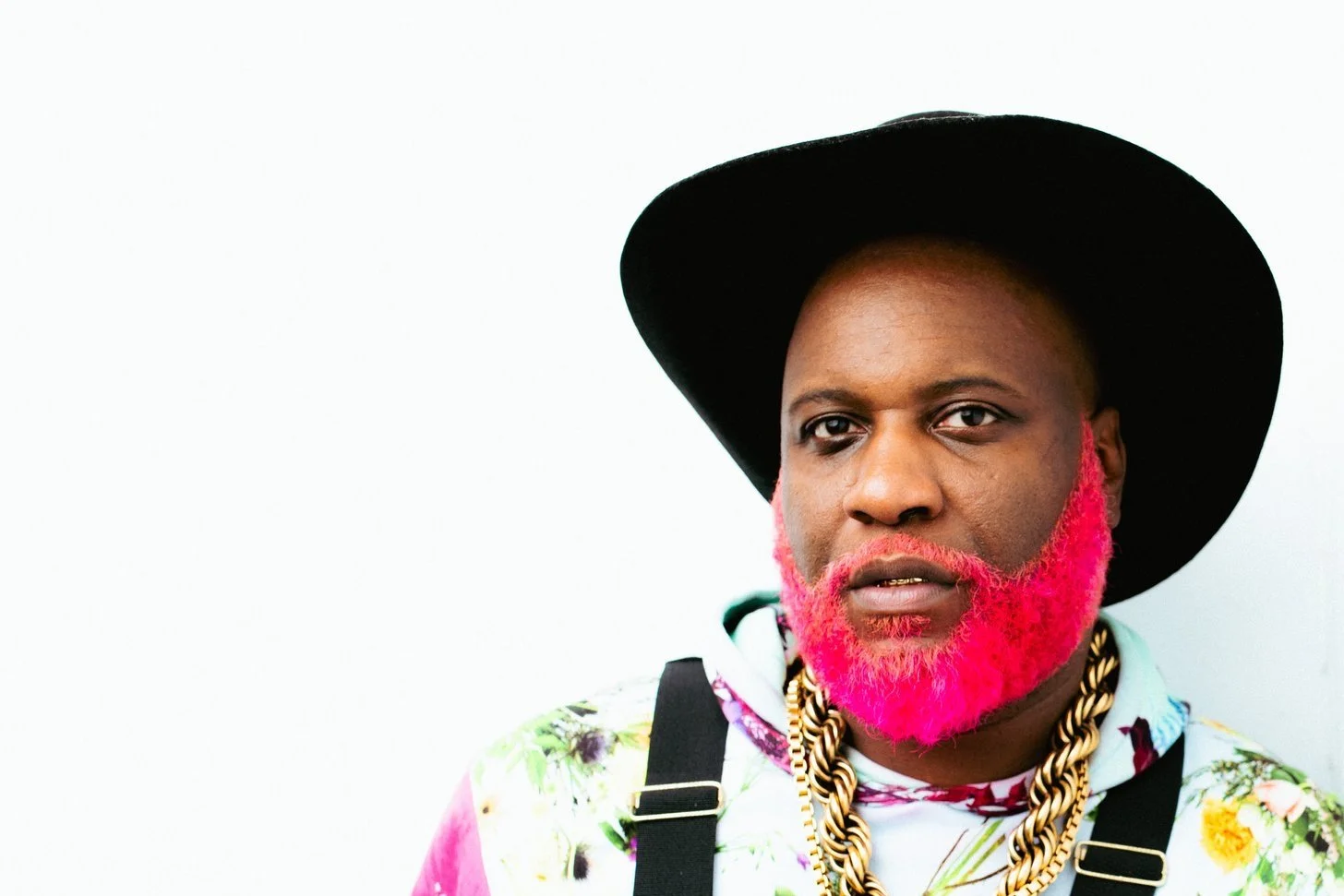
Before there was a pink beard, there was a boy with an anger problem and a mother who knew what to do about it. Sebastian Kole grew up in Birmingham, the son of two preachers, raised by a father whose discipline ran close to military. When the anger started surfacing in ways that worried her, his mother did not send him somewhere to be corrected. She sent him somewhere to be understood. The therapist, Dr. Paula Brown, did something small that quietly organized the decades that followed. She pointed him toward music and told him to put the feeling there.
Four decades later, that boy is a Grammy winning songwriter who spent most of his career writing hits for other people and is now stepping out front under a new name. As Pynk Beard, he has traded the studio shadows for a stage, a country and soul hybrid, and a beard dyed a color you cannot miss. He came on the Taproot Therapy Collective podcast, Discover Heal Grow, to talk about all of it. What follows is less about the headlines around his recent songs and more about the thing a therapist listens for, which is process. How a person becomes who they are, what it costs, and what it gives back.
It turned out to be one of the more quietly instructive conversations we have had on the show, because almost everything he described maps onto the work that happens in a therapy room.A Child, an Anger Problem, and a Piano
The detail that stops a clinician is not that he was angry. Plenty of children are angry, especially children raised under a hard hand. The detail is what the therapy taught him. He did not learn to suppress the anger or to apologize for it. He learned, in his own words, to talk through a conflict, and to care more about being understood than about being right. That is not a small lesson. It is most of what couples spend years in therapy trying to reach.
What Dr. Brown gave him was a container. Music became the place where the feeling could go and be metabolized rather than acted out. In trauma work we talk about this constantly, because unprocessed emotion does not disappear when you ignore it. It waits, and it leaks, and it tends to come out sideways. Give it a form, a song, a canvas, a body that can move, and it has somewhere to complete itself. Kole has been doing that since grade school. He simply happened to get extraordinarily good at the song part.
He told one story from college that he still calls life changing, about a confrontation that turned physical and then, improbably, turned into a lasting friendship. He tells it not as a story about who was right but as a story about what it took to stay in relationship with someone after a rupture. The preacher’s kid and the fighter were arguing inside him the whole time. Therapists have a word for the capacity to hold that kind of contradiction without splitting the world into pure good and pure bad. We call it integration, and it is one of the markers of a psyche that has done some work.
Birmingham as the First Lens
Ask Kole where his worldview comes from and he does not start with Los Angeles or the industry. He starts with Birmingham, which he calls the first lens through which he sees everything. He is clear eyed about the city’s reputation and quietly insistent that the reputation is wrong. What Birmingham actually feels like, he says, is a place where people take care of each other. He wears being from here as a badge of honor.
Place does this to all of us, whether we notice it or not. The earliest environment becomes the unconscious template for what is normal, what is safe, and who you are allowed to be. Kole’s template happens to be unusually layered. He was raised on the dividing line between Birmingham and the more rural Warrior, with one grandmother on a farm and the other near the steel mills of Dolomite. One side handed him city culture. The other handed him the country values of self reliance and neighborliness. He did not have to choose between them. He absorbed both, and the tension between them is now the engine of his art.
This is worth sitting with if you grew up somewhere you have complicated feelings about. The places that formed us are rarely all good or all bad. The work is not to escape where you are from. It is to understand what it put in you, keep what serves you, and stop reenacting the rest.
Sugar and Salt, or How to Hold Two Things at Once
His album, Sugar and Salt, is by his own description a deconstruction of what it means to be a Black man in Alabama, with the country, the urban, and the gospel all sitting in the same room. The title comes from something almost too perfect. In the South, people divide along the question of whether you take your grits with sugar or with salt. He is a salt person. But the point of the metaphor is the opposite of division. Two people from the same place, the same breakfast table even, can be fundamentally alike beneath a difference that feels enormous from the inside.
There is a deep psychological truth folded into that. The work of becoming whole is largely the work of holding opposites without collapsing one into the other. Jung described the psyche as a system that grows by integrating the parts of ourselves we would rather disown, and he described maturity as the capacity to hold the tension between them rather than amputating one side. Kole built a fourteen song record out of exactly that move. He refuses to be only urban or only country, only sacred or only profane, and the refusal is the art.
He carries one more rule from home, which is that an artist is never bigger than their hometown. It keeps him tethered to the people the songs are actually about, and it is a surprisingly good piece of mental hygiene for anyone whose work risks pulling them away from the ground they came from.
The Pink Beard Is the Point
Now, about the beard. He dyed it, at a friend’s encouragement, into a color no one can ignore, and he is refreshingly unmystical about why. It is a calling card. It is hard to forget. But the more interesting thing is what it does to him rather than to his audience. The beard, he says, is a daily reminder to be productive, to make sure whatever he does that day is meaningful enough to justify walking around looking like that. The mask holds him accountable.
Jung had a word for the face we present to the world. He called it the persona, after the mask worn by actors in ancient theater. The persona usually gets a bad reputation in pop psychology, treated as the false self we hide behind. Kole is doing something more sophisticated. He has built a persona on purpose, as a deliberate creative act, and he uses it to summon a version of himself that is more alive, more generous, and more disciplined than the man might otherwise be on an ordinary unremarkable morning. He wants people to be able to dress as him for Halloween. He wants to be, in his own phrase, a valuable character. The mask is not concealing him. It is calling him forward.
There is a clinical version of this that we see all the time. People who feel stuck often cannot access certain parts of themselves directly, but they can reach them through a role, a costume, a stage, a different name. The new self is real. It simply needed a door.
Talking to the Kid You Were
Maybe the most moving thing he said is that he makes his art, in part, to speak directly to his inner child. He wants to reassure the kid he used to be that he was never as strange or as wrong as he feared he was. Anyone who has done depth work will recognize this immediately. A great deal of adult suffering is the residue of a younger self who concluded, often in a single painful moment, that something about him was unacceptable. Healing frequently looks like going back and telling that child a truer story.
He brings the same patience to the songs. He described beginning a track from a single precise feeling he wanted to land, the recent “Ice on the Road” being one example, an instinct that traces straight back to the preacher’s house and the old instruction to love your neighbor and to treat the stranger as if he might be someone worth your care. Whatever you make of any individual song, the method is the thing. Begin with a true feeling. Build outward until other people can stand inside it. That is craft, and it is also, not coincidentally, what good therapy helps a person learn to do with their own life.
Why a Famous Songwriter Wants to Play Your Backyard
Kole is candid that the economics of music have moved away from recorded songs, and his response to that is the part that should interest anyone paying attention to where the culture is going. He is not chasing the algorithm harder. He is going the other direction, toward the body in the room. He wants to play backyards. He wants the handshake, the small and ferociously engaged crowd, the place where a person can, as he puts it, safely lose their mind for a couple of hours the way he once could in church.
His read on the moment is that the more digital the world becomes, the more people are starving for something analog and real, for proof that they are not alone in a room full of other warm bodies. It is hard to argue with him. The loneliness numbers in this country are grim, and a great deal of what brings people into therapy is not a discrete disorder so much as a sense of disconnection from other people and from themselves. He is selling, of all things, presence. So are we.
What a Country Singer Has to Do with Psychotherapy
We did not have Pynk Beard on the show because he is a celebrity passing through town. We had him on because his story is a clean illustration of how a person actually changes, which is the only subject this podcast really cares about. A child is handed his pain and taught to make something of it. A man integrates the warring halves of where he is from instead of choosing a side. He builds a self on purpose and uses it to become more of who he already was. He goes back, again and again, to comfort the kid he used to be.
That arc is not unique to artists. It is available to everyone, and it is most of what we do at Taproot Therapy Collective. Our work is built on the conviction that therapy is about more than reducing symptoms, that it is a process of growth and self discovery rather than a quick correction. The brain based and relational methods we practice, from Brainspotting to somatic and depth oriented approaches, are all, at bottom, ways of helping a person metabolize what happened to them and step into who they are becoming. You can read more about how we think and who we are here.
This conversation happened in our own studio, with our own host, which is the part of the work we love most. Sometimes the clearest lesson in psychology comes from a man with a pink beard who decided, a long time ago, to put the feeling into the song.
Questions People Ask
Who is Pynk Beard?
Pynk Beard is the current stage name of Sebastian Kole, born Coleridge Gardner Tillman in Birmingham, Alabama. He is a Grammy winning songwriter who has written for artists including Alessia Cara, Alicia Keys, John Legend, and Jennifer Lopez, and he is now performing as a country and soul artist under his own name. You can read more about his transition in The Birmingham Times.
Is Pynk Beard from Birmingham, Alabama?
Yes. He was born and raised in Birmingham, on the line between the city and the more rural community of Warrior, and he describes the city as the first lens through which he understands the world.
What is the album Sugar and Salt about?
Sugar and Salt is his debut country album, which he describes as a deconstruction of what it means to be a Black man in Alabama, blending country, urban, and gospel influences. The title plays on the Southern divide over whether to eat grits with sugar or salt, using it as a metaphor for how alike people can be beneath their differences.
What does a musician have to do with mental health?
His path mirrors the process of psychological growth. As a child he was sent to therapy for anger and learned to channel emotion into music, and his adult work reflects core ideas in depth psychology, including integrating opposite parts of the self, working consciously with the persona, and healing the inner child.
Joel Blackstock, LICSW-S, is the Clinical Director of Taproot Therapy Collective in Birmingham, Alabama, and the host of the Discover Heal Grow podcast. He specializes in complex trauma and brain based therapies, including Brainspotting.


















0 Comments