
How Can Ancient Practices Inform Modern Therapy

In today’s fast-paced world, an interesting phenomenon has occurred – ancient spiritual practices that originated hundreds or thousands of years ago have undergone a remarkable transformation, evolving from their roots as sacred rituals and ceremonies into secular, evidence-based therapeutic techniques and wellness trends. A closer look reveals fascinating insights into how traditional wisdom continues to shape contemporary approaches to well-being, offering a window into both the preservation and adaptation of these age-old practices to suit modern needs and sensibilities.
To understand this evolution, it’s helpful to first examine the anthropological foundations of ritual practices. The work of scholar Mircea Eliade on comparative religion provides a useful framework. Eliade pointed out that traditional societies conceived of time very differently than we do today. For them, so-called “sacred time,” or “illud tempus,” represented special moments outside of ordinary temporal experience, in which profound transformation and transcendence could occur. Many modern wellness practices, often unconsciously, attempt to recreate these sacred temporal “spaces” within contemporary secular contexts.
The research of ethnographer Arnold van Gennep on rites of passage across cultures also offers valuable insights. He identified that transformative rituals typically involved three key phases: 1) a separation or break from ordinary life, 2) a liminal period of transition, and 3) a reintegration back into society, but now with new insight and an altered state of being. When we look at the structure of many modern wellness retreats, mindfulness programs, and personal growth workshops, we can see how they mirror this traditional three-part structure, though usually without explicitly acknowledging its anthropological origins.
Victor Turner’s work examining rituals from a sociological perspective adds another crucial piece of the puzzle. He emphasized the deeply communal nature of traditional practices and coined the term “communitas” to describe the temporary dissolution of normal social roles and hierarchies that occurs when people come together for sacred rites and ceremonies. This speaks to why modern group-based wellness practices, from yoga classes to meditation circles, often prove more impactful than isolated individual efforts. They tap into this ancient power of communal healing and transformation.
Depth psychology, especially the work of Carl Jung, serves as an essential bridge for bringing ancient practices into modern therapeutic contexts. Jung extensively studied Eastern spiritual traditions and shamanic practices, distilling their wisdom through a psychological lens. He saw the psyche as a repository of universal wisdom and potential for growth, which could be accessed through practices like active imagination, dream work, and engaging with symbolic archetypes – not unlike traditional modes of healing and insight.
James Hillman, a pioneer of archetypal psychology, extended Jung’s work to emphasize how ancient practices ultimately serve the deeper purpose of “soul-making,” the cultivation of meaning, beauty, and purpose in human life beyond the limited scope of fixing specific problems. His perspective helps explain why simplified modern adaptations of practices like meditation and yoga sometimes fall short of their more comprehensive traditional counterparts.
When it comes to modern therapeutic adaptations of ancient wisdom, the popularization of meditation and mindfulness practices stands out as perhaps the clearest example of this evolutionary process. Meditation has undergone a remarkable secularization, with techniques originally tied to specific spiritual paths now extensively researched and applied in clinical settings. We see mindfulness-based stress reduction (MBSR) programs offered in hospitals, meditation apps promising increased focus and decreased anxiety, and even corporations bringing in teachers to offer mindfulness trainings – all adaptations that would have been unthinkable even a few decades ago.
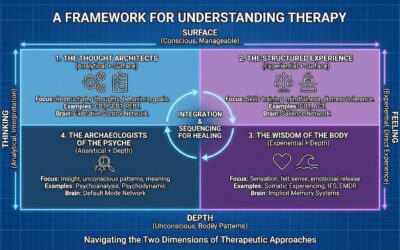
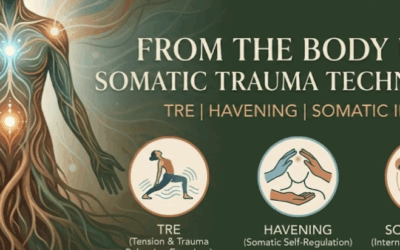
Somatic practices represent another domain in which ancient wisdom has taken on new forms to meet contemporary needs. Traditional societies understood the deep connection between physical movement, emotional processing, and psychological well-being. Today, therapeutic modalities like Peter Levine’s Somatic Experiencing draw on this time-honored body wisdom while integrating cutting-edge research on trauma, nervous system regulation, and the mind-body connection.
Even the way we conceive of space, both built and natural, has begun to incorporate traditional sensibilities. The work of eco-philosopher David Abram highlights how ancient practices were intimately tied to the specifics of place, with sacred sites and power spots reflecting a deep attunement to the living world. We see echoes of this in the modern application of environmental psychology and biophilic design principles to create therapeutic and wellness-enhancing spaces, from hospitals to spas to retreat centers.
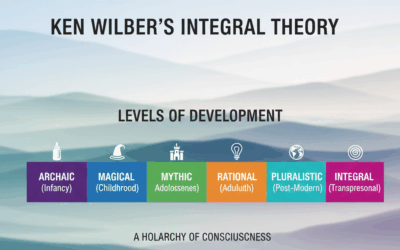
The cross-pollination of Eastern and Western approaches has also led to new forms of ancient-modern synthesis. Early pioneers like D.T. Suzuki, who helped introduce Zen Buddhism to Western audiences, paved the way for a rich dialogue between contemplative traditions and contemporary psychology. Integral thinkers like Ken Wilber have taken this a step further, developing comprehensive frameworks to integrate perennial wisdom, modern scientific research, and psychological best practices into novel yet tradition-respecting forms.
This integrative trend is increasingly visible in clinical settings as well, with therapeutic modalities like EMDR and parts-based therapies often seamlessly weaving in traditionally-inspired practices. Even the corporate world has gotten on board, with workplace wellness programs frequently incorporating secularized and science-validated techniques like mindfulness to help boost employee well-being and performance.
Yet the mainstreaming of ancient wisdom has not been without controversy. Some, like psychotherapist and author Thomas Moore, have raised valid concerns about the inherent tension between preserving the integrity of traditional practices and increasing their accessibility to a wider audience. The ever-present risk of cultural appropriation and the dilution of time-tested methods in service of commercial interests must be considered. There is a fine line between skillful adaptation and spiritual bypassing or the superficial commodification of sacred practices.
Looking ahead, the next horizon in the evolution from ritual to routine seems to be the increasing influence of new technologies. Just as ancient practices were reshaped by modern psychology and scientific research, we are now seeing the emergence of digitally-mediated wellness techniques, from virtual reality meditation to AI-guided personal growth programs that, perhaps paradoxically, use cutting-edge tech to deliver age-old wisdom.
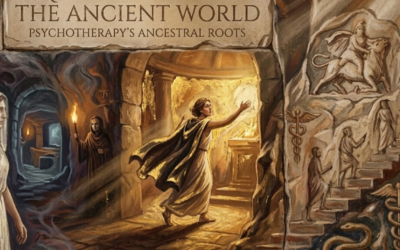
Ultimately, the winding path from ancient temple to modern therapy room, yoga studio, and beyond is still being mapped. What is clear, however, is that the perennial human quest for meaning, healing, and transformation continues to draw from the same deep wells of insight that have nourished seekers across millennia, even as it simultaneously innovates to keep pace with the needs and opportunities of the present moment.
Our task, both individually and collectively, is to embrace this creative tension – to honor the ancient roots of modern wellness while still allowing these practices to grow and flourish in new forms. In this way, the old and the new, the timeless and the timely, can join hands to illuminate the path ahead, revealing fresh possibilities and ancient truth in equal measure. The sacred heritage of the past and the uncharted potential of the future come together, soul-making venture that is the essence of human becoming.



0 Comments