
Emotional Transformation Therapy is the method we reach for when EMDR and Brainspotting have taken a client as far as they can. Developed by Dr. Steven Vazquez, ETT adds precise visual stimulation, specific colors, light patterns and eye positions, to an ordinary therapy conversation to reach emotional states that language and eye movement alone don't. Joel Blackstock, our clinical director, is listed by the ETT Institute as one of only two ETT practitioners in Alabama, and the only one in the Birmingham metro, for complex trauma and dissociation. Office sessions only, in Hoover off I-65 at the Riverchase exit, minutes from Birmingham.
What Emotional Transformation Therapy is
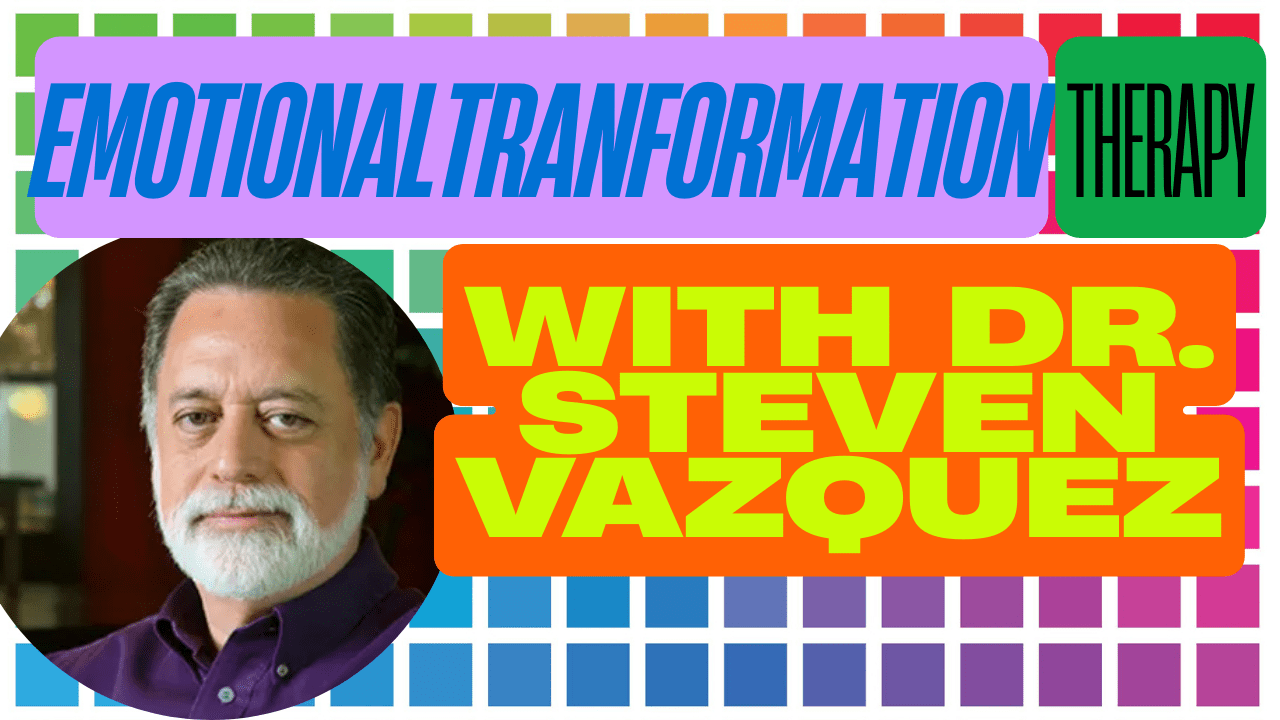
The ETT Institute defines it as an attachment-based interpersonal psychotherapy whose outcomes are enhanced by precise visual brain stimulation. Dr. Steven R. Vazquez, a Texas psychotherapist with a doctorate in counseling psychology, licensed as a professional counselor and marriage and family therapist and in practice since 1979, noticed that specific wavelengths of light changed what his clients could feel and access in session, and built that into a method he has developed, trained and published on since the 1990s. His textbook, Emotional Transformation Therapy: An Interactive Ecological Psychotherapy, was published by Jason Aronson in 2012 and reissued by Rowman & Littlefield in 2014; Accelerated Ecological Psychotherapy details the four visual techniques, and Spiritually Transformative Psychotherapy extends the work to religious and spiritual conflict. Joel interviewed him about inventing the method on our podcast.
How ETT claims to work
The claim is that color entering the eye travels along the retinohypothalamic tract to the hypothalamus and the limbic system, the circuitry that regulates arousal and mood, so that calibrated color delivered while you process an emotion shifts your physiological state in real time. ETT uses four visual techniques: a multidimensional eye-movement technique with colored dowels, peripheral light stimulation from the sides of the visual field, a spectral resonance technique using intense color, and a tunable light device that emits precise wavelengths. That's how it differs from EMDR, which moves the eyes bilaterally, and Brainspotting, which holds one eye position: ETT adds the color dimension and specific eye angles to reach targets the other two don't aim at. These are the Institute's claims; the published literature is Dr. Vazquez's books, case material and trade-journal articles, not controlled trials, and we say so plainly below.
Who ETT is for
People who have done EMDR or Brainspotting and hit a wall. Complex trauma and dissociation, which is what Joel is listed for. Anxiety and depression with a body-level, physical quality. Seasonal depression. Chronic pain tied to emotion. Cravings in recovery. Grief that hasn't moved. And people who process visually, for whom color does what words don't.
What a session looks like
You keep your eyes open, as in almost all psychotherapy. You and Joel name the emotional state you're working with. He selects a color and light pattern from the ETT protocol for that state, positions the light in your visual field, and you keep talking or simply notice while the stimulation does its work; as the state shifts, so does the color. ETT is woven into a course of trauma therapy rather than done on its own, and it is office-only, because it depends on the light equipment and a controlled environment.
Evidence and safety, stated plainly
The ETT Institute's directory carries its own disclaimer, and we adopt it: ETT is an evidence-informed approach supported by clinical case literature and practitioner experience; it has not yet been independently validated through randomized controlled trials and is not listed on the APA Division 12, SAMHSA or NICE treatment registries. We offer it where the evidence-based methods have plateaued, we don't oversell it, and if it doesn't move something within a few sessions we say so and change course. Because some protocols use flickering colored light, tell Joel about any seizure disorder or light sensitivity before the first session.
How it works at Taproot
- 1Free 15-minute intake call
Tell the coordinator you're interested in ETT.
- 2You're matched with Joel
He is the ETT-certified clinician at Taproot and one of two therapists listed by the ETT Institute in Alabama.
- 3Sessions at the Hoover office
ETT depends on the light equipment and environment at the office; it isn't offered by video.
ETT compared with the other brain-based methods at Taproot
| ETT | EMDR | Brainspotting | |
|---|---|---|---|
| Stimulus | Color, light pattern and eye position, eyes open | Bilateral eye movement, taps or tones | One fixed eye position |
| Developed by | Dr. Steven Vazquez, from the 1990s | Francine Shapiro, 1987 | David Grand, 2003 |
| Best for | States EMDR and Brainspotting couldn't move; body-level emotion; visual processors | Single-incident trauma with a clear origin | Complex and developmental trauma |
| Evidence | Case literature and practitioner experience; no RCTs (the Institute says so) | Extensive RCTs; APA and VA recommended | Growing; practitioner and pilot studies |
| Online? | No, office only | Yes | Yes |
| In Alabama | Two listed practitioners; one in Birmingham | Widely available | Several practices |
Is emotional transformation therapy right for me? A 30-second check
Your ETT therapist in Alabama

Certified in Emotional Transformation Therapy and listed by the ETT Institute as one of two ETT practitioners in Alabama, for complex trauma and dissociation. Clinical director; integrates ETT with EMDR, Brainspotting and Jungian depth work. Host of the podcast interviews with Dr. Vazquez and ETT trainer MJ Denis.
Cost, insurance and teletherapy
We accept Blue Cross Blue Shield of Alabama for most clinicians. Private-pay and out-of-network sessions are $250, with an income-based sliding scale, and we send a monthly superbill with the codes your insurer needs for out-of-network reimbursement. ETT is an office-only method. Secure video sessions are available anywhere in Alabama on the same sliding scale.
Emotional Transformation Therapy explained
Frequently asked questions
Is ETT evidence-based?
The ETT Institute's own words: ETT is an evidence-informed approach supported by clinical case literature and practitioner experience, not yet independently validated through randomized controlled trials, and not listed on the APA Division 12, SAMHSA or NICE registries. We quote that rather than soften it. Dr. Vazquez has been developing and publishing on the method since the 1990s, and the clients we use it with are the ones EMDR and Brainspotting have taken as far as they can.
Is ETT the same as a light box for seasonal depression?
No. A light box delivers bright white light to reset circadian rhythm. ETT uses specific colors, light patterns and eye positions inside a psychotherapy session, with the therapist changing the stimulation as your state changes. The light is the tool; the relationship and the processing are the treatment.
Who should not do ETT?
Anyone with photosensitive epilepsy or a seizure disorder, because some ETT protocols use flickering colored light. Raise it before the first session and Joel will tell you whether ETT is appropriate or another method fits better.
Can I get ETT anywhere else in Alabama?
The ETT Institute lists two practitioners in the state: Joel Blackstock in Birmingham and Carl Stewart, LPC in Huntsville. There is no one else in the Birmingham metro or central Alabama, and no one in Georgia, Mississippi or Louisiana on the directory at all.
Start ETT in Hoover
Your first call is a free 15-minute conversation with our intake coordinator, who matches you with the right clinician. Our office is off I-65 at the Riverchase exit in Hoover, about ten minutes from Vestavia Hills, Homewood and Mountain Brook and fifteen from downtown Birmingham, with free parking at the door.
Book onlineCall (205) 598-6471