

Pamela Hayes
MSW LICSW
About Pamela


Pamela Hayes, LICSW: Chronic Pain, Trauma and OCD Therapist in Hoover and Across Alabama
Pamela Hayes, LICSW, is a licensed independent clinical social worker at Taproot Therapy Collective who specializes in chronic pain, chronic illness, OCD, and severe PTSD. She works primarily with Internal Family Systems (IFS) and Lifespan Integration, with somatic work and EMDR available alongside them. Pamela sees clients in person at the Hoover office, by secure teletherapy anywhere in Alabama, or through a hybrid schedule that combines both.
In-Person, Teletherapy, and Hybrid Therapy in Alabama
In-person sessions take place at the Taproot Therapy Collective office at 2025 Shady Crest Drive, Suite 203, in Hoover, off I-65 at the Riverchase exit and about ten minutes from Vestavia Hills, Homewood, and Mountain Brook. Directions and parking details are here. Teletherapy sessions are available to anyone located in Alabama, from Birmingham to rural areas with no therapist nearby.
Hybrid therapy combines the two. Clients come to the office for some sessions and meet by video for the rest. The office visits are usually the ones built around somatic work, where Pamela can see posture, breathing, and small shifts in the body directly and pace the work in the room. Video sessions cover the rest of the work, including parts work and Lifespan Integration. Hybrid scheduling also suits people whose symptoms vary. A flare, a hard symptom day, or a long drive can move a session online without interrupting the work.
Therapy for Chronic Pain and Chronic Illness
Chronic pain is Pamela’s primary specialty. She works with adults living with chronic pain, POTS, dysautonomia, mast cell activation syndrome (MCAS), Ehlers-Danlos syndrome, fibromyalgia, and chronic fatigue. After long periods of symptoms, stress, uncertainty, or feeling unsafe in their own bodies, many people find their nervous systems stay in a state of heightened alert. A nervous system stuck on alert can amplify pain signals and make sleep, digestion, and recovery from flares harder.
While therapy is not a primary treatment for chronic pain or chronic illness, it can help the nervous system move out of chronic dysregulation and spend more time in a settled, parasympathetic state. As that happens, many people find their pain less intense and their symptoms easier to live with. Pamela works alongside each client’s medical care. Her aim is to build safety, steadiness, and regulation within the realities of a particular body, and to help people develop a more compassionate relationship with it instead of forcing it toward wellness.
IFS has been tested in chronic illness. In a randomized controlled trial of 79 adults with rheumatoid arthritis published in The Journal of Rheumatology in 2013, participants who received nine months of IFS-based group and individual sessions reported less pain and better physical function at the end of treatment than a comparison group that received educational materials by mail. One year after treatment ended, the IFS group showed sustained improvements in joint pain, self-compassion, and depressive symptoms. The trial found no lasting change in disease activity itself, and the researchers concluded that IFS may be a useful addition to medical care for the disease.
Pamela brings both clinical training and lived experience with chronic illness to this work. She understands how deeply chronic illness affects a person’s sense of safety, identity, relationships, and capacity. She is also trained in Pain Reprocessing Therapy (PRT), a neuroscience-based approach for persistent pain in which the nervous system has learned to keep sounding an alarm. Her background includes extensive inpatient psychiatric experience, and she is a graduate of the University of Alabama at Birmingham.
Internal Family Systems (IFS): How It Works
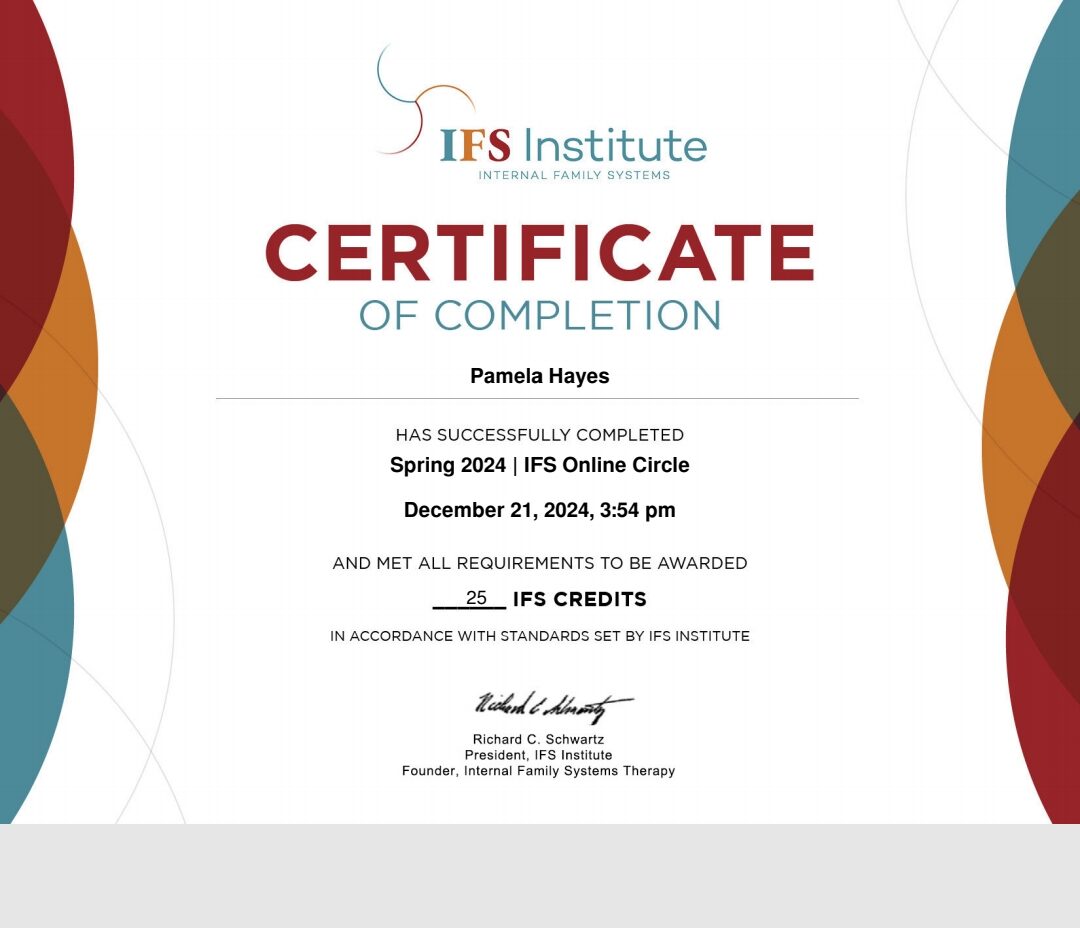
IFS, developed by Richard Schwartz, starts from the idea that the mind is made of parts, each with its own role, and that everyone also has a core Self that is calm, curious, and able to lead. Protective parts work to keep you safe. Managers act in advance, through control, perfectionism, or worry. Firefighters react after distress hits, through numbing, rage, or compulsion. Underneath them are exiles, the parts that carry the pain, fear, and shame from earlier experiences.
In IFS therapy, you get to know your protective parts and learn what they are afraid would happen if they stopped. Once they trust the process, and only with their permission, you approach the exiled parts they guard, so those parts can set down what they have been carrying. Nothing is forced, and no part is treated as the enemy. IFS is one of the two approaches at the center of Pamela’s practice. With chronic pain, it gives people a way to hear the part that pushes through symptoms and the part that dreads every sensation, instead of fighting their bodies.
Lifespan Integration: How It Works
Lifespan Integration (LI) was developed by Peggy Pace. Client and therapist build a timeline of memory images, one for each year of life, drawn from ordinary moments as well as difficult ones. In session, the therapist reads the timeline aloud in chronological order, moving forward to the present, while the client lets each image come to mind, and the timeline is run several times. Clients do not need to narrate their trauma.
The working idea is that younger states of the self, shaped by early frightening or neglectful experiences, stay cut off from the rest of the person’s life story. Running the timeline connects those states to one continuous life, so the nervous system registers that time has passed and the danger is over. Lifespan Integration has a smaller research base than EMDR or exposure-based treatments, and it is often combined with other approaches, including IFS and EMDR. Along with IFS, it is one of the two approaches at the center of Pamela’s practice.
IFS, Lifespan Integration, and OCD, Including Pure OCD
OCD involves intrusive thoughts, images, or urges and the rituals used to neutralize them. The rituals can be visible, like checking and washing, or mental, like reviewing, ruminating, and seeking certainty. Pure OCD is the form where compulsions are mostly mental, so it is often missed. Exposure and response prevention (ERP) is the first-line treatment for OCD with the strongest research support. Pamela is completing her training in ERP and will offer it alongside IFS and Lifespan Integration. Those two approaches do not replace ERP. They address parts of the experience that the exposure work does not always reach.
In IFS, compulsions are understood as protective parts doing a job, trying to prevent a catastrophe by checking, reviewing, or demanding certainty. Intrusive thoughts tend to attack what a person values most, which leaves behind a layer of shame, and the part that carries that shame can be worked with directly. Clients learn to stop arguing with the compulsion and to ask what the part fears. For some people, OCD first took hold in childhood during a period of fear or instability. Lifespan Integration helps that younger state register that it is no longer living in that period.
IFS, Lifespan Integration, and Severe PTSD
Severe and complex PTSD often involve repeated trauma, dissociation, and difficulty tolerating strong emotion, and detailed retelling can overwhelm the person doing it. Both IFS and Lifespan Integration are paced to avoid that. Pamela’s inpatient psychiatric background means she is comfortable working with severe symptoms.
In IFS, the symptoms people live with, such as numbing, hypervigilance, anger, and dissociation, are treated as protectors with a job to do, not as problems to remove. The parts that hold traumatic memories are approached only with the protectors’ permission, and the client is never asked to relive the event. Lifespan Integration works with brief memory images instead of a full account, which keeps clients within their window of tolerance and makes it a fit for developmental, attachment, and dissociative trauma. When it helps, Pamela adds somatic work for the body’s stress response and EMDR for specific memories.
What Pamela Treats
- Chronic pain and post-surgery pain
- Postural Orthostatic Tachycardia Syndrome (POTS)
- Dysautonomia
- Mast Cell Activation Syndrome (MCAS)
- Ehlers-Danlos Syndrome
- Fibromyalgia
- Pure OCD and OCD
- Severe PTSD and complex PTSD
Sliding Scale Therapy and Out-of-Network Billing
Pamela reserves a limited number of sliding scale spots for adults who are uninsured, underinsured, or have financial need. The sliding scale page has full details. Rates are based on annual household income and are not billable to insurance.
- $30,000 to $49,999: $125 per session
- $50,000 to $69,999: $135 per session
- $70,000 to $89,999: $145 per session
- $90,000 to $109,999: $155 per session
- $110,000 to $129,999: $165 per session
- $130,000 and above: $175 per session
Pamela is not in-network with insurance companies. She provides monthly superbills that you may submit for potential out-of-network reimbursement, so check with your insurer about out-of-network mental health benefits.
Frequently Asked Questions
Does Pamela Hayes see clients in person?
Yes. Pamela sees clients in person at the Taproot Therapy Collective office at 2025 Shady Crest Drive, Suite 203, in Hoover, and by secure teletherapy anywhere in Alabama.
What is hybrid therapy, and who is it for?
Hybrid therapy combines office visits with video sessions. Clients come in for some sessions, often the ones centered on somatic work, and meet online for the rest. It suits people whose symptoms or schedules vary, including many people living with chronic pain or chronic illness.
Can IFS and Lifespan Integration help with OCD?
They can support OCD treatment, but they do not replace exposure and response prevention (ERP), the first-line treatment with the strongest research support. Pamela is completing her training in ERP and will offer it alongside IFS and Lifespan Integration. IFS helps clients understand the parts of them that drive compulsions and carry shame about intrusive thoughts. Lifespan Integration can help when OCD took hold during a frightening or unstable period of childhood.
Do I have to describe my trauma in detail?
No. IFS does not require retelling traumatic events, and Lifespan Integration works with brief memory images rather than full narratives. Pamela paces the work so that it stays within what you can tolerate.
Can therapy help with chronic pain or chronic illness?
While therapy is not a primary treatment for chronic pain or chronic illness, it can help the nervous system move out of chronic dysregulation, and many people find their pain less intense and their symptoms easier to live with as that happens. Pamela works alongside each client’s medical care. In a randomized controlled trial of adults with rheumatoid arthritis, those who received IFS therapy reported less pain and better physical function at the end of treatment than a comparison group.
Does Pamela take insurance?
Pamela is not in-network with insurance companies. She provides monthly superbills for possible out-of-network reimbursement and reserves a limited number of sliding scale spots. Check with your insurer about out-of-network mental health benefits.
Schedule a Free 15-Minute Consultation
Taproot Therapy Collective has multiple clinicians who treat a wide range of issues and conditions. You can also meet the full team of therapists.