
A QEEG brain map shows how your brain is actually firing, so treatment for ADHD, autism, brain injury, anxiety and depression that hasn't responded to medication is aimed at your data instead of a guess. Peak Neuroscience, the neurotherapy division of Taproot Therapy Collective, provides brain mapping, neurofeedback and neurostimulation at our Hoover office off I-65 at the Riverchase exit, minutes from Birmingham, under licensed psychologist Dr. Jason Mishalanie, with every map analyzed by electrical engineer Diana Pizarro.
What is QEEG brain mapping?
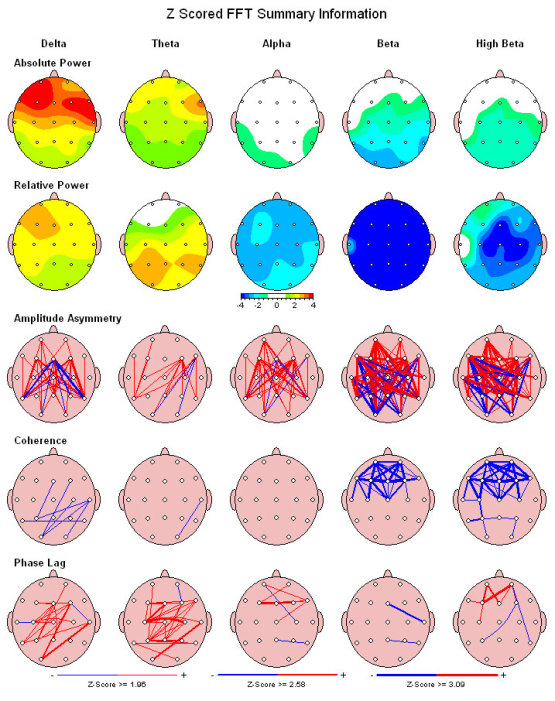
A cap of electrodes records your brain's electrical activity at rest, eyes open and eyes closed. The recording is cleaned and compared to a normative database of people your age, and the differences are displayed as a map: which regions are over-aroused, which are under-powered, which aren't communicating. That map is what the Biofeedback Certification International Alliance and the International Society for Neuroregulation and Research treat as the foundation of responsible neurofeedback: no protocol without a map.
Who is brain mapping and neurofeedback for?
ADHD, where a 2009 meta-analysis found neurofeedback produced large improvements in inattention and impulsivity. Autism in children and adults. Concussion and brain injury. Depression that two or three medications haven't touched. Anxiety that runs in the body regardless of what you think. PTSD alongside trauma therapy. Stuttering. And the question a lot of adults bring us: is it ADHD, autism, trauma, or all three?
What happens at Peak Neuroscience?
The intake is a clinical interview with Dr. Mishalanie. The map itself takes about an hour in the office. Diana Pizarro, who came to us from the University of Alabama at Birmingham's epilepsy research program, cleans and analyzes the recording. You then sit down with Dr. Mishalanie to see your map and agree on a plan: neurofeedback, which trains the brain by rewarding the patterns you want; LENS, a low-energy neurofeedback that needs no effort from you; or neurostimulation for regions that need a direct nudge. Sessions are in the office only. Trauma therapy with one of our psychotherapists can run alongside, in person or by video.
How it works at Taproot
- 1Free 15-minute intake call
The coordinator books your clinical interview with Dr. Mishalanie and quotes the package.
- 2The map
About an hour in the office: a cap of electrodes, eyes open, eyes closed.
- 3Analysis and review
Diana Pizarro cleans and analyzes the recording; you sit down with Dr. Mishalanie to see your map and agree on a plan.
- 4Training sessions
Neurofeedback, LENS or neurostimulation in the office, with a re-map partway through to confirm the brain is changing.
The neurotherapy tools at Peak Neuroscience
| Clinical EEG | QEEG brain map | Neurofeedback | LENS | Neurostimulation | |
|---|---|---|---|---|---|
| What it does | Looks for seizures | Compares your activity to a normative database | Rewards the brainwave patterns you want | Low-energy feedback with no effort required | Direct low-intensity stimulation of a region |
| Who | Neurologist | Dr. Mishalanie with EEG analyst Diana Pizarro | Dr. Mishalanie | Dr. Mishalanie | Dr. Mishalanie |
| Effort from you | None | Sit still for an hour | Attention during sessions | Almost none | None |
| Where | Hospital or clinic | Hoover office | Hoover office | Hoover office | Hoover office |
Is a brain map right for me? A 30-second check
The neuroscience team
Licensed psychologist, Board Certified in Neurofeedback, PhD in physiological psychology, more than twenty years in neurotherapy; Clinical Director of Peak Neuroscience.
Electrical engineer and EEG analyst from the UAB epilepsy research program, where she developed deep-learning seizure detection; analyzes every brain map.
Cost and insurance
Brain mapping, neurofeedback and neurostimulation are billed separately from psychotherapy, and the intake coordinator quotes the current package on your free 15-minute call. Psychotherapy alongside it is covered by Blue Cross Blue Shield of Alabama for most clinicians, with private-pay and sliding-scale options.
A look inside Taproot
Frequently asked questions
Is a QEEG the same as the EEG a neurologist orders?
A clinical EEG looks for seizures and gross abnormalities. A QEEG uses the same recording, then quantifies it and compares your brain's activity to a normative database of people your age, which is what makes it useful for ADHD, anxiety, depression and brain injury rather than epilepsy.
Can a brain map tell whether it's ADHD, autism or trauma?
It can show which pattern your brain is running, which is often the missing piece when symptoms overlap. It doesn't replace a clinical evaluation, and Dr. Mishalanie interprets every map alongside your history.
How many neurofeedback sessions does it take?
It depends on the map and the goal. Dr. Mishalanie gives you a realistic range at the map review rather than a fixed number, and re-maps partway through to confirm the brain is changing.
Can any of this be done online?
No. Brain mapping, neurofeedback and neurostimulation require the equipment at our Hoover office. Psychotherapy alongside it can be in person or by video.
Book a brain map in Hoover
Your first call is a free 15-minute conversation with our intake coordinator, who matches you with the right clinician. Our office is off I-65 at the Riverchase exit in Hoover, about ten minutes from Vestavia Hills, Homewood and Mountain Brook and fifteen from downtown Birmingham, with free parking at the door.
Book onlineCall (205) 598-6471