

Executive Summary: The Neuroscience of Laughter
The Core Mechanism: Humor is not merely an emotional escape; it is a physiological state-shift. Laughter activates the Ventral Vagal Complex, forcibly moving the nervous system out of “Fight or Flight” and into “Social Engagement.”
Key Biological Benefits:
- Cortisol Reduction: “Mirthful laughter” lowers serum cortisol levels by up to 39%, halting the catabolic stress response.
- Cognitive Reappraisal: Humor engages the Prefrontal Cortex to “re-frame” a threat as a benign violation, a critical skill in processing PTSD.
- Endorphin Release: Social laughter triggers the endogenous opioid system, raising the pain threshold and promoting bonding.
Clinical Verdict: While “Gallows Humor” can be a defense mechanism, it is often a highly adaptive tool for survival in high-stress populations (first responders, veterans).
Does Humor Heal Trauma? The Neurobiology of Laughter and Resilience

“If you can laugh at it, you can survive it.” This aphorism is common among trauma survivors, ER nurses, and combat veterans. But is it scientifically true? Or is humor just a form of dissociation—a way to avoid feeling the pain?
In the field of Gelotology (the study of laughter) and modern trauma therapy, the consensus is shifting. Laughter is increasingly viewed not as a distraction, but as a Somatic Release mechanism comparable to crying or shaking. It is a biological reset button that hacks the autonomic nervous system, forcing the body to down-regulate fear.
This article explores the hard science behind why we laugh when things are dark, how humor rewires the traumatized brain, and when it is (and isn’t) appropriate in therapy.
Part I: The Physiology of a Belly Laugh
Laughter is a full-body event. It involves the contraction of 15 facial muscles, the respiratory system, and the limbic system. When you laugh, you are performing a “respiratory gymnastics” that oxygenates the blood and massages the internal organs.
1. The Neurochemical Cocktail
Laughter triggers the release of a potent cocktail of neurotransmitters that directly counteract the effects of trauma:
- Dopamine: The reward chemical. It enhances motivation and attention, countering the “anhedonia” (numbness) of depression.
- Oxytocin: The bonding hormone. It reduces amygdala activity (fear) and promotes trust, crucial for healing attachment trauma.
- Endorphins: The body’s natural painkillers. Studies show that 15 minutes of laughter can increase pain tolerance by 10%.
2. The Cortisol Crash
Trauma keeps the body in a state of chronic inflammation due to elevated Cortisol. Research from Loma Linda University has shown that “mirthful laughter” lowers serum cortisol levels significantly. By lowering cortisol, laughter allows the immune system to reboot, increasing the production of Natural Killer (NK) cells and T-cells.
Part II: Polyvagal Theory and the “Safety Valve”
According to Dr. Stephen Porges’ Polyvagal Theory, the nervous system has three states:
1. Dorsal Vagal: Shutdown/Freeze (Trauma).
2. Sympathetic: Fight/Flight (Stress).
3. Ventral Vagal: Safety/Social Connection (Healing).
Trauma survivors often get stuck in the Dorsal Vagal “Freeze.” They feel numb, heavy, and isolated.
Laughter is a Ventral Vagal Trigger. You cannot genuinely laugh while in “Freeze.” The act of laughter requires rhythmic breathing and vocalization (prosody), which stimulates the Vagus Nerve. It mechanically pulls the nervous system out of shutdown and into connection. This is why a shared laugh in a therapy session often marks the breakthrough moment where a client finally feels “safe.”
Part III: Cognitive Reappraisal (The “Comic Frame”)
Trauma creates a rigid narrative: “The world is dangerous, and I am a victim.”
Humor relies on Incongruity—the surprise of seeing things from a different angle. Psychologically, this is known as Cognitive Reappraisal. To find something funny, you must detach from the immediate threat and look at it from a distance.
Viktor Frankl, a psychiatrist and Holocaust survivor, used humor in the concentration camps as a survival tool. He called it “The Art of Living.” By cracking a joke about their dire situation, the prisoners momentarily rose above their captors. They asserted their agency. In Cognitive Behavioral Therapy (CBT), this is the ultimate goal: to change the meaning of the event so it no longer controls you.
Part IV: The Defense Mechanism – Gallows Humor
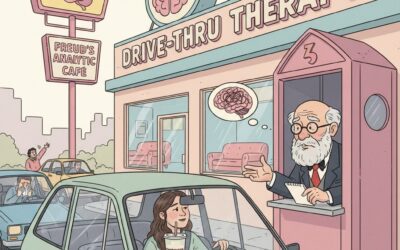
Is all humor healthy? Not necessarily. Freud classified humor as a mature defense mechanism, but he also warned of its use as avoidance.
1. “Gallows Humor” as Armor
First responders, ER doctors, and soldiers often use dark, morbid humor. This is Gallows Humor. It serves a specific function: it creates an emotional buffer against horror. By laughing at death, they reduce its power to traumatize them in the moment.
The Risk: If this humor is used constantly to avoid processing grief, it creates a wall. The person becomes cynical and detached. In therapy, we look for the difference between “laughing with the pain” (integration) and “laughing at the pain” (avoidance).
2. Self-Deprecation vs. Self-Compassion
Trauma survivors often use self-deprecating humor (“I’m such a disaster”). While this can be disarming, it often reinforces Toxic Shame. It is a preemptive strike: “I will mock myself before you can mock me.” Healing involves moving from self-mockery to self-compassion.
Part V: Humor in the Therapy Room
Should your therapist be funny?
Provocative Therapy, developed by Frank Farrelly, uses humor and absurdity to jolt clients out of rigid thinking patterns. However, humor in therapy is a high-risk, high-reward tool.
- The Benefit: Humor ruptures the power dynamic. It makes the therapist human. It can gently expose the absurdity of a limiting belief (e.g., “I must be perfect to be loved”).
- The Risk: If timed poorly, humor can feel like invalidation. The client may feel their pain is being mocked.
A skilled therapist uses humor not to minimize the trauma, but to maximize the client’s resilience. As the saying goes, “The devil cannot stand to be mocked.”
Conclusion: The Last of the Human Freedoms
Does humor heal trauma? It does not erase the event. It does not bring back what was lost. But it does heal the nervous system. It reminds the body that it is capable of joy, even in the midst of suffering.
Laughter is the sound of the spirit asserting its invincibility. In the journey of recovery, finding your laugh again is often the final sign that the trauma no longer owns you.
Explore Therapeutic Modalities
Taproot Therapy Collective Podcast
Somatic & Brain Therapies
Somatic Experiencing: Releasing Trauma from the Body
QEEG Brain Mapping: Visualizing Stress
Neurofeedback: Training Brain Regulation
Emotional Transformation Therapy (ETT)
Trauma Processing
EMDR: Reprocessing Traumatic Memories
Brainspotting: Accessing the Subcortex
Lifespan Integration: Healing the Timeline
Cognitive & Integrative
Jungian Therapy: Working with the Shadow
DBT: Distress Tolerance Skills
Aromatherapy: Olfactory Regulation
Scientific Bibliography
- Berk, L. S., et al. (1989). Neuroendocrine and stress hormone changes during mirthful laughter. American Journal of the Medical Sciences.
- Dunbar, R. I. M., et al. (2011). Social laughter is correlated with an elevated pain threshold. Proceedings of the Royal Society B.
- Porges, S. W. (2011). The Polyvagal Theory: Neurophysiological Foundations of Emotions, Attachment, Communication, and Self-regulation. Norton.
- Frankl, V. E. (1946). Man’s Search for Meaning. Beacon Press.
- Farrelly, F., & Brandsma, J. (1974). Provocative Therapy. Meta Publications.

















0 Comments