

Everything You Ever Wanted to Know about Brainspotting: A Clinical Deep Dive
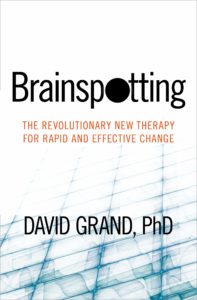
Trauma activates our body’s fight or flight system making us experience strong emotional and physical reactions without a logical cause which can make you feel angry or scared before you can intellectually understand why you react that way because reexperiencing trauma is not a choice but an unconscious reaction. Brainspotting is a revolutionary new trauma processing tool to help you process this unconscious reaction because to heal trauma we need a tool that will let you get out of your conscious mind and release the deep emotional and physical pain that often resides beyond the reach of language. While traditional talk therapies engage the neocortex or the thinking brain they often fail to reach the subcortical brain where traumatic survival reflexes are stored. This disconnection explains why a patient can intellectually understand their trauma and yet still suffer from the visceral symptoms of panic and dissociation. Brainspotting bridges this gap by utilizing the visual field to locate and access these encapsulated memories in the midbrain. It operates on the clinical premise that where you look affects how you feel and by holding a specific eye position the brain can process and release the stuck survival energy that causes symptoms of Post Traumatic Stress Disorder and other anxiety conditions. This modality relies on the latest neuroscience regarding the relationship between the retina and the limbic system to provide a physiological reset for the nervous system.
Brainspotting is based on the latest neuroscience available and is one of the newest and most effective treatments for trauma and PTSD because it allows you to release the grip that trauma has on your personality and emotion regulation system. Brainspotting heals trauma by activating the subcortical brain similar to how ketamine or MDMA or psilocybin and neurofeedback work but unlike these treatments Brainspotting does not use any expensive equipment or require you to take psychedelic drugs. It works similarly to EMDR and somatic therapy and parts based therapies but works rapidly with minimal distress. By accessing the autonomic nervous system directly Brainspotting facilitates the completion of survival reflexes that were interrupted at the time of the traumatic event. When a person is overwhelmed the brain may freeze the memory in a raw and unprocessed state which leaves the individual in a state of perpetual hypervigilance. Brainspotting acts as a key to unlock these frozen states and allows the brain to metabolize the experience and integrate it into the individual’s narrative history rather than reliving it as a present danger. This process reduces the emotional charge associated with the memory and restores the body’s natural capacity for self-regulation and homeostasis.
What Is Brainspotting and How Does It Access the Subcortical Brain?
Brainspotting is an experiential treatment that activates the natural healing ability of the deep brain and does not require laborious analysis or re-experiencing the triggers from a traumatic event which allows you to release the effect of trauma on your emotions mood and physical body. Psychological trauma affects the subcortical brain’s ability to regulate our emotion mood and body and Brainspotting activates the healing potential of this body brain. In a Brainspotting session a therapist holds a pointer that you will follow with your eye and you will look for an eye position that activates the physical and emotional memory of a traumatic event. Our brain associates certain eye positions with some traumatic memory and emotional reactions because the visual field is mapped to the internal experience of the body. Brainspotting allows you to feel your body brain directly and to turn off the cognitive and language brain which often acts as a defense mechanism against deep feeling. During Brainspotting processing you may feel strange sensations in your body or feel uncomfortable or unfamiliar emotions as the nervous system discharges held energy. The effects of Brainspotting include rapid decreases in panic attacks and anxiety and blunted or flat affect and depression and dissociation and depersonalization and rapid mood changes. The benefits of Brainspotting can include a stronger sense of self and improved emotion recognition and emotion regulation and improved emotional resilience and personal growth. It is one of the fastest trauma processing tools available because it bypasses the resistance of the conscious mind and works directly with the physiological roots of the issue.
The Origins and Evolution of Brainspotting
Brainspotting is an eye movement therapy similar to EMDR invented by Dr. David Grand who discovered the method while working with a survivor of the 9/11 attacks and a figure skater with a performance block. It is an experiential therapy meaning that the healing process comes from your own direct experience rather than the interpretation of the therapist. You do not need to memorize techniques or retrain your behavior because Brainspotting allows you to directly experience your unconscious mind and emotional states. Brainspotting is a self guided experience meaning that you are in control of the process and learn directly from your experiences. The therapist in a Brainspotting session will give you minimal instructions and allow the session to proceed at a pace that you control which makes it distinct from protocol-driven therapies like standard EMDR. Brainspotting is less overwhelming than exposure therapy and processes trauma more deeply than cognitive or behavioral therapy alone. It is a mind-body therapy like Internal Family Systems and somatic experiencing and sensorimotor therapy and AEDP. In a mind-body therapy you will reconnect with your body and use the experience to release stress and repressed emotion because many traumatic reactions are stored in the body brain. Somatic therapies target similar brain states and heal trauma by using the subcortical brain because without using the body it is difficult to heal the deep roots of a traumatic event.
The Mechanism of Action: How Brainspotting Rewires the Nervous System
Trauma causes unconscious physical and emotional reactions that we may understand intellectually without being able to control emotionally and Brainspotting allows you to process these physical and emotional reactions. It is not a cognitive or analytical therapy so you will learn about yourself by directly experiencing your unconscious mind. Unlike cognitive or behavioral therapies Brainspotting targets the part of the brain that is most affected by psychological trauma which is the midbrain and the brainstem. Brainspotting heals the subcortical brain and helps release strong emotions and traumatic memories from the part of your brain that has the deepest connections to your body. Brainspotting is able to directly access unprocessed trauma and eliminate its effects without long term talk therapy or behavioral retraining or laborious analysis of past events. This is accomplished through the concept of dual attunement where the therapist attunes to both the client’s emotional process and their neurophysiological responses. As the client scans their visual field the therapist looks for reflexive signals known as tells which can include rapid blinking or swallowing or a sudden change in breathing. These tells indicate that the eyes have located a Brainspot or a capsule of traumatic memory. By holding the gaze on this spot the brain is able to focus its processing power on that specific neural network and facilitate a deep and often rapid release of the stored trauma.
Brainspotting can have life changing effects but the process itself is quite simple and unintrusive and does not require extensive preparation or reexperiencing triggers. In a Brainspotting session a therapist holds a pointer that you will follow with your eye and sometimes a client will listen to bilateral music during the process or wear glasses that cover one eye to enhance access to the subcortical brain. The Brainspotting process is simple and intuitive and there are specialized forms of Brainspotting for specific conditions but they all use this simple framework. The use of biolateral sound at a low volume helps to balance the activation between the left and right hemispheres of the brain which can provide a sense of safety and containment during the processing of intense memories. This bilateral stimulation mimics the natural processing that occurs during REM sleep and helps the brain to integrate the traumatic material into the long-term memory where it no longer triggers a visceral survival response.
Understanding the Body Brain and Somatic Storage
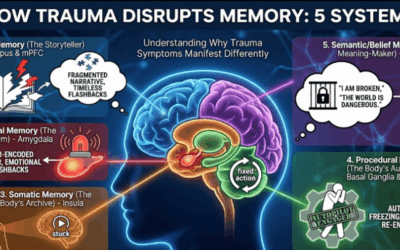
When trauma and extreme emotion is not experienced in the present it is stored in the body and when your brain experiences a traumatic event the psychological trauma is stored in the subcortical body brain. Trauma stored in the body might be experienced as tension or chronic pain or flat affect or numbness or dissociation or rapid mood changes or hypervigilance or an elevated stress response. These trauma reactions can cause damage to our relationships and professional life and sense of personal identity. The subcortical brain regulates how much emotional energy and stress and muscle tension we experience in a given situation and we learn how to experience emotion as children. Trauma can further entrench negative patterns in emotional expression and when we experience trauma or chronic stress our subcortical brain can become dysregulated. This creates extreme emotional responses and chronic tension and anxiety and therapy that does not use the unconscious and subcortical brain cannot heal the deepest effects of trauma. Research published by the National Institutes of Health supports the understanding that complex trauma creates neurobiological insults that require interventions targeting these lower brain structures.
What to Expect During a Brainspotting Session
Unlike cognitive or behavioral or analytical methods of therapy Brainspotting is simple and works very fast and in most cases you can discuss Brainspotting goals with your therapist in one session and be ready to begin Brainspotting by the second session of therapy. Your experience during Brainspotting can be intensely personal and hard to explain because the experience often does not fit into words as it takes place in the pre-lingual part of the brain. Most people experience a heightened awareness of their emotions and a heightened physical awareness during a Brainspotting session. After a Brainspotting session it is common to have increased awareness of how emotions affect your body and Brainspotting can be calming or stimulating but deep awareness of emotion and physical movement are common effects. There are several phases of Brainspotting sessions and sessions are adjusted to fit an individual’s specific needs. The general steps in the Brainspotting process usually involve choosing an area where life or emotion is overwhelming to you and helping you map the physical reaction that your body has to the anxiety. You will concentrate on the physical sensations of the anxiety in your body and your therapist will look for an eye position that stimulates the physical sensation that you are concentrating on. You will concentrate on the feeling that the eye position brings up and wait for the energy and sensation in your body and emotion to change. Your therapist may support you or help you understand the experience however you are the one experiencing the process and your therapist is just there to help you stay centered on the experience. Once processing is slowing down your therapist will ask if you are ready to move the pointer and end the session and you will be given a few minutes to reflect on the experience and debrief with your therapist.
Clinical Efficacy and Evidence-Based Research
Brainspotting can help you revisit and release the unprocessed remnants of past traumatic events and muscle tensions and uncomfortable emotion and scary childhood experiences and panic responses can all be experienced and then let out of the body and the brain. Often during a Brainspotting session we feel our physical reactions to negative emotion in a slow motion type way and you may feel the stress responses from your life slowly move through your body. This can give us insights into how we react to stress and help us have better emotional control during negative experiences. Additionally Brainspotting can help you feel the emotions under your life and conscious experience which can help you bring the avoidant or compulsive parts of you from the unconscious into the conscious mind. Brainspotting processing makes it easier for most people to recognize and regulate emotions and control their reactions and can help you remember traumatic and stressful events more clearly. Brainspotting can reduce the effects of psychological trauma and can help you achieve peak performance in sports or at work and can also help you discover unknown parts of your personality and grow personally.
Research into the efficacy of Brainspotting is growing rapidly and demonstrates its effectiveness across a variety of clinical presentations. A study published in the Mediterranean Journal of Clinical Psychology compared Brainspotting to EMDR for the treatment of PTSD and found that while both were effective Brainspotting patients continued to show symptom improvement at the six-month follow-up. This suggests that the deep subcortical processing initiated by Brainspotting may facilitate ongoing neural integration long after the therapy sessions have concluded. Further research on Generalized Anxiety Disorder indicates that Brainspotting is effective in downregulating the hyperarousal of the limbic system which is often the driver of chronic anxiety. Unlike other forms of therapy the majority of processing in a Brainspotting session is done outside the room because a Brainspotting session can be thought of as unblocking a path or opening a box in your unconscious mind. The majority of Brainspotting processing happens outside the therapy office as your brain heals and integrates previously compartmentalized content. During processing after Brainspotting you may have intense and symbolic dreams or notice that you have more time to react to your emotions or feel yourself learn to regulate your body. Processing after a Brainspotting session is likely to last a few days but can sometimes last a few weeks and processing may leave you feeling raw but it is not destabilizing or decompensating like other forms of therapy.
Integrating Brainspotting into a Holistic Treatment Plan
Brainspotting is only one part of a treatment plan and we believe that the more models of psychotherapy a provider knows the more that they are able to integrate to help you. We want to have a big bag of tools for you because we know that everyone is different and Jungian and parts based and somatic therapy integrate easily into Brainspotting treatment. For trauma and PTSD and panic and dissociation Brainspotting is a rapid and effective treatment option but for everything else Brainspotting is a powerful addition to your treatment to make sure it is lasting and effective. Brainspotting can help you clarify feelings and discover new treatment goals and can help you sit with difficult feelings and access hard to pin down emotions. This may help you discover treatment goals that you didn’t even think about when you first came to therapy. Brainspotting helps you improve your mind-body relationship and can leave you with skills that will help you accomplish your goals long after therapy is over. It helps make sure that the progress you make in therapy is permanent.
When choosing a Brainspotting therapist it is important to look for qualifications and reputation. Taproot Therapy Collective specializes in Brainspotting for trauma and all of our clinicians have Brainspotting training. It is our mission to provide you the most cutting edge services and neuroscientifically backed treatment available for anxiety and trauma and PTSD. Our clinicians have received training in modern approaches to trauma therapy and do not use a one size fits all approach. We see therapy as a collaborative and creative process and it is our goal to provide personalized care that is fast and effective. Everyone deserves access to high quality and effective therapy and we never want finances or culture or generational experience or religious faith or gender or sexuality to be a barrier to a person receiving care.
Safety, Contraindications, and Best Practices for YMYL Topics
While Brainspotting is generally considered a safe and non-invasive modality it is a powerful exposure therapy that requires strict adherence to safety protocols especially when dealing with complex trauma and dissociation. Patients currently experiencing active psychosis or mania should typically achieve stabilization before engaging in deep subcortical processing as the intense internal focus can potentially exacerbate a detachment from reality. Individuals with a history of severe dissociation such as Dissociative Identity Disorder (DID) require a modified approach often referred to as Resource Spotting. In these instances the therapist identifies a visual spot that correlates with a feeling of calm and grounding before attempting to access any traumatic material which ensures that the client has a neurological safe harbor to return to if the processing becomes too intense. Guidelines from the American Academy of Neurology emphasize the importance of careful assessment and management when treating posttraumatic stress to prevent retraumatization. It is also crucial for clients to understand that Brainspotting can induce a processing hangover characterized by fatigue or emotional tenderness for 24 to 48 hours following a session. This is a sign that the brain is continuing to reorganize neural pathways and requires rest and self-care.
Comprehensive Bibliography of Brainspotting Research
Anderegg, J. (2015). Effective treatments for generalized anxiety disorder. *Journal of Anxiety Disorders*. Retrieved from brainspotting.com.
Corrigan, F., & Grand, D. (2013). Brainspotting: Recruiting the midbrain for accessing and healing sensorimotor memories of traumatic activation. *Medical Hypotheses*, 80(6), 759-766.
Corrigan, F., Grand, D., & Raju, R. (2015). Brainspotting: Sustained attention, spinothalamic tracts, thalamocortical processing, and the healing of adaptive orientation truncated by traumatic experience. *Medical Hypotheses*, 84(4), 384-394.
Grand, D. (2013). *Brainspotting: The Revolutionary New Therapy for Rapid and Effective Change*. Sounds True.
Hildebrand, A., Grand, D., & Stemmler, M. (2017). Brainspotting – the efficacy of a new therapy approach for the treatment of Posttraumatic Stress Disorder in comparison to Eye Movement Desensitization and Reprocessing. *Mediterranean Journal of Clinical Psychology*, 5(1).
Levine, P. A. (2010). *In an Unspoken Voice: How the Body Releases Trauma and Restores Goodness*. North Atlantic Books.
Masson, J., Bernoussi, A., & Moukouta, C. S. (2017). Brainspotting Therapy: About a Bataclan Victim. *Global Journal of Health Science*, 9(7).
National Institutes of Health. (2015). Recognition of the neurobiological insults imposed by complex trauma and the implications for psychotherapeutic interventions. *PubMed Central*.
Porges, S. W. (2011). *The Polyvagal Theory: Neurophysiological Foundations of Emotions, Attachment, Communication, and Self-regulation*. W. W. Norton & Company.
Van der Kolk, B. A. (2014). *The Body Keeps the Score: Brain, Mind, and Body in the Healing of Trauma*. Viking.
Wolpe, S. (2022). Psychotherapeutic Techniques for Distressing Memories: A Comparative Study between EMDR, Brainspotting, and Body Scan Meditation. *International Journal of Environmental Research and Public Health*.














0 Comments