

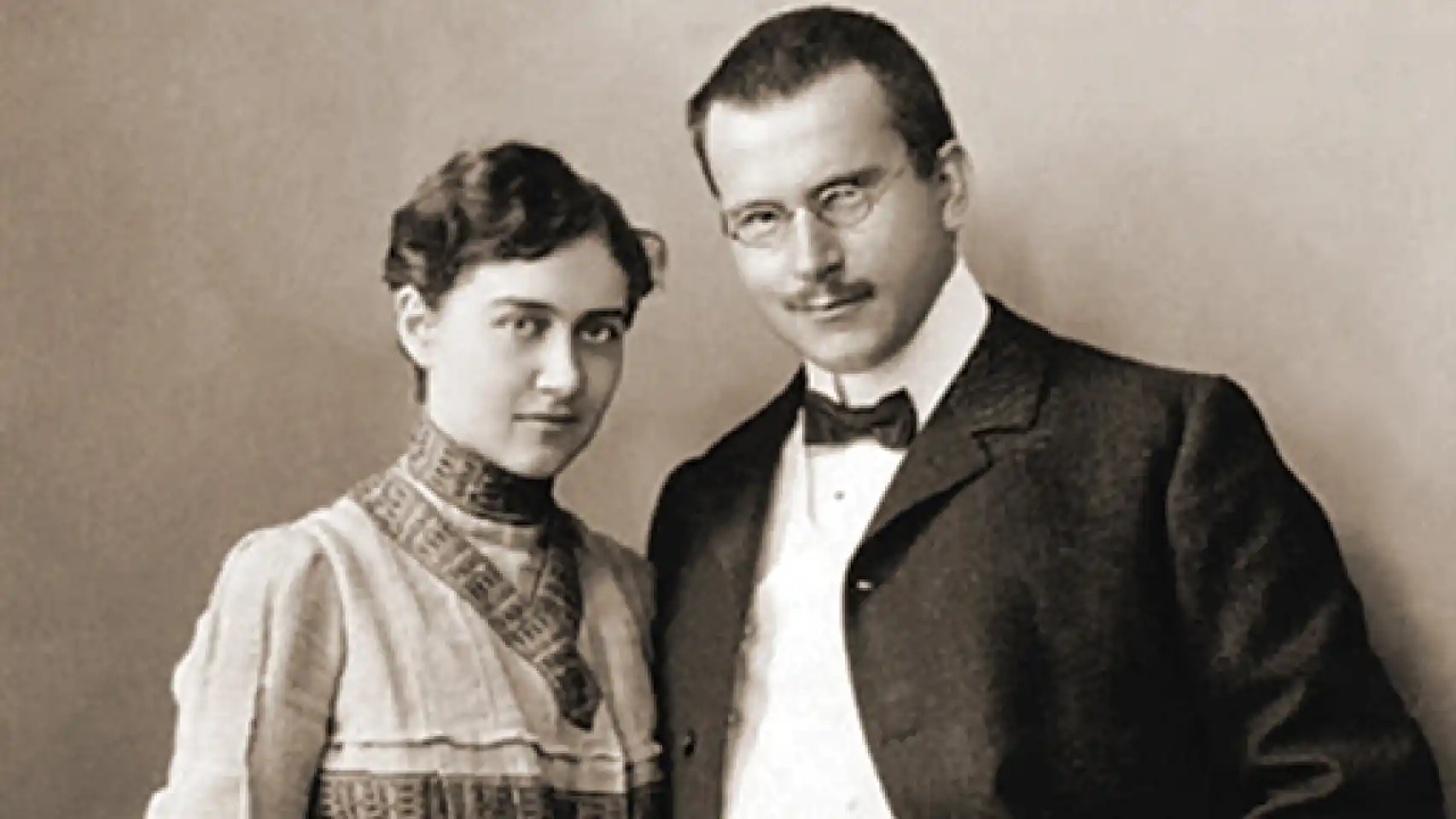
The Matriarch of Analytical Psychology
History often remembers Emma Jung (1882–1955) merely as the wife of Carl Jung. However, this reduction misses the reality: Emma was a formidable analyst, scholar, and the stabilizing force behind the entire Jungian movement. While Carl explored the wild frontiers of the collective unconscious, Emma built the structures—both intellectual and institutional—that allowed those discoveries to be communicated to the world.
She was the first president of the Psychological Club in Zurich and a key figure in the development of the concept of the Animus. Her work on the Grail Legend, completed posthumously by Marie-Louise von Franz, remains a seminal text in understanding the evolution of Western consciousness.
Biography & Timeline: Emma Jung
Born Emma Rauschenbach into a wealthy Swiss industrialist family, she met Carl Jung when she was just a teenager. They married in 1903. Her inheritance provided the financial freedom that allowed Carl to pursue his research without the constraints of academic employment. However, Emma was not content to be a financier.
She immersed herself in the study of mathematics, Latin, and Greek, eventually becoming an analyst in her own right. She bore the immense emotional burden of Carl’s “creative illness” (his confrontation with the unconscious) and his complex relationship with Sabina Spielrein and Toni Wolff. Through it all, she maintained her own dignity and intellectual independence.
Key Milestones in the Life of Emma Jung
| Year | Event / Publication |
| 1882 | Born in Schaffhausen, Switzerland. |
| 1903 | Marries Carl Jung. |
| 1910 | Begins her own analytic practice. |
| 1916 | Becomes the first president of the Psychological Club of Zurich. |
| 1934 | Publishes “On the Nature of the Animus,” a groundbreaking essay on feminine psychology. |
| 1955 | Dies in Zurich; her work on the Grail Legend is left unfinished. |
Major Concepts: The Animus and the Grail
The Nature of the Animus
While Carl Jung conceptualized the Animus (the masculine inner figure in a woman), it was Emma who fleshed out its phenomenology. In her famous essay, she distinguished between the “negative Animus” (which manifests as rigid opinions and argumentative logic) and the “positive Animus” (which acts as a bridge to the spirit and intellectual clarity).
She argued that a woman’s task is not to eliminate the Animus but to differentiate it. When a woman engages in intellectual or creative work, she gives the Animus a constructive outlet, preventing it from possessing her personality.
The Grail Legend
Emma spent 30 years researching the Holy Grail. She saw the Grail myth not just as a medieval story, but as a dream of the Western psyche. The Grail represents the “feeling function” that was lost during the rise of Christian patriarchy. The quest for the Grail is the quest to restore the feminine principle (the vessel) to its rightful place alongside the masculine spirit.
The Conceptualization of Trauma: The Container
Emma Jung’s life offers a masterclass in the concept of Containment. In therapy, the “container” is the safe space where the patient’s fragmented psyche can be held.
Holding the Tension
During Carl’s turbulent confrontation with the unconscious (documented in The Red Book), Emma provided the container that kept him sane. She managed the household, raised five children, and grounded him in reality.
Clinical Relevance: In trauma therapy, the therapist often plays the role of Emma. We must hold the client’s chaos without collapsing or retaliating. This “holding” allows the client to eventually internalize a sense of safety.
Legacy: The Unsung Heroine
Without Emma Jung, there would likely be no Analytical Psychology. She was the “rock” upon which the church of Jung was built. Her correspondence reveals a woman of deep wisdom, patience, and fierce intelligence.
For modern women, she serves as a complex role model of how to maintain one’s own center in the presence of a powerful, often overwhelming partner. She teaches us that the “feminine” power of containment is not passive; it is an active, structural force that makes transformation possible.
Bibliography
- Jung, E. (1957). Animus and Anima. Spring Publications.
- Jung, E., & von Franz, M.L. (1960). The Grail Legend. Princeton University Press.
- Clay, C. (2016). Labyrinths: Emma Jung, Her Marriage to Carl, and the Early Years of Psychoanalysis. HarperCollins.



















0 Comments