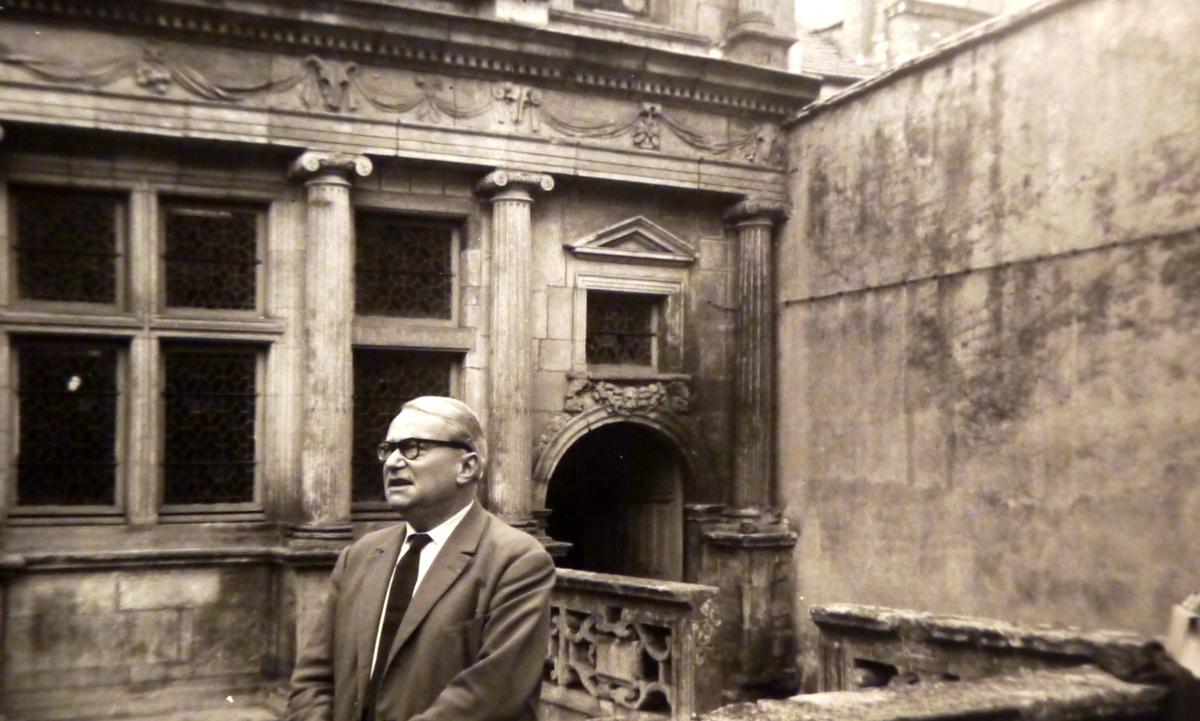
Henry Corbin: Visionary of the Imaginal Realm

by | Jul 12, 2024 | 0 comments

Henry Corbin Imaginal Realm

The Philosopher of the Angel

In the modern West, we tend to divide the world into two: the “real” (matter, science, atoms) and the “imaginary” (fantasy, dreams, nothing). Henry Corbin (1903–1978) shattered this binary. A French philosopher and Islamicist, Corbin argued that between the sensory world and the intellectual world lies a third realm: the Mundus Imaginalis (Imaginal World).

This is not a world of “make-believe.” It is a world of ontological reality—the place where the soul encounters the sacred. Corbin’s work is essential for depth psychology because he provides the metaphysical geography for what Jung called the Active Imagination. He teaches us that when we close our eyes and visualize, we are not just “inside our heads”; we are traveling.

Biography & Timeline: Henry Corbin

Born in Paris, Corbin was a student of Etienne Gilson and Louis Massignon. He was the first person to translate Heidegger into French, but his spiritual home was not German existentialism—it was Iranian mysticism. He spent years in Tehran, studying the works of Suhrawardi, Ibn ‘Arabi, and the Ismaili gnosis.

He was a regular attendee of the Eranos Conferences in Ascona, Switzerland, where he formed a deep intellectual friendship with Carl Jung. Jung provided the psychology; Corbin provided the theology. Together, they mapped the soul’s journey not as a cure for neurosis, but as a return to the divine.

Key Milestones in the Life of Henry Corbin

Year Event / Publication
1903 Born in Paris, France.
1939-1945 Spends the war years in Istanbul, diving deep into Islamic manuscripts.
1954 Succeeds Louis Massignon as Chair of Islamism at the Sorbonne.
1958 Publishes Creative Imagination in the Sufism of Ibn ‘Arabi (later titled Alone with the Alone).
1978 Dies in Paris, leaving a legacy that bridges East and West.

Major Concepts: The Mundus Imaginalis

Imaginary vs. Imaginal

Corbin fought to distinguish the “imaginary” (unreal, fantasy) from the “imaginal” (real, symbolic).

The Imaginal Realm: This is the “inter-world” (barzakh) where spiritual realities take on form and material realities are spiritualized. It is the place of prophecy, dreams, and visions. In therapy, this validates the client’s inner world. A dream figure is not just a “part of the self”; it is an autonomous entity in the imaginal realm.

The Angel of the Self

Drawing on Avicenna and Suhrawardi, Corbin wrote extensively about the “Celestial Twin” or the “Angel.” He argued that individuation is the process of the earthly soul meeting its heavenly counterpart. We are not complete until we unite with our Angel. This parallels Jung’s concept of the Ego merging with the Self.

The Conceptualization of Trauma: The Exile of the Soul

Corbin’s philosophy offers a poignant view of trauma: it is an exile. The soul feels trapped in the “Occident” (the world of matter and death) and longs for the “Orient” (the world of light).

Healing as Ta’wil

In Islamic mysticism, Ta’wil means “to take something back to its origin.” Corbin applied this to psychology. Healing is not just fixing symptoms; it is tracing the symptom back to its archetypal root in the Imaginal World.

Example: A depression is not just a chemical imbalance; it is a “Dark Night” where the soul is being initiated. By using active imagination, the patient can turn the symptom into a guide.

Legacy: The Prophet of the Imagination

Henry Corbin remains the patron saint of Archetypal Psychology. James Hillman openly acknowledged Corbin as his master. Corbin taught us that the imagination is an organ of perception—as real as the eye or the ear.

For the modern therapist, Corbin is a reminder that we are not mechanics of the mind. We are guides in a landscape of angels, demons, and dreams. To heal the soul, we must believe in the reality of the soul.


Bibliography

  • Corbin, H. (1969). Alone with the Alone: Creative Imagination in the Sufism of Ibn ‘Arabi. Princeton University Press.
  • Corbin, H. (1977). Spiritual Body and Celestial Earth. Princeton University Press.
  • Corbin, H. (1978). The Man of Light in Iranian Sufism. Shambhala.
  • Cheetham, T. (2003). The World Turned Inside Out: Henry Corbin and Islamic Mysticism. Spring Journal Books.

Explore More on Mysticism & Psychology

Explore the Other Articles by Categories on Our Blog 

Hardy Micronutrition is clinically proven to IMPROVE FOCUS and reduce the effects of autism, anxiety, ADHD, and depression in adults and children without drugsWatch Interview With HardyVisit GetHardy.com and use offer code TAPROOT for 15% off

Who was Theodore Millon?

Who was Theodore Millon?

The Grand Unifier: Theodore Millon and the Mathematical Architecture of the Self In the fragmented landscape of 20th-century psychology, where clinicians pledged loyalty to competing schools of thought like feudal lords, Theodore Millon (1928–2014) stood as a rare...

What is a Diagnosis Anyway: Is the DSM Dying Part 2

What is a Diagnosis Anyway: Is the DSM Dying Part 2

The Archaeology of a Label: What We Forgot About Diagnosis and Why It Matters Now By Joel Blackstock, LICSW-S | Clinical Director, Taproot Therapy Collective Part II of A Critical Investigation into the Document That Defines American Mental Health Contents...

Is the DSM Dying? Rethinking Suffering

Is the DSM Dying? Rethinking Suffering

A Critical Investigation into the Document That Defines American Mental Health—and Why It May Have Already Failed By Joel Blackstock, LICSW-S | Clinical Director, Taproot Therapy Collective Contents Introduction: The Controversial Bible Part I: The History of a...

Understanding How the Different Types of Therapy Fit Together

Understanding How the Different Types of Therapy Fit Together

You've tried therapy before. Maybe it helped a little. Maybe you spent months talking about your childhood without anything changing. Maybe you learned coping skills that worked until they didn't. Maybe the therapist was nice but you left each session feeling like...

Fractal Fluency: Why Your Nervous System Hates Minimalism

Fractal Fluency: Why Your Nervous System Hates Minimalism

Discover fractal fluency—the neuroscience of why natural patterns calm the brain while minimalist architecture stresses it. Learn how to create a “visual diet” for trauma recovery by designing environments with the right fractal dimension (D=1.3-1.5) to passively regulate the nervous system.

David Bohm: The Physicist Who Saw Mind in Matter

David Bohm: The Physicist Who Saw Mind in Matter

The Heretic of Copenhagen David Bohm (1917-1992) committed what many physicists considered an unforgivable sin: he took quantum mechanics seriously as a description of reality, not just a calculation tool. While the Copenhagen interpretation (Bohr, Heisenberg)...

Insights into Therapy Through Quantum Neuroscience

Insights into Therapy Through Quantum Neuroscience

Something extraordinary is happening in consciousness research right now. After decades of incremental progress and philosophical stalemate, 2025—designated by the United Nations as the International Year of Quantum Science and Technology—has delivered a cascade of...

The Metamorphosis of the Sufferer: From Neurotic Soul to Digital User

The Metamorphosis of the Sufferer: From Neurotic Soul to Digital User

From “neurotic soul” to “digital user”: How insurance companies, Big Pharma, and Silicon Valley systematically dismantled the depth of psychotherapy—and why the BetterHelp scandal was just the beginning. A critical history for therapists who refuse to become technicians.

The Neuroscience of Disassociation

The Neuroscience of Disassociation

The unitary nature of consciousness is the most persistent intuition of human experience. We feel like a single protagonist in a continuous narrative. Yet, for the trauma survivor, this intuition is often a lie. As therapists, we are often the first to witness the...

Who Is Gerald Edelman?

Who Is Gerald Edelman?

Discover Nobel Laureate Gerald Edelman’s Neural Darwinism, a revolutionary theory applying evolutionary principles to the brain’s development and consciousness.

Who Is Victor Lamme?

Who Is Victor Lamme?

The Neuroscientist Who Found Consciousness in the Feedback Loops of the Brain When you look at a face, what happens in your brain? The answer turns out to be surprisingly complex. First, visual information streams forward from your eyes through your visual cortex,...

Bill O’Hanlon: The Therapist Who Asked “How Do People Get Happy?”

Bill O’Hanlon: The Therapist Who Asked “How Do People Get Happy?”

Bill O’Hanlon, MS, LMFT, studied with Milton Erickson as his only work/study student (serving as Erickson’s gardener) before co-founding Solution-Oriented/Possibility Therapy in the 1980s. Author of nearly 40 books including the Oprah-featured “Do One Thing Different” and foundational “In Search of Solutions” with Michele Weiner-Davis, O’Hanlon delivered over 3,700 presentations worldwide teaching his collaborative, non-pathologizing approach asking “How do people get happy?” rather than “What’s wrong?” He retired from clinical practice in 2020 to pursue professional songwriting from Santa Fe, New Mexico.

0 Comments

Submit a Comment

Your email address will not be published. Required fields are marked *