

The unitary nature of consciousness is the most persistent intuition of human experience. We feel like a single protagonist in a continuous narrative. Yet, for the trauma survivor, this intuition is often a lie.
As therapists, we are often the first to witness the paradox of the “fractured mind.” We see clients who function with high competence in their careers (“Apparently Normal Personality”) while simultaneously harboring parts frozen in the terror of decades-old trauma. Until recently, our understanding of dissociation was largely metaphorical—we spoke of “walls,” “parts,” and “splitting.”
But the science has changed.
Research from 2024 and 2025 has moved beyond descriptive psychopathology to probe the neurocomputational and quantum-biological underpinnings of dissociative states. We are no longer just mapping symptoms; we are mapping the physics of the split. This article integrates the latest findings with the titans of consciousness science—Friston, Dehaene, Tononi, Hameroff, and others—to explain how the brain physically sustains a divided self, and how emerging therapies are targeting these specific mechanisms.
The Phenomenology of the Void: 2024–2025 Clinical Updates for the Neurology of Dissociation
Dissociation is not a monolithic construct. The latest literature emphasizes a tripartite classification, each with distinct neurobiological signatures.
Depersonalization and the “Unreal” Self
Recent work in 2024 has coalesced around a predictive coding model of Depersonalization/Derealization Disorder (DPDR). Patients often describe feeling like automata. Research suggests this is not a failure of perception (they see the world fine), but a failure of interoceptive prediction. The brain, overwhelmed by anxiety, “attenuates” the precision of bodily signals (heartbeat, gut feelings). The visual system says “I am here,” but the body says “I feel nothing.” This mismatch creates the haunting sense of unreality.
Dissociative Amnesia: The Prefrontal Blockade
New imaging studies have confirmed that dissociative amnesia is an active, metabolically expensive process. It is not that the memory is gone; it is that the Dorsolateral Prefrontal Cortex (DLPFC) is hyperactive, actively inhibiting the hippocampus to prevent the “ignition” of traumatic memory traces.
Dissociative Depression: A New Clinical Entity?
Emerging 2025 research argues for “Dissociative Depression” as a distinct subtype. Unlike melancholic depression, this presentation is driven by the opioid and glutamatergic systems involved in numbing. These patients often fail to respond to SSRIs because their pathology isn’t about low serotonin—it’s about defensive shutdown.
The Architecture of Fragmentation: Theoretical Titans
To understand how a brain splits, we must look to the leading theories of consciousness. Surprisingly, they explain dissociation with startling precision.
Ignition Failure: The Global Neuronal Workspace (Baars & Dehaene)
Bernard Baars and Stanislas Dehaene propose the Global Neuronal Workspace (GNW) theory. They argue that consciousness arises when information is “broadcast” across the brain via long-range networks. This requires a non-linear event called “ignition.”
In dissociation, we see ignition failure. The trauma exists in local processors (amygdala, sensory cortex), but the “host” personality exerts top-down inhibition to prevent it from igniting the global workspace. The memory remains “preconscious”—driving behavior (flashbacks, avoidance) without ever entering the narrative self’s awareness.
Split Phi: Integrated Information Theory (Giulio Tononi)
Giulio Tononi’s Integrated Information Theory (IIT) offers a mathematical definition of consciousness: Phi (Φ). IIT posits an “Exclusion Principle”—only the complex with the maximum integrated information exists as a conscious entity.
Tononi explicitly predicts that if functional connectivity between brain regions drops (as seen in trauma), the single “major complex” can split into two. Mathematically, the “self” ceases to be one. Two separate local maxima of Phi emerge. This provides a rigorous scientific basis for the subjective experience of DID: “I was not there.” According to IIT, the “I” literally was not there; a different complex was running the show.
The High-Entropy Threat: Active Inference (Karl Friston)
Karl Friston’s Free Energy Principle suggests the brain’s primary job is to minimize “surprise” (prediction error). Trauma represents catastrophic surprise—a high-entropy state that threatens the organism’s model of the world.
To survive, the brain uses Precision Modulation. It assigns a weight of “zero reliability” to the incoming trauma signals. By treating the terror as “noise” rather than “signal,” the brain preserves its sanity. Dissociation is, in Friston’s view, a radical strategy to minimize free energy. The “Apparently Normal Personality” (ANP) is a generative model built on the exclusion of chaotic data.
The Interpreter & The Zombie: Gazzaniga and Lamme
- Michael Gazzaniga’s “Left Hemisphere Interpreter” explains the rationalization we see in clients. When a dissociated part acts, the host (unaware of the cause) confabulates a reason. “I bought this toy because… I thought my niece might visit,” masking the reality that a child part took executive control.
- Victor Lamme’s Recurrent Processing Theory distinguishes between the “feedforward sweep” (unconscious robot) and recurrent loops (conscious). He argues that much of dissociative behavior (highway hypnosis, rote functioning) is driven by complex feedforward “zombie” systems that lack the recurrent processing required for phenomenal experience.
Quantum Decoherence: The Wildcard (Hameroff & Penrose)
Perhaps the most controversial yet fascinating development is the intersection of Orch OR theory with anesthesia research. Stuart Hameroff and Sir Roger Penrose propose that consciousness arises from quantum vibrations in microtubules.
Recent studies on Ketamine (a dissociative anesthetic) show that it disrupts these quantum oscillations. Hameroff suggests that dissociation may be a form of “Quantum Pulse Decoherence”—the unified quantum field of the self physically shatters into isolated islands of coherence. This aligns eerily with the “K-hole” experience and the phenomenology of profound derealization.
The Danger of “Healing”: Psychedelic Iatrogenic Structural Dissociation (PISD)
A critical hypothesis published in Frontiers in Psychology (2025) has introduced the concept of Psychedelic Iatrogenic Structural Dissociation (PISD). With the rush to use MDMA and Psilocybin for PTSD, we must tread carefully.
The REBUS model (Carhart-Harris) suggests psychedelics work by “relaxing beliefs” (lowering the energy barrier). For a neurotic patient, this is healing. But for a dissociative patient, the “rigid beliefs” of the ANP are the only thing holding the psyche together. PISD warns that psychedelics can aggressively dismantle these defenses too quickly, flooding the system with unintegrated trauma and causing a secondary fragmentation rather than integration.
Therapeutic Frontiers: Treating the Hardware
Understanding the physics of dissociation changes how we treat it. We are moving away from purely “top-down” talk therapy toward methods that address the “ignition failure” and “connectivity splits.”
Promising Modalities in 2024/2025
1. Deep Brain Reorienting (DBR)
Developed by Frank Corrigan, DBR targets the Periaqueductal Gray (PAG) and the Superior Colliculus—the brainstem’s orientation system. 2024 studies indicate that by resolving the “shock” at the brainstem level, we can bypass the cortical confusion of the Interpreter.
2. Lifespan Integration (LI)
LI uses the repetition of a timeline to bridge the “split Phi.” By rapidly firing neural networks across time, it forces Hebbian learning (“neurons that fire together, wire together”), physically building the connectivity required to integrate the fragmented self-states. Recent trials show high efficacy in reducing PTSD symptoms.
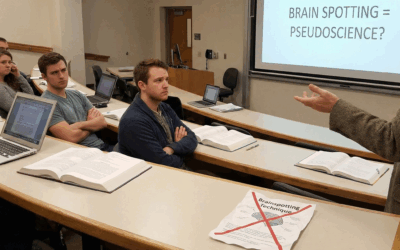
3. Neurofeedback & Brainspotting
Neurofeedback is showing promise in down-regulating the amygdala without requiring verbal processing, essential for patients who dissociate when they speak. Similarly, Brainspotting accesses subcortical “trauma capsules” via fixed eye positions, leveraging the oculocardiac reflex to regulate the autonomic nervous system directly.
A Unified Science of the Many
The study of dissociation has matured. We now see the “fractured mind” not as a metaphor, but as a masterpiece of biological adaptation—a calculated reduction of functional connectivity to minimize the entropy of an unbearable reality.
Whether we view it through the lens of Tononi’s exclusion principle, Friston’s free energy, or Dehaene’s ignition, the message is clear: Therapy must be safe enough to lower the barriers, and robust enough to handle the energy that is released when the “split Phi” finally unifies.
Key References for Clinicians
- Baars, B. J. (2005). Global workspace theory of consciousness. Progress in Brain Research.
- Elfrink, S., & Bergin, A. (2025). Psychedelic Iatrogenic Structural Dissociation: An Exploratory Hypothesis. Frontiers in Psychology.
- Friston, K. J. (2010). The free-energy principle: a unified brain theory? Nature Reviews Neuroscience.
- Hameroff, S., & Penrose, R. (2014). Consciousness in the universe: a review of the ‘Orch OR’ theory. Physics of Life Reviews.
- Lanius, R. A., et al. (2024). Novel adjunct treatments for posttraumatic stress disorder: Neurofeedback and deep brain reorienting.
- Tononi, G. (2004). An information integration theory of consciousness. BMC Neuroscience.











0 Comments