
You’ve tried therapy before. Maybe it helped a little. Maybe you spent months talking about your childhood without anything changing. Maybe you learned coping skills that worked until they didn’t. Maybe the therapist was nice but you left each session feeling like something essential was being missed.
Here’s what nobody told you: different therapies target different parts of your brain. The therapy that transforms one person’s life might be completely wrong for another—not because either therapy is bad, but because they’re designed to access different systems. And what you think you need from therapy often isn’t what you actually need.
Understanding this can save you years of wrong-fit treatment.
The Two Dimensions That Define Every Therapy
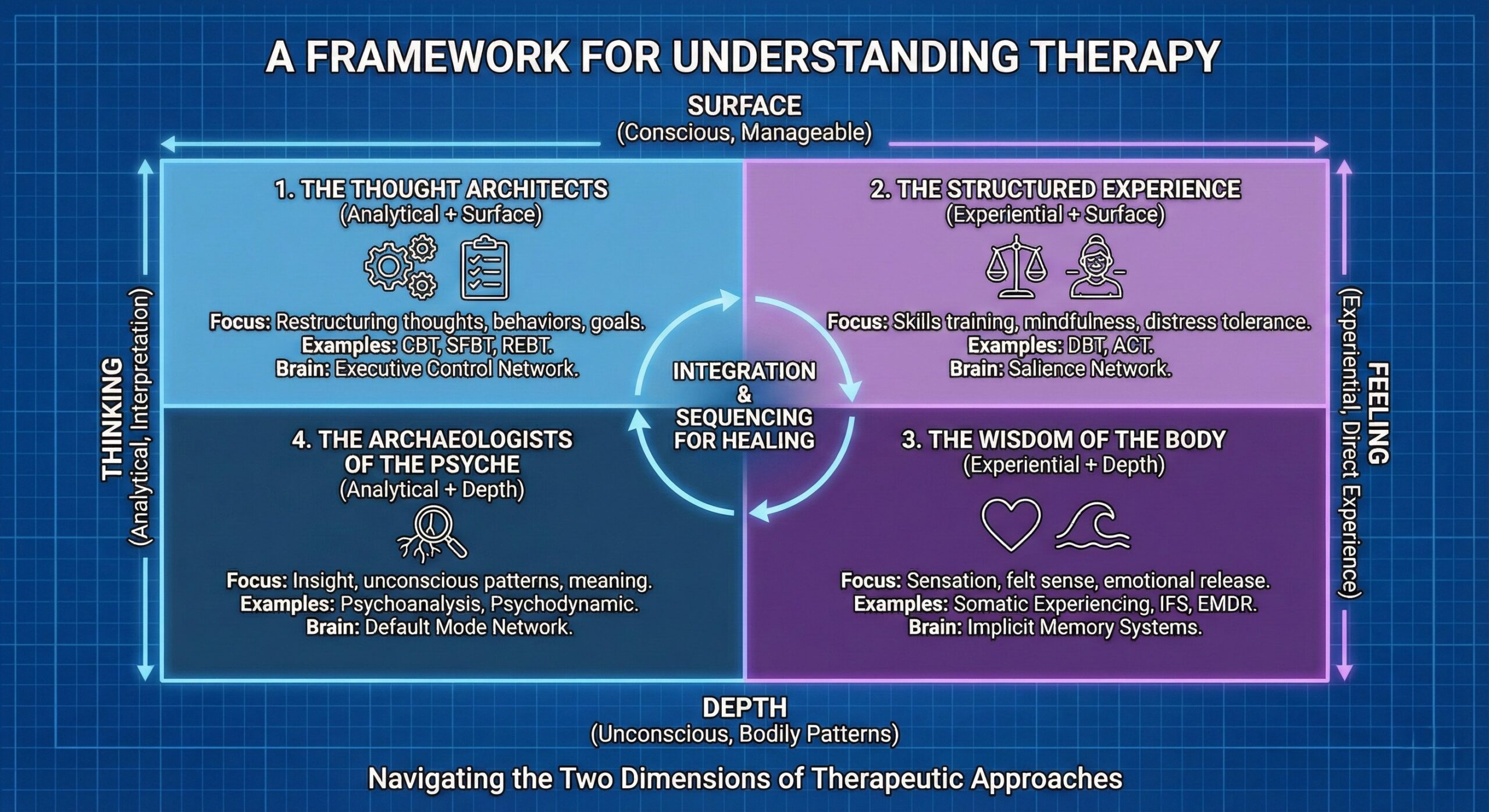
Forget the alphabet soup of therapy acronyms—CBT, DBT, EMDR, IFS, SFBT. Underneath all these brands, every therapeutic approach can be mapped along two fundamental dimensions:
Dimension 1: Thinking vs. Feeling
Some therapies operate primarily through analysis and interpretation. The therapist helps you understand what’s happening—providing models, explanations, and frameworks. The assumption: if you comprehend the pattern, you can change it.
Other therapies operate through direct experience. The therapist doesn’t explain what anything means; they guide you into having an experience. The assumption: change happens through new experiences, not new thoughts.
Dimension 2: Surface vs. Depth
Some therapies focus on the conscious, manageable surface—your thoughts, behaviors, stated goals, what you can control. These are practical, strategic, often brief.
Other therapies target the unconscious depths—the emotional and bodily patterns that operate below awareness. These address what you feel in ways you can’t articulate, especially what lives in your body.
These two dimensions create four quadrants, and every major therapy falls somewhere on this map.
The Four Quadrants of Therapy
Quadrant 1: Analytical + Surface (The Thought Architects)
What it looks like: Structured sessions with agendas. Homework assignments. Identifying and restructuring thoughts. Measuring progress on scales. Learning to recognize cognitive distortions.
Therapies here: Cognitive Behavioral Therapy (CBT), Solution-Focused Brief Therapy (SFBT), Rational Emotive Behavior Therapy (REBT)
The neuroscience: These approaches primarily engage the Executive Control Network—the brain’s goal-directed problem-solving system. Research by Cole et al. (2013) in Neuron identified this network as managing cognitive control and task-switching. CBT essentially strengthens this network through conscious thought restructuring.
Who it helps: People with specific phobias, mild-to-moderate depression and anxiety, those who need structure and concrete tools. APA clinical guidelines support CBT’s efficacy for these presentations.
The limitation: You can understand exactly why you have a problem and still have the problem. Aaron Beck developed CBT after observing that his depressed patients had persistent negative thoughts, but cognitive restructuring doesn’t always reach the body. The person who can explain their anxiety perfectly but still panics in meetings. The one who knows intellectually that the abuse wasn’t their fault but still feels the shame in their chest.
Quadrant 2: Experiential + Surface (The Structured Experience)
What it looks like: Skills training combined with practice. Mindfulness exercises. Learning to tolerate distress through specific techniques. Balancing acceptance with change.
Therapies here: Dialectical Behavior Therapy (DBT), some forms of Emotion-Focused Therapy (EFT), Acceptance and Commitment Therapy (ACT)
The neuroscience: These approaches engage both cognitive control and the Salience Network—which Uddin (2015) characterized in Nature Reviews Neuroscience as monitoring internal and external stimuli to determine what deserves attention. DBT’s mindfulness training directly refines interoceptive awareness while building regulation capacity.
Who it helps: People with emotional dysregulation, those who need to build capacity before going deeper. Marsha Linehan developed DBT specifically for chronically suicidal individuals with Borderline Personality Disorder after finding that standard CBT’s relentless focus on change felt invalidating.
The limitation: Skills are essential but can become sophisticated avoidance. You can regulate your way around trauma without ever processing it. The tools work until they don’t—until stress exceeds your capacity and the underlying wound surfaces anyway.
Quadrant 3: Experiential + Depth (The Wisdom of the Body)
What it looks like: Following sensation. Dialogue with inner parts. Tracking what arises without interpretation. Long silences. Completion of thwarted defensive responses. The therapist guides experience rather than explaining it.
Therapies here: Somatic Experiencing (SE), Internal Family Systems (IFS), Brainspotting, Gestalt Therapy, AEDP
The neuroscience: These approaches access implicit memory systems—procedural and emotional memory that exists outside conscious awareness. Research on memory systems confirms these operate through different neural substrates than explicit recall. David Grand’s Brainspotting accesses points in the visual field connecting to deep brain structures—the amygdala, hippocampus, and orbitofrontal cortex—where trauma gets encoded below language.
Who it helps: People with complex trauma, those whose bodies hold what their minds forgot, anyone who’s done years of talk therapy without the problem budging. Peter Levine’s Somatic Experiencing works by completing interrupted defensive responses trapped in the nervous system.
The limitation: Opening deep material without adequate preparation can overwhelm. Going into the depths without having built regulation capacity first risks retraumatization. This is why sequencing matters—you sometimes need Quadrant 2 skills before Quadrant 3 work.
Quadrant 4: Analytical + Depth (The Archaeologists of the Psyche)
What it looks like: Free association. Dream analysis. Exploring transference. Making the unconscious conscious through interpretation. Long-term treatment measuring progress in years.
Therapies here: Psychoanalysis, Jungian Analysis, Psychodynamic Therapy, Existential Therapy
The neuroscience: These approaches engage the Default Mode Network—active during introspection and self-referential processing. Raichle et al. (2001) discovered this network in PNAS, and subsequent research linked overactive DMN to rumination in depression. You can get stuck here—understanding everything while changing nothing.
Who it helps: People seeking meaning, those with complex personality patterns requiring long-term exploration, individuals whose suffering has existential dimensions that skills-based approaches can’t address.
The limitation: The person who can trace their smoking to an oral fixation, discuss what their mother did, spend decades gaining profound insight into their neurosis—and still smoke. You can understand the pattern intellectually without touching the actual problem, because the problem doesn’t live in the prefrontal cortex. It lives in the body.
The Problem Lives Where You’re Not Looking
Here’s what matters clinically: trauma doesn’t live in the thinking brain.
As Bessel van der Kolk argues in The Body Keeps the Score, trauma lives in the body brain—the deep emotional system that determines how much energy you respond to life with, your reaction to confrontation, your immediate fear when you have an emotional need. All of this happens in the body before it colors cognition.
Simply thinking about it and analyzing it doesn’t release that emotional defensive response. This is why purely cognitive approaches leave some trauma responses completely intact. You can intellectually understand the abuse wasn’t your fault (explicit memory change) while your body still freezes around authority figures (implicit memory response unchanged).
Research on functional incompatibility between memory systems explains why: different types of memory require different therapeutic approaches. The insula doesn’t speak English. The striatum doesn’t respond to insight.
What You Want vs. What You Need: The Personality Paradox
Here’s where it gets complicated: people often seek the therapy that confirms their existing patterns rather than challenges them.
John Beebe’s expansion of Jung’s personality theory, detailed in his work on the eight-function model, helps explain this. Each personality type has dominant and inferior functions—the ones they’re strongest in and the ones they’ve least developed.
Under stress, people get “in the grip” of their inferior function. Naomi Quenk’s research shows that when significant stress overwhelms typical functioning, the least-developed function erupts primitively. These episodes feel alien and uncontrolled.
The therapeutic implication: your growth edge is usually in the quadrant you avoid.
The Thinker’s Trap
Strong analytical types gravitate toward psychoanalysis, existential therapy, or CBT. They can use their formidable intellect to analyze problems from a safe distance. But their growth edge often lies in direct emotional and relational experience—the Experiential-Depth quadrant they’ll initially resist.
The anxious intellectualizer wants more analysis when they need embodiment. They want to understand why they feel terror; they need to feel the terror and discover they survive it.
The Feeler’s Trap
Strong feeling types may seek catharsis and emotional expression. But sometimes they need containment—structure, cognitive distance, grounding techniques. The person overwhelmed by emotion doesn’t always need more emotional exploration; they may need Quadrant 1 or 2 tools first.
The Avoider’s Trap
Some people seek therapy that stays safely on the surface. Solution-focused work feels comfortable because it never asks them to feel the depths. They want strategies; they need to eventually go where the wound lives.
This explains the clinical observation that patients often resist the therapy that would help them most. If someone needs deep work and you give them nail-biting strategies, you’re colluding with their defense. If someone needs stabilization and you push them into the depths, you risk overwhelming them.
The Insurance Company Problem
There’s a systemic dimension to this. The rise of managed care in the 1980s fundamentally altered what therapy gets funded. Research cited in JAMA Internal Medicine (2014) shows that over 80% of psychotherapists don’t accept public insurance, highlighting access barriers created by economic pressures.
Insurance companies prefer treatments that are:
- Standardized and manualized
- Measurable with clear outcomes
- Limited to 5-20 sessions
This systemically privileges Quadrant 1 approaches (CBT, SFBT) while making long-term depth work or less structured experiential work harder to access. Everything pushed forward has “brief” or “solution-driven” or “time-limited” attached.
The result: a lot of band-aids that don’t get to the root of the issue. People cycle through short-term treatments that help temporarily, never accessing the quadrants where their actual healing needs to happen.
The Neuroscience of Why Integration Matters
Contemporary neuroscience validates why no single approach works for everyone.
The brain networks targeted by different therapeutic approaches are genuinely distinct:
- Executive Control Network: Goal-directed problem-solving (Quadrant 1 target)
- Salience Network: Interoceptive awareness, determining what deserves attention (Quadrant 2-3 target)
- Default Mode Network: Self-reflection, introspection, meaning-making (Quadrant 4 target)
Research by Fox et al. (2005) in the Journal of Neuroscience demonstrated an anti-correlation between DMN and ECN activity. Someone stuck in DMN-driven rumination struggles to activate the ECN for goal-directed behavior. Someone over-relying on ECN (the compulsive problem-solver) disconnects from the self-reflective capacity of the DMN.
Mental health corresponds to the brain’s ability to flexibly activate and coordinate these networks. Therapy helps restore this flexibility—which requires therapists who can move between quadrants rather than staying locked in one.
PTSD: A Case Study in Why One Size Doesn’t Fit
Trauma research reveals a bifurcated disorder requiring different approaches:
Hyperarousal Subtype: Research by Shin et al. demonstrated PTSD can involve exaggerated amygdala response with diminished prefrontal regulation. The amygdala screams danger while the prefrontal cortex fails to apply brakes. This creates hypervigilance, intrusive re-experiencing, panic.
Dissociative Subtype: Lanius et al. identified a neurobiologically distinct pattern—increased prefrontal activity that over-inhibits limbic regions. Same disorder, opposite neural pattern. This creates numbness, depersonalization, disconnection.
The hyperaroused person may need containment and cognitive tools first (Quadrants 1-2). The dissociated person may need gentle somatic activation (Quadrant 3). One-size-fits-all trauma treatment fails because trauma itself isn’t one thing.
The Sequencing Principle: When to Use What
Effective treatment isn’t about finding the “right” quadrant—it’s about moving through them appropriately.
For Complex Trauma with Severe Dysregulation:
- First, Stabilization (Quadrant 2): Build capacity to manage internal states. DBT skills, distress tolerance, basic structure. You need a container before you open the contents.
- Then, Processing (Quadrant 3): Once stable, move into somatic and parts work. Let the body speak what words cannot. Complete thwarted defensive responses.
- Then, Integration (Quadrant 4): Construct new narrative. Make meaning from suffering. Understand patterns.
- Finally, Implementation (Quadrant 1): Maintain gains, prevent relapse, manage daily life with cognitive tools.
For Ruminative Depression:
Someone stuck in depressive rumination is already overusing their Default Mode Network. More insight-oriented therapy (Quadrant 4) can worsen rumination.
- First, Behavioral Activation (Quadrant 1): Interrupt the ruminative cycle. Schedule activities. Force activation of different networks. Get moving before exploring meaning.
- Then, Underlying Exploration (Quadrants 3-4): Once there’s cognitive distance, explore what drives the depression. Now they can feel without drowning.
What This Means for Finding the Right Therapist
The question isn’t “What’s the best therapy?” It’s “What does this person need right now, and what will they need next?”
Questions to consider:
- Where does your problem live? If it’s primarily thoughts and beliefs, Quadrant 1 approaches may help. If it’s in your body, your automatic reactions, your felt sense of danger—you need Quadrant 3.
- What’s your natural tendency? If you’re drawn to analysis and understanding, your growth edge might be in direct experience. If you’re drawn to emotional expression, you might need containment first.
- What have you already tried? If talk therapy hasn’t touched the problem, the problem probably isn’t verbal. If somatic work overwhelmed you, you might need stabilization skills first.
- What’s your current capacity? Deep work requires the ability to tolerate intense states. If that capacity isn’t there yet, building it is the first step.
About This Article
This framework was developed by Joel Blackstock, LICSW-S, Clinical Director of Taproot Therapy Collective, integrating contemporary neuroscience research with clinical observation across multiple therapeutic modalities. Our practice serves the greater Birmingham area with offices in Hoover, Alabama.
Key Sources:
- Cole et al. (2013). Multi-task connectivity reveals flexible hubs for adaptive task control. Neuron.
- Uddin, L.Q. (2015). Salience processing and insular cortical function and dysfunction. Nature Reviews Neuroscience.
- Raichle et al. (2001). A default mode of brain function. PNAS.
- Fox et al. (2005). The human brain is intrinsically organized into dynamic, anticorrelated functional networks. Journal of Neuroscience.
- van der Kolk, B. (2014). The Body Keeps the Score. Penguin Books.
- Beebe, J. (2016). Energies and Patterns in Psychological Type. Routledge.
Last updated: January 2026























0 Comments