
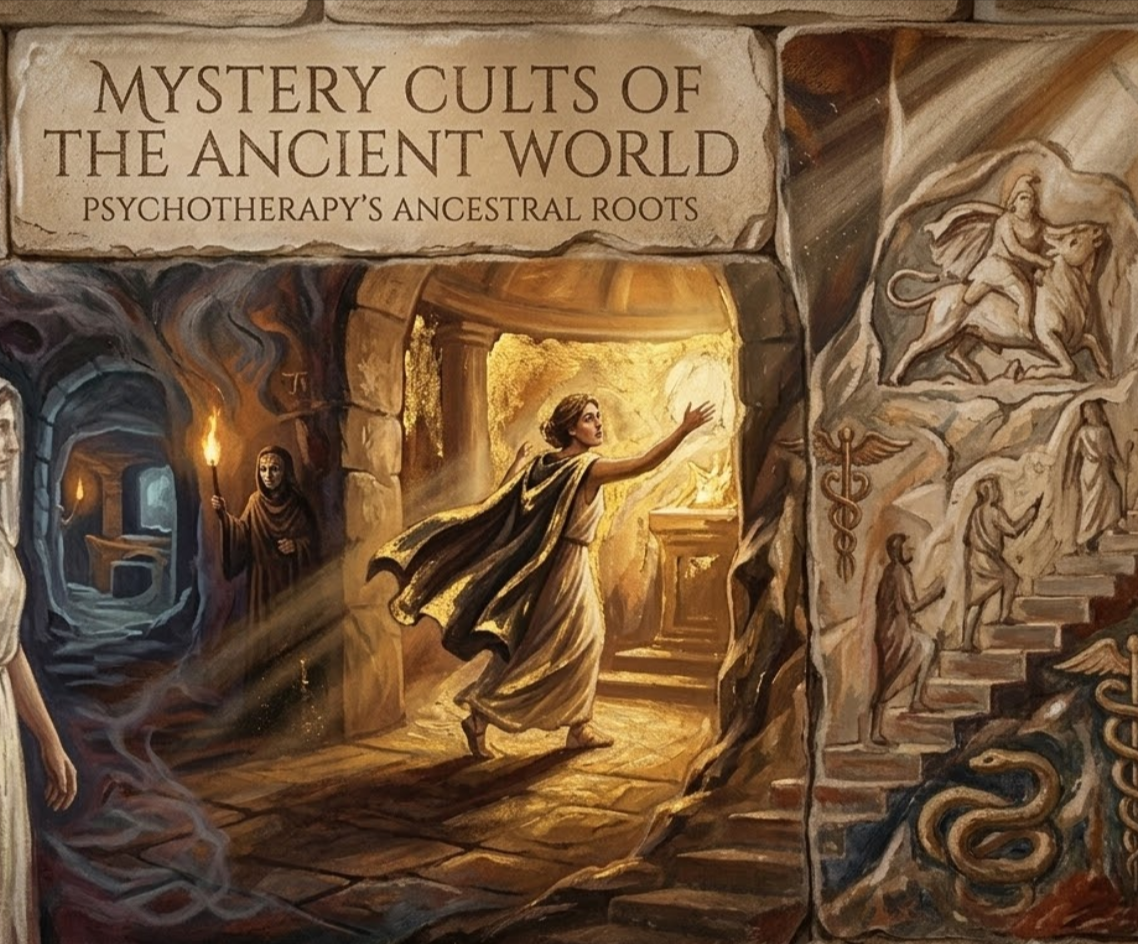
Their objective: systematically dismantle the initiate’s ordinary sense of identity, guide them through symbolic death, and facilitate the emergence of a newly integrated self.
Modern psychotherapy has increasingly recognized the limitations of purely cognitive, top-down approaches to complex trauma. The resurgence of parts-based therapies like Internal Family Systems, somatic experiencing, and psychedelic-assisted integration reflects a paradigm shift toward holistic, experiential healing.
What’s striking is how closely these modern modalities mirror the ancient initiatory toolkit. The hierophants of Eleusis and the priests of Mithras understood something we’re only now rediscovering: true healing requires more than insight. It requires orchestrated experience that bypasses the ego’s defenses.
Here are ten techniques the mysteries employed, and what they teach us about trauma processing today.
1. The Gephyrismoi: Ritual Humiliation
In the Eleusinian Mysteries, the initiation began during the physical journey along the Sacred Way. As initiates crossed the bridge over the Cephissus river, they were subjected to the gephyrismoi, or “bridge jests.” Individuals hurled intense, personal insults and mockery at the passing procession.
This wasn’t hazing for its own sake. Subjecting individuals of high social status to vulgar degradation enforced radical egalitarianism. The socially constructed parts of the psyche that rely on status and dignity for survival were stripped away. The initiate arrived raw, emotionally vulnerable, and highly receptive.
In IFS terms, the Manager parts were exhausted before the real work began. The ego’s protective armor was removed at the threshold.
2. Existential Reduction: “You Are a Bag of Meat”
In the Mithraic Mysteries, candidates were forced to confront extreme existential paradoxes. Unseen voices would assail them: “You are just a thinking animal that believes it’s a god!” or “You are a bag of meat collecting pain, speeding towards oblivion!”
By aggressively asserting that the candidate is merely a biological mechanism, the ritual shattered narcissistic grandiosity. This directly addresses what modern clinicians call “spiritual bypassing”: the use of spiritual frameworks to avoid confronting visceral, somatic reality.
The mysteries forced initiates into their bodies. They could not float above their suffering in abstraction. They had to feel it.
3. Manufactured Failures and Double-Binds
Candidates were frequently thrust into impossible ordeals designed to evoke profound inadequacy. Hierophants used paradoxical koans and intellectual double-binds to frustrate the analytical mind entirely.
The goal was impasse. When the illusion of control breaks down completely, something else can emerge.
This mirrors what Acceptance and Commitment Therapy calls “cognitive defusion”: the recognition that the thinking mind cannot solve every problem, and that some problems require a fundamentally different relationship to experience rather than a solution.
The mysteries engineered therapeutic crises of meaning.
4. Ontological Interrogation: “Who Are You?”
Once outer defenses were fractured, protocols targeted core cognitive structures of identity. Candidates led blindly into darkness were confronted by figures who aggressively demanded: “Who are you? What are you? Where are you going?”
In Orphic and Mithraic traditions, initiates were trained to bypass their mundane autobiographical identity entirely. They answered with ontological claims: “I am a child of Earth and Starry Heaven.”
This sudden, hostile questioning acts as a cognitive interrupt. It forces the initiate to “unblend” from societal roles and recognize something beneath the accumulated identifications.
Richard Schwartz’s IFS model posits an unalterable “Self” distinct from the protective parts that surround it. The ancient interrogation was designed to produce exactly this recognition: you are not your roles, your status, your history. There is something beneath all that.
5. Entheogenic Sacraments
The ancient world did not rely solely on psychological pressure. They also utilized pharmacology.
The Dionysian Mysteries employed wine and intoxicants. The Eleusinian rites used the kykeon, a barley-based brew that scholars have long suspected contained ergot alkaloids (precursors to LSD). These entheogenic sacraments facilitated direct, chemical bypassing of ordinary ego structures.
Modern neuroimaging confirms what the ancients intuited: psychedelics reliably downregulate the Default Mode Network, the neural substrate of the narrative self. The result is ego dissolution, mystical insight, and (when properly integrated) lasting therapeutic benefit.
The mysteries understood that some defenses cannot be talked through. They must be chemically circumvented.
6. Ecstatic Dance and Rhythmic Exhaustion
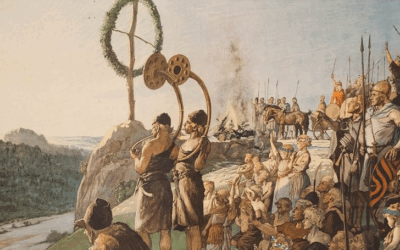
In cults devoted to Dionysus and Cybele, orgiastic revelry was a core technology. Processions featured deafening drum beats, clashing cymbals, and frenzied, continuous dancing that could last for hours or days.
This rhythmic exhaustion served a specific neurological function. Sustained physical movement down-regulates the sympathetic nervous system’s defense responses. The body, pushed past its ordinary limits, releases its rigid armoring.
Peter Levine’s Somatic Experiencing operates on similar principles: trauma is held in the body, and the body must discharge it through movement. The ancient ecstatic dance was a form of somatic release therapy, shaking loose what could not be verbalized.
7. Symbolic Dismemberment: Sparagmos
The Dionysian archetype represents the violent tearing apart of all structured categories. Through sparagmos (the ritual tearing apart of a sacrificial victim, mirroring the myth of Orpheus torn by the Maenads), the initiate’s ego-boundaries were symbolically breached.
This is a literalization of parts work. The psyche is acknowledged as fragmented before it can be brought back together.
The mythological motif of gathering scattered pieces (Isis reassembling Osiris, Demeter searching for Persephone) serves as the ancient blueprint for what shamanic traditions call soul retrieval and what IFS calls the integration of exiled parts.
You cannot integrate what you have not first acknowledged as fragmented.
8. Cave Isolation and Sensory Deprivation
The mysteries frequently utilized profound physical isolation. At the oracle of Trophonius, suppliants descended into a narrow underground grotto, entirely cut off from sensory input. They remained in darkness for extended periods before receiving their vision.
Modern isolation studies confirm what the ancients discovered: absence of light and external time cues induces profound temporal distortion. Linear time dissolves. The ordinary anchoring of consciousness gives way.
In this state, material that is ordinarily sequestered emerges into awareness. IFS conceptualizes traumatic memories as held by “Exiles” that exist outside ordinary time. The cave created conditions where those Exiles could surface.
The isolation chamber and the flotation tank are modern reconstructions of the ancient grotto.
9. The Taurobolium: Somatic Shock
In the rites of Cybele and later Mithraism, initiates underwent the taurobolium. The aspirant was placed naked in a subterranean pit covered by a lattice of branches. Above them, a bull was sacrificed. Roughly fifty liters of warm blood cascaded directly onto the initiate’s body.
This is extreme. It is also unmistakably effective as somatic shock.
The overwhelming sensory experience served as visceral boundary dissolution. The old self was literally washed away. The initiate emerged from the pit reborn, the physical enactment of psychological transformation.
Modern trauma therapy rarely employs methods this intense, but the principle is recognized: some transformations require experiences that cannot be merely imagined. They must be felt in the body with undeniable immediacy.
10. The Epopteia: Sudden Illumination
The culmination of the Eleusinian Mysteries was the epopteia, “the viewing.”
After days of darkness, fasting, terror, and exhaustion, the initiate stood in the pitch-black Telesterion. The Hierophant then violently threw open the sanctuary doors, revealing blazing torches and sacred objects in blinding illumination.
This massive light exposure triggered an involuntary autonomic response. The sympathetic nervous system, pushed to its absolute breaking point by days of ordeal, experienced instantaneous parasympathetic rebound.
The subjective experience: overwhelming awe, relief, and unitive consciousness. The terror resolved into ecstasy. Death gave way to rebirth.
Stephen Porges’ Polyvagal Theory describes this as the shift from dorsal vagal collapse or sympathetic hyperarousal into ventral vagal safety. The mysteries engineered this shift through precise sequencing of stress and release.
What the Mysteries Teach Us
Modern psychotherapy has inadvertently reconstructed the initiatory container of the ancient world.
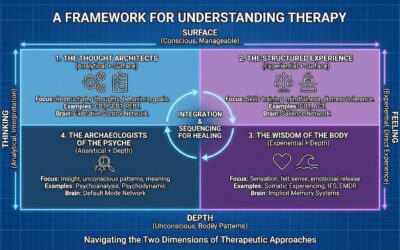
IFS unblends parts from the core Self. Somatic Experiencing releases trauma held in the body. EMDR uses bilateral stimulation to process sequestered memory. Psychedelic-assisted therapy bypasses ego defenses chemically. Exposure therapy confronts what has been avoided.
But the mysteries understood something that our fragmented, modality-specific clinical world often misses: these techniques work best in combination, in sequence, within a coherent ritual container.
The initiate was not given one intervention. They were taken on a journey. Humiliation preceded confrontation. Exhaustion preceded insight. Darkness preceded light. Each stage prepared the ground for the next.
True integration of the fragmented psyche requires more than intellectual talk therapy. It demands deeply felt, somatic, experiential passage through the dark. The courageous unblending of the protective ego. The humbling acceptance of mortal biology. And ultimately, the illuminating encounter with something that cannot be destroyed.
The ancients called it initiation into the mysteries.
We call it trauma therapy.
The technology is the same.
Joel Blackstock, LICSW-S, is the Clinical Director of Taproot Therapy Collective in Birmingham, Alabama. He specializes in complex trauma treatment using qEEG brain mapping, Brainspotting, and somatic approaches.






0 Comments