
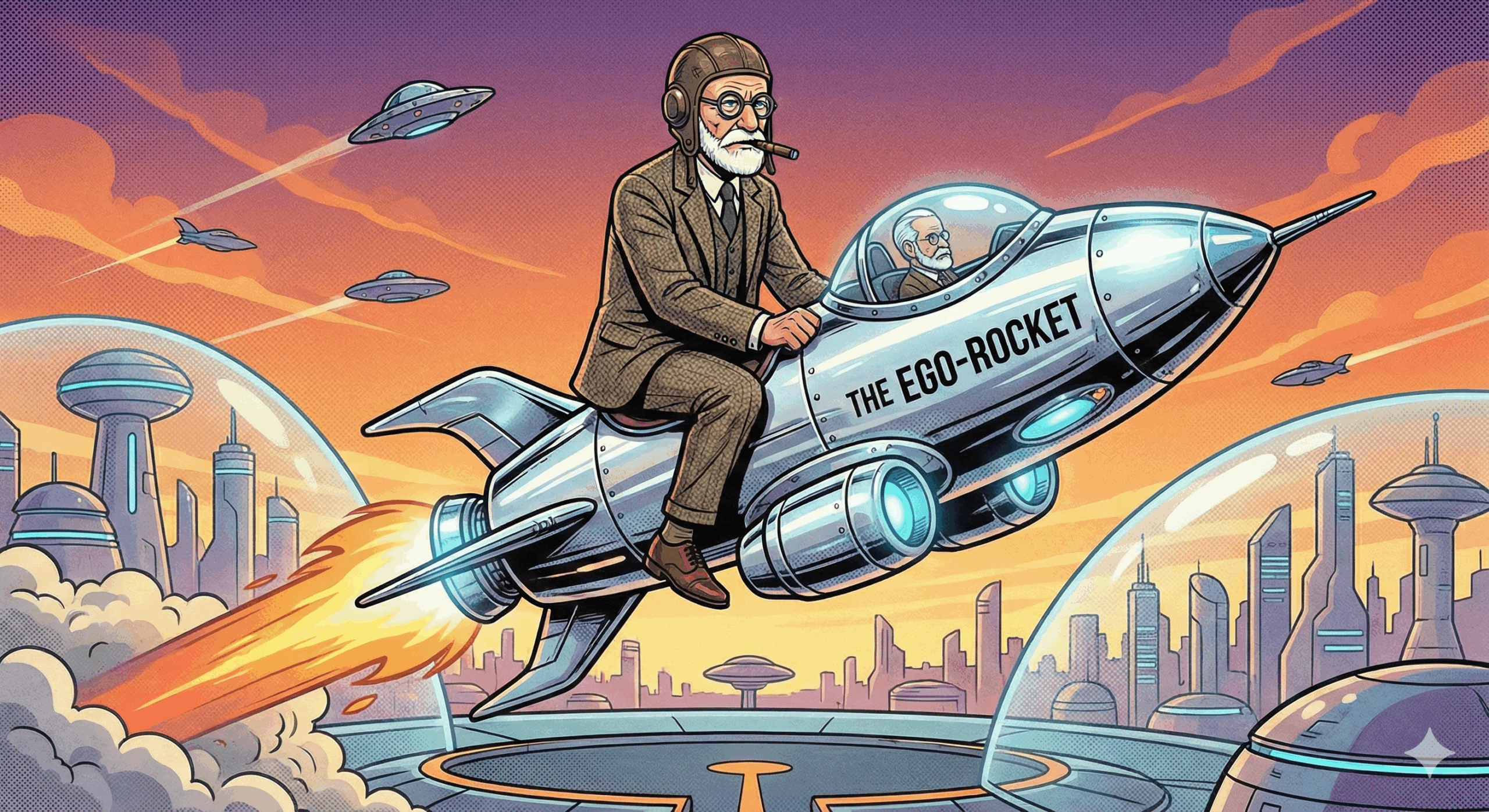
For decades, mental health has been dominated by a “maintenance” model. We treat symptoms like mechanical failures: fix the serotonin levels, reframe the negative thought, smooth out the behavioral glitch. But for many clients, this approach feels like rearranging deck chairs on the Titanic. It addresses the function of the mind, but not the reality of the experience.
A new, deeper paradigm is emerging, one that bridges the gap between the most ancient spiritual traditions and the most cutting-edge neuroscience. It suggests that trauma doesn’t just make us “sad” or “anxious”—it fundamentally fractures our perception of reality. It creates a “False Self” that lives in a simulation of safety.
This article explores a radical idea: that effective modern psychotherapy is essentially a form of Gnosticism—a process of waking up from a false world to encounter the “Real.”
1. The Simulation of Self: Trauma as a False World
In the early centuries of the common era, the Gnostics taught that the world we see is an illusion (a simulacrum) created by a false god to keep us asleep. While this sounds like theology (or the plot of The Matrix), it is actually a precise description of what happens to the human brain under trauma.
When we are traumatized, our nervous system creates a “protective self”—a mask or persona designed to survive an unbearable environment. This is explored in The Simulation of Self: Why We Feel Crazy in a Normal World. We begin to live as this mask. We lose touch with our authentic core and inhabit a constructed reality where safety is the only god.
This biological “false reality” is what modern dissociation theorists describe. It aligns perfectly with Gnosticism as a metaphor for consciousness. The goal of therapy, then, is not just symptom reduction—it is gnosis: the direct, experiential knowledge of who we actually are beneath the armor.
2. The Archons of the Mind: Internal Family Systems & Archetypes
If we are living in a false internal world, who is running the show? The Gnostics believed the world was ruled by “Archons”—petty tyrants who kept the soul trapped. In modern therapy, we call these “Protector Parts.”
Internal Family Systems (IFS) therapy has mapped this territory with startling precision. We have “Managers” who try to control every outcome to prevent pain, and “Firefighters” who use addiction to extinguish it. These parts often hijack our consciousness, making us act in ways that feel alien to our true selves. This is discussed in Richard Schwartz and the discovery of the Internal Family System.
Simultaneously, Jungian psychology suggests these forces aren’t just personal, but archetypal. When we are possessed by a complex, we are acting out a script written thousands of years ago. This is why understanding whether Jungian archetypes can be evidence-based is crucial. We aren’t just dealing with “bad habits”; we are dealing with autonomous psychic structures that function like the “gods” of the ancient world.
3. The Somatic “Red Pill”: Waking Up Through the Body
In the Gnostic myth, waking up requires a shock—a piercing of the veil. In therapy, this shock doesn’t come from an intellectual insight (which often just reinforces the simulation). It comes from the body.
Trauma is stored in the subcortical brain, far below the reach of language. To access it, we must bypass the “story” and go directly to the sensation. This is the “Red Pill” of modern therapy. As described in The Primacy of the Body, somatic therapies force us to confront the biological reality of our experience, stripping away the “cognitive bypass” strategies we use to avoid feeling.
This is where modalities like Brainspotting and EMDR become technologies of awakening. By fixing the gaze, we access the deep brainstem, allowing the “frozen” time of trauma to finally move forward. We are literally metabolizing the “stuck” energy that has kept the simulation running.
4. The Hyperreal Crisis: Why This Matters Now
Why is this “Gnostic” perspective so relevant today? Because we are living in a time of unprecedented unreality. We are surrounded by deep fakes, algorithmic feeds, and curated identities. We are entering the world predicted by Jean Baudrillard’s concept of Hyperreality.
In a world where the external environment is increasingly artificial, the internal quest for the “Real” becomes an act of radical mental health. If we cannot distinguish between our “True Self” and our “Digital Avatar,” we fall into psychosis. This danger is explored in The Influencing Machine: How Technology Shapes the Architecture of Psychosis.
Therapy, therefore, becomes the last sanctuary of the Real. It is the one place where two human beings sit in a room (or a secure digital container) and attempt to speak the unvarnished truth. It is a rebellion against the dark psychology of the algorithm.
5. The Metamodern Synthesis: Science Meets Soul
The future of this work lies in “Metamodernism”—a sensibility that oscillates between the scientific rigor of modernity and the deep meaning-making of ancient wisdom. We don’t have to choose between being a neuroscientist and a mystic.
As we see in the fusion of science and mysticism, we can use qEEG brain mapping to see the hardware, and depth psychology to understand the software. We can understand that Jung’s metaphysics and Holographic Memory Theory are pointing at the same non-local nature of consciousness.
This approach allows us to reclaim the “Soul” not as a religious concept, but as a psychological necessity. It is the part of us that remains witnessing, whole, and “Real” beneath the trauma simulation.
Conclusion: The Great Remembering
In the end, healing is a process of remembering. We remember who we were before the world told us who to be. We dismantle the “false self”—the simulation—and learn to tolerate the intensity of being alive.
This path is not easy. It requires facing the shadow economy of our own repression. But it is the only path that leads to genuine freedom. As we navigate the chaos of the 21st century, the oldest map may be the only one that still works.
To dive deeper into the philosophical roots of this journey, explore The Perennial Philosophy and Depth Psychology.













0 Comments