
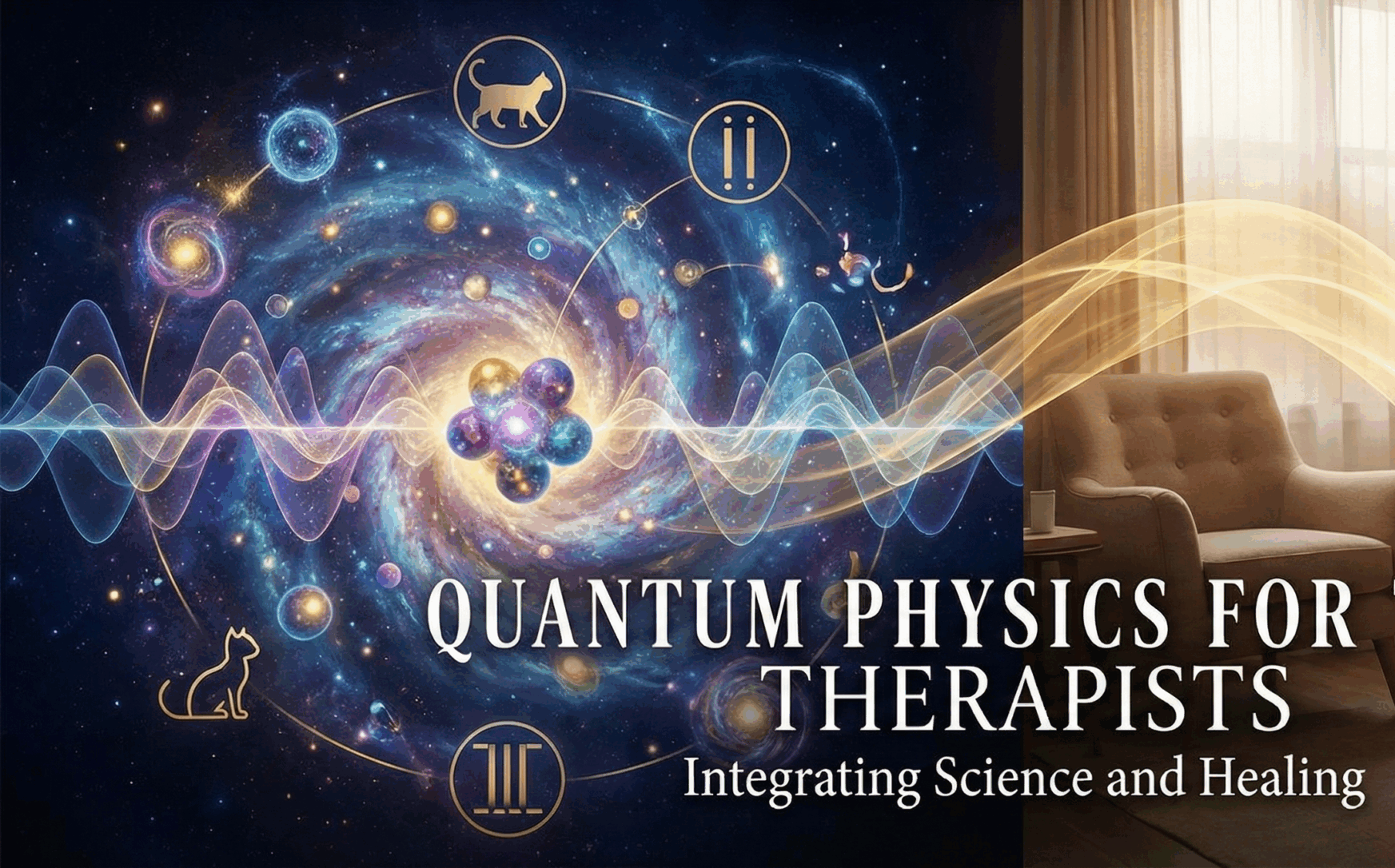
On the strange convergence between cutting-edge physics and ancient healing wisdom, and why the collapse of a wavefunction might be the best model we have for the moment a client finally changes.
There is an old joke in clinical circles that when psychotherapy is pushed to a certain extreme, it inevitably becomes metaphysics. Sigmund Freud anchored his theories in the dominant science of his day, treating the psyche as a hydraulic engine where libido was a form of energy that had to be conserved, channeled, or discharged. This Newtonian framework, deterministic and linear, suggested that if the analyst could trace the trajectory of a symptom back to its initial conditions, the resulting neurosis could be calculated and corrected with the precision of a clockmaker repairing a gear.
But the shadow of metaphysics always loomed large. As practitioners delved deeper into human experience, the neat lines of causality often blurred. Carl Jung eventually broke from the psychoanalytic orthodoxy by proposing concepts that defied the materialist worldview: the collective unconscious and synchronicity. He suggested that the psyche was not merely a byproduct of the brain but was connected to the cosmos itself. Wilhelm Reich went further, attempting to literalize Freud’s metaphors by transforming libido into “orgone energy,” a cosmic life force he believed could be accumulated in boxes. Reich’s descent into what many considered pseudoscience served as a cautionary tale for any therapist daring to bridge the gap between psychology and physics.
For decades, Reich’s orgone stood as a monument to the dangers of confusing psychological metaphor with physical reality. But in the 21st century, the ground has shifted beneath the feet of the materialists. The revolution in quantum physics, which began in the 1920s with Planck, Bohr, and Heisenberg, has finally begun to permeate the biological and psychological sciences. We are no longer dealing with the billiard ball universe of Newton, but a reality defined by probability, entanglement, and the fundamental role of the observer.
Today, serious researchers are proposing ideas that make Reich’s orgone look almost conservative. Nobel Laureate Sir Roger Penrose and anesthesiologist Stuart Hameroff argue that consciousness is a quantum computation occurring inside the brain’s microtubules. In late 2025, materials scientist Maria Strømme of Uppsala University published a theoretical framework in AIP Advances suggesting consciousness is the fundamental field of the universe, preceding matter entirely. These are not fringe mystics, but celebrated scientists using advanced mathematics and nanotechnology to dismantle the wall between mind and matter.
What follows is an exploration of how these quantum ideas might illuminate what happens in the consulting room. Not as proof that therapy works, but as a new vocabulary for describing what therapists have always sensed: that healing is nonlinear, that connection transcends physical proximity, and that the moment of genuine change has the quality of a discontinuous leap rather than a gradual climb.
The Quantum Substrate of Consciousness
For years, the prevailing dogma in neuroscience held that the brain is essentially a wet computer. Neurons are binary switches, and consciousness is the software that emerges when enough of these switches fire in a complex pattern. This is called computationalism. But this model has consistently failed to explain what philosophers call the “hard problem” of consciousness: the subjective quality of experience, what it feels like to see red or taste chocolate or remember a lost love.
Sir Roger Penrose, a mathematical physicist at Oxford, challenged the computational model using Gödel’s incompleteness theorems. He argued that human understanding is “non-computational,” that we can ascertain truths no algorithm can prove. This led him to propose that the brain must be utilizing quantum mechanics, which allows for superposed states that are not bound by classical algorithmic determinism.
The challenge was biological. Quantum states are notoriously fragile. In a laboratory, quantum computers must be kept near absolute zero to prevent “decoherence,” the collapse of the quantum state due to environmental noise. The brain is warm, wet, and noisy. How could it sustain quantum coherence?
Enter Stuart Hameroff, an anesthesiologist who spent his career studying the cytoskeleton, the structural scaffolding of the cell. Hameroff identified microtubules, cylindrical protein lattices within neurons, as the potential hardware for biological quantum computing. He proposed that the interior of these microtubules could shield quantum states from the brain’s wet environment.
Together, Penrose and Hameroff developed the theory of Orchestrated Objective Reduction, or Orch OR. According to this model, tubulin proteins within the microtubules exist in quantum superposition. These superpositions are “orchestrated” by synaptic inputs and genetic memory. When the difference in spacetime geometry between the superposed states reaches a critical threshold, the state collapses. This collapse, an “Objective Reduction,” is proposed to be a moment of conscious awareness.
The implications for therapy are foundational. If Orch OR is correct, the “mind” is not a byproduct of synaptic firing but originates in quantum vibrations within the cellular structure itself. Research published in Physics of Life Reviews reviews the evidence for this theory, including findings that anesthetic gases, which selectively erase consciousness while leaving non-conscious brain functions intact, appear to dampen quantum vibrations in tubulin proteins. They effectively stop the “music” of the microtubules.
For therapists practicing psychedelic-assisted therapy, this reframes the psychedelic experience. The patient is not hallucinating in the dismissive sense. Their “receiver” may be tuned to a different frequency, potentially allowing them to process information at a quantum level that is normally filtered out by the brain’s survival mechanisms. This aligns with Aldous Huxley’s “reducing valve” theory, now given a mechanism in quantum biology.
The Body as Mind: Why Somatic Therapy Makes Quantum Sense
The Orch OR model offers something else: a potential vindication for somatic and body-oriented psychotherapies like Somatic Experiencing and Sensorimotor Psychotherapy.
Microtubules are not exclusive to the brain. They are the structural basis of every cell in the human body. If microtubules are the seat of protoconsciousness, then the “mind” is literally distributed throughout the entire organism.
Trauma researchers like Bessel van der Kolk have long argued that the body keeps the score. Orch OR offers a mechanism for this storage. Traumatic memories may not just be synaptic weights in the amygdala but could be encoded in the lattice structure of the cytoskeleton throughout the body’s fascia and organ systems. Therapies that focus on physical release, posture, and “felt sense” are potentially modulating the quantum coherence of the body-wide microtubule network, releasing “frozen” quantum states that correspond to the traumatic event.
This is why a client can be talking about something mundane and suddenly feel a wave of nausea, or why a particular yoga posture can release tears. The body is not just housing the mind. In a very real sense, the body is mind.
Consciousness as Fundamental: The Maria Strømme Paradigm
While Penrose and Hameroff look inward to the nano-scale of the neuron, others are looking outward to the structure of the cosmos. In November 2025, Professor Maria Strømme, a renowned nanotechnology researcher at Uppsala University, published a radical theoretical model that challenges the very foundations of the materialist worldview.
Strømme’s theory proposes that consciousness is not an emergent property of matter (the standard view) but a fundamental field that exists independently of, and prior to, the Big Bang. Drawing on both quantum field theory and non-dual philosophy, Strømme argues that the universe is comprised of a “universal consciousness field,” and that spacetime, matter, and energy are secondary excitations of this field.
As Strømme told Uppsala University’s news service: “I am a materials scientist and engineer, so I am used to seeing matter as something fundamental. But according to this model, matter is secondary. Much of what we experience is representation or illusion.”
In this model, individual minds are not isolated generators of consciousness but are localized “receivers” or “knots” in the universal field, similar to how a whirlpool is a localized feature of the ocean but is not separate from the water.
The clinical implications are profound. One of the primary drivers of human neurosis is the fear of death, the terror of non-existence. Materialism dictates that when the brain ceases to function, the self is extinguished like a blown-out candle. Strømme’s model suggests the opposite: because consciousness is fundamental and precedes the brain, the death of the physical vessel does not imply the annihilation of awareness. Instead, the localized consciousness returns to the “background field.”
For therapists working in palliative care or grief counseling, this offers a narrative that is both comforting and scientifically grounded within this new framework. Terminal lucidity, the phenomenon where patients with severe dementia suddenly regain clarity moments before death, is difficult to explain materially but fits Strømme’s model of the brain as a “filter” that is breaking down, allowing the universal field to shine through unimpeded.
“Now he has departed from this strange world a little ahead of me. That means nothing. For us believing physicists, the distinction between past, present and future is only a stubbornly persistent illusion.”–Albert Einstein’s bereavement letter to the wife of a deceased colleague
A core pathology of the modern age is the sense of alienation, what Alan Watts called the “skin-encapsulated ego” cut off from the world. Strømme’s physics confirms the intuition of non-dual therapies: separation is an illusion. We are physically and consciously continuous with the environment and each other.
Entanglement: The Science of Empathy and Connection
Einstein famously derided quantum entanglement as “spooky action at a distance,” yet it remains one of the most experimentally verified phenomena in physics, winning the Nobel Prize in Physics in 2022.
When two particles interact and are then separated, they become “entangled.” They share a single quantum wavefunction. If you measure the spin of Particle A, Particle B instantly assumes the opposite spin, regardless of the distance between them. They are effectively the same object, spatially distributed. This “non-locality” defies the classical rule that information cannot travel faster than light.
The 2022 Nobel Prize was awarded to Alain Aspect, John Clauser, and Anton Zeilinger “for experiments with entangled photons, establishing the violation of Bell inequalities and pioneering quantum information science.”
Entanglement provides a compelling physical analogue for the profound, often inexplicable connections formed in the therapeutic dyad. Classical analysis views transference as a projection: the client projects an old “film” onto the blank screen of the therapist. Entanglement suggests a more active, real-time connection. The “electricity” or “magnetic pull” often described in intense therapeutic relationships may be a macroscopic expression of entanglement. When a therapist and client are deeply attuned, they may become a single entangled system.
This validates the use of countertransference as diagnostic data. If the therapist suddenly feels a wave of heavy dread, it is not just their dread. They are “measuring” the entangled state of the dyad. The therapist’s internal regulation can, through this link, directly affect the client’s regulation, a process known as “interactive regulation” or “limbic resonance.”
Jung proposed the concept of the unus mundus (one world), where psyche and matter are continuous. He used this to explain synchronicity, meaningful coincidences that have no causal link. Entanglement is the physics of synchronicity. Therapists often report thinking of a client moments before they call, or having a dream that mirrors the client’s experience. In a Newtonian world, these are statistical flukes. In an entangled world, they are evidence of the non-local bond.
The rise of tele-therapy has raised questions about whether “presence” can be transmitted digitally. Entanglement suggests that physical proximity is not a requirement for connection. Once the entangled state is established, the “distance” is irrelevant to the instantaneous correlation of states.
The Observer Effect: Why Diagnosis Creates Reality
The double-slit experiment is the crown jewel of quantum weirdness, demonstrating the inseparable relationship between the observer and the observed.
When particles are fired at a double slit without observation, they behave like waves, creating an interference pattern. When a detector is placed to see which slit the particle passes through, the interference pattern disappears, and they behave like solid particles. The act of measurement collapses the wavefunction from a probability, a superposition, to a definite state.
As MIT researchers confirmed in 2025, this principle holds even when stripped to its quantum essentials: light exists as both a wave and a particle but cannot be observed in both forms at the same time.
In the therapeutic setting, the therapist is never a neutral observer. The Observer Effect suggests that the act of assessment and diagnosis fundamentally alters the client’s psychological state.
A client walks into the consulting room as a “wave,” a complex, fluid superposition of potential behaviors, histories, and feelings. They are messy and undefined. The moment the therapist applies a diagnostic label (“You have Borderline Personality Disorder”), they force a collapse. The client creates a narrative identity around that label, effectively becoming the “particle” defined by the observer.
This places an immense ethical burden on the therapist. We must be aware of “diagnostic overshadowing.” But we can use this constructively. In Solution-Focused Brief Therapy or Positive Psychology, the therapist deliberately chooses to observe strengths and resilience. By asking, “How did you survive this?”, the therapist collapses the wavefunction into a state of competence rather than pathology. The clinical gaze is an active ingredient in the creation of the client’s self-concept.
Classical psychoanalysis strove for the “blank screen” analyst, detached and objective. Quantum mechanics proves that the observer is part of the system. There is no such thing as a “view from nowhere.” This validates the Intersubjective approach. The therapist must acknowledge that their own subjectivity, history, and “measurement tools” (theoretical orientation) are influencing the data they receive. Therapy is a co-created reality. The question is not “What is wrong with this patient?” but “What is happening between us?”
Superposition: Holding the Opposites
Superposition is the state of a quantum system existing in all possible configurations simultaneously until measured. Erwin Schrödinger proposed his famous thought experiment to highlight the absurdity of this: a cat in a box with a radioactive trigger is, according to the math of quantum mechanics, both dead and alive until the box is opened.
Human beings rarely exist in single, defined states. We love and hate the same person. We want to change and we want to stay the same. Pathology often arises from the inability to tolerate this ambiguity, from premature collapse.
Dialectical Behavior Therapy is fundamentally based on the logic of superposition. A client can be doing the best they can AND need to change. In classical logic, A cannot be non-A. In quantum logic (and DBT), two opposite truths coexist. The “Middle Path” in DBT is the practice of staying in the wave state, rather than collapsing into the particle state of “All Good” or “All Bad.”
Internal Family Systems therapy posits that the mind is a multiplicity of “parts.” A person is not “angry”; a part of them is angry, while another part is scared. The “Self” in IFS can be seen as the quantum observer that can hold all these parts in superposition without being overwhelmed by them. When a client says “I don’t know who I am because I feel so many different things,” the therapist reframes this not as fragmentation, but as a rich state of quantum superposition. The goal is coherence (harmony of parts), not the elimination of parts.
Wave-Particle Duality: The Fluidity of Identity
Light can be measured as a particle (photon) or a wave. It is both, depending on the context. Niels Bohr called this “Complementarity”: you can see the wave nature or the particle nature, but never both at the same time with the same apparatus.
In Acceptance and Commitment Therapy, a core process is distinguishing between “Self-as-Content” and “Self-as-Context.”
When a client fuses with their thoughts (“I am depressed,” “I am broken”), they are experiencing themselves as a particle, a solid, fixed, limited object defined by its coordinates. This is a rigid state, prone to suffering. The “Observing Self” or “Self-as-Context” is the space in which thoughts occur. It is the wave: fluid, expansive, and containing the potential for movement.
ACT metaphors often aim to shift the client from particle-mode to wave-mode. The “Clouds in the Sky” metaphor (you are the sky, thoughts are the clouds) is a direct invitation to experience the wave nature of consciousness. “Defusion” techniques are essentially tools to stop the premature collapse of the self into a “broken particle.”
If we are waves, we interact through interference. Our behavior sends ripples through our social networks. A “particle” view of therapy asks, “How do I fix this isolated individual?” A “wave” view asks, “How does this person’s vibration affect the family system?”
Quantum Tunneling: The Physics of Breakthroughs
Classical physics says that if a ball does not have enough energy to roll over a hill, it will roll back down. It is trapped in the valley. Quantum physics says otherwise.
In quantum tunneling, a particle can encounter a potential energy barrier that it statistically should not be able to cross. However, because the particle is also a probability wave, the “tail” of the wave extends through the barrier. There is a non-zero probability that the particle will simply appear on the other side of the wall, without ever having climbed over it.
Therapy is often viewed as a linear climb: you work hard, gain skills, and eventually overcome the trauma. But clinical experience often defies this. Clients often struggle for months with no progress, stuck in the valley, and then, suddenly, without a clear linear cause, they shift. They are on the other side of the barrier. This is the “Aha!” moment, the breakthrough.
Understanding tunneling helps therapists maintain hope during periods of stagnation. The “work” is not always pushing the ball up the hill (linear effort). It is widening the probability wave, increasing psychological flexibility and lowering defenses, so that tunneling becomes possible. Vulnerability elicits the conditions for change, amplifying the wavefunction of emotional possibilities.
Defense mechanisms are energy barriers. Confrontational therapy tries to smash through them. Supportive therapy tries to climb over them. EMDR, ETT, and Brainspotting can be seen as “tunneling” technologies. They bypass the conscious executive barrier to access the deeper emotional state directly. The therapist helps the client “tunnel” through the wall of dissociation to access the repressed affect.
The Uncertainty Principle: Embracing Anxiety
Werner Heisenberg introduced a fundamental limit to what we can know about the world, shattering the dream of a perfectly predictable universe.
The Uncertainty Principle states that you cannot know both the position and the momentum of a particle with perfect precision. The more precisely you measure one, the less you know about the other. This is not a failure of measurement. It is a fundamental property of nature.
Anxiety disorders, particularly Generalized Anxiety Disorder and OCD, are often driven by a desperate need for absolute certainty. Clients often come to therapy wanting to “get rid of anxiety.” The Uncertainty Principle suggests that anxiety, as uncertainty, is woven into the fabric of reality. You cannot eliminate it without stopping the motion of life itself.
The goal shifts from “control” (fixing the position) to “flow” (momentum). If a client tries to control every outcome, they lose all sense of movement and aliveness. They become paralyzed. Therapy helps them accept that uncertainty is the price of living. A system with zero uncertainty is a dead system.
In couples therapy, the Uncertainty Principle applies to the “other.” You can never fully know your partner. If you try to pin them down completely, through jealousy, checking phones, demanding guarantees, you kill the “momentum” of the relationship, the romance and growth. Love requires tolerating the uncertainty of the other.
The Quantum Eraser: Rewriting the Past
This is perhaps the most mind-bending concept, challenging our linear perception of time and causality.
In the “Delayed Choice Quantum Eraser” experiment, a variation of the double-slit, the choice of whether to measure the particle (and collapse it) or not is made after the particle has arguably already passed through the slits. The results suggest that the decision made in the present determines the path the particle took in the past. It appears that the present observation “rewrites” the history of the photon.
As Physics World notes, “The quantum eraser doesn’t rewrite the past; it rewrites the observer.”
Psychotherapy is largely a business of the past. We dig into history to understand the present. The Quantum Eraser suggests that the arrow of causality might flow both ways, or at least, that our present observation defines the nature of our past reality.
Neuroscience now knows that when a memory is recalled, it becomes labile. It can be changed before being re-stored. This is called memory reconsolidation, the biological basis of therapies like Coherence Therapy and some applications of EMDR.
When a client revisits a trauma in the safety of the therapeutic alliance, they are “measuring” the past event with a new detector (the safe, adult self). This new measurement collapses the memory wave into a new state. We are effectively “erasing” the traumatic charge of the past event. We do not change the facts (the particle hits the screen), but we change the interference pattern (the meaning and emotional weight).
Narrative therapy explicitly engages in “rewriting” the story of the life. By highlighting different “sparkling moments” (exceptions to the problem), the therapist and client construct a new past that supports a healthy future. The Quantum Eraser validates that the “past” is not a fixed video recording. It is a superposition of data points that we construct into a narrative upon observation.
The New Metaphysics of Healing
The journey from Freud’s steam engine to Penrose’s quantum microtubules represents a seismic shift in how we conceive of the human mind. The old joke that psychotherapy becomes metaphysics is losing its punchline, because physics itself has become metaphysical.
The integration of these concepts offers two distinct levels of value for the modern therapist.
First, metaphorical resilience. Even if the brain is not a literal quantum computer, concepts like superposition, tunneling, and entanglement provide a rich, non-pathologizing vocabulary for the nuances of human experience. They help us explain nonlinear change, the complexity of identity, and the profound depth of the therapeutic bond in ways that “stimulus-response” behaviorism never could.
Second, mechanistic plausibility. If theories like Orch OR and Universal Consciousness prove correct, therapy is not just “talking cure” or “soft science.” It is a direct intervention into the quantum geometry of the universe. When a therapist helps a client reconsolidate a traumatic memory or find a moment of integration, they may be acting as a biological engineer of the quantum substrate.
We are moving toward something we might call “Quantum Psychiatry.” This new paradigm asks us to hold the ultimate dialectic: we are biological machines made of meat and bone, and simultaneously, we are nonlocal, eternal fields of consciousness. Therapists, sitting in their chairs, are the observers at the double slit, holding the space for the client to collapse into a new, more whole reality.
Jung and Reich may have been premature. They intuited a reality that physics is only now confirming. The “metaphysical route” they took was not a wrong turn. It was a trail blazed decades before the map existed.
And for those of us sitting with clients in the consulting room, perhaps the most important takeaway is this: the moment of genuine change, the moment a client finally sees themselves differently, feels like magic because it is, in some very real sense, quantum. It is a discontinuous leap from one state to another, a collapse of infinite possibility into a single, new actuality.
We are not mechanics fixing gears. We are observers at the edge of reality, helping people collapse into better versions of themselves.
References and Further Reading
Quantum Consciousness Theories:
Wikipedia: Orchestrated Objective Reduction (Orch OR)
PubMed: Consciousness in the Universe: A Review of the Orch OR Theory
Stuart Hameroff: Orch OR Research Overview
ScienceDaily: Discovery of Quantum Vibrations in Microtubules
Universal Consciousness Field:
Uppsala University: Consciousness as the Foundation
AIP Advances: Universal Consciousness as Foundational Field
Phys.org: New Theory Addresses Nature of Reality
Quantum Entanglement:
Nobel Prize 2022: Quantum Entanglement Experiments
Nobel Prize: How Entanglement Has Become a Powerful Tool
Scientific American: Explorers of Quantum Entanglement
Double-Slit Experiment and Observer Effect:
Wikipedia: Double-Slit Experiment
MIT News: Double-Slit Experiment Holds Up
Physics World: Do Atoms Know If They Are Being Observed?
Fundamental Quantum Mechanics:
Wikipedia: Heisenberg Uncertainty Principle
Memory and Reconsolidation:
NIH: Memory Reconsolidation as Treatment for Emotional Disorders
Physics World: The Quantum Eraser Rewrites Observers










0 Comments