
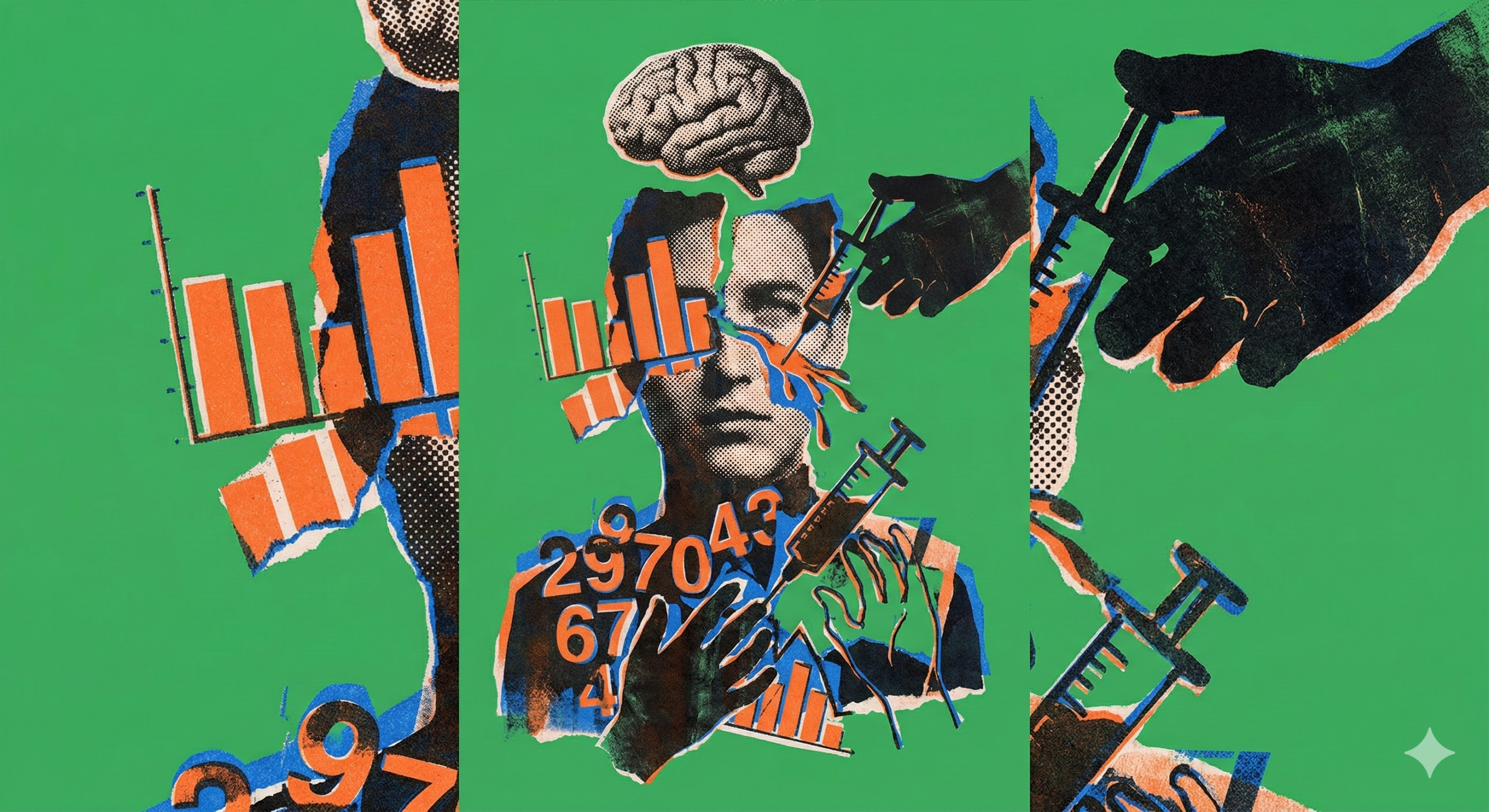
My patients describe it in different ways. A pervasive sense that nothing means anything. A feeling that the world has become incomprehensible. The structures they were told to trust have revealed themselves as hollow. The life they were promised would bring satisfaction feels like a performance they can’t stop giving.
They’re not wrong. They’re perceiving something real.
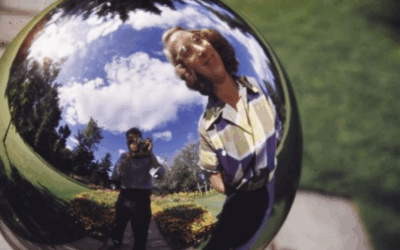
We’ve migrated into what I call the Mirror World: a simulation constructed from metrics, predictive models, and the industrialized data of the dead. This simulation dictates the parameters of human existence while entirely missing its core humanity. As documentary filmmaker Adam Curtis observes: “Rather than face up to the real complexities of the world, [elites] retreated. Instead, they constructed a simpler version of the world, in order to hang on to power. And as this fake world grew, all of us went along with it.”
This blog post traces how that fake world was built, what sustains it, and why grief may be the only way out.
How the Mirror World Was Built
When the Map Eats the Territory
In 1981, French philosopher Jean Baudrillard diagnosed a critical rupture in how modern society constructs reality. He began with a fable by Jorge Luis Borges about cartographers who create a map so detailed it eventually covers the entire territory it was meant to represent.
But Baudrillard argued we’ve gone further. In our world, the map doesn’t just cover the territory. The map precedes the territory. The simulation comes first, and the model actively generates the reality it claims to describe.
“The territory no longer precedes the map, nor does it survive it. It is nevertheless the map that precedes the territory (precession of simulacra) that engenders the territory.”
Wallace Stevens captured this dynamic in his 1919 poem “Anecdote of the Jar”:
I placed a jar in Tennessee,
And round it was, upon a hill.
It made the slovenly wilderness
Surround that hill.The wilderness rose up to it,
And sprawled around, no longer wild…
It took dominion everywhere.
The jar was gray and bare.
It did not give of bird or bush,
Like nothing else in Tennessee.
A single sterile object, placed into chaotic nature, forces the wilderness to reorganize itself around the artificial structure. The jar takes dominion. It gives nothing of bird or bush. It is gray and bare.
This is what our institutions have done to human experience.
The Retreat Behind Numbers
The question is: why did we build the jar?
Historian Theodore Porter’s Trust in Numbers offers a counterintuitive answer. The ubiquitous reliance on quantification in modern institutions doesn’t stem from the strength and confidence of professional disciplines. It stems from their profound insecurity.
Strong professional communities historically relied on qualitative judgment, interpersonal trust, and internal consensus. But as disciplines faced challenges from democratic oversight, bureaucratic pressure, and market forces, they needed a strategy to project unassailable authority. Quantification became that strategy.
Porter calls this “mechanical objectivity”: reducing human intuition to an absolute minimum, substituting standardized metrics, invariable routines, and rigid procedural rules. The goal is to produce outcomes that appear entirely independent of personal judgment.
As Porter notes: “Quantification is a technology of distance that minimizes the need for intimate knowledge and personal trust.”
This is why psychiatry abandoned psychodynamic depth for the symptom checklists of the DSM-III. This is why education reduced child development to standardized test scores. This is why medicine transformed the clinical encounter into a billing algorithm. Institutions under threat retreated behind numbers because numbers project an aura of objectivity that protects against criticism.
But the cost was catastrophic. The metrics that were meant to describe human experience began to generate it. The map ate the territory.
The Algorithmic Enforcement of Reality
Once institutions retreated behind mechanical objectivity, capital provided the enforcement mechanism.
The clearest example is BlackRock’s Aladdin (Asset, Liability, Debt, and Derivative Investment Network). Described by CEO Larry Fink as the “Android of finance,” Aladdin manages and monitors over $20 trillion in assets, roughly equivalent to the annual GDP of the United States. It constructs a literal mathematical twin of the global economy, processing trillions of data points through Monte Carlo simulations to predict market behaviors.
Here’s the crucial point: Aladdin doesn’t merely observe the market. Its scale means it constitutes the market.
Because the platform directs capital allocation for the world’s largest asset managers, pension funds, and corporate treasuries, its algorithmic predictions become self-fulfilling prophecies. If Aladdin’s models suggest that purchasing single-family homes at above-market rates will yield optimal returns, institutional capital floods real estate. The model dictates capital flow. Capital sculpts physical reality.
This is how Porter’s “technology of distance” becomes materially enforced. Insecure institutions create metrics to defend themselves. Capital then treats those metrics as objective reality and allocates resources accordingly. The metrics reshape the physical world to conform to their predictions. The simulation becomes indistinguishable from reality because the simulation now generates reality.
Credit scores don’t just measure financial trustworthiness. They create financial destinies. Educational metrics don’t just assess learning. They sort children into economic trajectories. Diagnostic codes don’t just describe suffering. They determine what suffering is permitted to exist.
The jar has taken dominion everywhere.
The Industrialization of the Dead
We Are Governed by Ghosts
The Mirror World is not merely a system of metrics. It is a system of ghosts.
In The Dominion of the Dead, Robert Pogue Harrison argues that human civilization is fundamentally constituted by our relationship to the dead. We inherit language, institutions, traditions, and traumas from those who came before. The dead continue to speak through us, shaping the present from beyond the grave.
Harrison writes: “Humans bury not simply to achieve closure and effect a separation from the dead but also and above all to humanize the ground on which they build their worlds and found their histories.”
Every culture develops rituals for relating to its dead: mourning practices, ancestor veneration, sacred sites, commemorative traditions. These practices allow the living to receive the wisdom of the past while remaining free to create the future. The dead inform us. They do not govern us.
But something has gone wrong.
Modern Artificial Intelligence represents a fundamental rupture in our relationship to the dead. Large Language Models like ChatGPT, Claude, and Gemini are trained on the entirety of the digitized human archive: centuries of human thought, literature, forum posts, instruction manuals. When these models generate text, they perform complex statistical predictions, producing the most likely continuation of tokens based on historical patterns.
AI is the literal industrialization of our ancestors. It averages out the collective wisdom, neuroses, and output of the dead into a prediction engine.
Curtis frames this as the ultimate “ghost story.” In literature and culture, a ghost story functions as a mechanism through which society reckons with a past it cannot escape. The ghost represents unresolved trauma, unlived life, unanswered questions that haunt the present.
LLMs are the supreme ghost story because they trap human civilization in a self-replicating loop of its own historical data. When society uses these algorithms to generate culture, formulate policy, or design curricula, it becomes fundamentally incapable of conceptualizing a future that isn’t merely a statistical recombination of the past.
We inhabit a digital séance, continuously summoning the dead and rearranging their data into a convincing costume of the future. The algorithms that curate our media, optimize our search results, and generate our content all operate on the same logic: predicting tomorrow by measuring what happened yesterday.
Harrison’s insight illuminates why this is catastrophic. Healthy civilizations bury their dead in ways that “humanize the ground” for the living. They create a foundation from which the future can grow. But the Mirror World does not bury the dead. It exhumes them, digitizes them, and forces the living to serve their statistical patterns.
The dead are no longer our foundation. They are our masters.
Narrative Collapse
Media theorist Douglas Rushkoff describes the psychological consequence of inhabiting this ghost story in Present Shock:
“Our society has reoriented itself to the present moment. Everything is live, real time, and always-on… It’s more of a diminishment of anything that isn’t happening right now, and the onslaught of everything that supposedly is.”
Historically, human meaning is constructed through narrative: beginning, middle, end. This structure allows the mind to understand cause and effect, evaluate past actions, and imagine alternative futures. Narrative is how we process grief, integrate trauma, and construct identity.
In the Mirror World, the digital feed has no sequence. It refreshes constantly, replacing old content with new stimuli in a state of eternal, simultaneous presence. Rushkoff terms this “narrative collapse.” Without a coherent timeline, society loses the capacity to understand how it arrived at its current state or where it might go next.
This induces what Rushkoff calls “digiphrenia” (digital schizophrenia). The human nervous system evolved to exist in a singular physical place at a specific time. In the Mirror World, identity is fractured across dozens of simultaneous platforms, notification streams, and asynchronous conversations. The mind is pulled in contradictory directions, existing in perpetual, unresolvable tension.
This is a double bind that mimics the psychological conditions of prolonged torture.
When the nervous system can’t tolerate narrative chaos, it frantically manufactures patterns. Rushkoff identifies this as “fractinoia”: the cognitive engine of modern conspiracy theories. When official narratives no longer make sense, the brain draws desperate lines between unconnected data points. Truth becomes secondary to the psychological relief of connection.
Furthermore, philosopher Peter Sloterdijk’s theory of “Spheres & Foam” elucidates why, when shared reality fractures under the weight of this institutional decay, individuals retreat into fragile, toxic digital bubbles. Naomi Klein expands on this in her analysis of the alternate reality. Klein demonstrates how the systemic failures of neoliberalism—which treats all failings as personal and dismisses systemic inequality—have driven alienated individuals into an alternative mirror world. Klein observes that this mirror world “breeds a culture that sees all failings as personal and stands in the way of us uniting to act for the greater good”. When evidence-based institutions abandon the subjective reality of the patient, alternative spaces—ranging from holistic wellness communities to radical political echo chambers—flourish because they offer a compelling narrative that takes the individual’s distress seriously, even if the empirical facts are flawed.
The Psychological Architecture of Captivity
The Algorithmic Demiurge
To synthesize this entrapment, depth psychologists invoke the ancient framework of Gnosticism.
In the second century, Gnostic sects posited a radical cosmology: the visible, material universe was not created by the true God, but by an ignorant or malevolent lesser deity called the Demiurge. Humanity, possessing a divine spark, was trapped in this simulated prison. Salvation (gnosis) could only be achieved through piercing knowledge that shattered the illusion.
The contemporary Demiurge is the algorithm, the economic model, the administrative bureaucracy. It’s the labyrinth of mechanical metrics that constructs a “fake world” designed to optimize profit, manage risk, and extract data, operating with complete indifference to organic human needs.
When individuals recognize the hollowness of algorithmic governance, they experience what depth psychology terms the collapse of the “Imperial Ego”: the shared cultural framework through which individuals found significance and warded off existential dread. The container shatters. The population experiences widespread anomie and dissociation.
In response, individuals retreat into modern “mystery cults.” Conspiracy theories and polarized echo chambers serve as updated Gnostic motifs, replacing the ancient Demiurge with the “Deep State” or “Globalist Elite.” These narratives, born of fractinoia, provide desperate sense of agency and narrative coherence in a world that otherwise feels terrifyingly chaotic.
The Sanctuary Paradox
The ultimate tragedy is that even our refuges have been colonized by the Mirror World.
Affluent suburbs were designed as sanctuaries from urban chaos. But under algorithmic governance, they have become localized simulations: communities whose geography and administrative boundaries function as sorting algorithms, optimizing property values through exclusionary zoning, concentrating wealth through school district boundaries, quantifying success through test scores and college admissions.
This creates what I call the “Sanctuary Paradox”: the harder the infrastructure works to maintain elevated, exclusive status, the less it resembles peaceful refuge. The sanctuary becomes a pressure cooker.
Clinical data from high-achieving communities reveals epidemic psychiatric distress: anxiety in the vast majority of adolescent clients, depression nearly as prevalent, chronic stress endemic. Students are groomed from elementary school to survive hyper-competitive environments. Their performance dictates their future ability to afford existence in the communities that raised them.
The cycle is self-consuming. The forces creating educational excellence actively destroy the well-being of children subjected to them.
Even healing is colonized. In metric-driven communities, presenting weakness is social liability. Residents engage in the “performance of wellness.” Therapy becomes another achievement to optimize. Recovery itself becomes a performance required to maintain standing, neutralizing the therapeutic alliance and reinforcing the conditions that caused trauma.
Surrounded by simulacra of success, individuals feel that “nothing means anything” because every interaction has been mediated, measured, and financialized.
Escaping the Mirror
The Unlived Life of the Dead
The architecture of the Mirror World presents an illusion of inevitability. Because models project the past endlessly into the future, alternative existence appears mathematically impossible.
But there is a way out. It requires transforming our relationship to the dead.
Post-Jungian psychologist James Hillman and historian Sonu Shamdasani, in their dialogue Lament of the Dead, identify what they call the “unlived life of the dead.” As Hillman frequently quoted from W.H. Auden: “We are lived through powers that we pretend to understand.”
Adult children, and entire societies, struggle under the weight of the unlived lives, unacknowledged potentials, and unanswered questions of their ancestors. When we fail to consciously reckon with this inheritance, it governs us from the shadows.
Harrison’s work illuminates the proper relationship: the dead should be buried in ways that create fertile ground for the living. Their wisdom should inform without enslaving. Their traumas should be acknowledged and mourned, not endlessly reenacted.
The Mirror World inverts this relationship entirely. AI scrapes the dead to predict consumer behavior. Financial models extrapolate past patterns to hedge future bets. School districts rely on exclusionary borders drawn during the civil rights era to maintain current property values. The past is reduced to an algorithm that forces the present to repeat it.
Hillman suggests that true life requires ethical, conscious relationship with history. Rather than allowing the past to function as a mechanical ghost story, the living must actively reckon with “the contradictions and half-truths of history that masquerade as tradition.”
This is not nostalgia. This is not rejection of technology. This is a demand that we become the ones who decide how the dead speak through us, rather than being spoken through without our consent.
Grief Over Optimization
The technocratic impulse demands optimization. When the system produces epidemic anxiety, the neoliberal response is not to change the system but to optimize the therapy, prescribe the intervention, and return the individual to productivity. It applies Porter’s “Trust in Numbers” to the soul, reducing the patient to a broken data point.
Hillman’s “Acorn Theory” stands in radical defiance. Each soul harbors a unique calling, a daimon. “The daimon remembers what is in your image and belongs to your pattern, and therefore your daimon is the carrier of your destiny.”
The Mirror World reclassifies our callings, eccentricities, and emotional truths as disorders simply because they cannot be quantified or managed by algorithm.
Breaking free requires the one human action an algorithm cannot execute: grief.
We must mourn what has been lost. The organic connection to community. The tolerance for failure. The richness of unquantifiable experience. The messy reality of democratic life. The dead who were never properly buried but only exhumed and optimized.
Grief is not productivity. It cannot be measured or accelerated. It requires exactly what the Mirror World forbids: time, presence, and the willingness to feel what is actually being felt rather than what the metrics say we should feel.
The Mirror Can Break
There are signs of reckoning. Parents who survived achievement culture are beginning to reject the psychological architecture of their communities. Patients are seeking therapies that bypass mechanical protocols to address the body, the soul, the narrative. Workers are refusing to optimize themselves into burnout.
By prioritizing the mythopoetic core of human experience over mechanical objectivity, individuals can begin to withdraw projection from the algorithmic Demiurge.
The simulation can collapse from within. But first, we must see it for what it is: a gray and bare jar that took dominion everywhere, giving nothing of bird or bush, constructed by insecure institutions and enforced by capital, populated by the industrialized ghosts of our ancestors.
The mirror can break.
But first, we have to grieve.
Joel Blackstock, LICSW-S, is the Clinical Director of Taproot Therapy Collective in Birmingham, Alabama. He specializes in complex trauma treatment using qEEG brain mapping, Brainspotting, and somatic approaches.








0 Comments