
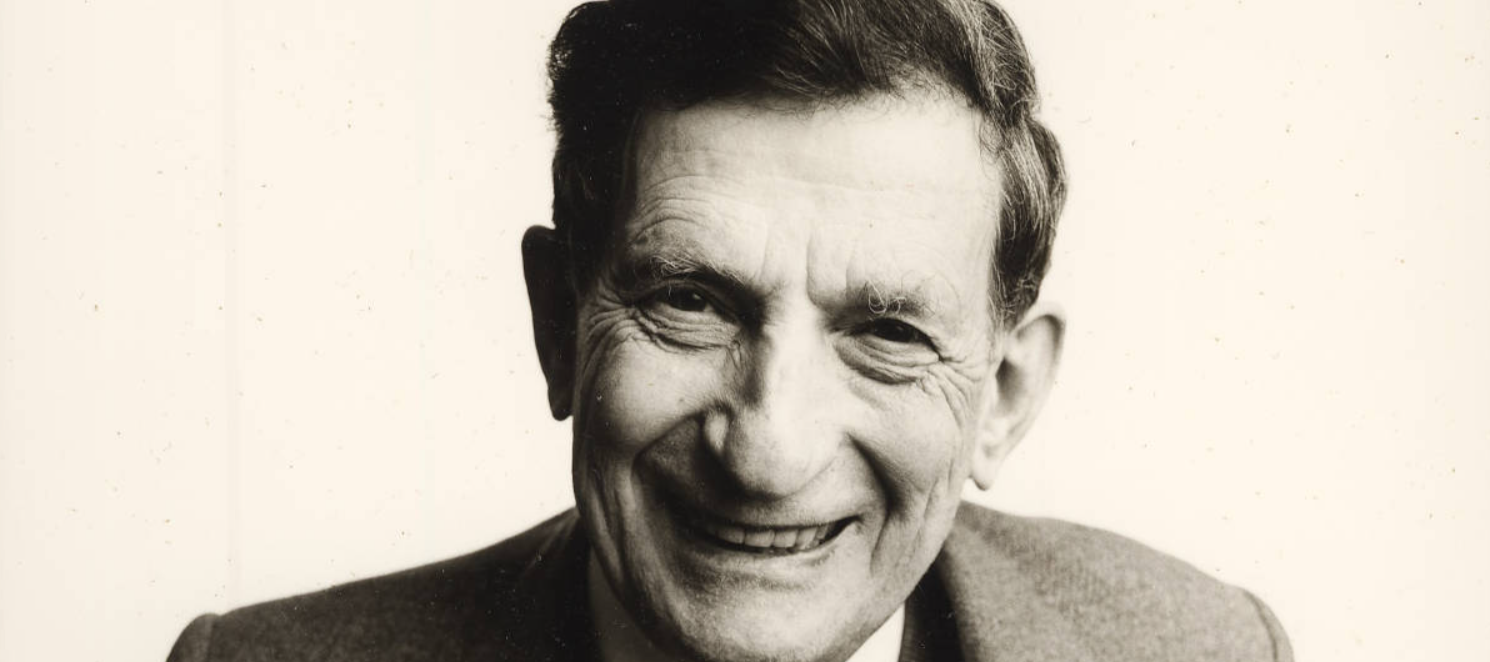
The Heretic of Copenhagen
David Bohm (1917-1992) committed what many physicists considered an unforgivable sin: he took quantum mechanics seriously as a description of reality, not just a calculation tool. While the Copenhagen interpretation (Bohr, Heisenberg) insisted we must never ask what’s “really happening” beneath the probability wave, Bohm asked anyway—and proposed an answer that would make him a pariah in physics and a prophet in consciousness studies.
His 1952 “hidden variables” interpretation restored determinism to quantum mechanics through a radical move: the introduction of a “quantum potential” field that guides particles instantaneously across any distance. Einstein loved it. The physics establishment buried it. Bohm, already politically radioactive (he’d been caught in McCarthyism, refused to testify against colleagues, fled to Brazil, then UK), became a ghost in his own field.
But exile gave him freedom. If the universe was fundamentally interconnected at the quantum level—if nonlocality was real—what did that mean for mind?
The Implicate Order: Reality as Hologram
Bohm’s mature philosophy, developed in Wholeness and the Implicate Order (1980), proposed that the reality we perceive (the “explicate order”) unfolds from a deeper level of enfolded totality (the “implicate order”). His favorite metaphor was the hologram: cut a holographic plate in half, and each piece still contains the whole image. Information is distributed everywhere.
This wasn’t mysticism dressed as physics—it was physics taken to its logical conclusion. If quantum nonlocality is real, then the apparent separateness of objects is secondary to an underlying unity. Space and time themselves are explicate projections of something deeper.
The implications for consciousness were explosive. If the universe is holographic, perhaps the brain is too.
Bohm and Pribram: The Holonomic Brain
Enter Karl Pribram, the Stanford neurosurgeon who couldn’t explain memory. Classical models said memories should be stored in specific locations—but Lashley’s lesion studies showed rats retained memories even after massive cortical destruction. Where was the engram?
Pribram proposed that memory was stored holographically—distributed across the brain as interference patterns, like a hologram stores an image. He needed a physics. Bohm provided it.
Their collaboration produced the “holonomic brain theory”: the brain performs holographic transformations on incoming sensory data, encoding information in frequency domains rather than spatial locations. Perception isn’t a camera—it’s a Fourier transform. The “lens” that converts frequency domain to spatial image is the process of attention itself.
This explained several puzzles: how memories survive brain damage (the information is everywhere), how we recognize patterns regardless of size or orientation (frequency encoding is scale-invariant), and how consciousness could be both unified and distributed.
The Bohm-Krishnamurti Dialogues: Thought as the Problem
From 1961 until Bohm’s death, he engaged in a remarkable series of dialogues with the Indian philosopher Jiddu Krishnamurti. Their conversations, published in The Ending of Time and The Limits of Thought, represent perhaps the deepest inquiry into consciousness conducted between a scientist and a contemplative.
Krishnamurti’s central claim was radical: thought itself is the source of psychological suffering, and thought cannot solve problems created by thought. The “thinker” is not separate from thought—it’s thought’s creation, a feedback loop generating the illusion of a continuous self.
Bohm recognized this as a description of what he called “fragmentation”—the mind’s tendency to divide reality into separate objects and then forget it made the divisions. The implicate order is whole; the explicate order is fragmented; thought perpetuates fragmentation by treating its own categories as real.
Their conclusion was startling: the observer IS the observed. Subject and object are not fundamentally separate but are two aspects of the same movement. This wasn’t philosophy—it was phenomenology confirmed by physics.
“Rheomode”: Language as Trap
Bohm’s most underappreciated contribution was his analysis of how language structures thought. In Wholeness and the Implicate Order, he proposed that Indo-European languages, with their rigid subject-verb-object structure, force us to perceive reality as composed of separate things acting on each other.
He proposed an experimental language he called the “rheomode” (from Greek rheo, to flow), where verbs would be primary and nouns derivative. Instead of saying “the observer sees the object,” one would use a verbal form indicating that “observing is happening”—without presupposing separate observer and observed.
This was Sapir-Whorf taken seriously: our language doesn’t just describe reality, it constrains what reality we can perceive. The structure of thought is the structure of language, and both fragment the implicate wholeness.
Soma-Significance: Matter and Meaning United
In his later work, Bohm proposed that the Cartesian split between mind and matter was itself a product of fragmentation. He introduced the concept of “soma-significance”: every physical process (soma) has a meaning aspect (significance), and every meaning has physical embodiment.
This was not property dualism—it was the claim that the distinction itself is an artifact of explicate-order perception. At the implicate level, matter and meaning are one movement. Information isn’t carried BY matter; matter IS information in a certain form.
This anticipated by decades the current interest in integrated information theory and panpsychism—the view that consciousness is fundamental to the universe, not an emergent accident of biological complexity.
The Verdict: Vindication Pending
Bohm died in 1992, still marginalized in physics, increasingly revered in consciousness studies and by therapists who found his “dialogue” method transformative for group work.
His scientific legacy remains contested. The holonomic brain theory never achieved mainstream acceptance—neuroscience moved toward connectionism and computational models rather than holographic ones. His hidden variables interpretation is now taken more seriously (as “Bohmian mechanics”), but remains a minority position.
Yet Bohm’s philosophical contributions are increasingly recognized as prescient:
On nonlocality: He was right. Bell’s theorem and Aspect’s experiments confirmed that quantum entanglement is real. The universe IS nonlocal at the fundamental level.
On the observer problem: His insistence that we can’t separate knower from known anticipated the current crisis in consciousness studies, where the “hard problem” forces us to confront the irreducibility of first-person experience.
On fragmentation: His diagnosis of thought as inherently fragmenting—and of this fragmentation as the source of individual and collective pathology—anticipates everything from mindfulness-based therapy to critiques of reductionist psychiatry.
On language: His analysis of how linguistic structure shapes perception remains underexplored but points toward why contemplative traditions emphasize silence—not as mystical obscurantism but as escape from the conceptual prison.
The Bohm Question for Therapy
If Bohm is right, then:
The self that suffers is itself a product of fragmenting thought.
The therapist who “observes” the client is participating in the same movement as the client’s psyche.
Healing cannot come from more thinking about the problem—only from a direct perception of the whole from which both problem and observer emerge.
This is not a rejection of therapy but a reframing of what therapy does. The therapeutic relationship, at its best, creates conditions where fragmenting thought can quiet, where the implicate order can be glimpsed through the cracks in the explicate self.
Key Works:
- Quantum Theory (1951)
- Causality and Chance in Modern Physics (1957)
- Wholeness and the Implicate Order (1980)
- The Ending of Time with J. Krishnamurti (1985)
- Thought as a System (1992)








0 Comments