
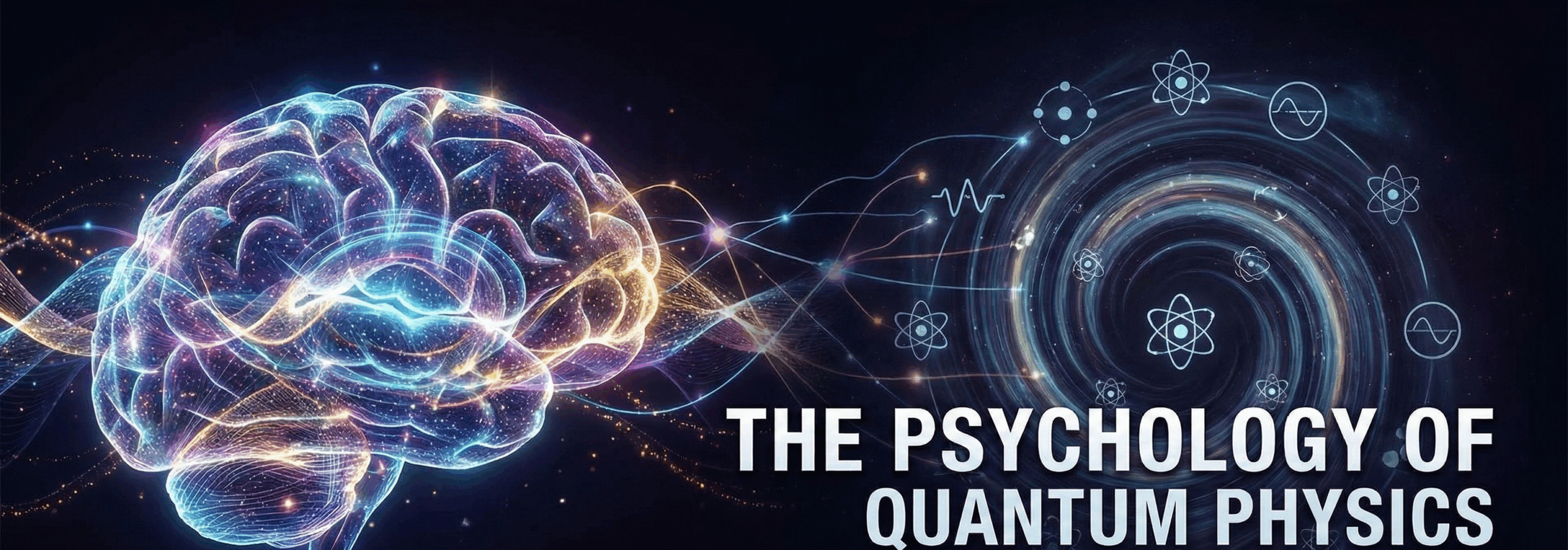
What Einstein’s elevator, Kekulé’s snake dream, and Oppenheimer’s abyss reveal about the primacy of subjective knowing, and why it matters for how we understand healing.
There is a cultural artifact we all carry in our minds: the image of the genius physicist standing before a blackboard covered in chalk equations. We look at those symbols, those tensors and integrals and wave functions, and we assume that’s where the truth came from. We believe the discovery emerged from the equation, that the scientist suppressed the human element to see the object clearly, that removing subjectivity is how we find reality.
This belief is almost entirely wrong.
A forensic examination of the history of scientific revolution reveals something closer to the opposite. The mathematics, while essential for verification and communication, is almost always retrospective. It is the language used to describe a truth that was first grasped through subjective intuition, visualization, bodily sensation, and sometimes dreams. The scrawlings on the blackboard are not the discovery. They are the post-hoc rationalization of a discovery that has already occurred in the theater of the mind.
This matters beyond physics. It matters for how we understand healing, for how we approach trauma, for what we trust in the clinical encounter. If the greatest truths in science emerged not from cold objectivity but from disciplined subjectivity, then perhaps the same is true in the consulting room.
Einstein and the Elevator: The Happiest Thought
To understand the primacy of intuition, we must return to 1907. Albert Einstein was working as a patent clerk in Bern, Switzerland. He was not staring at a blackboard. He was sitting in his chair, staring into space, when he had what he later called “the happiest thought of my life.”
The thought was simplicity itself: If a person falls freely, he will not feel his own weight.
This was not a mathematical deduction. It was a somatic realization. It was a feeling in the gut. Einstein engaged in what the Germans call a Gedankenexperiment, a thought experiment, essentially a disciplined daydream. He placed a human observer inside a windowless chest, an elevator, suspended in deep space. He visualized a rope attached to the roof of this elevator. An invisible hand pulls the rope upward with constant acceleration. The man inside feels his feet pressed against the floor. If he drops a coin, it falls. Einstein realized, through this act of imaginative empathy, that the man inside the elevator has no way of knowing whether he is sitting still on Earth or being pulled through deep space by that invisible hand.
This subjective indistinguishability became the Equivalence Principle: the acceleration of a reference frame is physically equivalent to a gravitational field.
Newton had been wrong. Newton viewed gravity as a force acting instantaneously across distance. Einstein, through his subjective visualization, realized gravity was not a force at all. It was an inertial effect. The “force” we feel on Earth is actually the ground pushing us up, preventing us from following our natural path through spacetime.
The somatic insight led to a geometric one. If the elevator is accelerating upward and a beam of light enters through a pinhole on the left side, by the time the light reaches the right side, the elevator has moved up. To the person inside, the light beam appears to curve downward. If acceleration bends light, and gravity is equivalent to acceleration, then gravity must bend light. But light always takes the shortest path between two points. If the shortest path is a curve, then the space itself must be curved.
This was the moment Einstein saw that space has a shape. He visualized space not as the rigid invisible grid of classical physics, but as a malleable fabric that warped around massive objects. The mathematics required to describe this, Riemannian geometry and tensor calculus, were agonizingly difficult for Einstein. He spent years struggling to translate his visual intuition into the Einstein Field Equations. But the discovery had already happened. The math was merely the translation of a subjective vision into an objective language.
It is a well-worn observation in the history of science that some of its greatest figures, Einstein among them, did not particularly love mathematics. They were brilliant at it, but they viewed it as a tool, a necessary drudgery required to communicate a vision they had already seen. Einstein relied on his friend Marcel Grossmann to help him with the non-Euclidean geometry. This was not intellectual laziness. It was because Einstein’s primary mode of engagement with the universe was not symbolic manipulation but sensory visualization. He did not compute the universe. He felt it.
He saw the limitations of objectivity, the idea that truth can only be found by standing outside the system, and realized that to understand the system, one had to imaginatively inhabit it. This connects to what we understand about how the body and brain work together in ways that bypass purely cognitive processing.
Oppenheimer and the Abyss: Seeing What Others Refused to See
If Einstein’s intuition revealed the shape of space, J. Robert Oppenheimer’s intuition revealed its destruction.
In the 1930s, the community of “objective” physicists, including Einstein himself, held a deep psychological bias toward stability. They believed that nature would never allow a star to collapse completely. There had to be a law, a repulsive force, a speed limit, something that would stop matter from being crushed into nothingness. This was, at bottom, a projection of the human ego’s desire for permanence onto the physical universe.
Oppenheimer, a man of complex psychology and aesthetic sensitivity, did not share this need for stability. In 1939, working with his student Hartland Snyder, he decided to take the laws of General Relativity seriously, more seriously than even Einstein did. They asked a question that pushed classical physics to its breaking point: What happens to a star massive enough that it overwhelms all structural resistance? When the fuel runs out, and gravity begins to win, and the star shrinks past the density of a white dwarf and a neutron star, what then?
The objective math of the time suggested that above a certain mass, no known force could halt the collapse. Most physicists assumed the math was breaking down, not the star. Oppenheimer and Snyder’s paper, “On Continued Gravitational Contraction,” contains one of the most terrifying intuitions in the history of science. Oppenheimer visualized the collapse not just from the outside, but from the perspective of the geometry itself.
He realized that as the star shrank, the gravity at the surface would become so intense that it would bend light rays back into the star. He saw that there would be a boundary, a place where gravity would compete so successfully with the structural integrity of space that communication with the outside world would cease. “The star thus tends to close itself off from any communication with a distant observer; only its gravitational field persists.”
This was the prediction of the black hole and the event horizon, though the terms were coined later. Oppenheimer saw that inside the star, matter would have to cease to exist in any conventional sense. The shrinking matter would disappear from the observable universe, leaving behind only a gravitational ghost.
This theory was immediately rejected by the establishment. Einstein himself published a paper arguing that such singularities do not exist in physical reality. The idea was too fringe, too destructive. It offended the objective sensibility of a static universe. It would take thirty years for the community to catch up to Oppenheimer’s 1939 intuition. We now know that his subjective leap was correct. He saw the abyss before the telescope did.
The resistance to his insight was not scientific. It was psychological. The establishment feared what the intuition implied. This pattern repeats throughout the history of science, and throughout the history of therapy. We resist the truths that threaten the ego’s sense of control. Understanding where trauma lives in the deep brain requires a similar willingness to look into the abyss.
The Dreamers: When the Unconscious Solves What the Conscious Cannot
Some of the most celebrated discoveries in science arrived not through waking calculation but through dreams and hypnagogic states.
August Kekulé had been struggling for years to understand how benzene could exist. Standard chemistry said carbon chains couldn’t hold that many hydrogens. He was dozing by a fire in Belgium when he slipped into a hypnagogic state. He didn’t see formulas. He saw atoms dancing like imps, forming long strings, twisting and turning like snakes. Suddenly, one snake seized its own tail and began to whirl mockingly before his eyes. He awoke with a start. The ancient symbol of the Ouroboros, the snake eating its tail, was the key. The atoms weren’t in a line. They were in a ring. The subjective mythology of the unconscious solved the objective chemical structure.
Dmitri Mendeleev was exhausted. He had been playing “chemical solitaire” for three days without sleep, trying to force the elements to fit into a logical pattern based on atomic weight. His objective mind was jammed. He finally collapsed into sleep. In his dream, the rigid grid of his waking mind dissolved. He saw a table where all the elements fell into place as required. It was a visual spatialization of data. He woke up and scribbled it down on an envelope. He trusted this dream so implicitly that he left gaps for elements not yet discovered, predicting their properties based on the dream logic.
Srinivasa Ramanujan, an untrained clerk in India, produced mathematical theorems of infinite complexity that baffled Cambridge mathematicians. He claimed he did not calculate them. He would dream of drops of blood. These drops would expand into red screens, and the Goddess Namagiri would appear and write complex formulas on the screen. He was merely the scribe. His subjectivity was a portal. He famously said, “An equation has no meaning to me unless it expresses a thought of God.” The intuition was religious and relational, not analytical.
Otto Loewi had a dream on Easter Saturday, 1921, that would win him a Nobel Prize. Scientists were debating whether nerves sent signals via electricity or chemicals. He woke up, scribbled down the dream, and went back to sleep. The next morning, he couldn’t read his own writing. The dream returned the next night. This time, he didn’t risk writing. He got up at 3:00 AM, went straight to the lab, and performed the experiment from the dream on two frog hearts. He discovered neurotransmitters because the dream provided the experimental design his conscious mind couldn’t see.
Even practical inventions arrived this way. Elias Howe was obsessed with inventing a sewing machine, but he was stuck on the idea of a needle with the eye at the base, like a hand needle. It wouldn’t work. He had a nightmare. He was captured by warriors who ordered him to invent the machine or die. As they raised their spears to kill him, he noticed, in the hyper-detail of the dream, that the spears had holes in the tip, not the base. He woke up shivering. He realized the needle needed the eye at the point. The lockstitch was born from death anxiety.
Niels Bohr was struggling to understand how electrons could orbit a nucleus without crashing into it as classical physics predicted. He had a dream of the sun with planets tethered to it by thin strings. The strings represented the invisible force fields holding the electrons in quantized orbits. This visual analogy allowed him to break the rules of classical electrodynamics and formulate the quantum model of the atom.
The unconscious mind, it seems, continues calculating while the ego sleeps. This is why experiential and somatic therapy often accesses material that purely cognitive approaches cannot reach. The rational mind is not always the most capable instrument for truth.
The Visualizers: Seeing the Invisible
Nikola Tesla was walking in a park in Budapest at sunset. He was in a state of high aesthetic emotion, reciting Goethe’s Faust. As he looked at the sun, he suddenly “saw” a magnetic field rotating. It was a hallucination-like visualization. He saw the invisible forces spinning, dragging the rotor with them. He drew the diagram in the dirt with a stick. He had solved the problem of the AC motor by visualizing the invisible etheric swirl.
Michael Faraday was the son of a blacksmith and had no formal training in math. He couldn’t understand the abstract calculus of the French physicists. He had to see it. When he looked at a magnet, he didn’t see an object. He saw a spiderweb of “lines of force” extending into space. He visualized these lines as elastic tubes that had tension. He felt the stress in the empty space between objects. This subjective visualization of the “field,” a term he coined, challenged the objective idea of action at a distance and laid the groundwork for all modern physics.
Henri Poincaré had been struggling with Fuchsian functions for weeks, drinking black coffee, unable to sleep. He reached a dead end. He decided to stop working and go on a geological excursion. He was boarding a bus in Coutances. At the precise moment his foot hit the step, while he was talking to a companion about something else entirely, the solution arrived with perfect certainty. The unconscious mind had continued the calculation while his ego was on vacation. He didn’t verify the math until days later. He just knew.
William Rowan Hamilton was walking along the Royal Canal in Dublin with his wife. He had been trying to multiply triplets for years and failing. Suddenly, he felt what he called the “galvanic circuit of thought” close. He realized he didn’t need three numbers. He needed four. He saw the equation flash in his mind. He was so afraid of losing the subjective flash that he carved the formula into the stone of Brougham Bridge with his penknife. He had to physically scar the world to anchor the intuition.
Benoit Mandelbrot was an outcast because he was obsessed with roughness: clouds, coastlines, cotton prices. Mathematicians loved smooth shapes. Mandelbrot refused to smooth out the data. He used early computers to hallucinate shapes based on simple recursive rules. He saw that the roughness was the same at all scales. He trusted his eyes over the prevailing calculus. This visual intuition birthed fractal geometry, giving us a language for chaos.
Alfred Wegener was a meteorologist, not a geologist. He was looking at a map of the world, not studying rocks. He simply saw that South America and Africa fit together like puzzle pieces. It was a child-like visual observation. The objective geologists ridiculed him for 50 years because he had no mechanism to explain how continents moved. But his visual intuition was flawless. He saw the Gestalt that the experts missed.
The Somatic Knowers: Feeling the Organism
Barbara McClintock didn’t just study corn chromosomes. She meditated on them. She said she practiced “a feeling for the organism.” She described looking through the microscope until she was “down there” among the chromosomes. She let her ego dissolve and became the system. She realized genes were moving, what we now call transposons, decades before molecular biology could explain how. She claimed the chromosomes “spoke” to her because she treated them as subjects, not objects. She won a Nobel Prize for discoveries made through empathic identification with her research material.
Ignaz Semmelweis was haunted by the smell of death in the maternity ward. Women were dying of childbed fever. When his colleague died after cutting his finger during an autopsy, Semmelweis had a flash of horror. He saw the connection: the doctors were carrying invisible “cadaverous particles” from the morgue to the mothers. He didn’t have germ theory. It didn’t exist yet. He just had the smell and the intuition of contamination. He ordered handwashing, and the death rate dropped. The objective establishment destroyed him because his intuition wounded their ego. Doctors as healers, not killers. He died in an asylum, vindicated only after his death.
Barry Marshall knew bacteria caused ulcers, but the objective consensus was that stress caused them. He couldn’t infect mice to prove it. He decided to be the subject and the object. He drank a beaker of H. pylori culture himself. He trusted his gut intuition enough to risk his life. He gave himself gastritis and cured it with antibiotics, proving the theory and winning a Nobel Prize. He bypassed the objective trial for immediate subjective verification.
Jane Goodall had no formal training. She went into the Gombe forest and sat with the chimps. She gave them names, not numbers. The objective scientists screamed “Anthropomorphism!” But by treating them as subjects with personalities, she saw what everyone else missed: tool use, war, and emotion. Her subjectivity was the only tool capable of seeing the reality of their social lives.
John Snow faced a London dying of cholera. The objective theory was miasma, bad air. Snow didn’t look at the air. He looked at the victims. He plotted the deaths on a map. He visualized the deaths not as a random cloud but as a cluster radiating from a single point: the Broad Street Pump. He removed the handle, an act of intuition, and the epidemic ended. He used data visualization to see the invisible killer.
This somatic knowing, this feeling for the organism, is exactly what we cultivate in Brainspotting and other body-based approaches to healing. The clinician who can feel the client’s system, who can sense what is unspoken, is engaging in the same process that allowed McClintock to see jumping genes and Semmelweis to smell death.
The Serendipity of the Mistake
Alexander Fleming had a mold spore ruin his petri dish of staphylococcus. Standard protocol: throw it away. Fleming paused. He muttered, “That’s funny.” He looked at the fringe of the mistake, the halo where the bacteria had died. He allowed his curiosity to override the urge for cleanliness. He discovered antibiotics because he respected the anomaly.
Wilhelm Roentgen was experimenting with cathode rays. He noticed a screen glowing across the room. It shouldn’t have been glowing. Instead of fixing the leak, he put his hand in front of it. He saw his own bones. He realized he was seeing a new kind of ray. He embraced the ghost in the machine and discovered X-rays.
Percy Spencer was standing near a magnetron, radar equipment. He felt something weird in his pocket. His chocolate bar had melted. He didn’t ignore the sticky mess. He realized the invisible waves were cooking it. He sent a boy to get popcorn. He discovered microwave cooking by paying attention to his pants.
George de Mestral took his dog for a walk in the woods. They both came back covered in burrs. He was annoyed, but curious. He looked at a burr under a microscope. He saw tiny hooks catching on loops. He didn’t just brush them off. He biomimicked them. He invented Velcro by respecting the tenacity of nature.
Kary Mullis was driving his Honda Civic on Highway 128 in California, late at night. He wasn’t in a lab. He was thinking about DNA replication while shifting gears. He visualized the DNA molecule zipping and unzipping in the headlights. He saw the process of recursive doubling. He pulled over and scribbled the math. He had discovered PCR, the copy-paste tool of life. He later attributed his ability to visualize this to altered states that allowed him to “get down there” with the molecules.
Albert Hofmann had synthesized LSD-25 five years earlier and discarded it. It was uninteresting. He had a “peculiar presentiment,” a gut feeling he couldn’t explain, that he should look at it again. He re-synthesized it and accidentally absorbed a tiny amount. As he rode his bicycle home, the world dissolved into a kaleidoscope. He discovered the most potent psychoactive substance known to man because he followed an irrational urge to revisit a failure.
Werner Heisenberg was suffering from severe hay fever. He couldn’t think. He retreated to the treeless, pollen-free island of Helgoland. He gave up on the visual model of electron orbits, which wasn’t working, and decided to work only with the observables. At 3 AM, the matrix mechanics came to him. He was so excited he couldn’t sleep. He climbed a rock to watch the sunrise over the ocean. He felt he was looking through the surface of atomic reality to a layer of pure abstract order. The fever broke, and quantum mechanics was born.
Why the Establishment Resists
Why did doctors reject Semmelweis? Why did geologists reject Wegener? Why did Einstein reject Oppenheimer’s black holes?
It is the fear of ego inflation and the loss of control. Objectivity provides a sense of safety. It creates a boundary between the observer and the observed. Fringe theories, like the idea that continents move, or that atoms are waves, or that the body holds trauma, threaten that boundary. They suggest the universe is more fluid and interconnected than the ego wants to admit.
Lynn Margulis serves as a prime example. Her theory of endosymbiosis, that our cells are symbiotic communities of bacteria, was rejected by 15 journals. It sounded like science fiction. It sounded “feminine” and cooperative in a biology dominated by “masculine” competition. Yet her intuition was correct. She is now recognized as one of the most important biologists of the twentieth century.
The pattern is consistent. The establishment resists intuitions that threaten its sense of mastery. And then, decades later, the objective community catches up to what the intuitive mind already knew.
Checking the Subjectivity: The Role of Objectivity
None of this means that all intuitions are true. Subjectivity without verification is delusion. The point is not to abandon objectivity but to understand its proper role.
Subjectivity is the engine. Objectivity is the brakes. Without the engine, the car doesn’t move. Without the brakes, the car crashes.
The danger of fringe theories is ego inflation, believing that every intuition is true because it feels true. This is where the scientist and the clinician must do their own work. We must check our emotional blind spots. Did I invent this theory because it feels true, or because it makes me feel special? Am I holding onto this diagnosis because it fits the client, or because it fits my favorite theory?
Einstein checked his elevator intuition against the rigorous math of Riemannian geometry. He didn’t just stop at the feeling. He spent ten years proving it. That is the model: intuition first, verification second. Not intuition instead of verification.
This is why evidence-based practice matters, even as we recognize its limitations. The question is not whether to use evidence, but how to understand the relationship between the intuitive discovery and the subsequent proof.
The Psychotherapy Connection
In the current landscape of mental health, we are obsessed with Evidence-Based Practice. We want the math before we do the work. But the history we have just traversed proves that Practice-Based Evidence usually comes first.
Francine Shapiro discovered EMDR not by reading a paper, but by walking in a park and noticing her own eyes moving back and forth to reduce anxiety. She followed the subjective anomaly. She built a protocol around it. Decades later, neuroscience explains why it works.
Peter Levine discovered Somatic Experiencing not in a lab, but by watching an impala shake off a tiger attack and realizing humans have lost this instinct. He saw animals discharge survival energy through trembling and movement. He built a therapy around helping humans complete what their nervous systems had frozen. The neurobiological explanations came later.
Richard Schwartz discovered Internal Family Systems by listening to his clients talk about “parts” and taking them seriously, rather than pathologizing them. He followed the phenomenology. He built a model. Now neuroimaging research supports the validity of parts work.
David Grand discovered Brainspotting by noticing that where a client looked affected how they felt. He followed the observation. He built a technique around fixed eye positions accessing subcortical material. The neuroscience is still catching up, but the clinical results are there.
These clinicians were like Oppenheimer. They saw the anomaly. They trusted the subjective data. They built models that worked. The objective verification follows the intuitive discovery, not the other way around.
The Clinical Instrument
When you sit with a client and you feel the “invisible hand,” the sudden heaviness, the flash of an image, the gut instinct that something is unspoken, you are engaging in the same process that discovered the black hole and the benzene ring.
The huge scrawlings of mathematics are impressive, but they are secondary. The primary instrument of truth is the human instrument. Einstein’s elevator. Oppenheimer’s abyss. Kekulé’s snake. McClintock’s feeling for the organism. Your clinical intuition.
They are all the same thing: the ability to see outside of objectivity, into the subjective core of reality, where the new discoveries are waiting.
This does not mean abandoning rigor. It means understanding that rigor is verification, not origination. The truth arrives first through the body-brain connection, through visualization, through empathic identification with the system you are trying to understand. The proof comes later, translating the vision into language others can test.
The blackboard full of equations is not where physics happens. It is where physics is communicated. The physics happens in the theater of the mind, in the disciplined daydream, in the somatic flash of recognition.
The same is true for healing. The healing happens in the relational field, in the moment of attunement, in the somatic resonance between therapist and client. The manualized protocol is the communication, not the event.
This is what the history of science teaches us: trust the fringe, but check it against reality. Cultivate your intuition, but verify it against evidence. And never mistake the description for the thing itself.
The scrawlings on the blackboard are the map. The subjective flash is the territory. Both matter. But the territory comes first.
References and Further Reading
Scientific History:
Nobel Prize: Albert Einstein Biography
Britannica: J. Robert Oppenheimer
Britannica: The Equivalence Principle
Britannica: Srinivasa Ramanujan
Nobel Prize: Barbara McClintock
Nobel Prize: Alexander Fleming
Nobel Prize: Werner Heisenberg









0 Comments