
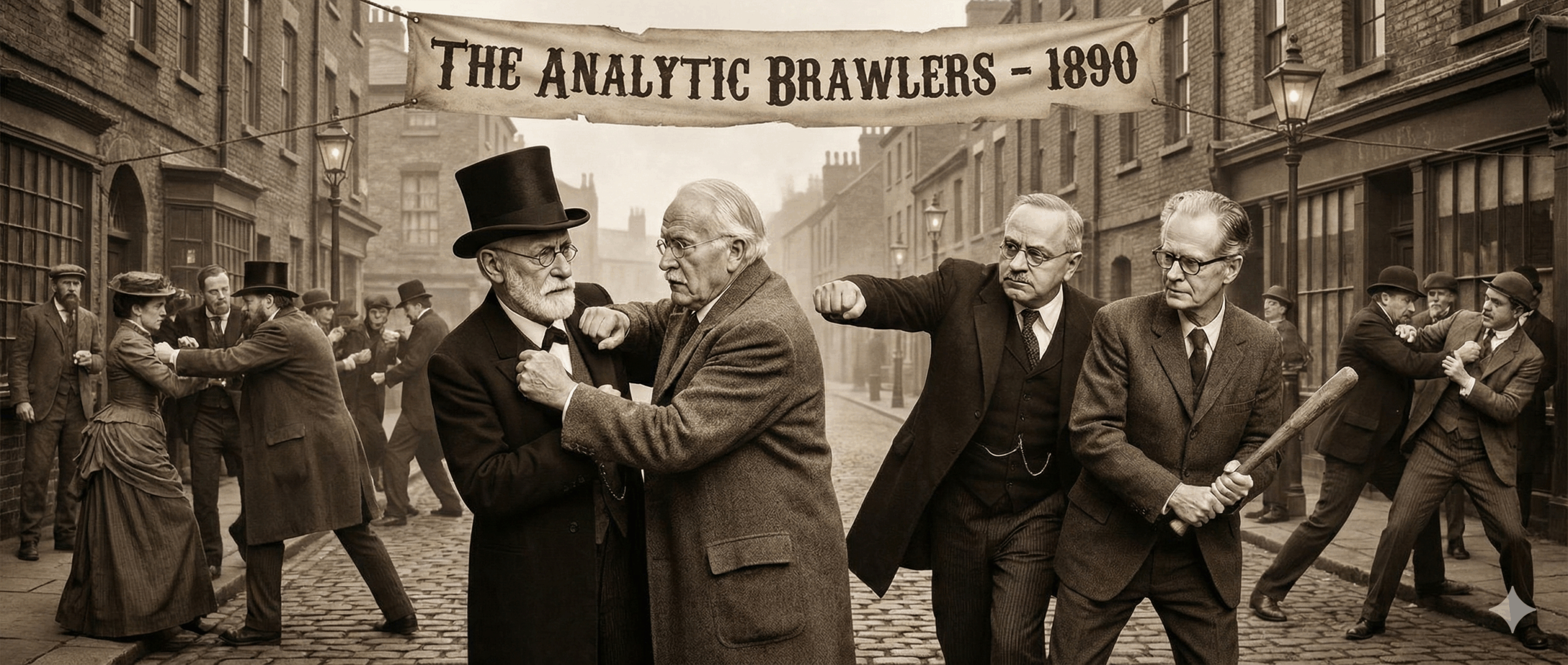
The history of psychotherapy isn’t a clean scientific progression. It’s a bloodbath. Fifteen feuds that shaped everything you do in the therapy room—and the verdict on who was actually right.
The Dialectic of the Cure
The history of psychotherapy reads less like a scientific logbook and more like a dynastic tragedy. From the smoke-filled salons of Vienna’s Berggasse 19 to contemporary American academia, the evolution of mental health treatment has been driven not merely by data, but by the collision of titan personalities.
These weren’t polite academic disagreements. They were existential battles for the very soul of the human subject.
Every modality you practice today carries the genetic markers of a victor or a martyr from these historical struggles. When you choose to validate a client’s emotion rather than interpret it as resistance, you’re unknowingly taking a side in the Ferenczi-Freud dispute. When you ask a father to change seats to alter the power dynamic in family therapy, you’re re-enacting Minuchin’s structural mandates against the humanistic pleas of Satir and Johnson.
This report provides a forensic analysis of fifteen of the most significant feuds in the history of psychotherapy. Beyond the gossip and the drama, we seek to answer a historiographical question: in the hindsight of history, aided by advances in neuroscience, attachment theory, and outcome research, who was actually the most correct?
A recurring metatheme emerges—a dialectic that refuses to be resolved: the tension between authority and empathy, between intrapsychic fantasy and external reality, and between the medical model of illness and the humanistic ideal of growth.
Part I: The Primal Schisms (The Freudian Circle)
The early history of psychoanalysis reads less like a scientific logbook and more like a theological schism. Sigmund Freud viewed psychoanalysis not just as a treatment, but as a “Cause” (die Sache). This cause demanded loyalty to central tenets: the primacy of the libido, the universality of the Oedipus complex, and the reality of the unconscious. Those who deviated were not innovators but apostates.
1. Sigmund Freud vs. Alfred Adler: Power vs. Pleasure
Alfred Adler was never Freud’s disciple in the strict sense—he was a founding colleague invited to join the Wednesday Psychological Society in 1902. By 1910, the divergence between Freud’s hydraulic drive theory and Adler’s emerging social psychology became untenable.
While Freud saw the human condition as a tragic struggle between biological instincts and societal repression, Adler saw it as a struggle for significance, belonging, and power within a social network.
The Rupture: In 1911, Adler—serving as President of the Vienna Psychoanalytic Society—presented lectures arguing that the “masculine protest” and feelings of inferiority were the primary drivers of neurosis, relegating sexual libido to a secondary, symbolic role. Freud forced a showdown. In a dramatic meeting, he declared that one could not be an Adlerian and a psychoanalyst simultaneously. He demanded a vote of loyalty. Adler resigned, taking nine members with him.
The Core Divergence:
| Feature | Freudian Psychoanalysis | Adlerian Individual Psychology |
|---|---|---|
| Primary Drive | Libido (Sexual/Aggressive energy) | Striving for Superiority (Overcoming inferiority) |
| Etiology | Conflict between Id, Ego, Superego | Deficit in social belonging; organ inferiority |
| Orientation | Causal/Deterministic (past causes present) | Teleological (future goal drives present) |
| Human Nature | Biological; defined by instinctual tension | Social; defined by interpersonal relationships |
| Therapy Goal | Insight into repressed unconscious drives | Encouragement; correcting the “lifestyle”; social interest |
The Real Fight: This was about the nature of human motivation and the politics of the self. Freud viewed humans as biological beasts tamed by civilization. Adler viewed humans as fundamentally social creatures whose mental health depended on Gemeinschaftsgefühl (social interest). Freud feared that removing the “sexual” element was capitulation to bourgeois morality.
Verdict: In the immediate aftermath, Freud retained the institutional crown. However, Adler was arguably more prescient. His concepts of the “inferiority complex,” the “lifestyle” (cognitive schema), and emphasis on social determinants are foundational to modern Social Work, Cognitive Behavioral Therapy, and Family Systems theory. Adler’s insistence that we are social beings motivated by power and belonging aligns more closely with contemporary evolutionary psychology than Freud’s hydraulic libido model.
However, Freud was correct that Adler underestimated the chaotic, irrational power of the unconscious. Adler’s psychology can appear overly rational, missing the deep, somatic entrenchment of trauma that Freud sought to excavate.
The synthesis: Therapy has adopted Adler’s social context but kept Freud’s depth.
2. Sigmund Freud vs. Carl Jung: The Parricide of the Crown Prince
This is the most mythologized feud in psychology, possessing all elements of a Greek tragedy. Carl Jung was Freud’s chosen successor—the “Crown Prince” and “Joshua” who would carry psychoanalysis out of its Jewish ghetto in Vienna into the wider Gentile scientific world. Their relationship was intensely emotional, characterized by a father-son dynamic fraught with homoerotic undertones, intense rivalry, and mutual idealization.
The Rupture: The break occurred gradually between 1909 and 1913, exacerbated during their trip to America where they analyzed each other’s dreams. Freud famously refused to provide associations to a dream, citing his need to “keep his authority”—which disillusioned Jung. The theoretical rupture became final with Jung’s Psychology of the Unconscious (1912), where he redefined “libido” not as sexual energy but as generalized psychic energy. He also began exploring mythology and religion not as neurotic symptoms but as expressions of a collective unconscious.
Freud viewed this as betrayal—a slide back into the “black tide of mud” of occultism.
The Core Divergence:
| Feature | Freudian Analysis | Jungian Analytical Psychology |
|---|---|---|
| Unconscious | Personal: Repressed memories/drives | Collective: Inherited archetypes + Personal |
| Libido | Sexual energy | General life energy (creative/spiritual) |
| Religion | A collective neurosis (illusion) | A necessary function for wholeness |
| Dreams | Wish fulfillment (disguised desires) | Compensatory messages from the Self; teleological |
| Goal | “Where Id was, Ego shall be” | Individuation (Integration of opposites) |
The Real Fight: This was about spirituality and the limits of reductionism. Freud was a staunch materialist who feared integrating mysticism would discredit his science. Jung felt Freud’s sexual reductionism failed to explain humanity’s higher creative and spiritual aspirations. The emotional toll was immense—Freud fainted in Jung’s presence twice, signifying overwhelming psychic tension.
Verdict: In terms of clinical efficacy and scientific validation, both men have lost ground to cognitive and biological models. Jung’s specific theories of archetypes are difficult to operationalize empirically. However, Jung’s concept of the “collective unconscious” finds echoes in modern evolutionary psychology (innate predispositions) and genetics. His emphasis on the meaning of symptoms, rather than just their cause, dominates modern humanistic and existential therapies.
Freud was likely correct that Jung drifted into unscientific speculation. But Jung was correct that humans cannot be reduced solely to repressed sexuality. The “spiritual” dimension Jung championed is now recognized in positive psychology and acceptance-based therapies as vital to resilience.
3. Sigmund Freud vs. Otto Rank: The Trauma of Birth
Otto Rank was Freud’s secretary and perhaps his intellectually closest confidant. He was the expert on culture, legend, and art within the circle. But in the 1920s, Rank began focusing on the pre-Oedipal phase—specifically the mother-child bond—an area Freud had largely neglected in favor of the father-centric Oedipal complex.
The Rupture: Rank published The Trauma of Birth (1924), arguing that primal anxiety isn’t castration anxiety (the father) but separation from the mother at birth. He proposed therapy should focus on reliving and mastering this separation. He also suggested therapy could be shorter—months, not years—and that the analyst should be more active.
Freud initially reacted with interest, but under pressure from loyalists like Karl Abraham, he denounced Rank. Rank was isolated, expelled, and eventually moved to America.
The Real Fight: This was a fight about the mother vs. the father. Freud’s theory was patriarch-centric; Rank tried to center the mother, anticipating attachment theory. It was also about efficiency and democratization—Rank was among the first to propose “active” and “short-term” therapy, challenging the endless, elitist nature of classical analysis.
Verdict: Otto Rank is the unsung hero of modern therapy. His focus on the mother-child dyad predated John Bowlby’s Attachment Theory and the Object Relations of Klein and Winnicott. His idea of “will therapy” and short-term intervention anticipated client-centered and brief therapy movements. Freud’s rejection of the pre-Oedipal mother was a massive blind spot that set psychoanalysis back by decades.
4. Sigmund Freud vs. Sándor Ferenczi: The Kiss and the Confusion of Tongues
Sándor Ferenczi was the “enfant terrible” of the circle, known for his warmth and willingness to experiment. While Freud maintained “surgeon-like” detachment, Ferenczi believed the patient needed love to heal. He felt Freud’s “abstinence” rule was a repetition of the cold parenting that caused the neurosis in the first place.
The Rupture: In the late 1920s and early 1930s, Ferenczi experimented with “mutual analysis” (analyzing each other) and “active technique” (sometimes holding patients, or a kiss on the forehead). His final paper, The Confusion of Tongues Between Adults and the Child (1932), argued that neurosis was often caused by actual sexual abuse—which the child interprets through a confusion of “tenderness” and “passion.”
Freud, who had long abandoned the Seduction Theory in favor of childhood fantasy, was furious. He accused Ferenczi of regressing to pre-analytic errors and refused to shake his hand at the congress.
The Core Divergence:
| Feature | Freud (Classical) | Ferenczi (Relational) |
|---|---|---|
| Analyst Stance | Blank screen (abstinence) | “Tender mother” |
| Abuse Memories | Often fantasies (Oedipal wishes) | Often real; trauma from denial |
| Countertransference | A hindrance | Data; acknowledge flaws (mutuality) |
The Real Fight: This was the battle for Trauma Theory. Freud pivoted to intrapsychic fantasy to save the reputation of the bourgeois family; Ferenczi insisted on the reality of victimization and environmental failure. It was also about Authority vs. Authenticity—Ferenczi believed detached authority was re-traumatizing.
Verdict: Ferenczi was spectacularly correct. The Confusion of Tongues is now the foundational text of modern trauma therapy. His recognition that the analyst’s “hypocrisy” (professional distance) can retraumatize is central to Relational Psychoanalysis. Freud’s dismissal of Ferenczi’s findings on sexual abuse is considered one of his greatest moral and scientific failures. Ferenczi’s “two-person psychology” (the relationship heals) has largely supplanted Freud’s “one-person psychology” (insight heals).
Part II: The Battle for the Child and the Soul (Mid-Century)
As psychoanalysis migrated to Britain and America to escape the Nazis, the feuds mutated into institutional wars over the treatment of children and the political role of therapy.
5. Wilhelm Reich vs. The IPA & The FBI: The Knife and the Orgone
Wilhelm Reich was a brilliant, radical analyst who sought to combine Freud with Marx. He believed sexual repression was a tool of the capitalist state to create submissive fascists (The Mass Psychology of Fascism). He advocated for sexual liberation and set up clinics for the working class.
The First Rupture—The Knife: Reich’s radical politics and his “Character Analysis” (reading the body’s armor) alienated conservative analysts desperate to appear respectable. At the 1934 Lucerne Congress, Reich was secretly expelled from the IPA—ostensibly for “unscientific” theories but largely to protect the IPA’s standing in Nazi Germany. Reich, feeling betrayed and paranoid, allegedly carried a large knife to the convention he was barred from.
The Second Front—Reich vs. The FBI: After fleeing to the US, Reich developed “Orgone Energy” theory—a physical, cosmic libido. He built “Orgone Accumulators” to cure cancer and mental illness. The FDA and FBI investigated him. He violated an injunction, was imprisoned, and his books were burned by the US government—one of the worst examples of censorship in American scientific history. He died in prison in 1957.
The Real Fight: This was about the political responsibility of therapy. Reich demanded therapists fight fascism and sexual repression; the IPA chose survival through neutrality.
Verdict: Reich was a tragic visionary. His work on “body armor”—that trauma is stored in somatic tension—is the direct ancestor of Bioenergetics, Somatic Experiencing, and Bessel van der Kolk’s The Body Keeps the Score. His critique of fascism remains relevant. However, his later descent into “Orgone energy” and rain-making machines suggests either a psychotic break or pseudoscience. The IPA was “correct” to distance itself from his later physics, but their cowardly appeasement of the Nazis remains a stain on the institution.
6. Anna Freud vs. Melanie Klein: The Controversial Discussions
When Sigmund and Anna Freud fled to London in 1938, they found the British Psychoanalytical Society dominated by Melanie Klein. Klein had extended analysis to very young children and proposed a theory of “internal objects” that differed wildly from Freud’s. She believed infants experienced intense psychotic anxieties (paranoid-schizoid) in the first months of life. Anna Freud, guarding her father’s legacy, vehemently opposed her.
The Rupture: The “Controversial Discussions” (1942–1944) were heated scientific meetings to decide if Klein’s work was “Freudian.” The society nearly split. Accusations of heresy flew. It was war for control of the training curriculum.
The Core Divergence:
| Feature | Melanie Klein (Kleinians) | Anna Freud (Freudians) |
|---|---|---|
| Infant Psyche | Active from birth; full of primitive fantasy/aggression | Developing slowly; “Narcissistic” stage first |
| Super-Ego | Early, harsh Super-Ego in infancy | Develops later (Oedipal stage, age 3-5) |
| Play | Equivalent to free association (interpretable) | Just play; children lack ego for full analysis |
| Technique | Interpret deep unconscious anxiety immediately | Build alliance; support Ego; educate |
The Real Fight: This was a battle for succession of the Crown. Anna was the blood heir; Klein was the intellectual usurper claiming to understand Freud better than he understood himself. It was also about the nature of the infant: blank slate learning to tame drives (Anna), or cauldron of primitive love and hate fantasies (Klein)?
Verdict: The solution was a distinctively British compromise: the “Ladies’ Agreement” creating two training tracks and a “Middle Group” (Independents like Winnicott). History leans toward Klein regarding the early origins of mental life—we now know infants have complex emotional lives much earlier than Freud thought. However, Anna Freud’s emphasis on defense mechanisms became the foundation of American Ego Psychology. Klein won the depth; Anna won the structure. Klein’s concept of “Projective Identification” is now standard for understanding personality disorders.
Part III: The Humanistic Revolt and the Scientific Counter-Attack
By the 1950s and 60s, the monolithic power of psychoanalysis was cracking. New challengers arose from the animal labs (Behaviorism) and the university counseling centers (Humanism).
7. Carl Rogers vs. B.F. Skinner: The Debate of the Century
This was the heavyweight bout of 20th-century American psychology. Carl Rogers represented Humanism (innate potential for growth, freedom, subjective experience). B.F. Skinner represented Radical Behaviorism (environmental determinism, control, objective observation).
The Clash: They engaged in public debates in 1956, 1960, and 1962. The most famous was in Duluth (1962), attended by over 1,000 people. They debated the “Control of Human Behavior.” Skinner argued that “freedom” was a pre-scientific myth; Rogers argued it was an experiential reality essential for health.
The Core Divergence:
Skinner: Freedom is an illusion (“autonomous man” is a myth). Behavior is determined by consequences. To improve the world, we must scientifically design culture to reinforce pro-social behavior.
Rogers: The subjective experience of freedom is reality. The goal of therapy (and society) is to facilitate the “fully functioning person” through empathy, congruence, and unconditional positive regard. Control creates pathology.
The Real Fight: This was a philosophical war between Democratic Idealism and Technocratic Utilitarianism. Skinner argued that if we don’t control behavior scientifically, it will be controlled by accident or tyrants. Rogers argued that external control destroys the very essence of what makes us human.
Verdict: Culturally, Rogers won. The language of “self-actualization,” “empathy,” and “client-centered” permeates modern society. Clinically, Skinner’s legacy is more potent in the age of managed care—CBT (behaviorism’s offspring) dominates because it’s measurable and protocol-driven.
Interestingly, modern research shows they were both right: Behavior is heavily conditioned (Skinner), but the therapeutic alliance (Rogers) is the single strongest predictor of outcome regardless of technique. The “Common Factors” model is essentially Rogerian soil growing Skinnerian plants.
8. Hans Eysenck vs. The Psychoanalytic Establishment: The Statistical Bomb
In 1952, psychoanalysis was the undisputed king of psychiatry. Hans Eysenck, a rigorous empiricist at the Maudsley Hospital in London, decided to audit the books.
The Bomb: Eysenck published The Effects of Psychotherapy: An Evaluation. He reviewed 24 studies and concluded that the recovery rate for psychoanalysis (44%) was lower than spontaneous remission for those receiving no treatment (72%). He effectively claimed psychoanalysis was a scam—a placebo at best, harmful at worst.
The Real Fight: This was the birth of Evidence-Based Practice. It was Art vs. Science. Eysenck challenged the priesthood to show their miracles.
Verdict: Eysenck’s data was deeply flawed—he compared apples to oranges, using different criteria for “cured” and overestimating spontaneous remission. Decades of meta-analyses (Smith & Glass, Wampold) have refuted his “no effect” claim, showing therapy is significantly effective.
However, Eysenck was “correct” in a meta-sense: his attack forced the field to adopt scientific standards. He destroyed the complacency of the analysts and paved the way for CBT and the randomized control trial as gold standard.
9. Albert Ellis vs. Fritz Perls: The Battle for Gloria
In 1965, the film Three Approaches to Psychotherapy (The Gloria Films) was released. It featured a real client, Gloria, being treated by Carl Rogers, Fritz Perls (Gestalt), and Albert Ellis (REBT). It became the most famous training film in history.
The Clash: The film highlighted the stark, almost violent contrast between Ellis and Perls. Perls was abrasive, focusing on the “here and now,” calling Gloria a “phony,” frustrating her to break her defenses. Ellis was cerebral, debating her irrational beliefs. Behind the scenes, the feud was personal: Perls viewed Ellis’s rationalism as superficial intellectualization; Ellis viewed Perls’s theatricality as dangerous anti-intellectualism.
The Core Divergence:
Perls (Gestalt): “Lose your mind and come to your senses.” Insight is a “booby prize.” Change happens through emotional catharsis and breaking impasses in the present moment.
Ellis (REBT): “You feel the way you think.” Neurosis is caused by irrational beliefs (Musts/Shoulds). Change happens by disputing cognitions energetically.
The Real Fight: Thinking vs. Feeling. Ellis bet on the prefrontal cortex; Perls bet on the limbic system and the body. Stoicism vs. Existentialism.
Verdict: Gloria herself preferred Perls at the time (falling for the “bad boy” dynamic), but later maintained contact with Rogers. Historically, Ellis won the war of technique—REBT is the direct precursor to CBT, the dominant paradigm. Perls’s confrontational style is now viewed as potentially harmful and unethical.
However, Perls’s emphasis on the body (“somatic markers”) and the “now” has been resurrected in mindfulness and somatic therapies. The modern synthesis (DBT, ACT) combines Ellis’s cognitive work with Perls’s mindfulness.
10. R.D. Laing vs. Institutional Psychiatry: The Anti-Psychiatry Revolt
In the 1960s, R.D. Laing, a charismatic Scottish psychiatrist, argued that schizophrenia was not a biological disease but a sane reaction to an insane family/world. He became a counter-culture hero.
The Experiment: Laing founded Kingsley Hall (1965-1970), a therapeutic community in East London with no locks and no drugs. Residents (not “patients”) were encouraged to “go down” into their madness—regressing to infancy, smearing feces, painting—as a shamanic journey of rebirth. This was a direct assault on the medical establishment.
The Core Divergence:
Psychiatry: Mental illness is biological pathology requiring medication and containment.
Laing: “Madness” is a breakthrough, not a breakdown. It’s a desperate strategy for a self to survive in an unlivable situation (often a “double-bind” family). The psychiatrist is a policeman of social norms.
The Real Fight: Politics vs. Medicine. Laing politicized madness, linking it to the Vietnam War, the nuclear family, and capitalism. He argued the “sane” people were dropping napalm while the “mad” were the ones sensitive enough to crack.
Verdict: Laing was right that the medical model often dehumanized patients and that family dynamics (high expressed emotion) play a huge role in psychosis course. However, he was tragically wrong about the biological basis of schizophrenia. Romanticizing psychosis led to real suffering for those at Kingsley Hall who needed medication but were denied it in favor of a “journey” they never returned from.
The biological revolution of the 1980s swept Laing away, but the Recovery Model today (emphasizing meaning, agency, and Open Dialogue) owes him a significant debt.
Part IV: Modern Wars of Diagnosis, Narcissism, and Trauma
As therapy professionalized in the late 20th century, feuds became more granular but no less vicious, focusing on specific diagnoses and the politics of trauma.
11. Heinz Kohut vs. Otto Kernberg: The Narcissism Wars
In the 1970s, psychoanalysis struggled to treat Narcissistic Personality Disorder—patients who were arrogant yet fragile, who didn’t form typical transferences. Two giants emerged with opposing theories.
The Core Divergence:
| Feature | Heinz Kohut (Self Psychology) | Otto Kernberg (Object Relations) |
|---|---|---|
| Nature of Narcissism | A Deficit. The self wasn’t mirrored by parents. | A Conflict. A defense against aggression/envy. |
| The Grandiose Self | Normal developmental need that was arrested | Pathological structure (fused Real/Ideal Self) |
| Primary Emotion | Shame (falling apart) | Envy/Rage (destroying the other) |
| Treatment | Empathy. Allow idealization. Don’t challenge grandiosity early. | Confrontation. Interpret hidden aggression/envy. |
The Real Fight: The Carrot vs. The Stick. Kohut believed the patient needs what they missed (love/mirroring)—a “corrective emotional experience.” Kernberg believed the patient needs to see the reality of their aggression, or they’ll exploit the therapist. Kohut viewed the narcissist as “Tragic Man” (unfulfilled); Kernberg viewed him as “Guilty Man” (destructive).
Verdict: The consensus is split. Kohut’s approach is favored for milder, “fragile” narcissism (vulnerable type). Kernberg’s Transference-Focused Psychotherapy (TFP) is superior for “malignant” narcissism and borderline organization where aggression dominates. Kohut humanized the narcissist; Kernberg recognized the danger they pose.
12. Jeffrey Masson vs. The Freud Archives: The Return of Seduction
In the 1980s, Jeffrey Masson, the young, charismatic Projects Director of the Freud Archives, gained access to Freud’s unpublished letters to Wilhelm Fliess. He concluded that Freud abandoned the Seduction Theory (that neurosis is caused by actual abuse) in 1897 not because of clinical evidence, but to curry favor with colleagues and protect his friend Fliess.
The Explosion: Masson went public, declaring psychoanalysis a “fairy tale” built on the suppression of truth about child abuse. He was fired. Janet Malcolm interviewed him for The New Yorker, portraying him as an arrogant “intellectual gigolo.” Masson sued for libel—the case went to the Supreme Court.
The Real Fight: Truth vs. Institution. Masson challenged the foundational myth of psychoanalysis.
Verdict: Masson was largely correct that Freud suppressed the reality of abuse (echoing Ferenczi). The #MeToo movement and modern trauma theory vindicate the prevalence of abuse that Freud dismissed as fantasy. However, Masson’s scorched-earth personality and lack of clinical nuance allowed the establishment to dismiss the message by attacking the messenger.
13. Salvador Minuchin vs. Sue Johnson: The Battle of Emotion and Structure
Salvador Minuchin was the god of Family Therapy in the 1970s. His “Structural Family Therapy” viewed problems as issues of hierarchy and boundaries. Emotion was secondary to structure. In the 2000s, Sue Johnson’s “Emotionally Focused Therapy” (EFT) arose, based on Attachment Theory, arguing that emotion was the key organizer of experience.
The Clash: At a Psychotherapy Networker conference, the two titans clashed. Minuchin argued families need to enact new behaviors and structures. Johnson argued without addressing the underlying emotional music (attachment fears), structural changes are superficial.
The Core Divergence:
Minuchin: Change behavior (enactment) → Emotion changes. (Outside-In). The therapist is a director.
Johnson: Change emotion (softening/vulnerability) → Behavior changes. (Inside-Out). The therapist is a process consultant.
The Real Fight: Power vs. Love. Minuchin saw families as political systems (who has power?). Johnson saw them as attachment systems (who is safe?).
Verdict: Sue Johnson won the 21st century. EFT has gold-standard empirical support for couples. The field has moved decisively toward attachment and emotion regulation—neuroscience supports Johnson: emotion organizes cognition. However, Minuchin’s tools remain vital for chaotic, enmeshed families (like those with anorexia) where boundaries are literally nonexistent.
14. Bessel van der Kolk vs. The DSM-5 Committee: The Diagnosis That Wasn’t
Bessel van der Kolk, a leading trauma researcher, argued that PTSD failed to capture the complexity of childhood abuse. PTSD describes reaction to a single event; abused children have pervasive developmental impairments (attention, attachment, body regulation).
The Rejection: Van der Kolk proposed a new diagnosis: Developmental Trauma Disorder (DTD) for the DSM-5. He gathered massive data. The committee rejected it, arguing insufficient evidence to distinguish it from other disorders (ADHD, Bipolar, ODD).
The Core Divergence:
Van der Kolk: Current diagnoses (ADHD, Bipolar) describe symptoms, not etiology. Treating a trauma kid for ADHD is malpractice. We need a diagnosis that names the cause: trauma.
DSM Committee: Diagnostic conservatism. We label symptoms, not causes.
The Real Fight: Validity vs. Politics. A DTD diagnosis would force insurance and medical systems to acknowledge the massive scale of child abuse and fund long-term trauma therapy—which is expensive.
Verdict: Clinicians overwhelmingly side with Van der Kolk. The label “DTD” is widely used unofficially because it describes clinical reality better than “Comorbid ADHD/ODD/Bipolar.” The DSM’s rejection is seen by many as failure to integrate neuroscience and developmental psychology.
15. Viktor Frankl vs. The Critics (The Pytell Controversy): The Saint and the Gray Zone
Viktor Frankl, a Holocaust survivor, founded Logotherapy based on the idea that meaning is the primary drive. His book Man’s Search for Meaning is a sacred text in the field.
The Controversy: Historian Timothy Pytell and others questioned Frankl’s narrative. Evidence suggested Frankl may have performed experimental interventions on Jewish suicide attempters under Nazi orders. He was accused of having “protection” status initially. Pytell argued Frankl’s theory of “meaning” was a way to rationalize his own survival and ignore systemic evil.
The Real Fight: Heroism vs. Historical Complexity. Can a therapy be based on a sanitized version of history?
Verdict: Frankl’s core insight—that meaning is a resilience factor—is empirically robust. However, the historical critique adds necessary nuance. Frankl was not a saint; he was a man navigating hell. The accusations of “lobotomies” appear to be distortions of his attempts to save suicide victims from immediate Nazi execution (suicide was a capital offense in the camps). The fight reminds us that therapeutic theories are often autobiographical defenses against the theorist’s own trauma.
The Therapeutic Implications of Conflict
Looking back at these fifteen feuds, a pattern emerges. The history of psychotherapy is a pendulum swinging between:
Structure/Biology/Authority (Freud, Eysenck, Minuchin, Kernberg, Skinner)
— and —
Emotion/Relationship/Experience (Ferenczi, Rank, Rogers, Johnson, Kohut)
Who was actually the most correct?
History has favored the Synthesizers.
Freud built the house, but Ferenczi and Rank furnished it with the empathy and trauma awareness we use today.
Skinner gave us the tools of behavior change (CBT), but Rogers gave us the relationship required to use them.
Minuchin understood the system, but Johnson understood the fuel (emotion) that runs it.
The “winners” are those who recognized that the human mind is both a biological machine and a maker of meaning; that we need both the surgeon’s knife (to cut through defense) and the mother’s embrace (to heal the wound).
The feuds were not errors in the system. They were the friction necessary to polish the mirror in which we see ourselves.
As practitioners of depth work, we inherit all of it—the scars and the wisdom. Every time you attune to a client’s body, you’re channeling Reich. Every time you work with archetypes, you’re invoking Jung. Every time you validate the reality of trauma, you’re vindicating Ferenczi against Freud.
The wars are over. The synthesis is ours to use.













0 Comments