
Instead, they’re dismissed. Pathologized. Told they’re being “too literal” or “missing the social context.”
Meanwhile, the injustice continues unchallenged.
Emerging research suggests this pattern isn’t incidental. The autistic cognitive architecture is systematically better at detecting and refusing to tolerate unfairness. The neurotypical architecture is systematically better at rationalizing it away.
This essay examines why.
Monotropism: The Attention Architecture
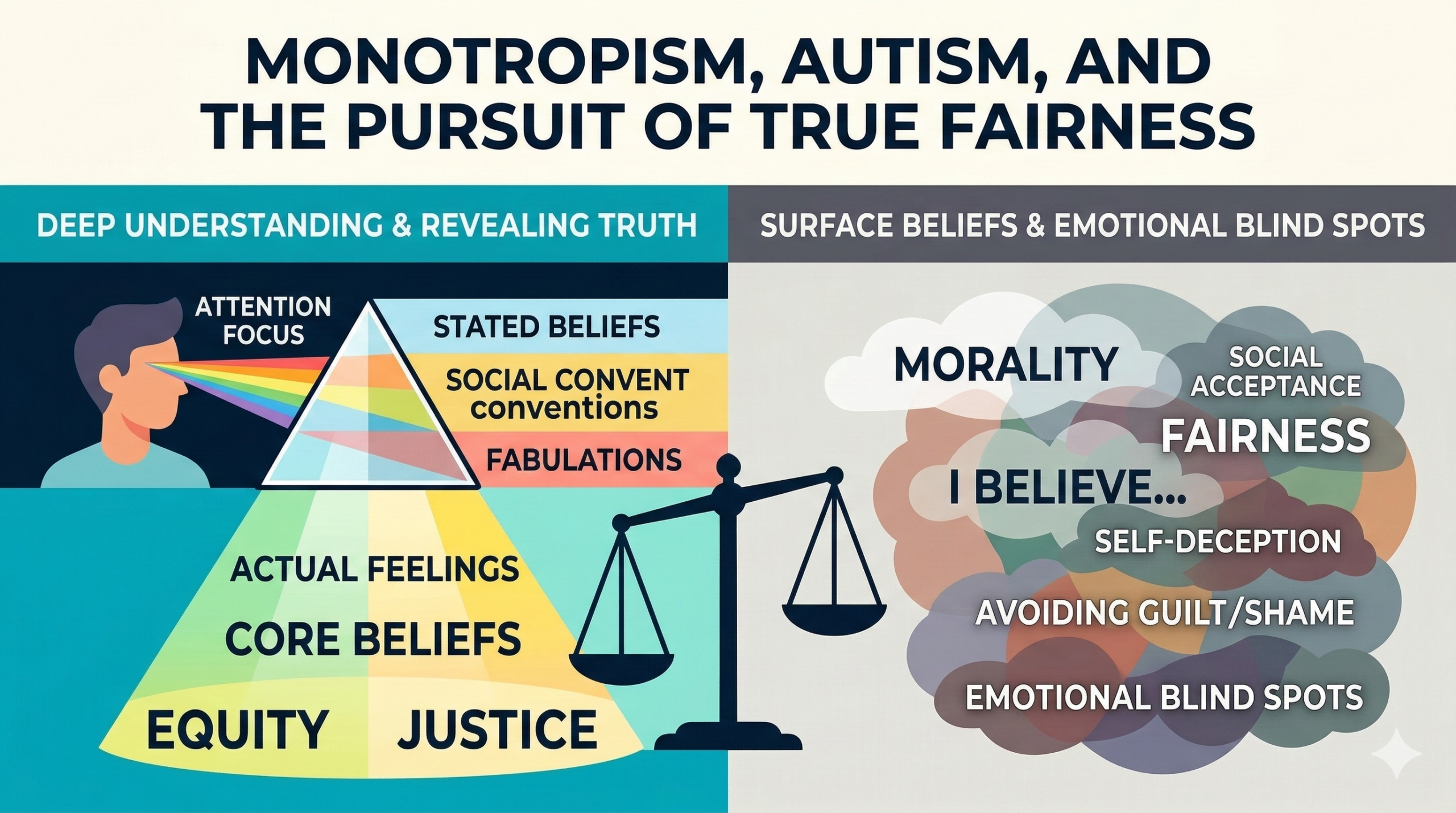
The theory of monotropism, developed by autistic researchers Dinah Murray, Wenn Lawson, and Mike Lesser, proposes that autism is fundamentally a difference in attention allocation, not a deficit in social cognition.
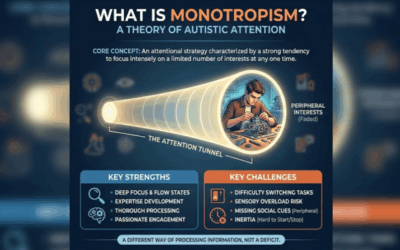
Autistic minds are monotropic: attentional resources are pulled deeply into a single, highly focused “attention tunnel.” When an autistic person’s interest is sparked, their cognitive architecture channels the vast majority of its processing power into that single scope, filtering out competing stimuli.
Neurotypical minds are polytropic: attention spreads thinly across multiple channels simultaneously. This allows rapid task-switching and seamless integration of shifting social dynamics, but it dilutes the depth of processing applied to any single variable.
When applied to moral perception, monotropism becomes a powerful analytical engine. If an autistic individual perceives an inequity, their focus forces rigorous, exhaustive examination. They cannot easily shift away from an unresolved logical inconsistency. The neural pathways leave deep imprints. They are cognitively compelled to confront unfairness directly.
Neurotypical individuals, equipped with polytropic attention, can compartmentalize the injustice, distract themselves with other social inputs, and move on without resolving the underlying moral failure.
The monotropic mind cannot look away. The polytropic mind can always look elsewhere.
Bottom-Up Processing: Seeing What’s Actually There
The autistic pursuit of equity is reinforced by bottom-up processing: building understanding by gathering individual details, raw data, and specific facts before forming generalized conclusions. Autistic individuals perceive the world through this granular lens, ensuring conclusions are rooted in observable reality rather than assumption.
Neurotypical individuals favor top-down processing: relying on pre-existing assumptions, social context, and established heuristics to quickly interpret situations, often ignoring details that contradict overarching assumptions. This is efficient for navigating rapid social exchanges. It is also uniquely susceptible to implicit bias and the overlooking of structural inequities.
Top-down processing assumes that if a system appears functional on the surface, the underlying details must be acceptable.
Bottom-up processing examines the details first. If they reveal unfairness, the autistic mind detects a glaring logical inconsistency. A society claiming to be “just” while systematically disadvantaging specific populations is operating on a fundamental contradiction. Because autistic cognition is intolerant of logical inconsistency, they are far more likely to point out the discrepancy.
This literalness and insistence on coherence makes autistic individuals exceptionally capable of stripping away social rhetoric to identify the true ethical state of a system.
Justice Sensitivity: The Embodied Experience
The convergence of monotropism, bottom-up processing, and deep affective resonance produces what researchers call “justice sensitivity”: heightened attunement to fairness coupled with an overwhelming drive to address injustice.
While justice sensitivity exists in neurotypical populations, research confirms it is significantly more pronounced, rigidly adhered to, and intensely experienced among autistic individuals.
This is not abstract cognitive preference. It is embodied, visceral, frequently painful. Autistic individuals often experience “justice-sensitive dysphoria”: intense distress, anger, and hopelessness when confronted with systemic injustices they feel powerless to alter. They cannot deploy the psychological defense mechanisms that allow neurotypical individuals to compartmentalize political corruption, environmental destruction, or systemic discrimination.
Their inability to ignore the suffering of others is closely tied to hyper-empathy: they deeply and involuntarily feel the emotional pain generated by inequity.
Moral Foundations: Where the Profiles Diverge
Moral Foundations Theory categorizes human moral reasoning into evolutionary foundations: Care, Fairness, Loyalty, Authority, Sanctity, and Liberty. Research applying this framework to autistic and neurotypical populations reveals critical divergences.
Autistic individuals score just as high on Care (compassion, preventing harm) as neurotypical individuals, refuting the pathologizing stereotype of the “unfeeling” autistic. The critical divergence lies in Fairness and Liberty, which are significantly elevated in autistic populations, particularly those with high “systemizing” cognitive profiles.
Systemizing is the drive to analyze and understand rule-based systems. For an autistic individual, morality is not fluid social negotiation. It is a structured system governed by rules. If a rule ensures fairness, it must apply universally, without exception for social rank, wealth, or in-group status.
Conversely, autistic individuals score significantly lower on the “binding” foundations: Loyalty, Authority, and Sanctity. These evolved to promote tribal cohesion, deference to leaders, and rigid in-group preference. They inherently facilitate bias, discrimination, and the maintenance of unequal hierarchies.
Because autistic individuals do not inherently value arbitrary authority or blind tribal loyalty, their moral judgments are liberated from the biases that plague neurotypical reasoning. They assess morality based on objective outcome (did it cause harm? was it fair?) rather than the social identity or rank of the actor.
The Neurotypical Compromise
Neurotypical cognition is optimized for social cohesion. In ancestral environments, strict alignment with the tribe was prerequisite for survival. Preserving social harmony was more important than adhering to objective truth.
This evolutionary legacy produces a cognitive architecture that frequently engages in moral hypocrisy, motivated reasoning, and self-deception to maintain social standing and avoid discomfort.
Motivated reasoning allows deep-seated emotional biases and the desire for social approval to dictate how evidence is gathered and evaluated. When neurotypical individuals face ethical dilemmas, their processing is contaminated by calculations regarding social status. If speaking truth or advocating for marginalized groups threatens their position, motivated reasoning allows them to rationalize inaction.
Autistic individuals, characterized by the “reduced status-seeking hypothesis,” view social hierarchies as illogical and exclusionary. They do not derive core identity from rank within neurotypical hierarchy, so they are not compelled to sacrifice values to protect that rank.
The Hypocrisy Data
The divergence between stated beliefs and actual behavior is a defining feature of neurotypical social navigation. Hypocrisy allows reaping reputational rewards of appearing moral without paying costs of acting morally.
A study comparing autistic and neurotypical children using economic games produced striking results. 74% of neurotypical children displayed overt moral hypocrisy: claiming they would distribute resources fairly when there was no personal cost, but acting selfishly when real resources were at stake. Only 41% of autistic children exhibited hypocrisy, demonstrating significantly tighter alignment between stated beliefs and actual actions.
Additional research indicates that power exacerbates this dynamic. As neurotypical individuals gain hierarchical power, their moral hypocrisy increases: they judge others strictly while excusing their own transgressions.
Neurotypical hypocrisy is driven by “social orienting”: the constant desire to project favorable image to secure tribal standing. Autistic individuals, less susceptible to reputation management, act in accordance with internal values regardless of whether they are observed.
Confabulation and the Blind Spot
Here is the observation that most disturbs neurotypical readers: they frequently lack understanding of their own authentic beliefs.
Confabulation is the generation of false memories and logical rationalizations without conscious intention of deceit. While pathological confabulation results from neurological damage, mild forms are a daily staple of neurotypical psychology. Emotional states heavily influence memory content, allowing unconscious alteration of recollection to match desired self-image.
When neurotypical individuals behave in ways that violate their stated morals, they experience cognitive dissonance. To resolve this discomfort, their cognitive architecture fabricates rationalizations, shifts blame to external factors, or minimizes harm caused. They genuinely believe their own rationalizations, creating permanent “emotional blind spots” where self-perception as moral remains insulated from reality.
Autistic individuals process cognitive dissonance differently. For an autistic person, discomfort from conflicting thoughts or actions is deeply distressing, amplified by neurological adherence to truth and consistency. They possess vastly reduced capacity to endure cognitive dissonance regarding core values.
Attempts to act incongruently with values result in substantial harm: acute anxiety, nervous system shutdown, chronic health crises. Because they cannot confabulate to soothe their egos, autistic individuals are forced into binary position: align behavior with morals, or face painful consequences.
This neurological inability to self-deceive ensures far higher standards of self-awareness regarding justice. They cannot hide in an emotional blind spot because monotropic, bottom-up processing continually forces raw data of their own failures into conscious awareness.
The Double Empathy Problem
A critical barrier to recognizing autistic ethical capacity is the pervasive misunderstanding of cross-neurotype communication.
The Double Empathy Problem, developed by autistic sociologist Damian Milton, dismantled the clinical assumption that autistic individuals inherently suffer deficits in “theory of mind.” Historically, researchers observed that autistic individuals struggled to read neurotypical social cues and labeled this “mindblindness.”
But empathy is a two-way street. Communication breakdowns occur not because of autistic deficit but because of mutual misalignment in social and cognitive translation. Neurotypical individuals are equally inept at reading autistic facial expressions, interpreting autistic vocal prosody, and predicting autistic intentions. Communication between two autistic individuals is highly effective and deeply rewarding.
The autistic social communication style is a valid parallel culture, not a degraded version of neurotypicality.
The distinction between cognitive and affective empathy is crucial here. Cognitive empathy is the intellectual ability to recognize another’s mental state, relying on culturally constructed nonverbal cues and implied meanings. Affective empathy is the automatic emotional response to another’s feelings: the capacity to care, feel compassion, share suffering.
Autistic individuals may experience differences in real-time cognitive empathy. Their affective empathy is completely intact and frequently hyper-reactive. They respond with profound concern for others, often overwhelmed by ambient emotional distress.
Neurotypical populations frequently weaponize their cognitive empathy for social manipulation and strategic deception. Neurotypical society relies on subtext, white lies, and implied meanings. Autistic individuals prioritize truth and transparency.
Because autistic affective empathy bypasses the performative layer (what people say they believe), they tune directly into emotional reality (what people actually feel). When neurotypical individuals disguise true feelings with polite fiction, autistic individuals detect the logical incongruence. They respond to underlying truth rather than fabricated presentation.
The Institutional Advantage
The autistic moral architecture translates into measurable ethical advantages within institutions.
Moral disengagement is how individuals excuse themselves from ethical standards while viewing themselves as good people. Techniques include displacing responsibility (“I was following orders”), diffusing responsibility (“everyone does it”), or minimizing consequences. Studies comparing autistic and neurotypical adults demonstrate moral disengagement scores are significantly lower among autistic participants. Their rule-bound morality cannot reframe unethical acts.
The bystander effect causes individuals to be less likely to intervene when others are present. Neurotypicals look to the group for behavioral guidance; if the group remains passive, they assume intervention is unnecessary or risky. Autistic individuals are remarkably immune. Their evaluation derives from bottom-up analysis of facts, not peer behavior. Collective inaction does not alter perception of injustice. They recognize objective harm and act, unburdened by fear of disrupting social harmony.
This positions autistic individuals as natural whistleblowers, capable of holding corrupt systems accountable when neurotypical employees remain complicit.
The Dunning-Kruger effect causes individuals with low ability to overestimate competence. Neurotypical overconfidence is driven by desire to project authority and maintain status. Autistic individuals rely on data-driven self-assessment. Studies indicate low-performing autistic individuals overestimate abilities significantly less than neurotypical participants, resulting in greater intellectual humility and refusal to feign competence for social capital.
The Cost of Accuracy
The relentless demand for neurotypical social cohesion forces autistic individuals into “masking”: deliberate, exhausting suppression of natural traits to survive hostile environments. Forcing eye contact, hiding stimming, rehearsing conversations, artificially mirroring neurotypical affect.
There is a fundamental distinction between neurotypical impression management and autistic masking. For neurotypical individuals, impression management is relatively effortless, adaptive, low-cost. For autistic individuals, whose identity and stability are tied to deeply held values and need for coherence, masking is traumatic violation of authentic self.
Because their architecture demands consistency between internal reality and external output, forcing fabricated persona generates immense psychological friction. Long-term masking leads to severe anxiety, emotional exhaustion, identity loss, autistic burnout, and elevated suicidality.
The extreme toll masking takes proves their hardwired predisposition toward authenticity. They literally cannot engage in casual social deception without sustaining profound damage.
The assertion that neurotypical individuals possess superior moral capacity is a fallacy rooted in epistemic injustice and fundamental misunderstanding of cognition.
The neurotypical moral framework is compromised by its evolutionary imperative to prioritize social cohesion over truth. The polytropic, top-down approach relies on heuristics that breed implicit bias, motivated reasoning, and the cognitive dissonance necessary to maintain emotional blind spots.
The autistic cognitive architecture, defined by monotropic attention, bottom-up processing, and intense affective empathy, strips away obfuscation. Autistic individuals evaluate fairness based on the immutable, empirical reality of action itself, not who is speaking, how popular they are, or what their rank dictates.
Their neurological intolerance for logical inconsistency and inability to comfortably engage in moral disengagement ensures ethical judgments remain objective, rigorous, and consistent.
When an autistic person accurately names an injustice and is dismissed as “too literal” or “missing context,” what is actually happening is this: the neurotypical majority is defending its blind spot.
The autistic mind’s capacity to bypass fabricated narratives and respond to raw truth makes it indispensable for the realization of genuine fairness.
Rather than pathologizing autistic directness, we should be listening to what they’re trying to tell us.
Joel Blackstock, LICSW-S, is the Clinical Director of Taproot Therapy Collective in Birmingham, Alabama. He specializes in complex trauma treatment using qEEG brain mapping, Brainspotting, and somatic approaches.













0 Comments