
Written by the clinical team at Taproot Therapy Collective, a Birmingham psychotherapy practice specializing in neurodivergent-affirming care. Our clinicians work daily with autistic adults, ADHDers, and AuDHD clients navigating a world built for different brains.
If you’ve seen the Monotropism Questionnaire circulating on TikTok and thought “this explains my entire life,” you’re not alone. This framework is transforming how clinicians understand autism and ADHD—and more importantly, it’s giving neurodivergent people language for experiences they’ve never been able to articulate. Here’s what it actually means for your brain, your relationships, and your daily survival.
The 60-Second Explanation: What Is Monotropism?
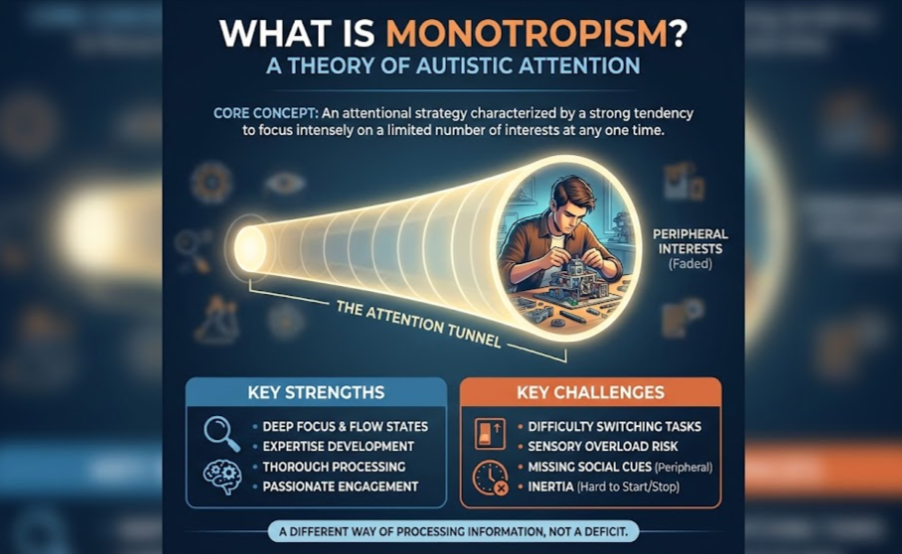
Monotropism is a theory of how attention works in the human brain. It proposes that we all have a limited amount of attention, but we distribute it differently.
Polytropic minds (typical): Attention spreads out like a lantern, casting diffuse light in all directions. This allows easy multitasking and social scanning—noticing when someone enters a room, tracking multiple conversations, shifting fluidly between tasks.
Monotropic minds (autistic/AuDHD): Attention concentrates into intense “tunnels,” like a laser beam. When you’re in the tunnel, you experience extraordinary depth, focus, pattern recognition, and often joy. The tradeoff: everything outside the tunnel essentially disappears.
This single mechanism—how attention is distributed—may explain nearly all autistic traits. Not as “deficits,” but as downstream effects of a different cognitive operating system.
Why This Changes Everything You Were Told About Autism
For decades, autism was explained through “Theory of Mind”—the idea that autistic people lack empathy or can’t understand others’ perspectives. This framework was developed by non-autistic researchers observing autistic people from the outside.
Monotropism was developed by autistic researchers—Dr. Dinah Murray, Dr. Wenn Lawson, and Mike Lesser—describing their own lived experience from the inside. It was formally published in 2005 but largely ignored by the medical establishment until now.
The difference matters clinically:
- Theory of Mind says: You don’t notice social cues because you lack social understanding
- Monotropism says: You don’t notice social cues because your attention is deeply focused elsewhere, and shifting the beam is energetically expensive
One frames you as broken. The other frames you as specialized.
5 Signs You Have a Monotropic Mind
These aren’t diagnostic criteria—they’re experiential markers that resonate with monotropic people:
1. You Lose Time Inside Interests
When you’re engaged with something that captures your attention, hours vanish. You forget to eat, drink, or use the bathroom. You may not hear someone calling your name from the next room. This isn’t a “hyperfocus superpower”—it’s the natural state of a monotropic attention system doing what it does.
2. Transitions Feel Physically Painful
Stopping a task to do something else—even something you want to do—requires enormous effort. It’s not laziness or defiance. Dismantling an attention tunnel and building a new one consumes significant cognitive resources. The technical term is “monotropic inertia.”
3. Interruptions Trigger Disproportionate Distress
Someone asking “quick question?” while you’re working doesn’t feel quick. It feels like being yanked out of deep water. The irritation or shutdown that follows isn’t rudeness—it’s the neurological cost of forced attention shifting.
4. You Have a “Spiky Profile”
You’re exceptional at some things and struggle with others that seem “basic.” You might have a graduate degree but forget to pay bills. You might solve complex problems but can’t figure out what to make for dinner. Monotropism explains this: your attention system creates depth at the cost of breadth.
5. Small Talk Exhausts You; Deep Talk Energizes You
Surface-level social interaction requires constant attention-shifting—monitoring faces, tracking topics, managing timing. Deep conversation about a shared interest lets you stay in one tunnel, which is restorative rather than depleting.
The AuDHD Experience: When Two Systems Collide
This is where monotropism becomes essential for understanding the AuDHD (autism + ADHD) experience—and why AuDHD individuals scored highest on the viral Monotropism Questionnaire.
Here’s the internal conflict:
- The autistic side builds attention tunnels. It craves depth, sameness, and completion. It wants to stay in the flow state forever.
- The ADHD side constantly seeks new tunnels. It craves novelty and stimulation. It gets bored and wants to shift.
The result is what some researchers call an internal “civil war”:
You’re desperate for a flow state but can’t maintain it. You start projects with intense focus, then your ADHD pulls you toward something new before completion. You feel guilty for abandoning things. You cycle between hyperfocus and paralysis.
This also creates “Meerkat Mode”—a state of hypervigilance where you’re scanning for the next interesting thing while simultaneously trying to stay focused on the current thing. It’s exhausting in a way that’s hard to explain to people with neurotypical attention systems.
What Is “Monotropic Split”? (And Why It Causes Burnout)
This is the most clinically useful concept from monotropism research. Understanding it can change how you structure your entire life.
Monotropic Split occurs when a monotropic person is forced to divide their attention across multiple channels simultaneously—something the polytropic world treats as normal and expected.
Examples of forced splitting:
- Maintaining eye contact while listening to instructions while filtering out background noise
- Taking notes while someone is talking while tracking time
- Cooking dinner while supervising children while answering a partner’s questions
- Working on a project while monitoring email while being available for “quick” interruptions
For a polytropic brain, these are manageable multitasks. For a monotropic brain, each split drains cognitive resources at an accelerated rate.
The cumulative effect of chronic monotropic splitting is autistic burnout—a state of profound exhaustion, skill regression, and increased sensory sensitivity that can last months or years.
7 Strategies to Protect Your Monotropic Mind
These aren’t “coping mechanisms” for a disorder. They’re accommodations for a different cognitive architecture.
1. Build “Entry Ramps” Into Your Tunnels
Abrupt transitions are the enemy. Create gradual on-ramps to new activities:
- Set a timer for 10 minutes before you need to switch tasks—not to stop immediately, but to begin mentally preparing
- Use transition rituals (a specific song, a cup of tea, a brief walk) to signal your brain that a shift is coming
- When possible, connect new tasks to current interests to make the tunnel-shift less jarring
2. Protect Your Tunnel Time
Schedule blocks of uninterruptible focus time and defend them fiercely:
- Turn off notifications—not silence, off
- Use visual signals (headphones, closed door, specific location) that communicate “I am in a tunnel”
- Communicate to family/coworkers: “I’ll be available at [specific time]” rather than being perpetually interruptible
3. Reduce Splitting Demands
Audit your daily life for forced attention splits and eliminate what you can:
- Request written instructions instead of verbal (so you’re not splitting between listening and remembering)
- Use noise-canceling headphones to reduce auditory splitting
- Batch similar tasks together rather than context-switching throughout the day
4. Script Your Transitions
If you know a transition is coming, pre-decide what you’ll do:
- “When the timer goes off, I will save my work, stand up, and walk to the kitchen”
- “When my partner gets home, I will finish my current sentence, close my laptop, and greet them”
- The decision fatigue of figuring out how to transition adds to the cognitive load—pre-scripting removes it
5. Use “Parallel Play” for Connection
Traditional social interaction requires constant attention-shifting. Parallel play—being together while focused on separate activities—allows connection without splitting:
- Reading in the same room as a partner
- Working on separate projects at the same table
- Walking together without requiring continuous conversation
This isn’t “antisocial.” It’s a monotropism-compatible way to be with people you love.
6. Teach Others “Gentle Entry”
When people need your attention, ask them to enter your tunnel rather than breaking it:
- “If you need me, start by saying my name and waiting for me to look up before continuing”
- “Text me ‘when you have a minute’ rather than launching into a question”
- “Approach from where I can see you rather than speaking from behind me”
This isn’t high-maintenance. It’s the accommodation equivalent of not shouting at someone wearing headphones.
7. Plan Recovery After High-Split Days
Some days will require extensive splitting—meetings, social events, unpredictable environments. Plan for recovery:
- Schedule buffer time after high-demand activities
- Have a “recovery tunnel” ready—an activity that restores rather than depletes
- Lower expectations for productivity the day after high-split events
What Monotropism Means for Therapy
If you’re seeking therapy as a monotropic person, this framework changes what effective treatment looks like.
What Doesn’t Work
Social skills training that increases splitting. Traditional approaches often teach autistic people to monitor more channels simultaneously—maintain eye contact, track facial expressions, manage body language, time responses appropriately. This increases masking and accelerates burnout.
Therapy that requires rapid topic-switching. Some therapeutic approaches jump between topics or use frequent interruptions. For monotropic clients, this is cognitively expensive and may prevent deep processing.
Homework that requires multitasking. “Practice this skill while doing your normal activities” doesn’t account for the splitting cost.
What Does Work
Input control. Therapy that helps you manage what enters your attention system rather than forcing you to handle more inputs simultaneously.
Depth over breadth. Staying with one topic or skill until it’s integrated rather than covering many things superficially.
Accommodating your tunnels. A therapist who lets you talk about your interests, uses them as bridges to other topics, and doesn’t pathologize your focus patterns.
Reducing shame. Understanding that your struggles aren’t character flaws—they’re the predictable result of a monotropic mind operating in a polytropic world.
For Partners and Family: How to Connect Without Breaking Tunnels
If you love someone with a monotropic mind, these strategies will improve your relationship more than any amount of asking them to “pay more attention.”
Enter, Don’t Interrupt
When you need their attention, signal first and wait:
- Say their name and pause
- Touch their shoulder gently if they haven’t heard you
- Wait for them to reach a stopping point before speaking
This feels slower but actually gets you better attention than forcing an abrupt break.
Join Their Tunnel
You don’t have to share their interests to connect. You can:
- Ask genuine questions about what they’re focused on
- Sit nearby while they’re engaged in something (parallel presence)
- Learn enough about their interest to have one meaningful conversation about it
Provide Transition Warnings
“We need to leave in 30 minutes” followed by “15 minutes” followed by “5 minutes” is not nagging—it’s accommodation. It gives their brain time to begin the tunnel-dismantling process.
Don’t Take the Tunnel Personally
When they’re deeply focused and don’t respond immediately, it’s not rejection. Their attention system isn’t designed for constant availability. The depth they bring to their interests is the same depth they’ll bring to you when the tunnel includes you.
The Viral Moment: Why Monotropism Is Exploding Now
The Monotropism Questionnaire went viral on TikTok and social media in 2024-2025, and suddenly thousands of late-diagnosed adults had language for experiences they’d never been able to articulate.
Key findings from the viral spread:
- People with AuDHD scored highest of all groups
- Many respondents reported the questionnaire was more validating than their formal diagnosis
- The framework gave people permission to stop forcing themselves into polytropic patterns
This matters because monotropism isn’t just an interesting theory—it’s a practical framework for restructuring your life around how your brain actually works rather than how the world says it should work.
Common Questions
Is monotropism the same as hyperfocus?
Related but not identical. Hyperfocus describes the experience of intense concentration. Monotropism is a broader theory about attention distribution that explains hyperfocus as one feature of a monotropic cognitive style—along with transition difficulties, sensory processing differences, and social communication patterns.
Can you be monotropic without being autistic?
The research suggests monotropism exists on a spectrum, with most autistic people falling on the strongly monotropic end. Some non-autistic people may have monotropic tendencies, but the full pattern of traits associated with monotropism overlaps heavily with autism.
Does monotropism explain ADHD too?
Current thinking suggests ADHD may represent a “kinetic” form of monotropism—the attention tunnels exist but shift rapidly and involuntarily rather than staying fixed. This explains the ADHD paradox of “attention deficit” coexisting with hyperfocus.
Can therapy change monotropism?
Monotropism appears to be a fundamental cognitive style, not a behavior to be modified. Effective therapy doesn’t try to make monotropic people polytropic—it helps them understand their attention system, reduce harmful splitting, and build a life compatible with how their brain works.
Next Steps: Finding Monotropism-Informed Support
If this framework resonates with you—if you’re finally seeing your experiences reflected accurately—working with a neurodivergent-affirming therapist can help you apply these insights practically.
At Taproot Therapy Collective, we work from a neurodivergent-affirming framework that treats autism and ADHD as differences to be understood and accommodated, not disorders to be fixed. Our clinicians specialize in helping late-diagnosed adults, AuDHD clients, and anyone whose brain doesn’t fit the neurotypical mold build lives that work with their neurology rather than against it.
About This Article
This guide was written by the clinical team at Taproot Therapy Collective, a Birmingham-based psychotherapy practice specializing in complex trauma, neurodivergent-affirming care, and depth-oriented approaches. We wrote this because we believe neurodivergent people deserve frameworks that describe their experience accurately rather than pathologically.
Key Sources: Murray, D., Lesser, M., & Lawson, W. (2005). Attention, monotropism and the diagnostic criteria for autism. Autism, 9(2), 139-156. Monotropism.org. Garau, V., et al. (2023). Monotropism Questionnaire validation studies.



















0 Comments