
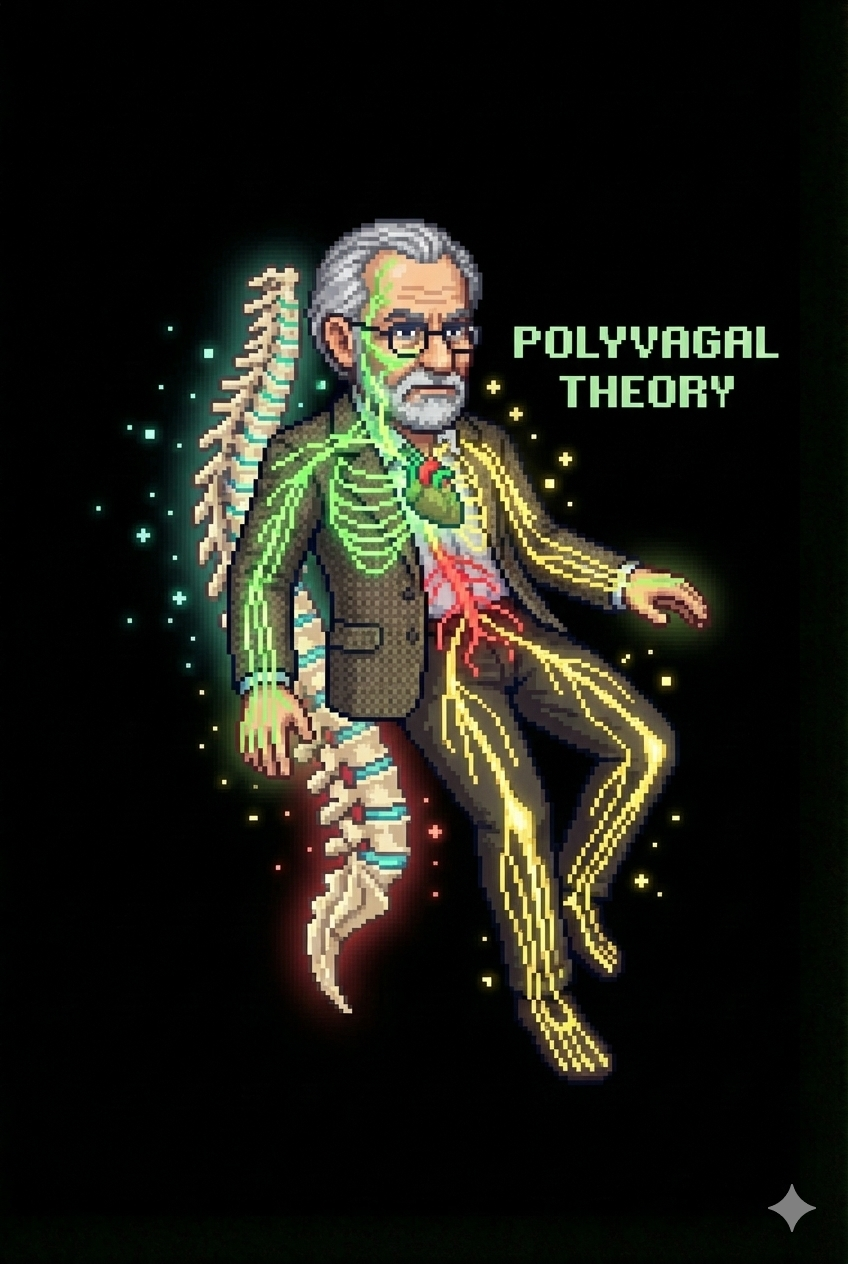
If you have ever felt your heart race during a stressful meeting, or felt your stomach knot up before a difficult conversation, you have experienced your nervous system shifting gears. For decades, traditional psychology treated anxiety as a “thinking” problem—a flaw in your mindset that could be fixed with logic. However, modern somatic psychology reveals that anxiety is often a physiological state, not a mental one. The key to unlocking this state isn’t in your brain; it’s in your neck. It is the Vagus Nerve, the longest nerve in the body, and learning to regulate it is the single most effective tool for managing stress without medication.
The Vagus Nerve (from the Latin for “wandering”) travels from the brainstem down into the chest and abdomen, connecting your brain to your heart, lungs, and gut. It is the command center of the Parasympathetic Nervous System—the “rest and digest” mode that counteracts the “fight or flight” response. According to Polyvagal Theory, developed by Dr. Stephen Porges, the Vagus Nerve is what allows us to feel safe, social, and connected. When it is functioning well (high “vagal tone”), we can bounce back from stress quickly. When it is dormant (low vagal tone), we get stuck in chronic defensive states: either the high-energy panic of anxiety or the low-energy collapse of depression.
For many of our clients in Birmingham, “talk therapy” hits a wall because you cannot think your way out of a survival response. If your body thinks it is being hunted by a tiger, no amount of rationalizing will lower your heart rate. You have to speak the body’s language. Below are five evidence-based somatic exercises that manually stimulate the Vagus Nerve, sending a direct signal to your brain that it is safe to relax.
1. The “Voo” Sound (Vocal Toning)
The Vagus Nerve passes right through the vocal cords. Vibration in the throat is one of the fastest ways to stimulate it. This exercise, often used in Somatic Experiencing, uses sound to vibrate the chest and neck.
- Take a deep breath into your belly, not your chest.
- On the exhale, make a low, deep, foghorn sound: “Voooooo.”
- Focus on feeling the vibration rumble in your chest and belly.
- Repeat for 1-2 minutes until you feel a “shift” (often a yawn or a sigh).
2. The Oculocardiac Reflex (Eye Movements)
The muscles of the eyes are directly connected to the suboccipital muscles at the base of the skull, which sits right over the Vagus Nerve. Stiff eyes often mean a stiff neck and a locked nervous system.
- Lie on your back with your hands interlocked behind your head.
- Keep your head perfectly still.
- Move only your eyes to look as far to the right as you can (without pain).
- Hold this gaze for 30-60 seconds.
- Wait for a sign of relaxation: a swallow, a yawn, or a deep sigh.
- Repeat on the left side.
3. Cold Water Immersion (The Diving Reflex)
Exposure to cold water triggers an ancient mammalian reflex known as the “diving response,” which instantly slows the heart rate to conserve oxygen. It is a biological “hard reset” for panic.
- Fill a large bowl with icy water, or grab an ice pack wrapped in a thin towel.
- Lean forward and submerge your face (or hold the pack to your eyes and cheekbones) for 30 seconds.
- Hold your breath while you do this.
- This is particularly effective for halting a panic attack in progress.
4. Ear Massage
The ear is the only place where the Vagus Nerve reaches the surface of the skin (specifically the cymba conchae, the hollow just above the ear canal). Research suggests that stimulating this area can reduce heart rate variability.
- Place your index finger in the hollow of your ear, just above the opening.
- Gently massage in a circular motion.
- You can also gently pull the ear down and back to open the ear canal.
- Do this for 30 seconds on each side while breathing slowly.
5. Diaphragmatic Breathing with a Long Exhale
The Vagus Nerve is most active during the exhale. By slowing down your exhalation, you physically force your heart rate to drop (a phenomenon called respiratory sinus arrhythmia).
- Inhale through your nose for a count of 4.
- Hold for a count of 4.
- Exhale through pursed lips (like you are blowing through a straw) for a count of 8.
- The key is making the exhale longer than the inhale.
Incorporating these tools into your daily routine can gradually increase your vagal tone, making you more resilient to stress over time. However, for those with a history of complex trauma, these exercises are just the beginning. At our clinic, we combine these physiological tools with deep processing work to help the nervous system relearn safety permanently. If you are stuck in a loop of fight-or-flight, consider reaching out for anxiety therapy that includes the body, not just the mind.
















0 Comments