
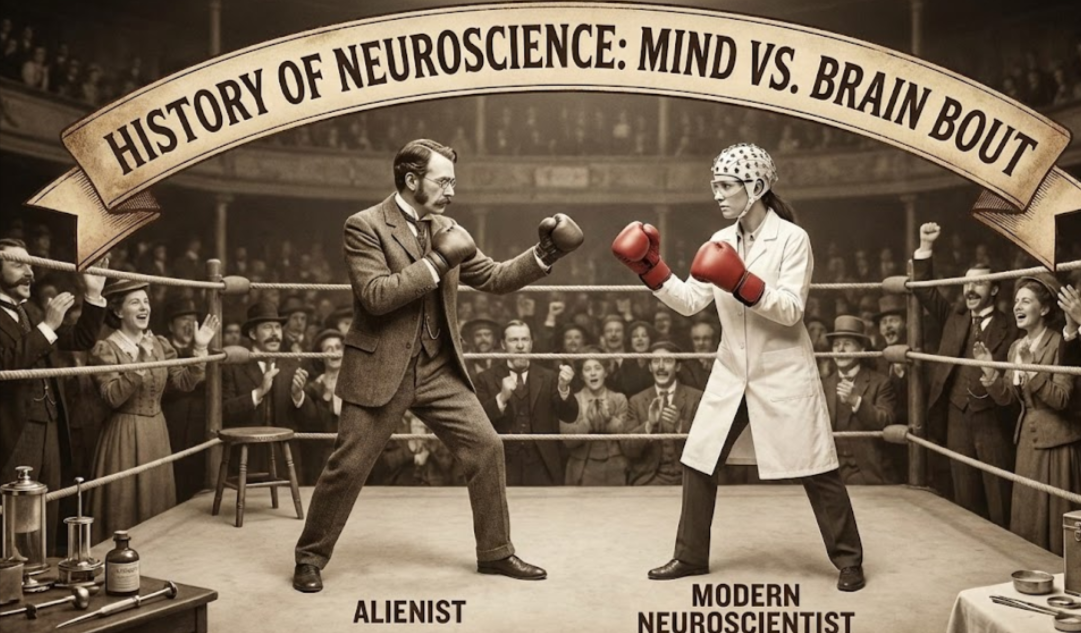
The history of neuroscience isn’t a clean progression toward enlightenment. It’s a chronicle of violent intellectual schisms. Fifteen feuds that shaped how we understand the mind—from the synapse to the soul.
The Fractured Mirror
The history of neuroscience is frequently narrated as a cumulative ascension toward enlightenment—a linear accumulation of facts leading inexorably from ignorance to understanding. This narrative is a fiction.
The true history of the field is a chronicle of violent intellectual schisms, bitter personal feuds, and profound philosophical ruptures. It is a history defined not by what was agreed upon, but by what was fought over. From the microscopic architecture of the synapse to the cosmic questions of quantum consciousness, the definition of the human mind has been forged in the fires of adversarial debate.
This report provides an exhaustive analysis of the fifteen most significant feuds in the history of neurology, psychology, and consciousness studies. It traces the arc of inquiry from the structural debates of the 19th century to the computational and quantum controversies of the 21st—including the contentious dialogues surrounding the “single neuron” theory of consciousness and the deep psychological wars regarding phylogeny and ontology in the work of Erich Neumann.
By dissecting the structural assumptions, the combatants, and the modern verdicts of these disputes, we reveal the fragmented nature of our current understanding of the self.
Part I: The War for the Hardware (Structural Foundations)
The most fundamental debates in neuroscience concern the physical substrate of the mind. Before one could ask how the brain thinks, one had to agree on what the brain was. These early wars were fought over tissue, dye, and the resolution of the microscope.
1. The Neuron Doctrine vs. The Reticular Theory
The Combatants: Camillo Golgi (The Reticularist) vs. Santiago Ramón y Cajal (The Neuronist)
The Era: Late 19th Century – Early 20th Century
The inaugural feud of modern neuroscience—the dispute that birthed the field itself—concerned the fundamental architecture of the nervous system. In the late 19th century, the dominant biological view was the Reticular Theory. Proponents, led by the distinguished Italian pathologist Camillo Golgi, maintained that the nervous system was a continuous, seamless meshwork—a reticulum—where the cytoplasm of nerve cells flowed freely into one another.
The Structural Assumption: The Reticular Theory was rooted in a holistic premise: that physical continuity was necessary for functional continuity. If the brain was to act as a unified whole, its physical constituents must be fused.
The Irony: It was Golgi who invented the reazione nera (“black reaction”), a silver nitrate staining technique that randomly darkened a small percentage of neurons in their entirety. For the first time, the intricate arborization of the nervous system was visible. Yet, Golgi looked at these images and saw a network.
Enter Santiago Ramón y Cajal, a Spaniard with an artist’s eye and a ferocious work ethic. Using Golgi’s own stain, Cajal improved the technique and applied it to embryonic tissue. He observed that the “network” was actually composed of distinct, individual cells that touched but did not fuse. He identified the growth cone at the tip of developing axons and the terminal buttons where they ended. This formed the basis of the Neuron Doctrine: the brain is made of discrete units (neurons) that are metabolically and structurally independent.
The Drama: The tension culminated in 1906 when both men were jointly awarded the Nobel Prize in Physiology or Medicine. In a display of spectacular professional animosity, Golgi used his Nobel lecture to launch a blistering attack on the Neuron Doctrine, defending his Reticular Theory despite the mounting evidence against it. Cajal sat in the audience, reportedly fuming at what he later described as a display of “unlimited self-worship.”
Modern Verdict: Victory for Cajal.
The electron microscope, developed in the 1950s, provided final visual proof of the synaptic cleft—the physical gap between neurons—vindicating Cajal’s claim of discontinuity.
However: A nuanced “post-verdict” has emerged. The discovery of gap junctions (electrical synapses) revealed that in certain inhibitory networks and glial syncytia, the cytoplasm of adjacent cells is connected by protein channels (connexons). While Cajal won the war for the primary architecture, Golgi’s intuition of a “continuous” network was not entirely hallucinated—it exists in specific, specialized subsystems.
2. Soup vs. Sparks: The Nature of Synaptic Transmission
The Combatants: Sir John Eccles (The Spark) vs. Sir Henry Dale and Otto Loewi (The Soups)
The Era: 1930s – 1950s
Once the Neuron Doctrine established that neurons were separated by a gap (the synapse), the battleground shifted to the mechanism of communication across that gap. How does the signal cross the void?
The Sparks (Eccles): Led by the Australian neurophysiologist John Eccles, this camp argued that synaptic transmission must be electrical. Their assumption was based on speed. The nervous system operates at milliseconds; the diffusion of a chemical across a gap seemed far too sluggish.
The Soups (Dale/Loewi): Henry Dale and Otto Loewi argued for chemical transmission. They believed a substance (a neurotransmitter) was released from the pre-synaptic terminal, diffused across the cleft, and bound to receptors on the other side.
The Dream Experiment: On Easter Saturday in 1921, Otto Loewi dreamed of an experiment. He woke up, scribbled it down, and went back to sleep. The next morning, he couldn’t read his notes. The dream returned the next night; this time, he ran to the lab. He isolated two frog hearts. Heart A was stimulated by the vagus nerve (slowing it down). He collected the fluid from Heart A and transferred it to Heart B. Heart B slowed down. This proved that a chemical substance (Vagusstoff, later identified as acetylcholine) was mediating the signal.
Despite this, Eccles held the line for the CNS for another two decades. The feud was resolved not by the victory of one ego, but by the conversion of the antagonist. In 1951, Eccles conducted an experiment using glass microelectrodes. The data showed a synaptic delay. Eccles, true to his Popperian principles, publicly renounced his theory and embraced the chemical model, later winning the Nobel Prize for elucidating the ionic mechanisms of the chemical synapse.
Modern Verdict: Victory for the Soups.
The vast majority of synaptic transmission in the human brain is chemical. This allows for the modulation, amplification, and inhibition that characterize complex thought.
Nuance: Just as with Golgi, the “loser” was not 100% wrong. Electrical transmission does exist via gap junctions, particularly in interneuron networks that require hyper-synchronous firing (e.g., gamma oscillations). The brain is mostly soup, but it has some sparks.
3. The “Silent” Majority: The Glia Wars
The Combatants: Ben Barres vs. The Neuro-Centric Establishment
The Era: 1990s – 2017
For a century, the neuron was the protagonist of the brain, and glial cells (astrocytes, microglia, oligodendrocytes) were the stagehands. The very name glia comes from the Greek for “glue,” reflecting the structural assumption that their only role was to hold neurons together and provide metabolic support.
The Revolution: Ben Barres, a visionary neurobiologist at Stanford, launched a career-long crusade against this dogma. He argued that the view of the brain as solely neuronal was a fundamental error. He proposed that glia were active participants in the formation, maintenance, and pruning of synapses—the “tripartite synapse” consisting of the pre-synaptic neuron, the post-synaptic neuron, and the astrocyte process wrapping them was the true unit of neural function.
Barres’s lab developed new purification techniques to culture neurons in the absence of glia. They found that without astrocytes, neurons could survive but failed to form functional synapses. They were structurally sound but functionally mute. It was the “glue” that turned the hardware on.
Modern Verdict: Total Victory for Barres.
We now know that astrocytes secrete specific proteins (such as thrombospondins) that induce synapse formation. Microglia, once seen only as immune scavengers, are now understood to actively “prune” weak synapses during development and sleep, shaping the connectivity of the brain. Modern neuroscience is distinctively “gliocentric” in its understanding of plasticity, neurodegeneration, and even intelligence.
4. The Dogma of the Static Brain: Adult Neurogenesis
The Combatants: Pasko Rakic (The Enforcer) vs. Joseph Altman, Michael Kaplan, and Elizabeth Gould (The Heretics)
The Era: 1960s – 1990s
The Dogma: For most of the 20th century, a central tenet of neurology was that the adult primate brain is structurally static. “No new neurons” was the law. It was believed that the complexity of the brain’s circuitry precluded the addition of new units without disrupting stored information.
The Heresy: In the 1960s, Joseph Altman used tritiated thymidine (a radioactive marker that integrates into the DNA of dividing cells) to show that new neurons were being born in the hippocampus of adult rats. He published these findings in prestigious journals, but they were largely ignored.
The Enforcer: Pasko Rakic, a dominant figure in primatology at Yale, vehemently argued against adult neurogenesis in primates. He posited that while it might happen in rodents, it was evolutionarily incompatible with the cognitive stability required by higher primates.
The Crushing: Rakic’s authority was so immense that it effectively suffocated the field for thirty years. When Michael Kaplan replicated Altman’s work in the 1970s, Rakic famously dismissed it, telling Kaplan at a conference, “Those may look like neurons in New Mexico, but they don’t in New Haven.” Kaplan eventually left research, his career a casualty of the feud.
The tide turned in the 1990s when Elizabeth Gould showed evidence in primates. Finally, Fred Gage used BrdU staining in cancer patients to prove unequivocally that the adult human dentate gyrus generates new neurons.
Modern Verdict: Victory for Altman (Posthumous Vindication).
Adult neurogenesis is now a verified fact in the human hippocampus. It is understood to be critical for pattern separation (distinguishing similar memories) and mood regulation. The “neurogenic theory of depression” suggests that antidepressants work not just by boosting serotonin, but by stimulating the birth of new neurons in the hippocampus—a process that takes weeks, matching the clinical lag of the drugs.
Part II: The War for the Map (Localization and Coding)
Once the cellular hardware was established, the war moved to the geography of the brain. Does specific tissue perform specific tasks, or does the brain act as a unified, equipotential mass?
5. Localization vs. Equipotentiality
The Combatants: Paul Broca (The Localizer) vs. Pierre Flourens and Karl Lashley (The Holists)
The Era: 1860s – 1950s
Localization: The brain is a collection of distinct organs or “modules,” each responsible for a specific faculty (language, color, motion, morality).
Equipotentiality: The cortex is a homogenous computing surface. If one part is damaged, other parts can take over. The amount of tissue matters, not the location.
This feud traces back to the pseudoscience of Phrenology (Franz Gall). Pierre Flourens, a French physiologist, sought to debunk Gall. He performed ablation studies on pigeons, removing vast swathes of cortex, and observed that the birds recovered function regardless of where he cut. He concluded the brain functioned as a whole (“Action Commune”).
The pendulum swung back with Paul Broca. In 1861, he presented the case of “Tan” (Monsieur Leborgne), a patient who could understand language but could only utter the syllable “tan.” Upon Tan’s death, Broca revealed a lesion in the left frontal lobe (now Broca’s Area). This was the “smoking gun” for localization.
However, the Holists returned with Karl Lashley. Lashley spent thirty years searching for the “engram” (memory trace) in rats. He trained rats to run mazes and then systematically lesioned different parts of their cortex. He found that the location of the cut didn’t matter, only the size. He formulated the Law of Mass Action: the efficiency of performance is reduced in proportion to the extent of brain injury, but not by the location.
Modern Verdict: A Synthesized Truce (Network Neuroscience).
Both sides were partially right, but structurally wrong.
Broca was right about “modular” input/output systems: primary visual cortex, motor cortex, and language areas are highly localized. Lashley was right about higher-order cognition: memory, attention, and consciousness are distributed properties.
Modern View: The brain is organized into large-scale distributed networks (e.g., the Default Mode Network, the Salience Network). Nodes are localized (specialized), but function emerges from the connectivity between nodes.
6. The Hunt for the Engram
The Combatants: Karl Lashley vs. Richard Thompson and Susumu Tonegawa
The Era: 1920s – Present
The Assumption: A memory must physically exist somewhere in the brain. It must be a physical change in matter—an “engram.”
Lashley’s failure to find the engram led him to a despairing conclusion: “It is not possible to demonstrate the isolated localization of a memory trace anywhere within the nervous system… [perhaps] learning is not possible.”
Richard Thompson challenged this in the 1980s by simplifying the model. Instead of complex mazes, he studied simple eyeblink conditioning in rabbits. He located the essential circuitry in the cerebellum (interpositus nucleus). He proved that a memory could be localized to a millimeter of tissue.
Susumu Tonegawa, a Nobel laureate in immunology who switched to neuroscience, took this to the cellular level. Using optogenetics, Tonegawa’s lab tagged specific neurons in the hippocampus that were active during fear conditioning. They then reactivated only those neurons with blue light in a different context, causing the mouse to freeze.
Modern Verdict: Victory for Specificity (The Engram Cell).
Tonegawa proved that engrams are real and reside in specific neuronal ensembles. We can now manipulate, erase, and even implant false memories by targeting these specific cells. This refutes Lashley’s “mass action” for specific episodic memories, though Lashley’s intuition about the distributed nature of complex knowledge remains valid.
7. The Grandmother Cell vs. Distributed Coding
The Combatants: Jerome Lettvin/Horace Barlow vs. The Parallel Distributed Processing (PDP) School
The Era: 1960s – 2000s
The Question: If the visual system processes information hierarchically (from lines in V1 to shapes in V4), does it culminate in a single neuron at the top of the pyramid that fires only when you recognize a specific object?
The Grandmother Cell: In 1969, Jerome Lettvin published a famous, semi-satirical paper. He told a parable about a neurosurgeon who ablated the concept of a mother from a patient by killing 18,000 specific neurons. This ridiculed the idea of extreme specificity.
Sparse Coding: Horace Barlow argued for “gnostic units”—neurons that represent complex percepts. He argued the brain uses “sparse coding” (very few active neurons) rather than “distributed coding” (millions of active neurons) to represent a concept.
Modern Verdict: The “Jennifer Aniston Neuron” Validation.
In 2005, Rodrigo Quian Quiroga, recording from single neurons in the medial temporal lobe of epilepsy patients, made a stunning discovery. He found neurons that fired exclusively to images of Jennifer Aniston. They fired for her face, her body, and even the written name “Jennifer Aniston,” but not for Julia Roberts or the Eiffel Tower.
These are now called Concept Cells. They do not represent the visual features (which is what Lettvin mocked) but the abstract semantic concept of the person. They are multimodal and invariant. The verdict is a victory for Sparse Coding: the brain uses a remarkably small number of neurons to encode specific, familiar concepts at the highest level of the hierarchy.
Part III: The War for the Self (Consciousness and Agency)
Here we address the specific query regarding the “Blake” and “Gazzaniga” debate on the single neuron. This dispute bridges the gap between the biological hardware and the philosophical software of the mind.
8. “To See a World in a Grain of Sand”: The Unit of Consciousness
The Combatants: Michael Gazzaniga vs. Reductionism (and The Single Neuron Theorists)
The Era: 1980s – Present
The “Blake” Connection:
Michael Gazzaniga frequently cites William Blake’s famous opening to Auguries of Innocence:
“To see a World in a Grain of Sand / And a Heaven in a Wild Flower / Hold Infinity in the palm of your hand / And Eternity in an hour”
Gazzaniga uses this metaphor to fight a war on two fronts:
Against Radical Reductionism: He argues against the view that the “Self” is an illusion that vanishes when you examine the parts. He uses Blake’s metaphor to argue that the particular (the grain of sand/the neuronal module) contains the complexity of the whole. “The human organism requires the Self to exist… The Self is not a simple amalgam of sensory experiences.”
Against Holism: Conversely, Gazzaniga argues that consciousness is not a uniform “mist” covering the brain. It is granular. In The Consciousness Instinct, he argues that consciousness is an inherent property of complex local circuits—”bubbles” of awareness that are stitched together.
The Structural Assumption: Gazzaniga posits a modular architecture where consciousness is “particularized” (quoting Blake: “to particularize is the alone distinction of merit”). The “one neuron” query refers to the finding (supported by Quiroga’s Jennifer Aniston cells) that a single unit can hold a complete, conscious percept.
Verdict: The “Grain of Sand” is Real, but the “World” requires the Network.
Modern neuroscience validates that single neurons (Concept Cells) can hold high-level semantic content (the “World” of Jennifer Aniston). However, the consensus (from Seth, Dehaene, etc.) is that for this content to be experienced (phenomenal consciousness), it must be integrated into a larger system. The single neuron is necessary, but likely not sufficient, for the subjective feeling of the self.
9. The Split-Brain and The Interpreter
The Combatants: Roger Sperry/Michael Gazzaniga vs. The Unity of Self (and modern critics like Pinto)
The Era: 1960s – Present
The Assumption: The subjective feeling of being “one person” implies the brain is a single unified processor.
In the 1960s, Roger Sperry and Michael Gazzaniga studied patients who had undergone callosotomy (severing the corpus callosum) to treat epilepsy. They found that the two hemispheres could operate independently. The left brain (which speaks) could not report what the right brain (which sees the left visual field) saw.
The Interpreter: Gazzaniga discovered that when the right brain performed an action (e.g., standing up), the left brain—unaware of the cause—would immediately fabricate a reason (“I wanted a soda”). This led to the theory of the Interpreter Module: a left-hemisphere system that creates a post-hoc narrative to create the illusion of a unified self.
Modern Challenge: Recently, researchers like Yair Pinto have challenged the “dual consciousness” model. They argue that split-brain patients claim to feel whole, and that attention might still be integrated subcortically.
Verdict: The Interpreter stands, but the split is messy.
The “Interpreter” remains one of the most powerful concepts in psychology, explaining everything from denial to confabulation in healthy people. However, the “two minds” view is now seen as too simplistic; subcortical connections likely maintain a low-level unity of arousal and emotion even when cortical cognition is split.
10. The Adversarial Collaboration: Structure vs. Broadcast
The Combatants: Giulio Tononi (Integrated Information Theory – IIT) vs. Stanislas Dehaene (Global Neuronal Workspace – GNW)
The Era: 2000s – Present
IIT (Tononi/Koch): Consciousness is a fundamental property of any system with a specific causal structure (high Φ or “Phi”). It is about being a structure, not doing a task. It predicts consciousness is located in the “hot zone” (posterior cortex) where connectivity is grid-like.
GNW (Dehaene): Consciousness is a function of broadcasting information. A stimulus becomes conscious only when it is amplified by the “ignition” of the prefrontal cortex and shared across the brain. No broadcast = no consciousness. It predicts frontal involvement.
The Drama: A massive “adversarial collaboration” funded by the Templeton Foundation pitted the two theories against each other in 2023. They pre-registered predictions and ran fMRI/MEG studies.
The Result: The data was mixed. The posterior cortex (IIT’s “hot zone”) maintained information during conscious experience better than the frontal cortex. However, the synchronization predicted by GNW was partly observed.
Verdict: Stalemate (leaning slightly to IIT on anatomy, GNW on function).
11. The Hard Problem: Illusionism vs. Realism
The Combatants: David Chalmers vs. Daniel Dennett
The Era: 1994 – 2024
Chalmers: Coined the “Hard Problem.” He argues that even if we explain every function of the brain (memory, attention, language), we still haven’t explained why it feels like something to be a brain. He argues for Property Dualism or Panpsychism: consciousness is a fundamental building block of the universe, like mass or charge.
Dennett: Argues the Hard Problem is a “user illusion.” He is an Illusionist. He claims that once you explain all the functions (the “Easy Problems”), you have explained consciousness. There is no “figment” of redness; there is only the brain’s reactive disposition to red wavelengths.
Verdict: Philosophical Deadlock.
Neuroscience generally proceeds methodologically as if Dennett is right (looking for mechanisms), but most people intuitively feel Chalmers is right. The feud defines the current boundary between science and philosophy.
12. Quantum Consciousness: Warm, Wet, and Noisy?
The Combatants: Roger Penrose/Stuart Hameroff vs. Max Tegmark
The Era: 1990s – Present
Orch OR (Penrose/Hameroff): They propose that consciousness arises from quantum computations occurring in microtubules inside neurons. The collapse of these quantum states (Objective Reduction) generates moments of conscious awareness.
The Physicist (Tegmark): Max Tegmark calculated the “decoherence time” of neural structures. He argued the brain is too “warm, wet, and noisy.” Quantum states would collapse in 10⁻¹³ seconds, far too fast for millisecond-scale neural processing.
Verdict: Skepticism, with a recent pulse.
Tegmark’s critique was widely accepted as the death knell for quantum consciousness. However, the nascent field of Quantum Biology has since proven that quantum effects do survive in warm biological systems (e.g., in photosynthesis and avian magnetic navigation). Recent studies showing anesthetics binding to microtubules have given Hameroff’s theory a “stay of execution,” though it remains a fringe view.
13. Free Will and the Readiness Potential
The Combatants: Benjamin Libet vs. Aaron Schurger
The Era: 1983 – Present
Libet’s Bomb: Benjamin Libet showed that the “Readiness Potential” (RP)—a buildup of electrical activity in the motor cortex—begins ~550ms before a voluntary action. The subject only becomes aware of the intention to move ~200ms before the act. Conclusion: The brain decides before “you” do.
The Challenger: Aaron Schurger overturned this in 2012. He modeled the RP not as a “decision” but as stochastic neural noise. The brain has background fluctuations; when this noise crosses a threshold, a movement is triggered. We interpret the noise buildup leading to the threshold as a “decision,” but it is just random accumulation.
Verdict: Libet Debunked (The Return of Agency).
Schurger’s work suggests the specific timing of the “decision” is an artifact of averaging data. This restores the possibility of “free will”—or at least “free won’t” (the ability to veto the action in the final 200ms).
Part IV: The Fragmented Self (Identity, Emotion, and Depth Psychology)
14. Ontogeny Recapitulates Phylogeny: The Archetypal Dispute
The Combatants: Erich Neumann (The Jungian) vs. Wolfgang Giegerich and Modern Anthropology
The Era: 1950s – Present
This dispute moves from the physical neuron to the structure of the psyche. Erich Neumann, C.G. Jung’s star pupil, wrote The Origins and History of Consciousness. He applied Ernst Haeckel’s biological law—”Ontogeny recapitulates Phylogeny” (the developing embryo goes through the stages of evolutionary history)—to the mind.
Neumann’s Thesis: The psychological development of the individual child (Ontogeny) mirrors the cultural evolution of the human species (Phylogeny).
Stage 1: The Uroboros. The snake eating its tail. The infant exists in undifferentiated unity with the mother/world, mirroring the “pre-conscious” state of early humanity.
Stage 2: The Great Mother. The ego is small and dependent, ruled by nature/matriarchy.
Stage 3: The Hero. The ego separates from the mother (killing the dragon), mirroring the rise of patriarchal civilization and rational consciousness.
The Critique (Giegerich): Wolfgang Giegerich and other analytical psychologists attacked this as a “naturalistic fallacy.” They argued Neumann was confusing “mythical history” with “empirical history.” Just because a child breaks away from the mother doesn’t mean Stone Age humans lived in a literal “matriarchal consciousness” era. Giegerich argued that the psyche produces history, it is not just a product of it.
Verdict: Valid Psychologically, Questionable Anthropologically.
Neumann’s model remains a brilliant map for therapeutic development (the stages of ego formation). However, modern anthropology and evolutionary psychology reject the strict linear “matriarchy to patriarchy” evolution he proposed. The “Triune Brain” model (reptilian → paleomammalian → neomammalian), which paralleled Neumann’s view, has also been largely discarded by neuroanatomists as overly simplistic, though the functional layering remains a useful heuristic for somatic therapy.
15. The Nature of Emotion: Universal vs. Constructed
The Combatants: Paul Ekman (The Universalist) vs. Lisa Feldman Barrett (The Constructivist)
The Era: 1970s – Present
Ekman: Emotions are “hard-wired” biological reflexes. A smile is a smile in New York or New Guinea. There are 6 basic emotions (Joy, Sadness, Anger, Fear, Disgust, Surprise) with distinct neural fingerprints.
Barrett: Emotions are constructed concepts. The brain receives raw “affect” (valence and arousal) and interprets it based on culture and context. “Fear” is not a circuit; it is a category we learn.
Modern Verdict: Victory for Barrett (The Constructed Theory).
Meta-analyses have failed to find consistent, specific neural fingerprints for the “basic” emotions. The modern view is that the brain predicts internal states (Interoception) and labels them based on cultural concepts. The “Universal” face is largely a result of Western media influence.
This has profound implications for emotional processing in therapy. If emotions are constructed rather than discovered, therapeutic work involves helping clients build new emotional categories, not simply identify pre-existing ones.
The Fragmented Mirror
Tracing these 15 feuds reveals a “meta-trend” in the history of the mind: The oscillation between Lumping and Splitting.
Structure: We moved from Lumping (Reticular theory) to Splitting (Neuron Doctrine) back to Lumping (connectomics/glia).
Function: We moved from Lumping (Equipotentiality) to Splitting (Broca/Localization) to Lumping (Network Neuroscience).
Consciousness: We are currently split between Lumping (Global Workspace) and Splitting (Gazzaniga’s modularity/IIT’s granularity).
The “Blake” debate—whether the universe is in the grain of sand (the single neuron) or the whole dune—remains the poetic heart of the scientific struggle. As Gazzaniga notes, the “Interpreter” in our left hemisphere will always try to weave these disparate feuds into a coherent story. But the history of neuroscience suggests the truth is usually found in the messy, unintegrated conflict between the opposing views.
The modern verdict on the mind is not a single theory, but a tension. We are biological machines (Libet) capable of vetoing our programming (Schurger). We are modular (Broca) yet integrated (Tononi). We are ancient biological entities (Neumann) navigating a constructed reality (Barrett).
The war is not over; the front lines have simply moved from the microscope to the math.
As practitioners of brain-based therapeutic approaches, we inherit all of it—the fractures and the frameworks. Every time you help a client locate sensation in their body, you’re navigating the territory between Barrett’s constructed emotions and the raw interoception beneath them. Every time you work with archetypal imagery, you’re walking the Neumann-Giegerich line between universal pattern and individual construction.
The feuds were not errors in the system. They were the friction necessary to polish the mirror in which we see ourselves.
Summary Table: Major Neuroscience Feuds and Verdicts
| Feud Name | Key Antagonists | Core Disagreement | Modern Verdict |
|---|---|---|---|
| Neuron Doctrine | Golgi vs. Cajal | Continuous network vs. Discrete cells | Cajal (mostly): Cells are discrete, but gap junctions allow continuity |
| Soup vs. Sparks | Eccles vs. Dale | Electrical vs. Chemical transmission | Dale (Soup): Synapses are chemical; gap junctions are electrical |
| Localization | Broca vs. Flourens | Specific modules vs. Holistic function | Synthesis: Network Neuroscience (modules within networks) |
| Glia Wars | Barres vs. Establishment | Glia as glue vs. Glia as active signals | Barres: Glia are critical for synapse formation and pruning |
| Neurogenesis | Rakic vs. Altman | Static brain vs. Adult new neurons | Altman: Adult neurogenesis occurs in hippocampus |
| Engram | Lashley vs. Tonegawa | Distributed memory vs. Specific cells | Tonegawa: Engrams are specific neuronal ensembles |
| Unit of Consciousness | Blake/Sevush vs. Gazzaniga | Single neuron consciousness vs. Network | Network: Single neurons hold concepts, but consciousness requires integration |
| Free Will | Libet vs. Schurger | Deterministic RP vs. Neural Noise | Schurger: RP is noise accumulation; “Free Won’t” is possible |
| Emotions | Ekman vs. Barrett | Universal faces vs. Constructed concepts | Barrett: Emotions are constructed, not biologically fixed fingerprints |
| Hard Problem | Chalmers vs. Dennett | Qualia are real vs. Qualia are illusion | Unresolved: The philosophical divide remains absolute |
| Split Brain | Gazzaniga vs. Pinto | Dual consciousness vs. Visual disconnect | Nuanced: Interpreter module exists, but consciousness may remain unified |
| Archetypes | Neumann vs. Giegerich | Phylogeny recapitulates ontology | Psychologically valid, Biologically doubtful: Useful heuristic, not literal evolution |
| Quantum Mind | Penrose vs. Tegmark | Microtubules vs. Warm/Wet Decoherence | Skeptical: Decoherence is the barrier, though quantum biology is growing |
| Grandmother Cell | Lettvin vs. Quiroga | Hierarchical specificity vs. Distribution | Quiroga: Concept Cells exist (Sparse Coding), validating specificity |
| IIT vs. GNW | Tononi vs. Dehaene | Intrinsic structure vs. Broadcast function | Stalemate: IIT favored on anatomy, GNW on function |




0 Comments