

The Holographic Universe of the Mind: A Clinical Exploration of Holographic Memory Theory and Trauma Resolution
The Holographic Memory Theory (also known as the Holonomic Brain Theory) represents one of the most significant paradigm shifts in modern neurobiology, cognitive science, and depth psychotherapy. First conceptualized through the collaborative insights of neuroscientist Karl Pribram and quantum physicist David Bohm, this model posits that memory storage and cognitive processing do not operate like a traditional computer hard drive. Instead, the brain functions on the structural principles of holography.
Unlike traditional localizationist models that attempt to pin specific memories to isolated neural coordinates, Holographic Memory Theory demonstrates that memories are encoded as complex wave interference patterns distributed non-locally throughout the brain. In a holographic system, each fragment of the network contains access to the absolute whole.
At Taproot Therapy Collective in Birmingham, Alabama, we integrate these advanced holonomic principles into our clinical trauma treatments. When working with complex PTSD, attachment trauma, or chronic somatic symptoms, this framework explains why traditional cognitive talk therapies often fall short—and how neuro-experiential modalities can systematically restore structural coherence to a fragmented mind.
1. Origins and Core Principles of Holonomic Brain Theory
Historical Development
The foundational architecture of Holographic Memory Theory emerged during the 1960s and 1970s from a profound intersection of neuroscience and quantum mechanics. Neuroscientist Karl Pribram was deeply vexed by a recurring clinical paradox: memories consistently survived even after substantial portions of a subject’s brain tissue were surgically removed. This directly contradicted the prevailing medical assumption that individual memories were stored in fixed, local “engrams.”
Concurrently, quantum physicist David Bohm was formulating his model of the Implicate and Explicate Order, suggesting that the physical universe itself is organized holographically—where information about the entire cosmos is enfolded within every region of space and matter.
When Pribram and Bohm combined their research, they arrived at a radical proposition: the brain processes and archives information by translating sensory inputs into wave interference patterns. This model solved major evolutionary mysteries in neuroscience:
-
Damage Resistance: It explained how memories could persist despite extensive localized brain damage.
-
Infinite Storage Capacity: It accounted for how the human brain could store an immense lifetime of multidimensional data within a finite, biological mass.
The Hologram as a Structural Metaphor
To understand how the brain processes data holographically, it is useful to look at how a physical, optical hologram is constructed:
[Laser Source] ---> [Beam Splitter] ---> (Reference Beam) ---------------> [Photographic Plate]
                                    ---> (Object Beam) ---> [Subject] ---> [Interference Pattern]
-
The Reference and Object Beams: A single laser light source is split into two pathways. The reference beam reflects directly onto a photographic plate, while the object beam illuminates the subject before bouncing onto the same plate.
-
The Interference Pattern: The intersection of these two wave fronts creates a chaotic, wave-like interference pattern on the plate. This pattern does not visually resemble the object; it resembles ripples on a pond.
-
Reconstructing the Whole: When a coherent light source shines back through that photographic plate, the original three-dimensional object is perfectly projected back into space.
-
Indivisible Resolution: If you smash that photographic plate into a hundred tiny pieces, each individual fragment still projects the entire three-dimensional image. The only consequence of smaller fragments is a subtle reduction in resolution, not a loss of the overall picture.
The human brain processes reality identically. Neural activity across axonal networks forms wave-like interference patterns that encode experiences across distributed cortical and subcortical maps. Every region of the brain retains access to the systemic whole.
2. Neuroscientific Evidence and Evidence of Non-Locality
The validity of the holographic model is supported by decades of experimental and neuroimaging data:
-
Karl Lashley’s Extirpation Experiments: In his seminal mid-century neurological research, Lashley discovered that rats trained to run mazes could still perform the task even after vast portions of their cerebral cortex were removed. Their movement became physically uncoordinated, but the memory of the maze layout remained intact. The data was distributed, not localized.
-
Distributed Network Activation: Modern functional neuroimaging (fMRI and PET scans) confirms that recalling a single memory does not light up a single “storage vault” in the brain. Instead, it activates vast, synchronous, distributed networks spanning across hemispheres.
-
Coherent Oscillatory Wave Properties: Neural communication is fundamentally oscillatory. The wave-like properties of the brain—specifically the phase-locking and coherence observed in alpha, beta, theta, and gamma frequency bands—function exactly like the interference fields used to record optical holograms.
-
Gazzaniga’s Split-Brain Observations: Michael Gazzaniga’s pioneering work with patients who underwent a corpus callosotomy (severed connection between brain hemispheres) revealed that consciousness can be split down the middle, yet each hemisphere retains a fully functional, independent, and coherent sense of self-awareness. Consciousness behaves like a fractured hologram, preserving wholeness within its smaller parts.
This non-local framework aligns with current research into the subcortical brain and somatic marker hypotheses, explaining how intuition, bodily memory, and immediate threat assessments bypass conscious, top-down processing loops.
3. Trauma and the Fragmentation of the Holographic Memory System
Trauma’s Impact on Memory Architecture
Under normal psychological conditions, experiences are smoothly processed, contextualized, and filed away as coherent linear narratives. However, overwhelming trauma halts this integration process entirely. Instead of being saved as a unified story, a traumatic event fractures across the psyche.
When viewed through the lens of Holographic Memory Theory, trauma can be understood as the fragmentation of a highly organized wave pattern into disconnected, hyper-charged pieces.
| Memory System | Normal Structural Function | Traumatic Disruption (The Fragmented Pieces) |
| Semantic Memory | General knowledge, facts, and the ability to build conscious meaning out of life events. | Radical disruption. The individual struggles to construct a coherent meaning or philosophy around the event, leaving them trapped in existential confusion. |
| Episodic Memory | Linear narrative of personal events anchored in a specific time and geographical space. | The timeline breaks. Memories manifest as raw, vivid sensory shards (smells, sounds, images) disconnected from space and time, making the past feel like the present. |
| Procedural Memory | Automatic bodily motor responses, muscle memories, and structural survival actions. | The body holds the structural action patterns. Hypervigilance, somatic armor, muscle tension, and chronic startle responses become trapped in the physical frame. |
| Emotional Memory | Contextualized affective responses managed smoothly by limbic networks. | The amygdala stores an unmitigated, high-intensity emotional imprint. When triggered, it floods the system with primal panic or rage without narrative context. |
Antonio Damasio’s work on somatic markers demonstrates that our visceral, emotional experiences write physical response patterns directly into our bodily tissues. Traumatic experiences create intense, destabilizing somatic markers that operate entirely outside of conscious awareness.
When a person experiences trauma, these memory systems scatter. The goal of advanced trauma therapy is to restore structural coherence to the distributed holographic system, bringing all parts back into safe alignment within the body’s optimal Window of Tolerance.
[Traumatic Event] ---> Structural Fracture ---> [Sensory Fragment]  (Episodic)
                                           ---> [Somatic Armor]     (Procedural)
                                           ---> [Limbic Panic]      (Emotional)
The Neurobiology of Holonomic Trauma
Neurobiologically, trauma breaks down the coordinated, synchronized brain networks that normally generate a unified sense of self. This structural breakdown manifests as:
-
Default Mode Network (DMN) Dysregulation: The network responsible for self-reflection and autobiographical identity fragments, disrupting the continuum of selfhood.
-
Limbic Dominance: The amygdala enters a state of chronic hyper-activation, overriding the prefrontal cortex’s ability to assess true safety.
-
Prefrontal Hypo-frontality: The executive brain centers lose the power to integrate emotional data with logical narrative structure, crippling the capacity for cognitive resolution.
-
Hippocampal Inefficiency: The hippocampus fails to timestamp the traumatic memory, causing subcortical regions to broadcast the trauma as a live, ongoing threat.
4. Holographic Modalities for Trauma Recovery and Integration
Because trauma is encoded across distributed, somatic, and subcortical networks, purely analytical talk therapy cannot reach the deep root of the injury. True transformation requires working across multiple memory channels simultaneously to restore systemic coherence.
Brainspotting (BSP)
Discovered by David Grand, Brainspotting is a powerful neuro-experiential modality based on the premise that “Where you look affects how you feel.” By locating specific eye positions that correlate with subcortical, somatized emotional distress, clients can directly access trapped traumatic networks.
-
Non-Local Mapping: Brainspotting treats eye positions as precise portals to distributed neural networks where trauma is held.
-
Subcortical Substrate Communication: It establishes a clear processing bridge between the deep brainstem/limbic structures (where somatic memory is held) and the prefrontal cortex (where narrative integration occurs).
-
Simultaneous Processing: By holding focus on a “brainspot” while maintaining somatic awareness, the client processes sensory, emotional, and cognitive data all at once, restoring balance to the fractured system.
QEEG Brain Mapping and Neurofeedback
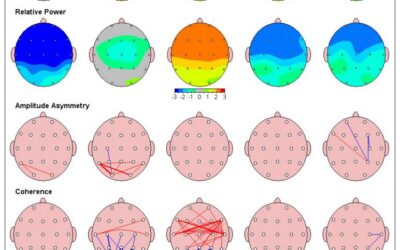
Quantitative Electroencephalography (QEEG) allows us to visually map the brain’s real-time electrical activity, providing a literal image of the neural interference patterns predicted by holographic theory.
-
Identifying Network Gridlock: QEEG mapping pinpoints exactly where brain networks are hyper-coupled or disconnected following trauma.
-
Restoring Coherence: Neurofeedback protocols train the brain to shift out of rigid, trauma-driven frequencies and rebuild flexible, rhythmic communication across hemispheres, fundamentally shifting the underlying holographic field.
Emotional Transformation Therapy (ETT)
Developed by Steven Vazquez, ETT utilizes precise frequencies of light, color stimulation, and strategic eye positions to instantly access and transform deep emotional states.
-
Visual Pathway Portals: ETT takes advantage of the visual system’s direct pathways into the limbic system and midbrain to access distributed neural arrays.
-
Pattern Disruption: Introducing specific wave frequencies of light into active trauma networks creates a neural “prediction error,” allowing the brain to rapidly reorganize and lift the heavy emotional charge from old memories.
Sensorimotor Psychotherapy and Somatic Experiencing
Rooted in the clinical breakthroughs of Pat Ogden and Peter Levine, these somatic approaches recognize that the physical body archives traumatic experiences within procedural memory networks.
-
Somatic Pieces of the Whole: These modalities treat physical symptoms—such as a tight jaw, a collapsed posture, or a racing heart—as the somatic fragments of the holographic memory.
-
Completing the Action: By guiding clients to slowly track and execute the defensive survival responses (like running, pushing, or crying out) that were frozen during the initial trauma, the somatic loop is successfully completed and integrated.
5. Transpersonal Consciousness and Expanded Mind Models
The clinical utility of Holographic Memory Theory extends far beyond symptom reduction; it provides an expansive, empirical framework for understanding the deepest layers of human consciousness and transpersonal psychology.
     [ Individual Conscious Ego ]
                 |
      (Ego-Self Axis Connection)
                 |
  [ Total Transpersonal Self / Field ]
The Jungian Blueprint and Collective Architecture
Carl Jung’s revolutionary mapping of the Collective Unconscious finds its perfect modern explanation within holographic principles. Jung argued that beneath individual, personal memories sits a vast, shared substrate of human experience populated by universal templates called Archetypes.
When viewed through a holonomic lens, archetypes are the primary, foundational interference patterns embedded within the collective human psyche. Because every human brain is a fragment of this larger species-wide field, each individual mind contains structural access to the entire archetypal library of humanity. Shadow work, mythic processing, and dream analysis are not mere metaphors—they are methods for navigating a non-local, psychological universe.
Erich Neumann and Developmental Consciousness
Erich Neumann traced the evolution of human awareness through universal mythological stages (from the uroboric state of wholeness to ego differentiation). Neumann’s developmental arc demonstrates the holographic reality that the individual child recapitulates the entire history of the collective consciousness. Each evolving mind contains the entirety of the psychological history of humanity enfolded within its structural growth steps.
Edward Edinger and the Ego-Self Axis
Edward Edinger focused heavily on the critical psychological link known as the Ego-Self Axis. In analytical psychology, the Ego is merely a small, local outpost of awareness, while the total Self represents the vast, organizing center of the entire psyche.
Edinger demonstrated that psychological suffering, alienation, and inflation stem from a breakdown in communication between the Ego (the part) and the Self (the whole). True psychological healing requires restoring the functional alignment of this axis. This ensures the individual ego recognizes its unique identity while remaining consciously anchored to the transcendent field of the greater Self.
6. Comprehensive Summary of the Paradigm Shift
To ground your clinical work, it is helpful to look at how this model completely transforms standard psychological assumptions:
OLD PATHOLOGICAL MODEL                 NEW HOLOGRAPHIC PARADIGM
----------------------                 ------------------------
Memory is localized in cells. --------> Memory is a distributed wave field.
Symptoms must be suppressed. ---------> Symptoms are portals to the whole story.
Mind and Body are separate. ----------> Mind and Body are a single entity.
The damaged psyche is broken. --------> The core Self is forever undamageable.
By working simultaneously across semantic narratives, limbic emotions, and somatic survival patterns, modern clinicians can systematically rewrite trauma-encoded circuits, allowing a fractured system to return to its natural state of health, resilience, and inner leadership.
7. 2025 Research Addendum: Empirical Advances in Holographic Memory Resolution (HMR)
Introduction to HMR
Holographic Memory Resolution (HMR) is an emerging, non-invasive mind-body therapeutic modality developed by Brent Baum in the early 1990s. It integrates elements of energy psychology, somatic tracking, guided imagery, and clean-language interviewing into a unified clinical framework designed to locate, unpack, and re-encode old trauma imprints without requiring the patient to re-traumatize themselves by reliving the event. While HMR has enjoyed widespread clinical utilization for over three decades, formal, peer-reviewed quantitative studies verifying its efficacy have only recently entered academic literature.
The Landmark Clinical Study: Gaddy et al. (2024)
The first peer-reviewed clinical trial investigating the efficacy of Holographic Memory Resolution was published by Gaddy, Baum, and colleagues in Psychiatric Research and Clinical Practice in 2024. This rigorous feasibility and mixed-methods study monitored 60 adults dealing with severe chronic pain (defined as a self-reported pain rating of $\ge 4$ on a 0–10 scale lasting for 6 or more consecutive months) across two distinct clinical sites in the United States between October 2021 and July 2022.
The patient demographic in this clinical trial was heavily burdened by complex historical trauma: 52% of the study participants reported Adverse Childhood Experience (ACE) scores that placed them at extreme risk for toxic stress responses. The group had a mean age of approximately 50 years, was predominantly female (85%), and largely Caucasian (87%).
Participants received four structured, 90-minute HMR sessions over the course of the trial. The clinical outcomes demonstrated profound, statistically significant reductions in psychiatric and physical symptom burdens across the board:
HMR Treatment Outcomes (Gaddy et al., 2024)
| Clinical Metric Assessed | Pre-Treatment Mean Score | Post-Treatment Mean Score (Session 4) | Statistical Significance Value (p) |
| Somatic Symptom Burden | 14.9 (Very High Burden) | 8.3 (Medium Burden) | $p < 0.01$ |
| Depression Severity | 10.9 | 6.9 | $p = 0.05$ |
| Anxiety Severity | 9.4 | 4.9 | $p = 0.03$ |
| PTSD Symptoms (PCL-5) | 29.2 | 15.8 | $p = 0.01$ |
| Vitality Score | 3.7 | 4.2 | $p = 0.72$ (Not Significant) |
The study definitively proved the programmatic feasibility of the intervention, hitting a 73% treatment completion rate, comfortably crossing the predetermined academic feasibility benchmark of 70%. While the researchers carefully noted specific design limitations—such as the absence of a randomized control group and a sample population lacking broad racial and ethnic diversity—the data provides clear, empirical verification that targeting trauma imprints via mind-body integration yields rapid, systemic relief.
Prior Literature Foundations
Before the publication of Gaddy et al.’s 2024 data, academic literature regarding HMR was sparse, consisting primarily of theoretical frameworks and descriptive perspective papers. A foundational article by W. Brandman (2005) in Perspectives in Psychiatric Care introduced HMR to the psychiatric nursing community, outlining its core mechanics and explaining how holonomic memory maps could be applied within clinical nursing paradigms.
While practitioner-focused publications and field training logs had anecdotally documented successful outcomes across a massive cohort of over 20,000 trauma survivors worldwide, the 2024 study represents HMR’s official transition into modern evidence-based clinical science.
The Interdisciplinary Theoretical Pillars of HMR
                 [ Holographic Memory Resolution ]
                                 |
     +---------------------------+---------------------------+
     |                           |                           |
[ Holonomic Theory ]    [ Clean Language ]     [ Energy Psychology ]
(Distributed Storage)    (Metaphorical Portals)   (Somatic De-escalation)
-
Pribram’s Holonomic Brain Theory: HMR is fundamentally anchored in Karl Pribram’s neuro-functional paradigm. Pribram proposed that memory architecture is non-local and distributed across intricate wave-interference grids within the brain. Because information about the whole experience is stored inside every smaller part, practitioners can use targeted somatic focus to unpack complete traumatic files without needing full narrative exposure.
-
Grove’s Clean Language Methodology: HMR relies heavily on the “Clean Language” interviewing principles pioneered by David Grove in the 1980s. Grove discovered that trauma survivors naturally process and organize their deep injuries through highly specialized internal metaphors and symbolic syntax. By utilizing strict, non-directive, structured questions, the therapist is prevented from introducing external bias or contaminating the client’s internal psychic landscape. This enables clean access to subconscious memory files via the client’s own symbolic code.
-
Energy Psychology Paradigms: HMR operates within the broader family of mind-body energy psychology. However, unlike traditional tapping modalities (such as EFT or TFT) that require manual stimulation of meridian acupoints, HMR resolves the intense subcortical emotional charge through focused visual color integration, targeted breathwork, and precise somatic indexing.
Broader Context within Modern Trauma Research
The clinical breakthroughs documented in recent HMR studies mirror significant parallel trends occurring across broader 2024 trauma and chronic pain literature:
-
Energy Psychology Efficacy: Massive meta-analyses continue to confirm the high power of mind-body interventions. A comprehensive meta-analysis by Stapleton et al. (2023) reviewing Clinical EFT for PTSD tracked a major treatment effect size of Hedges’ $g = 1.86$ following brief 4–10 session cycles. Similarly, a comprehensive review by Feinstein (2023) documented massive, durable clinical improvements across complex anxiety, depression, PTSD, and chronic pain conditions when using somatic energy psychology frameworks.
-
Emotional Awareness and Expression Therapy (EAET): In a landmark 2024 randomized controlled trial published in JAMA Network Open, Yarns et al. pitted EAET (a modality that directly targets underlying emotional and trauma networks to treat physical pain) against standard Cognitive Behavioral Therapy (CBT) among older military veterans suffering from chronic pain. The results were definitive: 63% of the patients who received EAET achieved a clinically significant pain reduction of 30% or greater, compared to a meager 17% of patients who received traditional CBT. EAET also triggered vastly superior drops in comorbid PTSD, depression, and generalized anxiety symptoms. This provides clear empirical validation for the foundational premise of HMR: resolving old emotional trauma is a vital prerequisite for curing chronic somatic illness.
-
The Childhood Trauma-Pain Axis: A 2024 systematic review by Karimov-Zwienenberg et al. in PLoS ONE synthesized data across multiple global studies, demonstrating an undeniable causal link between childhood attachment injuries, complex PTSD, and the development of chronic pain syndromes in adult life. This large-scale review directly validates why HMR focuses heavily on high-ACE demographics to address structural health issues.
Five Distinguishing Characteristics of HMR
HMR maintains several distinct operational features that separate it from other standard mind-body interventions and exposure therapies:
-
Absolute Linguistic Purity: The modality explicitly prohibits the therapist from offering interpretations, reframes, or cognitive re-labeling, relying entirely on the client’s self-generated metaphors to execute the healing process.
-
Somatic Site Specificity: Drawing directly on holonomic theory, HMR uncovers the exact physical coordinates where the trauma wave-pattern originally imprinted in the body’s tissues, rather than relying on generalized, predetermined energetic acupoints.
-
Chromodynamic and Sensory Infiltration: HMR dynamically introduces specific visual color constructs and precise sensory resources to instantly create an internal “prediction error,” providing the nervous system with a profound state of safety that shifts the brain’s subcortical wave patterns.
-
Organic Alpha-Theta Brainwave Induction: The protocol employs smooth, non-hypnotic guided relaxation to naturally drop the client’s nervous system into highly receptive alpha and theta wave bands, allowing safe communication with subconscious memory networks without formal trance states.
-
Resolution Without Re-traumatization: The primary goal of HMR is to completely strip away the painful emotional charge from the traumatic memory engram without requiring the client to flood their system by emotionally reliving the historical horror.
Future Research Directions
Building on the successful 2024 feasibility foundations, researchers have mapped out critical empirical milestones for the continued study of HMR:
-
Executing large-scale, multi-site Randomized Controlled Trials (RCTs) directly comparing HMR side-by-side against golden-standard trauma frameworks like EMDR, Prolonged Exposure, and traditional CBT.
-
Utilizing advanced functional neuroimaging (fMRI and QEEG) to clearly map the precise subcortical changes and network reconsolidations that occur in the brain during and immediately following an HMR intervention.
-
Launching longitudinal, multi-year follow-up studies to track the permanent durability of HMR treatment outcomes regarding chronic fibromyalgia and complex autoimmune flare-ups.
Conclusion
The formal entry of Holographic Memory Resolution into peer-reviewed clinical literature marks a major milestone for mind-body medicine. By successfully uniting Karl Pribram’s non-local brain models with structured somatic processing, HMR offers a potent, low-distress alternative for resolving the deep, interdisciplinary roots of chronic human suffering.





















0 Comments