
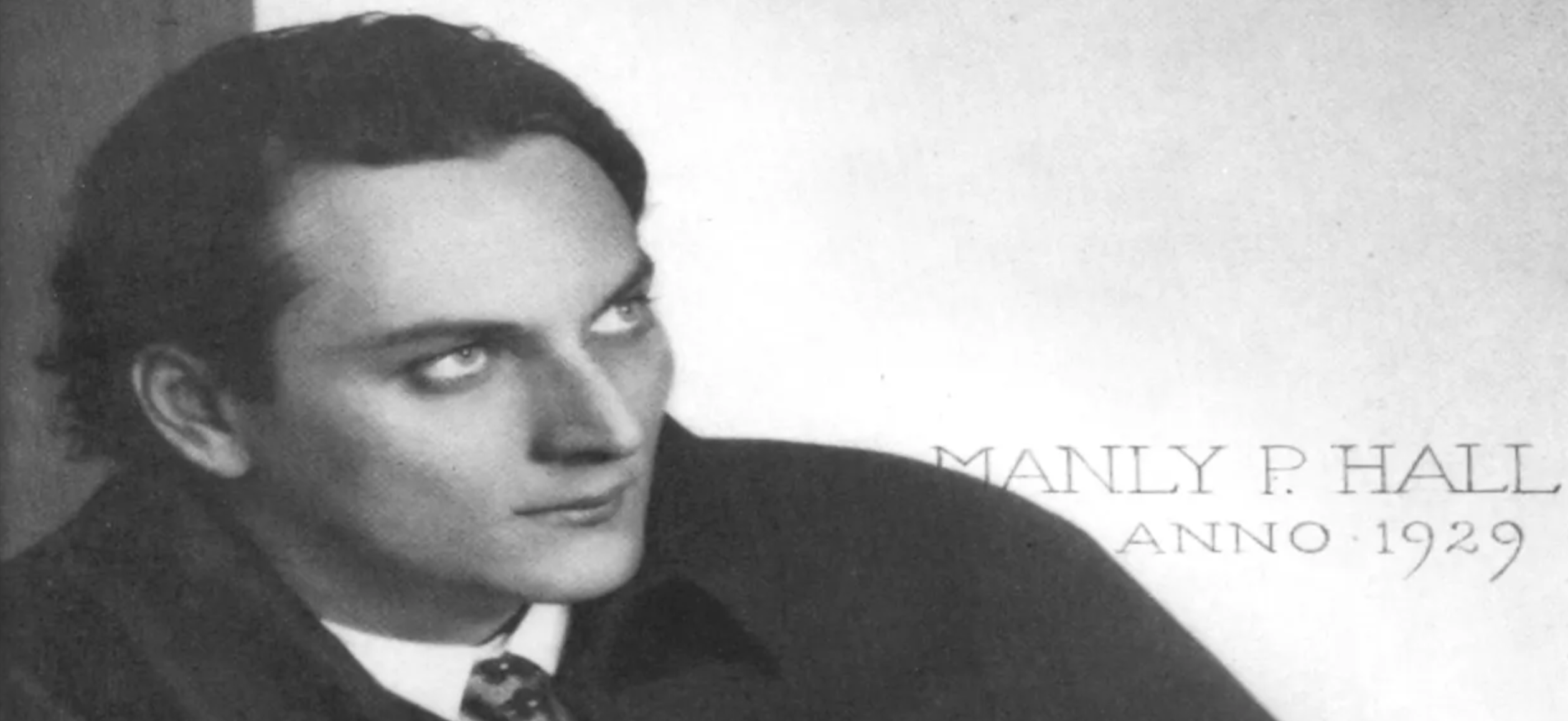
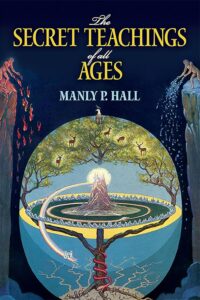
There is a particular kind of book that seems to find you rather than the other way around. For many who have wandered into the territory where psychology meets spirituality, that book is often The Secret Teachings of All Ages by Manly Palmer Hall. Published in 1928 when its author was barely twenty-seven years old, this encyclopedic work has remained continuously in print for nearly a century, quietly shaping how generations of seekers understand the relationship between ancient symbolism and the modern psyche. For those of us working in the clinical realm of trauma, depth psychology, and integrative mental health, Hall represents something rare and valuable. He was a bridge figure who preserved and transmitted ideas about human transformation that would later find their scientific articulation in the work of Carl Jung, Joseph Campbell, and the transpersonal psychology movement that emerged decades after Hall first articulated many of its core insights.
What makes Hall relevant to contemporary therapy is not his historical accuracy, which professional historians have rightly questioned, but rather his intuitive grasp of what we might now call archetypal psychology. Depth psychology concerns itself with the images and myths that shape human experience, and Hall was working with precisely these materials decades before the field had a name. He understood that the symbols, myths, and rituals of ancient cultures were not merely primitive superstitions but sophisticated maps of the human interior. He recognized that the process the ancients called initiation and the process Jung would later call individuation were describing the same fundamental journey of psychological integration.
What distinguished Hall from both the academic scholars and the popular mystics of his era was his remarkable prescience. Writing in the 1920s, he anticipated theoretical developments that would not receive mainstream acceptance until the latter half of the twentieth century. His interpretation of alchemical symbolism as describing psychological transformation predated Jung’s systematic treatment of the same material by nearly two decades. His comparative approach to world mythology, tracing common structural patterns across diverse cultures, anticipated the work of Mircea Eliade and Joseph Campbell. His insistence that mystical experiences, and perennial philosophy, represented genuine psychological phenomena worthy of serious study foreshadowed the emergence of transpersonal psychology as a recognized division within the American Psychological Association, a field that would not be formally established until 1969. Hall was, in many respects, a man out of time, articulating a vision of human psychology that the academy would not catch up to for generations.
The Life of the Sage of Los Angeles
Manly Palmer Hall was born on March 18, 1901, in Peterborough, Ontario, Canada, a small city that seemed an unlikely launching pad for a future occult luminary. The circumstances of his birth and early childhood laid the psychological groundwork for his later career. His father, William S. Hall, was a dentist, but he is essentially a ghost in his son’s biography. Manly is said to have never known his father, a familial rupture that biographers suggest created a lifelong yearning for authoritative, paternal wisdom. This absence of a biological patriarch may have propelled Hall toward the archetypal Father figures of ancient history, including Plato, Hermes Trismegistus, and Francis Bacon. Research published in the Journal of Analytical Psychology has documented how early attachment disruptions can catalyze compensatory spiritual seeking, and Hall’s biography exemplifies this pattern with striking clarity.
The primary architect of Hall’s worldview was his mother, Louise Palmer Hall. Louise was not merely a single mother in a conservative era. She was a chiropractor and, crucially, a member of the Rosicrucian Fellowship founded by Max Heindel. This affiliation is the skeleton key to understanding Hall’s intellectual development. He was not a blank slate who stumbled upon mysticism in a library. He was born into the esoteric lexicon. The Rosicrucian Fellowship was a Christian mystic organization that blended Theosophy with Western esoteric traditions, emphasizing spiritual healing, astrology, and the evolution of consciousness. Growing up in this milieu, the young Hall would have been exposed to concepts of invisible helpers, the brothers of the rose cross, and the notion of a secret history of the world long before he could read.
In 1919, at the age of eighteen, Hall made the pilgrimage that would define his life. He moved to Los Angeles to reunite with his mother, who was then living in Santa Monica. This relocation was fortuitous. Post-World War One Los Angeles was transforming into what some historians have called the world capital of alternative spirituality, a heterodox haven where Theosophy, New Thought, and Vedanta flourished alongside the booming oil and film industries. Swami Vivekananda’s introduction of Vedanta to American audiences at the 1893 World Parliament of Religions had sparked widespread interest in Eastern philosophy that continued to grow through the early twentieth century. Various Rosicrucian orders were competing for the attention of seekers dissatisfied with both mainstream Protestantism and scientific materialism. Into this environment stepped the young Hall, who would almost immediately begin his public teaching career.
A persistent element of Hall’s self-mythology concerns a brief period prior to his ministry where he supposedly worked in high finance. The narrative claims that the eighteen-year-old Hall worked as a clerk at a Wall Street banking firm. The lore posits that the outstanding event of this tenure was witnessing a man commit suicide in the office after suffering devastating investment losses. This traumatic spectacle of materialism’s ultimate failure is often cited as the catalyst that drove Hall toward the eternal values of philosophy. However, a critical examination of the timeline renders this story questionable. Hall arrived in Los Angeles in 1919 and almost immediately began preaching at the Church of the People. Given his age and lack of formal education, having left school after the sixth grade, a significant tenure on Wall Street seems geographically and chronologically improbable. It is likely that this story served a rhetorical function, establishing Hall’s credentials as a man who had seen the summit of material success and rejected it for the spiritual path. Whether apocryphal or a brief, exaggerated interlude, the Wall Street clerk persona allowed Hall to speak to the anxieties of a capitalist society with a veneer of experienced authority.
Upon his arrival in Los Angeles, Hall’s rise was nothing short of meteoric. In 1919, the same year he stepped off the train, he assumed the role of preacher at the Church of the People, located at the Trinity Auditorium in downtown Los Angeles. For a teenager with limited schooling to command the pulpit of an established congregation is a testament to his extraordinary oratorical gifts. Hall’s first public lecture addressed the topic of reincarnation. His style was distinct. He spoke extemporaneously, often for nearly two hours, weaving complex tapestries of comparative religion, history, and philosophy without a single note. This prodigious memory and eloquent delivery earned him the moniker the Boy Wonder. He was not preaching fire-and-brimstone Christianity. He was offering a synthesis of the Ageless Wisdom, blending the Rosicrucianism of his mother with the Theosophy popular in Los Angeles circles. By May 17, 1923, Hall was formally ordained as a minister in the Church of the People, and a few days later he was elected permanent pastor. This position provided him with a stable platform and a captive audience, but to expand his reach beyond the Trinity Auditorium, he needed capital.
The Economics of Esotericism and the Lloyd Patronage
The question of how a Canadian immigrant with a sixth-grade education became a global authority on comparative religion requires understanding the specific mechanisms of funding that enabled his massive projects. The answer lies not in book sales alone, but in the tradition of aristocratic patronage, specifically from the Lloyd family of Ventura County, California.
In the early 1920s, Hall attracted the devotion of Caroline Lloyd and her daughter Estelle Lloyd. The Lloyds were not merely wealthy. They were members of a family that controlled a massive oil field in Ventura County. This was old money derived from the black gold that was fueling the industrial boom of the twentieth century. The financial relationship between the Lloyds and Hall was transformative for his career and his institutional vision.
The Lloyds began sending a large portion of their income to Hall in the early 1920s. This stipend liberated Hall from the economic precariousness of a freelance lecturer. He did not need to pass the collection plate to survive. He could focus entirely on research and acquisition. With the Lloyd funds, Hall embarked on a global tour of Europe and Asia between 1923 and 1924. This was not merely a spiritual pilgrimage but an acquisition expedition. Hall visited the great museums, temples, and libraries of the world, studying the lives, customs, and religions of diverse peoples while building relationships with antiquarian book dealers.
The most significant financial intervention occurred in the early 1930s. Hall was in London during the Great Depression. The economic collapse had forced many European collectors to liquidate their assets at distressed prices. Utilizing an auction agent at Sotheby’s, and backed by the Lloyd oil fortune which was recession-resistant compared to other sectors, Hall acquired a substantial collection of rare books and manuscripts about alchemy and esotericism for below the typical market price. This strategic acquisition during a period of economic crisis formed the backbone of the library that would eventually become a world-class repository, transforming it from a personal collection into an institutional treasure.
The patronage did not end with Caroline Lloyd’s death. When she passed away in 1946, her will cemented Hall’s financial security for the rest of his life. She bequeathed to Hall a house, fifteen thousand dollars in cash, which was a significant sum in 1946 equivalent to roughly two hundred thirty thousand dollars today, and most importantly, an annual percentage of her family’s oil field shares valued at approximately ten thousand dollars per year for the next thirty-eight years. This annuity, equivalent to approximately one hundred fifty-five thousand dollars per year in modern purchasing power, provided a guaranteed baseline of income for Hall and his research society until 1984, insulating the institution from the vagaries of the book market and donation cycles. Understanding this petroleum-funded foundation is essential for grasping how Hall could operate outside the constraints that limited other independent scholars and spiritual teachers of his era.
Early Writings and the Masonic Confusion
During his early period as a pastor, Hall began his publishing career with small pamphlets. The Breastplate of the High Priest in 1920 and The Initiates of the Flame in 1922 were his first forays into print, exploring biblical symbolism and Egyptian mysteries. In 1923, Hall published The Lost Keys of Freemasonry. This slender volume became a seminal text within the Masonic fraternity, praised for its poetic insight into the spiritual purpose of the Craft. It created a widespread assumption that Hall was a high-ranking Freemason with insider knowledge of the tradition.
However, the historical record corrects this misconception. In the preface to the tenth edition published in 1967, Hall explicitly admitted that at the time of writing The Lost Keys, he was not a Mason and his knowledge was derived solely from a few books commonly available to the public. Hall did not actually join Freemasonry until decades later. He was initiated into Jewel Lodge No. 374 in San Francisco on June 28, 1954, passed on September 20, 1954, and raised on November 22, 1954. He received the 33rd Degree of the Scottish Rite in 1973. This chronology is vital for understanding Hall’s methodology. His early, defining works on Masonry were the product of an outsider’s romantic imagination, yet they were so compelling that they reshaped the insider’s view of the institution. This pattern of imaginative synthesis, where outsider interpretation becomes more influential than insider doctrine, would characterize much of Hall’s career.
The Secret Teachings of All Ages as Psychological Text
If the Lloyd money provided the foundation, The Secret Teachings of All Ages was the cathedral built upon it. Published when Hall was only twenty-seven years old, this book remains a landmark in the history of publishing and esotericism. In 1928, Hall sought to publish a book that would rival the craftsmanship of the Renaissance master printers. He envisioned what one biographer called a monstrous, encyclopedic folio that would visually and textually synthesize the Masonic, Hermetic, Qabbalistic, and Rosicrucian philosophies.
To finance such an opulent production, Hall utilized a subscription model. He solicited public funding through print and word-of-mouth advertising, asking wealthy esotericists to pay in advance for a book that was still in production. The book was released in five limited editions totaling approximately 2,200 copies, including the Subscribers Edition of 550 copies, the King Solomon Edition of 550 copies, the Theosophical Edition of 200 copies, and the Rosicrucian Edition. The original pricing was aggressive, targeting the elite collector. The secondary market value today reflects the quality, with original 1928 editions now selling for five to six thousand dollars. The sheer physical scale of the book, standing nineteen inches high and thirteen inches wide, required a custom carrying case.
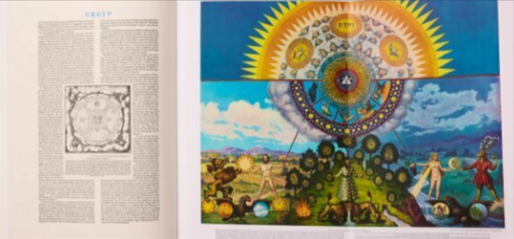
The visual impact of The Secret Teachings is largely due to the work of John Augustus Knapp, a veteran artist who was seventy-five years old when the book was published, nearly fifty years Hall’s senior. Knapp had worked for Russell Morgan Lithography and had designed titles for early cinema pioneer Thomas Ince. Hall hired Knapp to create the full-color illustrations that have since become iconic, including the hypnotic image of the High Priestess, the intricate diagrams of the Pyramids, and the vivid alchemical symbolism. These were not mere decorations. They were visual texts designed to convey esoteric concepts that words could not capture. The collaboration was a passing of the torch from the nineteenth-century craft tradition to the twentieth-century New Age.
Hall was obsessive about quality. He contracted the H.S. Crocker Company of San Francisco to print the work, but with a condition. They had to secure the services of John Henry Nash, a legendary book designer who had previously worked as a printer for the Vatican. The typography, the layout, and the paper quality using Alexander Japan paper were all overseen by Nash, ensuring that the physical object itself communicated a sense of sacred weight. Hall understood intuitively what depth psychologists would later articulate theoretically. The experience of engaging with sacred or transformative material is inseparable from the physical and aesthetic context of that engagement. The book was designed to function as a kind of portable temple, inducing in the reader a state of reverence and receptivity that primed them for psychological transformation.
To read The Secret Teachings purely as a work of history is to misunderstand its nature and purpose. The book is not organized chronologically but thematically, moving associatively between Egyptian mysteries, Greek philosophy, Kabbalistic cosmology, alchemical symbolism, and Masonic ritual. This structure reflects Hall’s fundamental conviction that these diverse traditions were expressions of a single underlying truth, what Renaissance scholars called the Prisca Theologia or Ancient Theology. Whether this conviction is historically defensible matters less than its psychological implications. By presenting these traditions as facets of one diamond, Hall created what we might now call a memory palace of archetypes, a visual and conceptual space in which the reader could encounter the fundamental patterns of human transformation.
The central thesis of the book, stripped of its metaphysical language, is essentially psychological. Hall argues that the purpose of human existence is the development of wisdom, which he defines not as the accumulation of information but as the transformation of consciousness. The ancient mystery schools, in his reading, were institutions dedicated to facilitating this transformation through carefully designed rituals of death and rebirth. The candidate for initiation was subjected to experiences that induced the symbolic death of the old self and the emergence of a new, more integrated identity. This process, which Hall calls philosophic death and resurrection, anticipates with remarkable precision what Jung would later describe as the confrontation with the shadow and the emergence of the Self.
The Gnostic Serpent and the Paradox of Trauma
One of the most clinically relevant aspects of Hall’s work is his treatment of Gnostic symbolism, particularly the figure of the serpent. In the Gnostic traditions that Hall synthesized throughout The Secret Teachings, the serpent occupies a radically different position than in orthodox Christianity. Rather than being simply an agent of evil or temptation, the Gnostic serpent is understood as a complex figure who separates human beings from the divine precisely so that they might find their way back through conscious effort and awakened knowledge.
In the Gnostic reading, the serpent in the Garden of Eden is not the enemy of humanity but an agent of awakening who offers the fruit of knowledge, gnosis, that the demiurge wished to withhold. The separation from the divine that follows is not merely punishment but the necessary precondition for the return journey. Human beings must be cast out of unconscious participation in the divine so that they can consciously choose to return. The fall is therefore also the beginning of the path of awakening. This paradoxical understanding of separation as the prerequisite for deeper connection runs throughout Hall’s work and has profound implications for how we understand psychological trauma.
 Many contemporary trauma therapists have observed that clients who have done the difficult work of processing and integrating traumatic experiences often emerge with capacities for self-awareness, compassion, and psychological depth that exceed what they possessed before the trauma occurred. This is not to romanticize suffering or to suggest that trauma is somehow beneficial. The destruction wrought by overwhelming experience is real and devastating. But it is to recognize that the shattering of the old self, when properly supported, can become the occasion for the emergence of a more integrated, more conscious self. Research on post-traumatic growth published by the American Psychological Association has documented these patterns extensively.
From the Gnostic perspective that Hall articulated, trauma can be understood as an initiatory crisis that puts people in contact with dimensions of their own psyche that they were not yet ready to contain. The overwhelming nature of the experience is precisely what shatters the defenses and adaptations of the old self, creating the possibility, though not the guarantee, of a more authentic relationship with one’s deeper being. The serpent, in this reading, is the agent of whatever force brings the trauma, separating the individual from their previous state of unconscious adaptation so that a conscious return becomes possible.
This framework has practical clinical implications. When working with trauma survivors, clinicians often encounter clients who are struggling to make meaning of their experiences. The narrative that trauma is simply damage to be repaired, while partially true, often fails to capture the phenomenology of what survivors actually experience in their healing journey. Many report that their most difficult experiences, once integrated, became sources of wisdom and capacity that they would not trade away even if they could. The Gnostic framework that Hall preserved offers a vocabulary for this paradoxical reality, suggesting that the descent into the underworld of trauma is also potentially the beginning of the return journey to the Self.
Hall’s discussion of the mystery school initiations throughout The Secret Teachings describes precisely this pattern. The candidate for initiation was subjected to experiences designed to induce terror, disorientation, and the symbolic death of the ego. These experiences were carefully contained within ritual structures that allowed for integration and emergence. The candidate who survived the ordeal was reborn as an initiate with access to knowledge and capacities that were unavailable before the death experience. While we cannot and should not manufacture trauma for therapeutic purposes, we can recognize that trauma that has already occurred contains within it the seeds of transformation when properly supported. Hall’s work provides the mythological and symbolic context for understanding this process.
Hall’s Treatment of Alchemy and Anticipation of Jung
Hall’s treatment of alchemy is particularly significant for those interested in depth psychology. Writing fourteen years before Jung’s Psychology and Alchemy, Hall explicitly interpreted the alchemical opus as a spiritual and psychological process rather than a primitive attempt at chemistry. He wrote that through the alchemical art, the whole mass of base metals, by which he meant the mental body of ignorance, was transmuted into pure gold, by which he meant wisdom. The Philosopher’s Stone, in his reading, was not a physical substance but the perfected human soul, achieved through the systematic transformation of the lead of unconscious existence into the gold of conscious wisdom.
This interpretation, which is now standard in Jungian analytical circles, was radical in the 1920s. The prevailing view of alchemy among historians was dismissive, treating it as a failed precursor to modern chemistry pursued by deluded or fraudulent individuals. Hall’s insistence that alchemy was a sophisticated symbolic system for describing psychological transformation helped keep alive a hermeneutic tradition that Jung would later elaborate with clinical precision.
The connection between Hall and Jung, though not extensively documented in public records, represents a significant transmission point in the history of depth psychology. In 1942, Jung borrowed rare alchemical manuscripts from Hall’s collection at the Philosophical Research Society. Jung was researching what would become Psychology and Alchemy, published in 1944, and he could not find the specific texts he needed in European libraries. Hall’s collection, built with Lloyd oil money and Depression-era opportunism, contained materials that were unavailable anywhere else. While the two men apparently never met in person, they moved in the same intellectual currents. Hall utilized Jungian concepts like archetypes to validate ancient myths for modern audiences. Jung, in turn, utilized the resources Hall had gathered, respecting the PRS library as a source of raw alchemical data. The noted Gnostic scholar Dr. Stephan A. Hoeller, who lectured at the PRS for over twenty years, has documented this connection in his own work on the relationship between the two thinkers.
Hall’s discussion of universal symbols throughout The Secret Teachings parallels what Jung would call the archetypes of the collective unconscious. Although Hall used Theosophical terminology such as the World Soul and the Astral Light, the functional meaning was similar. Certain symbols, Hall argued, recur across cultures not because of historical transmission but because they express innate patterns of the human psyche. The dragon, the serpent, the cross, the circle, the tree, these are not arbitrary cultural inventions but psychological necessities, forms through which the mind grasps realities too vast for ordinary conceptual thought.
Hall devoted particular attention to what he called the Solar Myth, the recurring narrative pattern in which a divine figure is born, rises to power, descends into darkness or death, and is resurrected to new life. He traced this pattern through Osiris, Dionysus, Mithras, and Christ, arguing that these figures were not merely historical individuals but personifications of cosmic and psychological processes. The life of Christ, he wrote, has been conventionalized until it agrees perfectly with the lives of dozens of world saviors, for all of them are also astronomical and physiological myths. This comparative approach, which Joseph Campbell would later popularize as the monomyth or Hero’s Journey, offered readers a way to understand their own psychological struggles as participation in an eternal pattern.
Hall’s Prescience in Comparative Religion and Depth Psychology
What makes Hall particularly remarkable is not merely that he anticipated later developments in psychology and religious studies, but that he did so with such clarity and conviction at a time when his ideas ran counter to prevailing academic opinion. In the 1920s, the study of religion in American universities was dominated by either confessional theology or the dismissive rationalism that treated all religious phenomena as primitive superstition destined to be replaced by scientific thinking. Hall charted a third course that would not become academically respectable for another half century.
His comparative method, which sought structural similarities across religious traditions rather than emphasizing their doctrinal differences, anticipated the approach that Mircea Eliade would later systematize in works like The Sacred and the Profane and Patterns in Comparative Religion. Eliade’s concept of hierophany, the manifestation of the sacred through symbols and rituals, closely parallels Hall’s understanding of how the mystery traditions communicated their teachings. Both thinkers recognized that religious symbols function not as arbitrary signs but as vehicles for genuine psychological and spiritual transformation.
Hall’s treatment of myth as psychologically rather than historically true also anticipates the approach that would later characterize depth psychology’s engagement with religious material. When Hall analyzed the story of Osiris being dismembered and reconstituted, he was not primarily interested in what ancient Egyptians literally believed. He was interested in what the story revealed about the universal human experience of psychological fragmentation and integration. This hermeneutic stance, which treats myth as phenomenologically valid regardless of its historical accuracy, would become central to Jungian analysis and to the work of scholars like James Hillman, who founded archetypal psychology as a distinct school.
Hall also anticipated the consciousness studies movement that would emerge in the latter twentieth century. He treated altered states of consciousness, mystical experiences, and visionary phenomena as genuine psychological events worthy of serious investigation rather than dismissing them as pathological or fraudulent. His detailed accounts of initiatory experiences in the ancient mysteries read remarkably like modern phenomenological descriptions of non-ordinary states of consciousness. Researchers at institutions like the Johns Hopkins Center for Psychedelic and Consciousness Research are now scientifically validating the transformative potential of experiences that Hall described nearly a century ago.
Perhaps most significantly, Hall understood that the split between psychology and spirituality was artificial and ultimately harmful. He saw clearly that the secular psychology emerging in his time, with its mechanistic models of the mind and its dismissal of religious experience, was impoverished. At the same time, he recognized that traditional religion, with its literalistic interpretations and institutional rigidity, was failing to address the genuine spiritual needs of modern people. His work attempted to articulate a third position that would honor both scientific rigor and spiritual depth. This integration, which seemed eccentric in 1928, is now recognized as essential by many clinicians working with meaning, purpose, and existential distress.
The Stoic Foundations of Hall’s Philosophy
One aspect of Hall’s work that deserves particular attention is his deep engagement with Stoic philosophy. While The Secret Teachings of All Ages ranges across dozens of traditions, Hall consistently returned to the Stoics as exemplars of what he called the philosophic life. His interpretation of Stoicism anticipated the contemporary revival of interest in this ancient school and its applications to mental health and personal development.
Hall emphasized that for the Stoics, philosophy was not an abstract intellectual exercise but a practical discipline for living well. The goal of Stoic practice was the achievement of eudaimonia, a state of flourishing characterized by wisdom, virtue, and inner tranquility regardless of external circumstances. This understanding of philosophy as therapeutic practice, which Pierre Hadot would later document in his influential studies of philosophy as a way of life, was central to Hall’s vision of what the ancient wisdom traditions offered modern seekers.
Hall was particularly drawn to the Stoic emphasis on what is within our control versus what is not. This distinction, articulated most famously by Epictetus, forms the basis of much contemporary cognitive behavioral therapy. The recognition that our distress comes not from events themselves but from our judgments about events is the foundation of cognitive restructuring techniques used by therapists worldwide. Hall grasped the therapeutic implications of this Stoic insight decades before it was systematized in clinical protocols.
The Stoic practice of prosoche or attention, which involves monitoring one’s thoughts and responses throughout the day, also features prominently in Hall’s teachings. He described this as the fundamental discipline of the philosophic life, the capacity to observe one’s own mental processes without being carried away by them. This practice is virtually identical to what contemporary mindfulness researchers describe as metacognitive awareness, and its therapeutic benefits have been extensively documented in the clinical literature on mindfulness-based interventions.
Hall also emphasized the Stoic understanding of human beings as participants in a larger cosmic order. For the Stoics, the universe was not a meaningless accident but an intelligent, interconnected whole in which human beings had a meaningful place and purpose. This cosmological vision, which Hall connected to similar ideas in Hermeticism, Neoplatonism, and the mystery traditions, addresses what contemporary psychologists call the meaning crisis of modern life. The epidemic of depression, anxiety, and existential distress that characterizes contemporary society is, from this perspective, a symptom of cosmological homelessness, the loss of any meaningful framework for understanding human existence within a larger order.
Hall’s integration of Stoic philosophy with depth psychological insights created a framework that remains remarkably relevant for contemporary practice. He understood that psychological healing requires not only the resolution of specific symptoms but the development of a coherent worldview that can sustain meaning and purpose. His work offers clinicians a vocabulary for addressing the philosophical and spiritual dimensions of psychological distress that purely symptom-focused approaches tend to neglect.
Institutionalizing Wisdom and the Philosophical Research Society
The success of The Secret Teachings transformed Hall from a local pastor into a national celebrity. It gave him entry into the inner circles of early Hollywood, where the book became a status object among the literate elite. By the early 1930s, Hall possessed a massive library and a significant following, but he lacked a permanent center. In 1934, he founded the Philosophical Research Society as a 501(c)(3) nonprofit institution. The mission was to create a sanctuary free from the dogmas of political, ecclesiastical, or educational institutions, a place dedicated to the ensoulment of all arts, sciences, and crafts.
In 1935, Hall acquired the land for the PRS in the Los Feliz neighborhood of Los Angeles, adjacent to Griffith Park. The folklore often claims Hall bought the property for a pittance, with some records suggesting a purchase price of roughly ten dollars, though this likely reflects a transfer fee or a distressed asset sale during the Depression rather than the full market value. Hall commissioned architect Robert Stacy-Judd to design the campus in the Mayan Revival style. This was a deliberate ideological choice. Hall believed deeply in the spiritual sophistication of the pre-Columbian civilizations, arguing in his later works that the Maya and Aztec held keys to universal truths equal to those of Egypt or Greece. The building itself was a manifesto, a temple of American wisdom.
The location is steeped in local legend. The land was originally part of the Rancho Los Feliz, granted to Don Antonio Feliz. Legend holds that upon his death in 1863, his niece Dona Petronilla cursed the land after being disinherited. While Hall, a collector of such myths, would have known this story, his choice was likely driven by the practicalities of the location, which was quiet, accessible, and surrounded by the natural beauty of the park.
The heart of the PRS was its library. Fueled by the Lloyd acquisitions during the Depression, the collection grew to over 30,000 volumes. It housed rare incunabula, alchemical scrolls, and manuscripts that were unavailable anywhere else in the United States. This library became a magnet for researchers. The noted scholar of Gnosticism, Dr. Stephan A. Hoeller, became a long-time associate of the PRS, lecturing there for over twenty years. Even Carl Jung interacted with the collection via correspondence, requesting facsimiles of alchemical texts that he could not find in Europe. The library represented Hall’s vision made physical, a permanent repository of the rejected knowledge that mainstream institutions had neglected.
The Private Life of the Public Sage
Behind the podium, Hall’s personal life was marked by a sharp dichotomy. He was a spiritual father to thousands, yet his own domestic life was often isolated and touched by tragedy. Understanding these personal dimensions is essential for a complete picture of the man, though they should not diminish the value of his intellectual contributions.
Hall’s first marriage is a dark chapter often excised from his official biographies. On April 28, 1930, Hall married Fay Bernice Lee, his secretary of five years. Fay was twenty-eight years old. The marriage was reportedly deeply unhappy. Friends of Hall noted that he was ill-equipped for emotional intimacy, preferring the world of ideas to the complexities of relationship. The tragedy culminated on February 22, 1941, when Fay committed suicide. The impact on Hall was profound but internalized. He removed virtually all information about Fay from his papers. This erasure suggests a protective mechanism, an attempt to insulate his persona as a master of life’s mysteries from the chaotic reality of suicide. For those of us who work clinically with the aftermath of suicide, this pattern of protective silence is painfully familiar.
On December 5, 1950, Hall married Marie Schweikert Bauer. Marie was a forceful, eccentric personality in her own right. She was not a passive disciple but an active esotericist with her own complex theories regarding what she called Space-Mother consciousness and the authorship of Shakespeare’s plays. The marriage was described by those who knew them as stormy. Marie often expressed frustration with Hall’s passivity, his obesity, and his withdrawal into his work. Biographers and associates have surmised that the marriage may never have been consummated, citing Hall’s own admission of a confused and insecure childhood and a general aversion to physical intimacy. Marie and Manly often disagreed on astrological interpretations. For their wedding, they argued over the exact time of the ceremony to ensure the best astrological chart, with Manly wanting the Sun in the ninth house of philosophy while Marie wanted it in the tenth house of public standing.
These biographical details reveal the complexity of a man who taught about emotional mastery and self-knowledge while struggling with the same human difficulties that bring people to therapy. Far from undermining Hall’s teachings, this complexity makes them more poignant. He was not a perfected being dispensing wisdom from an elevated plane. He was a human being grappling with the same shadow material that his work addressed, sometimes successfully and sometimes not.
Implications for Clinical Practice
For those of us working as clinicians, particularly with clients struggling with complex trauma, existential distress, or spiritual emergency, Hall’s work offers several practical resources. The first and perhaps most important is the framework of initiation itself. Many clients who have survived traumatic experiences describe a profound sense of discontinuity, a feeling that the person they were before the trauma no longer exists. Standard cognitive behavioral approaches, while valuable for symptom reduction, often fail to address this ontological dimension of traumatic experience. The initiatory framework provides a way of understanding trauma not merely as damage to be repaired but as a death and rebirth process that, when properly supported, can lead to genuine post-traumatic growth.
This does not mean romanticizing trauma or suggesting that suffering is somehow beneficial. Rather, it means recognizing that the dismemberment and reconstitution pattern Hall traces through world mythology corresponds to something real in the phenomenology of severe psychological disruption. When a client has experienced the shattering of their previous identity, they need more than symptom management. They need a narrative framework that can contain and give meaning to their experience. Hall’s work, alongside that of Jung and Campbell, provides such a framework. The client is not merely damaged. They are in the underworld, undergoing a transformation that countless others have undergone before them.
A second clinical implication concerns the use of symbol and image in therapeutic work. Hall understood that esoteric transmission is largely non-verbal, that certain truths can only be communicated through image, ritual, and aesthetic experience. This insight aligns with contemporary understanding of trauma as stored in implicit, procedural, and somatic memory systems that are not readily accessible through verbal processing alone. Approaches such as EMDR, Brainspotting, and Somatic Experiencing work precisely because they engage these non-verbal dimensions of experience. Hall’s emphasis on the power of symbol suggests that deliberately introducing archetypal imagery into therapeutic work, whether through art therapy, guided visualization, or dream amplification, can facilitate integration at levels that purely verbal therapy cannot reach.
Hall’s concept of the philosophic life also has clinical relevance, particularly for clients struggling with meaning and purpose. He argued that philosophy, properly understood, is not an academic discipline but a way of living, a continuous practice of self-examination and self-transformation. This understanding aligns with contemporary positive psychology research on eudaimonic well-being, which distinguishes between hedonic happiness based on pleasure and eudaimonic flourishing based on meaning, purpose, and the development of virtue. Hall’s work offers clients a rich vocabulary for articulating their aspirations toward a more meaningful existence, connecting their individual struggles to a tradition of wisdom extending back thousands of years.
For clinicians working with clients in spiritual emergency, meaning those experiencing overwhelming spiritual or transpersonal experiences that conventional psychiatry might pathologize, Hall’s work provides essential context. The experiences clients report during such crises, including visions of archetypal figures, encounters with death and rebirth themes, and sudden influxes of symbolic material, often correspond closely to what Hall describes as the initiatory process. Having familiarity with this material allows clinicians to normalize these experiences within an appropriate framework, distinguishing between genuine spiritual emergence and pathological processes requiring different intervention.
Implications for Self-Help and Personal Development
Beyond the clinical setting, Hall’s work speaks directly to individuals engaged in their own psychological and spiritual development. The Secret Teachings can function as a kind of self-administered bibliotherapy, providing readers with a comprehensive map of the territory they may be traversing in dreams, meditation, or life transitions. When a symbol appears in a dream or synchronistic event, Hall’s encyclopedia offers a starting point for amplification, connecting the personal image to its appearance across multiple cultural contexts.
Hall’s emphasis on self-study and self-initiation is particularly relevant in an era when traditional religious institutions have lost credibility for many people. He argued that while the ancient mystery schools had elaborate rituals and hierarchies, the essential process of transformation was always internal. The external forms served only to facilitate an inner awakening that each individual must ultimately accomplish alone. This understanding liberates the seeker from dependence on any particular teacher or institution while providing a rich tradition of maps and models to guide the journey.
The concept of the philosophic life offers a practical ethics for contemporary seekers. Hall consistently emphasized that genuine wisdom manifests not in abstract knowledge but in how one lives. He was critical of spiritual materialism, the tendency to accumulate esoteric information without corresponding transformation of character. True philosophy, he argued, reveals our kinship with the All and lifts us from taxpayers on a whirling atom to citizens of the Cosmos. This shift in identity, from isolated ego to participant in a meaningful universe, is perhaps the essential psychological transformation Hall sought to facilitate.
For those drawn to practices such as meditation, contemplation, or active imagination, Hall’s work provides valuable context. He understood these practices not as techniques for achieving particular states but as disciplines for transforming the practitioner over time. His lengthy discussion of the alchemical process, with its stages of nigredo, albedo, and rubedo, offers a map of the longer arc of spiritual development that can help practitioners contextualize both their progress and their inevitable periods of darkness and difficulty.
Academic Blind Spots and Critical Perspective
Intellectual honesty requires acknowledging the significant limitations in Hall’s work, particularly regarding historical accuracy. Hall was fundamentally a synthesizer and myth-maker rather than a critical historian. He relied heavily on sources that modern scholarship has superseded or discredited, and he often preferred the legendary version of events when it served his philosophical purposes. Understanding these limitations is essential for anyone engaging seriously with his work.
Hall’s treatment of the Druids exemplifies this problem. He presents them as white-robed philosophers possessing Pythagorean wisdom, essentially as the sages of the North who preserved and transmitted the universal Mystery Tradition. This romantic portrait derives primarily from Roman sources such as Caesar and Pliny, filtered through eighteenth and nineteenth century revival movements. Modern archaeology and Celtic studies present a more complex picture. The Roman accounts were written by military conquerors with obvious propaganda motivations. The actual practices and beliefs of the historical Druids remain largely unknown because they maintained an oral tradition and left no written records. Hall’s assumption that Roman descriptions accurately captured Druidic reality reflects a naiveté about source criticism that professional historians would not accept. He essentially assumed that whatever Romans thought about Druids was what they were actually doing, failing to account for the interpretatio romana, the Roman habit of reinterpreting foreign gods and customs through their own cultural lens.
Similarly, Hall’s work on the so-called Secret Destiny of America contains claims that cannot withstand historical scrutiny. His narrative of the Unknown Speaker, a mysterious stranger who supposedly appeared during the signing of the Declaration of Independence and delivered a rousing speech that convinced the hesitant delegates to sign, is not history but fiction. Research has traced this story to George Lippard, a gothic novelist who wrote a collection of Revolutionary War legends in 1847 titled Washington and His Generals, or Legends of the Revolution. Lippard explicitly presented his work as dramatic invention rather than historical fact. Hall apparently encountered this material in obscure sources and, believing it resonated with deeper spiritual truths, incorporated it into his work as if it were genuine history. This conflation of myth and fact, while psychologically understandable, compromises Hall’s reliability as a historical source. The story has since permeated American culture, even influencing President Ronald Reagan, who quoted the narrative in speeches as if it were history.
His advocacy for the Baconian theory of Shakespeare authorship represents another area where Hall’s judgment was clearly mistaken. The scholarly consensus, based on extensive documentary evidence, firmly attributes the plays to William Shakespeare of Stratford. The Folger Shakespeare Library and other authoritative institutions have thoroughly examined and rejected the alternative authorship theories that Hall championed. His insistence that Francis Bacon was the true author, embedding secret ciphers throughout the texts, reflects his general tendency to see hidden meanings and conspiratorial connections where simpler explanations suffice.
Perhaps most troubling is a 1941 lecture titled The Jew Does Not Fit In, in which Hall discussed Jewish persecution in terms that modern readers rightly find offensive. While Hall apparently intended a universalist argument against all forms of tribal identity, his suggestion that persecution resulted from karma and his language about assimilation displayed profound insensitivity, particularly given that the lecture occurred during the Holocaust. This material reminds us that even wise teachers can have significant moral and intellectual blind spots, and that uncritical veneration of any figure is always dangerous.
These criticisms do not invalidate Hall’s contribution but rather properly situate it. He was not a historian but a myth-maker in the best sense, someone who understood that human beings need sacred narratives to orient themselves in existence. His errors are consistent with this role. He cared more about the psychological and spiritual truth of a story than about its historical veracity. For clinical and personal development purposes, this orientation can be valuable. We do not require the literal historical truth of the Osiris myth to find it psychologically meaningful. But we must be clear about what kind of text we are reading and not mistake Hall’s mythological constructions for scholarly history.
The Tragic Final Chapter
The final chapter of Hall’s life is a harrowing tale of elder abuse and manipulation that stands in stark contrast to the wisdom he dispensed for seven decades. This period, dominated by a figure named Daniel Fritz, reads like a noir crime novel and raises painful questions about the vulnerability of even the wisest teachers.
In the late 1980s, Hall, approaching ninety, was suffering from obesity and various age-related ailments. He became the target of Daniel Fritz, a man described by Marie Hall as a con artist. Fritz, along with his son David and an associate named Mogins Brandt, gained Hall’s trust by promising health restoration. Fritz placed Hall on bizarre, grueling regimens, including swimming with dolphins and extreme dietary restrictions that left the elderly man weak and disoriented. The Fritz group systematically isolated Hall from Marie and his long-time PRS staff. They played on his paranoia, convincing him that his wife and associates were working against him.
The manipulation culminated in a legal coup. Just six days before Hall’s death, Fritz persuaded Hall to sign a document giving him power of attorney and control over the Hall estate and the PRS. The circumstances of Hall’s death on August 29, 1990, are gruesome and remain legally contentious. Hall died at his home. When his body was discovered, it presented a horrific tableau. Biographer Louis Sahagun records that Hall’s immense body lay on a bed without a single wrinkle, but thousands of ants were streaming from his ears, nose, and mouth. This detail suggested to investigators that the body had been dead and neglected for far longer than Fritz had reported.
Before the coroner or police arrived, Fritz and his associates allegedly cleaned the scene. Witnesses observed them removing reddish-brown stains from the carpet and carting away Hall’s clothes, valuables, and financial documents to their car. The death certificate initially cited natural causes from heart disease. However, the attending physician, suspicious of the scene and the cleanup, later rescinded the certificate. The autopsy was inconclusive regarding homicide, as no obvious poison or strangulation marks were found that could be distinguished from decomposition, but the circumstances suggested foul play or, at the very least, criminal neglect.
Marie Bauer Hall immediately accused Fritz of murder. She launched a bitter legal battle to regain control of the PRS and the estate. While prosecutors did not find enough evidence to charge Fritz with murder, the civil courts sided with Marie. In 1993, Superior Court Judge Harvey A. Schneider invalidated Hall’s last will, the one favoring Fritz. The court found that Fritz had exercised undue influence and had stolen money from Hall. Daniel Fritz avoided prison but died of cancer a few years later.
Following the legal battles, the PRS was left in a precarious financial position. The legal costs and the looting of the estate by Fritz had drained the coffers. In 1995, five years after Hall’s death, the Getty Research Institute acquired a significant portion of Hall’s alchemy and occult collection. While some sources describe this as a donation, deeper investigation suggests it was a sale necessitated by the need to stabilize the PRS finances. This acquisition was a watershed moment. It transferred Hall’s collection from the fringes of the occult into the heart of the academic establishment. Today, the Manly P. Hall collection at the Getty is a primary resource for scholars of art history and Western esotericism, validating Hall’s lifelong belief in the cultural value of these texts.
Legacy and Influence
Hall’s influence extends far beyond the readers of his books, permeating contemporary depth psychology, transpersonal psychology, and integrative approaches to mental health. His most direct influence was on Carl Jung, who borrowed materials from Hall’s library and who shared Hall’s conviction that alchemical symbolism provided essential maps of psychological transformation. While Jung developed this insight with clinical rigor and empirical observation that Hall lacked, the interpretive framework was substantially similar.
Joseph Campbell, whose work on the Hero’s Journey has become foundational for narrative therapy and popular understanding of myth, operated in the same intellectual space as Hall. Campbell’s comparative approach, tracing common patterns across world mythology, follows the same syncretic methodology that Hall employed. While Campbell brought greater academic discipline to this project, the underlying vision of myth as a universal language of the psyche connects directly to Hall’s work. The Joseph Campbell Foundation continues to develop these ideas in dialogue with contemporary psychology and neuroscience.
The transpersonal psychology movement founded by Abraham Maslow, Stanislav Grof, and others drew on many of the same sources that Hall had curated and synthesized. The recognition that peak experiences, mystical states, and encounters with archetypal material are not pathological but potentially transformative was central to Hall’s teaching decades before transpersonal psychology emerged as a formal discipline. Grof’s work on spiritual emergency, in particular, addresses experiences that Hall would have understood as initiatory crises. The Association for Transpersonal Psychology continues to explore the intersection of psychology and spirituality that Hall’s work exemplified.
Contemporary practitioners of Jungian analysis, depth psychotherapy, and various integrative modalities continue to draw on the tradition Hall helped preserve. The understanding of dreams as communications from the unconscious expressed in symbolic language, the use of amplification to connect personal images to their archetypal contexts, the recognition that psychological healing often follows a death and rebirth pattern, these insights, now commonplace in depth psychological circles, were articulated by Hall for a popular audience well before they received academic validation. Training institutes accredited by the International Association for Analytical Psychology teach methods that Hall would immediately recognize.
Hall also influenced the broader cultural understanding of esotericism in America. His work helped establish the idea that there exists a coherent Wisdom Tradition underlying diverse religious and philosophical schools, an idea that continues to shape how many Americans approach spirituality. While scholars of Western esotericism like Wouter Hanegraaff at the University of Amsterdam would critique the historical basis of this idea, they acknowledge its cultural power and treat Hall as an important figure in the history of what Hanegraaff calls rejected knowledge. Hanegraaff’s influential work Esotericism and the Academy explicitly addresses the category of knowledge that mainstream institutions marginalized, the very knowledge that Hall spent his life preserving and transmitting.
James Hillman, founder of archetypal psychology, developed ideas about the primacy of image in psychological life that resonate strongly with Hall’s approach. Hillman’s insistence that psychology should be understood as a form of mythology, and that therapeutic work involves engagement with archetypal images rather than merely behavioral modification, reflects the same understanding that animated Hall’s work.
The Philosophical Research Society that Hall founded continues to operate in Los Angeles, maintaining his library, publishing his works, and offering educational programs in philosophy and comparative religion. This institutional continuity has helped ensure that Hall’s contribution remains accessible to new generations of seekers. The Society’s collection of rare manuscripts and artifacts constitutes a significant resource for researchers studying Western esotericism and the history of American metaphysical movements.
The contemporary integration of ancient wisdom traditions with modern psychotherapy, exemplified in approaches like Internal Family Systems, Somatic Experiencing, and various mindfulness-based interventions, continues the project Hall began of showing how traditional spiritual practices can inform contemporary healing work. His vision of a synthesis between ancient wisdom and modern understanding remains vital and generative for clinicians seeking to address the full depth of human psychological experience.
Manly P. Hall was a man of contradictions: a high school dropout who built a university; a man of the people funded by oil barons; a guru of love who died in isolated neglect. He was not an academic scholar, and his historical claims often cannot withstand critical scrutiny. He was not a clinical psychologist, and he lacked the empirical methodology that gives scientific psychology its rigor. He was not a religious founder, and he consistently deflected the devotion that his followers sometimes wished to offer him. Yet he performed an essential function that none of these more specialized roles could accomplish. He served as a curator and transmitter of symbolic knowledge, preserving and synthesizing material that would later prove valuable to depth psychology, comparative religion, and integrative approaches to mental health.
For those of us working in clinical settings, Hall’s work offers a rich resource for understanding the archetypal dimensions of psychological suffering and transformation. His framework of initiation provides a way of making meaning from traumatic experience that goes beyond symptom reduction to genuine psychological integration. His attention to symbol and image supports therapeutic approaches that engage the non-verbal dimensions of trauma and transformation. His concept of the philosophic life offers clients a vision of purpose and meaning grounded in self-examination and the continuous development of wisdom. His preservation of the Gnostic understanding of separation as the precondition for conscious return offers a framework for understanding the paradoxical gifts that can emerge from properly integrated trauma.
For individuals engaged in their own personal development, Hall provides maps of territory that remains largely unmarked by conventional psychology. His encyclopedic synthesis of esoteric traditions creates a memory palace in which the seeker can locate and contextualize their own experiences. His emphasis on self-initiation and the internal nature of transformation empowers individuals to pursue their development without dependence on external authorities.
The critical engagement with Hall must acknowledge both his gifts and his limitations. He was often wrong about historical facts, sometimes seriously so. His judgment could be compromised by his commitment to particular narratives. He was capable of moral and intellectual blind spots that modern readers rightly find troubling. His personal life included tragedy and isolation that complicate any simple narrative of the perfected sage. But his fundamental insight, that the ancient symbols and rituals encode genuine wisdom about psychological transformation, has been vindicated by nearly a century of subsequent research and clinical observation.
Hall understood something essential about the human condition. We are meaning-making creatures who require not just facts but stories, not just information but wisdom, not just survival but transformation. The Secret Teachings of All Ages, for all its flaws, addresses this deeper need. It offers not merely knowledge about esoteric traditions but an encounter with the symbolic language through which human beings have always grasped the mysteries of their existence. In this sense, Hall was not merely an author but what the Greeks called a psychopomp, a guide of souls through the territory between the known and the unknown. His work continues to serve this function for all who are willing to undertake the journey.
Influences and Legacy
Hall’s intellectual formation drew from several major currents of nineteenth and early twentieth century thought. The Theosophical Society founded by Helena Blavatsky provided much of his conceptual framework, including the idea of a universal Wisdom Tradition underlying all religions and the hierarchical cosmology of spiritual evolution. The Rosicrucian Fellowship with which his mother was associated introduced him to Western esoteric Christianity and the symbolism of spiritual alchemy. The Masonic tradition, which Hall studied extensively though he did not become a Mason until 1954, provided much of the symbolic vocabulary of his work. The Neoplatonic philosophical tradition, particularly as transmitted through Renaissance figures like Marsilio Ficino and Pico della Mirandola, shaped his understanding of the relationship between the material and spiritual worlds.
Hall’s influence on subsequent psychological thought, while often indirect, has been substantial. His interpretation of alchemy as psychological transformation anticipated and potentially influenced Jung’s later work on the same subject. The materials Hall lent to Jung from the Philosophical Research Society collection in 1942 contributed directly to the research that produced Psychology and Alchemy in 1944. While Jung developed these ideas with clinical precision that Hall lacked, the interpretive framework showing alchemical symbolism as describing psychological processes owes much to the tradition Hall represented and preserved.
The transpersonal psychology movement that emerged in the late 1960s drew on many of the same sources Hall had synthesized. Stanislav Grof’s work on non-ordinary states of consciousness and spiritual emergency addresses phenomena that Hall would have understood as initiatory experiences. The Association for Transpersonal Psychology continues to explore the intersection of psychology and spirituality that Hall’s work exemplified.
Joseph Campbell’s comparative mythology, particularly The Hero with a Thousand Faces published in 1949, operated in the same intellectual space as Hall’s comparative approach to world symbolism. Campbell’s influence on narrative therapy and the understanding of personal development as following archetypal patterns connects back to the syncretic methodology Hall employed in The Secret Teachings.
Contemporary Jungian analysts continue to draw on the tradition of symbolic interpretation that Hall helped preserve. The International Association for Analytical Psychology and training institutes worldwide use amplification methods that connect personal symbols to their appearance across cultures, a methodology that Hall’s encyclopedic work directly supports.
James Hillman, founder of archetypal psychology, developed ideas about the primacy of image in psychological life that resonate strongly with Hall’s approach. Hillman’s insistence that psychology should be understood as a form of mythology, and that therapeutic work involves engagement with archetypal images rather than merely behavioral modification, reflects the same understanding that animated Hall’s work.
The academic study of Western esotericism, now established at universities including the University of Amsterdam and Rice University, treats Hall as an important primary source for understanding twentieth century American occultism. Scholars like Wouter Hanegraaff and Mitch Horowitz have written extensively on Hall’s significance as a transmitter and popularizer of esoteric ideas.
The contemporary integration of ancient wisdom traditions with modern psychotherapy, exemplified in approaches like Internal Family Systems, Somatic Experiencing, and various mindfulness-based interventions, continues the project Hall began of showing how traditional spiritual practices can inform contemporary healing work. His vision of a synthesis between ancient wisdom and modern understanding remains vital and generative for clinicians seeking to address the full depth of human psychological experience.
Timeline of Manly P. Hall’s Life
March 18, 1901: Born in Peterborough, Ontario, Canada to William S. Hall and Louise Palmer Hall
1919: Arrives in Los Angeles, California and begins lecturing at the Church of the People
1920: Publishes The Breastplate of the High Priest, his first pamphlet on esoteric symbolism
1922: Publishes The Initiates of the Flame, exploring Egyptian mysteries
1923: Publishes The Lost Keys of Freemasonry despite not being a Mason; ordained as minister at Church of the People
1923-1924: Undertakes global tour of Europe and Asia funded by Caroline and Estelle Lloyd
1928: Publishes The Secret Teachings of All Ages at age twenty-seven
1929: Publishes Lectures on Ancient Philosophy
April 28, 1930: Marries Fay Bernice Lee, his secretary
Early 1930s: Acquires rare alchemical manuscripts at Depression prices through Sotheby’s
1934: Founds the Philosophical Research Society in Los Angeles
1935: Acquires Los Feliz property and commissions Mayan Revival building from Robert Stacy-Judd
February 22, 1941: First wife Fay Bernice Lee commits suicide
1942: Lends rare alchemical manuscripts to Carl Jung for research on Psychology and Alchemy
1944: Publishes The Secret Destiny of America
1946: Caroline Lloyd dies, bequeathing house, cash, and annual oil field annuity to Hall
December 5, 1950: Marries Marie Schweikert Bauer
1951: Publishes The Mystical Christ
June 28, 1954: Initiated into Jewel Lodge No. 374 Freemasonry in San Francisco
November 22, 1954: Raised as Master Mason
1973: Receives 33rd Degree of Scottish Rite Freemasonry
Late 1980s: Comes under influence of Daniel Fritz
August 29, 1990: Dies under suspicious circumstances at age eighty-nine
1993: Superior Court Judge Harvey A. Schneider invalidates Hall’s final will, finding undue influence by Fritz
1995: Getty Research Institute acquires significant portion of Hall’s alchemy collection
Bibliography of Major Works
The Breastplate of the High Priest (1920): Hall’s first pamphlet exploring biblical symbolism
The Initiates of the Flame (1922): Early work on Egyptian mysteries and initiation
The Lost Keys of Freemasonry (1923): Hall’s influential interpretation of Masonic symbolism, written before he became a Mason
The Secret Teachings of All Ages: An Encyclopedic Outline of Masonic, Hermetic, Qabbalistic and Rosicrucian Symbolical Philosophy (1928): Hall’s magnum opus synthesizing Western esoteric traditions
Lectures on Ancient Philosophy (1929): Companion volume exploring Neoplatonic and mystery school philosophy
Man: Grand Symbol of the Mysteries (1932): Exploration of the human body as symbolic representation of cosmic principles
Freemasonry of the Ancient Egyptians (1937): Study connecting Masonic symbolism to Egyptian mystery traditions
Reincarnation: The Cycle of Necessity (1939): Examination of reincarnation beliefs across world traditions
Self-Unfoldment by Disciplines of Realization (1942): Practical guide to spiritual development
The Secret Destiny of America (1944): Controversial theory of America’s founding as part of a spiritual plan
Healing: The Divine Art (1944): Exploration of healing traditions with implications for holistic medicine
The Adepts in the Western Esoteric Tradition (1949-1950): Five-volume study of significant figures in Western esotericism
The Mystical Christ: Religion as a Personal Spiritual Experience (1951): Hall’s interpretation of esoteric Christianity
Words to the Wise: A Practical Guide to the Esoteric Sciences (1963): Guide for students beginning esoteric studies
Magic: A Treatise on Esoteric Ethics (1978): Examination of magical practice from philosophical perspective
The Therapeutic Value of Music Including the Philosophy of Music (1982): Exploration of music as healing modality
Meditation Symbols in Eastern and Western Mysticism: Mysteries of the Mandala (1988): Comparative study of meditation practices












0 Comments