

If you have ever done “Shadow Work”—journaling prompts, analyzing your triggers, or exploring your dreams—you might have noticed something strange. You can intellectually understand your shadow (“I know I have repressed anger,” “I know I project my insecurity”), but the pattern doesn’t change. You still snap at your partner. You still feel paralyzed by perfectionism. You still feel a vague sense of dread in your stomach.
This is because the Shadow is not just a concept in your mind; it is a physical reality in your body. As Carl Jung famously said, “The shadow is 90% pure gold,” but accessing that gold requires more than just thinking. It requires feeling. The body is the unconscious mind in physical form. Every time you swallowed your anger to be a “good girl,” you didn’t just repress a thought; you tensed your jaw, constricted your throat, and shallow-breathed. Over decades, these micro-tensions calcify into what Wilhelm Reich called “body armoring.” To truly do Shadow Work, we must go somatic.
The Physiology of Repression
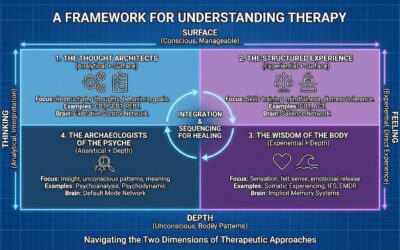
When we repress an emotion—say, grief or rage—we are essentially engaging in a biological wrestling match. The emotion wants to move (e-motion means “energy in motion”), and the Ego wants it to stop. To stop it, we must physically contract our muscles. We tighten the diaphragm to stop a sob. We clench the pelvic floor to stop fear. We hunch the shoulders to protect the heart.
This creates a state of chronic tension that eventually goes numb. We lose sensation in those areas. This is why many trauma survivors feel “cut off” from their bodies. The numbness is not an accident; it is a successful defense mechanism. But the energy doesn’t leave; it gets stored. In Somatic Experiencing, we understand that “the issues are in the tissues.”
Mapping the Shadow in the Body
While everyone is unique, there are common somatic patterns where specific shadow aspects tend to hide. Robin Taylor, LICSW-S uses somatic mapping to help clients locate these stuck energies:
1. The Jaw and Throat (The Shadow Voice)
This is the graveyard of unsaid words. If you were taught that “children should be seen and not heard,” or if you learned to fawn (people-please) to stay safe, your shadow voice likely lives here. Chronic TMJ, teeth grinding, or a tight voice often signal repressed anger or a need for boundaries.
2. The Diaphragm and Solar Plexus (The Shadow Power)
The solar plexus is the center of personal agency and will. When we are shamed for being “too much” or “too loud,” we collapse here. A tight, frozen diaphragm prevents deep breathing, keeping us in a state of low-level anxiety. Releasing this area often brings up waves of old terror—but also a massive surge of reclaimed power.
3. The Hips and Psoas (The Shadow Fight/Flight)
The psoas muscle (the “muscle of the soul”) connects the legs to the spine. It is the first muscle to contract when we need to run or kick. If you were trapped in a situation where you couldn’t escape, that “running energy” is still trapped in your hips. Tight hips are often a reservoir of frozen fear and sexual trauma.
How to Practice Somatic Shadow Work
Somatic Shadow Work is slower than mental shadow work. The body speaks in the language of sensation (heat, tingling, heaviness, numbness), not words. Here is a simple practice to start:
The “Felt Sense” Scan
- Bring to mind a situation that triggers a shadow reaction (e.g., feeling irrationally jealous).
- Stop the story. Don’t analyze why you are jealous.
- Scan your body. Where do you feel the jealousy physically? Is it a hot rock in your stomach? A band around your chest?
- Stay with the sensation. Do not try to relax it. Do not try to fix it. Just observe it. Say to it, “I see you.”
- Notice if it changes. Does it move? Does it get bigger? Does it turn into tears?
By witnessing the sensation without judgment, you are metabolizing the repressed energy. You are telling your body, “It is safe to feel this now.”
The Role of the Therapist
Doing this work alone can be intense. When you release body armoring, you may experience “flooding”—a sudden rush of the emotion you repressed 20 years ago. This is why having a skilled guide is essential. A somatic therapist acts as an external nervous system, helping you regulate the release so it is healing rather than retraumatizing.
If you are ready to stop just talking about your shadow and start healing it, consider exploring Somatic Trauma Mapping. By combining the depth of Jungian insight with the grounding of bodywork, you can finally reclaim the gold hidden in the dark.
Ready to explore the somatic shadow? Schedule a session with Robin Taylor, LICSW-S, to begin your journey into embodied healing.



















0 Comments