
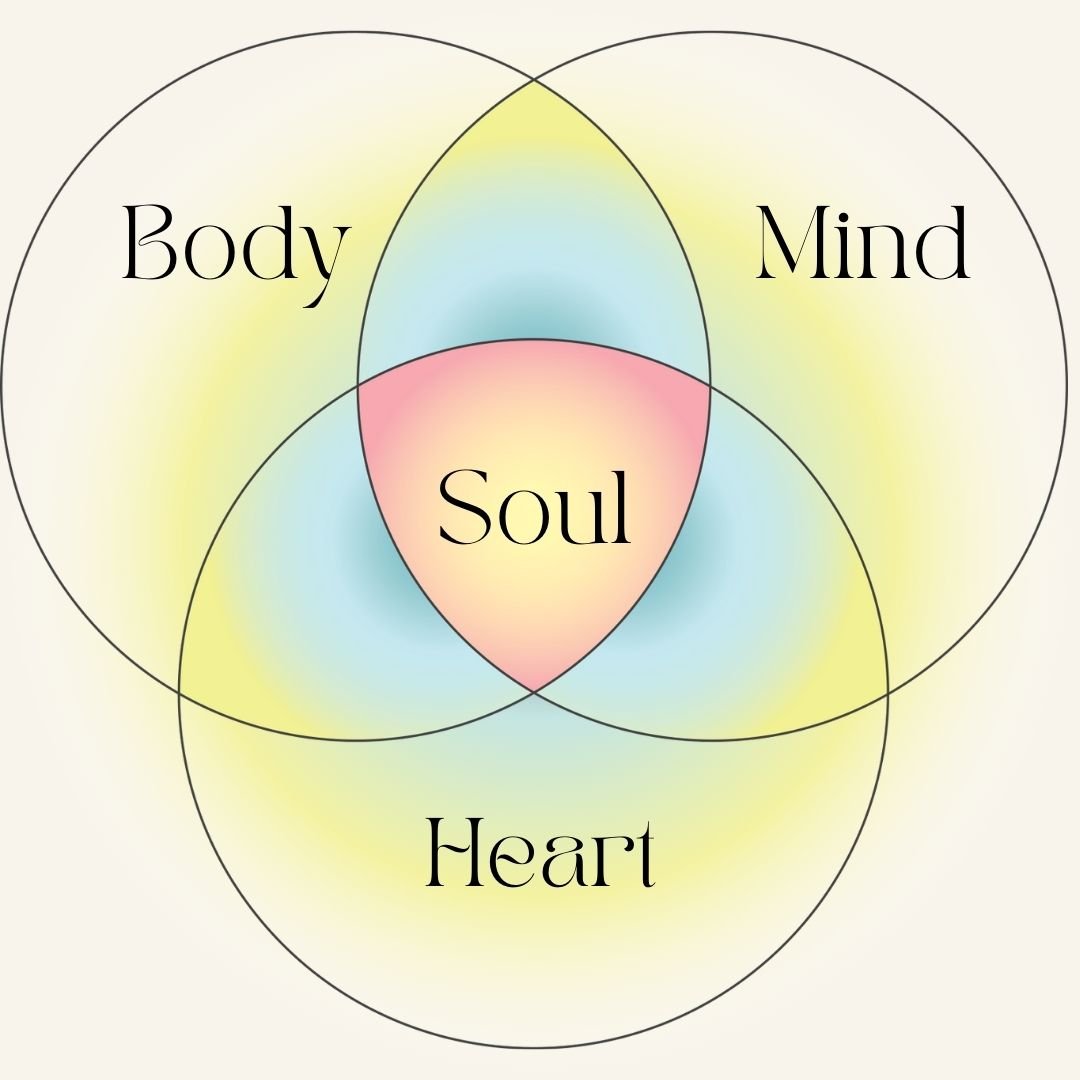
There is a specific, frustrating narrative we hear constantly at our clinic in Birmingham. A client comes in, exhausted and defeated, and says: “I’ve been in therapy for ten years. I can explain exactly why I have these panic attacks. I know it stems from my childhood. I know it’s irrational. But I still can’t stop my hands from shaking when my boss walks into the room.”
This client is not resistant. They are not “failing” at therapy. They are simply bumping up against the biological limits of the “Talking Cure.” For decades, the mental health field operated on the assumption that if we could just understand our trauma, we could heal it. We prioritized the cognitive, the logical, and the linguistic. But as Dr. Bessel van der Kolk famously established in his seminal work, The Body Keeps the Score, trauma is not stored in the part of the brain that creates stories. It is stored in the part of the brain that keeps you alive.
If you have tried Cognitive Behavioral Therapy (CBT) or standard talk therapy and felt stuck, it is likely because you were using a “Top-Down” tool for a “Bottom-Up” problem. To truly heal complex PTSD and chronic anxiety, we have to stop just talking to the mind and start listening to the body. This is the domain of Somatic Therapy.
The Neuroscience of “Stuckness”: Top-Down vs. Bottom-Up
To understand why logic fails during a panic attack, we have to look at the brain’s architecture. The brain develops from the bottom up. The Brainstem (Reptilian Brain) handles survival functions like heart rate and breathing. The Limbic System (Mammalian Brain) handles emotions and danger detection. Finally, the Prefrontal Cortex (Human Brain) handles logic, language, and time.
The Top-Down Approach (CBT)
Traditional therapies are “Top-Down.” They engage the Prefrontal Cortex (logic) to send calming signals down to the Limbic System. For example, you think, “I am safe, this is just a false alarm,” and your anxiety subsides. This works wonderfully for everyday stress.
The Bottom-Up Reality of Trauma
However, when you have unresolved trauma, your Limbic System (specifically the Amygdala) is hypersensitive. It perceives a threat—a loud noise, a specific smell, a tone of voice—and it initiates an Amygdala Hijack. In this state, the brain physically shunts blood flow away from the Prefrontal Cortex and toward the muscles for Fight or Flight. You literally lose access to your logic. You cannot “think” your way out of a trauma response because the thinking part of your brain has gone offline. This is why you can know you are safe, but feel like you are dying.
Implicit vs. Explicit Memory: Why You Can’t “Remember” to Heal
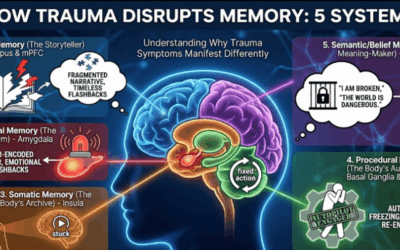
Another reason talk therapy hits a wall is the nature of traumatic memory. Explicit memory is the movie in your head: “I walked into the room, I saw the car, I felt scared.” Implicit memory is the sensation: the tightness in the chest, the urge to run, the collapse in the gut.
Trauma is often encoded as Implicit Memory. It is not a story; it is a physical shape. It lives in your posture, your digestion, and your nervous system’s baseline arousal. You cannot “talk” about implicit memory because it has no words. You have to feel it. Robin Taylor, LICSW-S, our lead somatic specialist, describes this as “speaking the language of the nervous system.”
What is Somatic Therapy?
Somatic (from the Greek soma, meaning body) therapy moves the focus from the story to the sensation. We don’t ask, “Why are you anxious?” We ask, “Where do you feel that anxiety in your body right now?” By tracking these sensations—a practice called Interoception—we can help the nervous system process the survival energy that got trapped during the traumatic event.
The “Freeze Discharge”
Dr. Peter Levine, the founder of Somatic Experiencing, observed that wild animals rarely get traumatized. When a gazelle escapes a cheetah, it doesn’t go back to grazing immediately. It falls to the ground and shakes violently. This “neurogenic tremor” discharges the massive amount of adrenaline mobilized for the escape. Once the shaking stops, the animal takes a deep breath and returns to the herd, trauma-free.
Humans, conditioned to be “polite” and “in control,” suppress this shaking. We “hold it together.” As a result, that massive survival energy stays trapped in our muscles and fascia, looping endlessly. Years later, it manifests as chronic pain, fibromyalgia, IBS, or explosive rage. Somatic therapy provides a safe container to finally complete that biological wave—to let the body shake, cry, or push until it feels the “All Clear” signal.
How Robin Taylor Uses Somatic Tools for Healing
At our Birmingham clinic, Robin Taylor integrates Somatic Experiencing and mindfulness-based approaches to treat what talk therapy cannot reach. Her work focuses on:
- Building the Container: Before diving into trauma, we must build “resources”—places in the body that feel safe, neutral, or grounded.
- Titration: We touch the trauma in tiny, manageable doses. We do not want to flood the system (which causes re-traumatization). We dip a toe in, then retreat to safety, slowly expanding the “Window of Tolerance.”
- Completing Defensive Movements: Often, trauma occurs because we couldn’t run or fight back. In therapy, we might physically push against a wall or make running motions with our legs, allowing the brain to register that we successfully defended ourselves.
- Somatic Trauma Mapping: Locating specific areas of armoring (tension) in the body and gently releasing the emotional history stored there.
Is Somatic Therapy Right for You?
If you find yourself looping in the same stories, experiencing physical symptoms with no medical cause, or feeling “numb” despite wanting to connect, your body may be asking for attention. You are not broken; you are just carrying an unfinished survival response.
Healing is possible, but it requires including the body in the conversation. By combining the safety of a therapeutic relationship with the biological wisdom of the nervous system, we can finally help the body realize that the war is over.
Ready to move beyond talk therapy? Schedule a session with Robin Taylor, LICSW-S, to explore Somatic Experiencing, MBSR, and trauma recovery.














0 Comments