

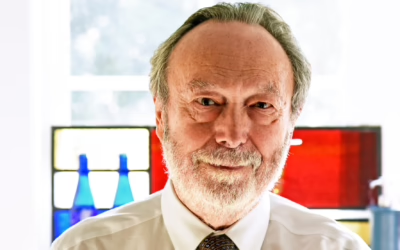
In 1975, a self-described “hippie transpersonal counselor” began working at the A.R.E. (Association for Research and Enlightenment) Clinic in Phoenix, Arizona—the clinic associated with renowned psychic Edgar Cayce. Bill O’Hanlon ran growth groups and taught seminars at Phoenix’s growth center Sentheon, immersed in the human potential movement sweeping through 1970s America. Encounter groups, gestalt exercises, consciousness-expanding workshops, and alternative healing modalities flourished in this era of cultural experimentation and personal transformation.
But something nagged at O’Hanlon amid his enthusiasm for helping people change: he honestly realized he ought to know more about what he was actually doing when attempting to facilitate transformation. This refreshingly honest self-assessment—admitting uncertainty rather than faking expertise—would become characteristic of his entire approach to therapy. It led him to study Neuro-Linguistic Programming (NLP) before the field had even standardized its name, and ultimately to return to school to become a marriage and family therapist.
During graduate school, O’Hanlon encountered the psychiatrist who would profoundly shape his career: Milton H. Erickson, the eccentric and creative founder of modern clinical hypnosis and strategic therapy. Erickson, despite severe disabilities from childhood polio and tone-deafness, had developed revolutionary therapeutic approaches emphasizing utilization of client resources, indirect suggestion, metaphor, strategic intervention, and respect for unconscious wisdom. His work influenced countless therapeutic movements including strategic family therapy, solution-focused therapy, narrative therapy, and Neuro-Linguistic Programming.
O’Hanlon became Erickson’s only work/study student, an unusual arrangement where he served as the psychiatrist’s gardener while learning therapeutic methods through observation, conversation, and occasional formal teaching. This apprenticeship model—learning through immersion rather than academic instruction—proved profound. O’Hanlon observed how Erickson worked, heard stories about cases, discussed theory and technique, and gradually absorbed Erickson’s permissive yet directive approach.
In 1978, O’Hanlon achieved certification in NLP in New Orleans in a training conducted by NLP founders Richard Bandler and John Grinder, along with Leslie Cameron-Bandler and Judith de Lozier. His graduating class included Steve and Connirae Andreas, who would become major developers and teachers of NLP themselves. This early exposure to NLP’s systematic pattern-recognition approach—identifying structure of subjective experience and creating replicable change techniques—complemented Erickson’s more intuitive artistry.
O’Hanlon found himself both confused and impressed by Erickson’s work. Erickson’s interventions often seemed mystical, intuitive, impossible to codify. A psychiatrist might tell a patient suffering depression to climb Squaw Peak mountain in Phoenix and notice something different about each rock, or prescribe that an anxious woman rearrange all furniture in her house. These interventions worked, but why? How could other therapists learn to think this way?
O’Hanlon felt compelled to spend years writing and teaching to make Erickson’s approach understandable and accessible. This translation project resulted in his first book, Taproots: Underlying Principles of Milton Erickson’s Therapy and Hypnosis, published by W.W. Norton in 1987. The book systematically identified underlying patterns in Erickson’s seemingly magical work—utilization (using whatever clients bring), indirection (working around resistance rather than confronting it), metaphor and storytelling, strategic intervention, expectancy and presupposition, and respect for unconscious resources.
By articulating these patterns, O’Hanlon helped democratize Erickson’s genius. No longer was effective therapy dependent on rare intuitive gifts—it could be learned through understanding principles and practicing techniques. Later, O’Hanlon authored Meetings with a Remarkable Man: Personal Tales of Milton H. Erickson, sharing personal stories from his apprenticeship that illuminated both Erickson’s methods and his character as teacher, clinician, and human being navigating severe disability with creativity and resilience.
But O’Hanlon didn’t stop at translating Erickson’s work. Drawing on Erickson’s influence, his NLP training, exposure to strategic and systemic family therapy, and his own clinical experience, he developed distinctive therapeutic method initially called Solution-Oriented Therapy and later refined as Possibility Therapy. This approach emerged from a simple, profound question that had driven O’Hanlon to become therapist in the first place: “How do people get happy?”
This question—focusing on happiness, wellbeing, and flourishing rather than just symptom reduction—oriented O’Hanlon’s entire therapeutic philosophy. Unlike many therapies focusing extensively on problems, pathology, diagnoses, historical causes, and elaborate explanations for dysfunction, his Solution-Oriented/Possibility approach deliberately emphasized identifying unrealized possibilities, evoking client resources and strengths, and discovering what works rather than exhaustively analyzing what doesn’t.
Yet O’Hanlon’s approach wasn’t naively optimistic or dismissive of genuine suffering. It acknowledged emotional pain, validated difficult experiences, and recognized contextual factors creating and maintaining problems. The synthesis of validation with solution-focus distinguished his work from approaches that minimized suffering in rush toward solutions.
In early 1980s, O’Hanlon began correspondence with Steve de Shazer, who had moved from California to Milwaukee, Wisconsin, where he and colleagues including his wife Insoo Kim Berg established what became the Brief Family Therapy Center (BFTC). De Shazer had earlier written papers on Erickson’s work and was developing what would be called Solution-Focused Brief Therapy (SFBT).
There was mutual influence, shared enthusiasm for brief approaches emphasizing strengths and solutions, and some disagreement about who originated solution-focused/solution-oriented approaches. Actually, neither de Shazer nor O’Hanlon deserves full credit for originating the idea. A therapist named Don Norum from Milwaukee first proposed the concept in 1978 talk/paper titled “The Family Has The Solution,” presented long before either de Shazer or O’Hanlon fully articulated their respective models. The most generous and accurate view recognizes multiple therapists simultaneously moving in similar directions, with mutual influences contributing to broader movement in brief therapy.
While O’Hanlon saw tremendous value in Milwaukee approach’s emphasis on client strengths, competencies, exceptions to problems, and future orientation, he identified crucial elements the BFTC’s strong solution-focus sometimes minimized or excluded. In interview conducted by Beyebach and Rodríguez-Arias in 1991 after In Search of Solutions was published in Spain, O’Hanlon explained preferring “solution-oriented” over “solution-focused” because his work wasn’t only focused on finding exceptions—it also emphasized validation of emotional experience, acknowledgment of suffering, and flexibility in method that strictly solution-focused approaches sometimes lacked.
The distinction matters clinically. Solution-focused therapy, particularly in its purer Milwaukee formulations, focuses almost exclusively on exceptions (times when problem doesn’t occur or occurs less), solutions, strengths, and futures. Past and problems receive minimal attention. Some solution-focused therapists avoid even asking about problem details, moving immediately to exception-finding and future-construction through techniques like the miracle question (“If a miracle happened tonight while sleeping and your problem was solved, what would be different tomorrow?”).
O’Hanlon recognized this exclusive solution-focus sometimes invalidated client experience. Someone describing devastating loss or trauma needs acknowledgment before pivoting to strengths. Rushing to solutions without validation can feel dismissive, creating alliance ruptures that undermine therapy. His solution-oriented approach integrated what he valued from Carl Rogers‘ client-centered therapy—particularly validation, empathy, and unconditional positive regard—with Erickson’s directive, change-focused methods.
O’Hanlon describes his approach combining “the best of Carl Rogers’ use of acknowledgment and validation, as well as the directive approaches of Milton Erickson and strategic therapies.” This integration creates therapy that validates client suffering while remaining actively oriented toward change, respects client expertise while offering directive guidance, and acknowledges problems while emphasizing possibilities.
Another distinction: O’Hanlon rejected formulaic method. Some solution-focused approaches became nearly protocol-driven—always ask certain questions in specific sequence, always focus on exceptions, always construct solutions. O’Hanlon maintained that flexibility, creativity, and responsiveness to each unique client situation mattered more than adherence to formulaic procedures. He describes himself as “cab driver”: “Yes, we have vast knowledge of the city, traffic patterns and various routes to reach any destination, but the client provides the destination and we negotiate the route.”
In Search of Solutions: A New Direction in Psychotherapy, co-authored with Michele Weiner-Davis and first published by W.W. Norton in 1989, became foundational text in brief therapy movement. The book provided clear, concrete, detailed guidelines for converting solution-oriented theory into actual clinical practice, filling gap between abstract principles and real-world application.
The book explained that when therapy orients toward solutions rather than exhaustive problem analysis, techniques of change become deliberate interventions often negating need for extended treatment. Some problems resolve in single sessions when appropriate changes in viewing or doing occur. Therapists “care for their language,” deliberately directing conversation toward change, inviting clients to contemplate futures filled with possibilities rather than fixating on problems and limitations.
Weiner-Davis brought her own clinical expertise and would later develop influential work on relationships, divorce prevention, and sexual intimacy, becoming internationally known expert through books like The Sex-Starved Marriage and Divorce Busting. Her collaboration with O’Hanlon on In Search of Solutions established both as leaders in solution-oriented movement.
The book emphasized that people are naturally cooperative if approached correctly and treated as resourceful and competent. This represented fundamental departure from psychodynamic traditions viewing resistance as inherent character pathology requiring confrontation and working-through. In solution-oriented framework, what traditional therapy calls “resistance” gets reframed as therapist-client mismatch requiring adjustment in therapeutic approach rather than correction of client deficiency.
O’Hanlon developed framework he calls “Possibility Therapy”—method and philosophy of psychotherapy, usually brief, stressing respect and collaboration alongside effectiveness and results. The approach views clients as experts on their concerns, problems, goals, and responses to therapy. Therapists work to evoke (not merely convince clients of) solutions, spiritual and personal resources, strengths, competencies, and exceptions to problem patterns.
Possibility Therapy explicitly eschews prescribed ideas about normalcy, recognizing such standards are typically subjective (what works for one person differs fundamentally from what works for another), dated (one decade homosexuality gets classified as mental illness, the next decade homophobia is identified as problem instead), and ethnocentric (culturally biased toward dominant group norms). When clients say they want to work on preventing their child’s temper tantrums, therapists work on that presenting concern. If observation suggests marital conflict may contribute, therapists offer that as possibility for exploration rather than expert diagnosis imposing therapist’s framework.
This radically collaborative stance differs profoundly from traditional expert-driven therapy where clinicians diagnose pathology based on external standards and prescribe treatment based on theoretical models. Possibility Therapy can address virtually anything clients identify as problems—hearing voices, asking for raise, sexual difficulties, trauma, relationship conflicts, depression, anxiety, life transitions. Some problems resolve quickly, others require extended work. Some people experience dramatic transformations, others achieve modest improvements. The only exclusion criterion: people who genuinely cannot identify any reason for being in therapy.
O’Hanlon identifies three key components of change essential for therapeutic movement: **(1) Changing the viewing**—how clients perceive, interpret, and make meaning of their situations. Reframing, offering alternative perspectives, challenging limiting beliefs, and inviting different interpretations all change viewing. **(2) Changing the doing**—patterns of action and interaction. Behavioral experiments, strategic tasks, pattern interruption, and trying something different all change doing. **(3) Evoking resources and solutions**—accessing strengths, competencies, spiritual resources, social supports, past successes, and exceptions that exist but may not be recognized or actively utilized.
These components can be engaged in any order and combination. Some clients need primarily viewing changes—new perspective on situation resolves difficulty without behavioral change. Others need primarily doing changes—pattern interruption creates transformation without insight. Most benefit from working multiple levels. The flexibility allows individualization rather than imposing uniform method.
O’Hanlon’s prolific writing career produced nearly forty books addressing clinical practice, self-help, professional development, hypnosis, spirituality, relationships, parenting, depression, trauma, and change processes. His 1999 book Do One Thing Different: Ten Simple Ways to Change Your Life, published by William Morrow, brought therapeutic philosophy to general audiences and landed him appearance on The Oprah Winfrey Show, exposing millions to solution-oriented thinking.
The book’s premise was elegant and accessible: people get stuck doing same ineffective things repeatedly, then feel frustrated when nothing changes. By doing one thing different in stuck situations—changing timing, location, sequence, who’s involved, emotional tone, anything—people interrupt rigid patterns and create space for new possibilities. Small changes ripple into larger transformations. The accessibility and practicality resonated with general audiences seeking concrete change strategies rather than abstract psychological theories.
Beyond Oprah, O’Hanlon appeared on The Today Show and various radio programs. His books achieved translation into fifteen languages: French, Spanish, Portuguese, Swedish, Finnish, German, Chinese, Bulgarian, Turkish, Korean, Indonesian, Italian, Croatian, Arabic, and Japanese, spreading solution-oriented ideas globally across diverse cultural contexts.
Major clinical works include Solution-Oriented Hypnosis: An Ericksonian Approach to Inner Healing (1992, co-authored with Michael Martin), systematically applying Ericksonian principles to clinical hypnosis. The book demonstrated how hypnosis could facilitate accessing resources, reframing experience, and creating therapeutic change within solution-oriented framework.
A Brief Guide to Brief Therapy (1993, co-authored with Brian Cade) provided accessible overview of brief therapy principles across multiple approaches. Guide to Possibility Land: A Possibility Therapy Manual (originally 1994 by Possibilities Press, reissued by Norton 1999, co-authored with Sandy Beadle) offered comprehensive clinical manual for Possibility Therapy with detailed techniques, case examples, and practical guidance.
Love is a Verb: Stop Analyzing Your Relationship and Start Making It Great (1995, co-authored with Pat Hudson, published under paperback title “Stop Blaming, Start Loving”) applied solution-oriented principles to intimate relationships. Rather than endlessly analyzing relationship problems or assigning blame, the book encouraged couples to focus on what works, do more of it, and try different approaches when stuck.
Even From a Broken Web: Brief and Respectful Solution-Oriented Therapy for Resolving Sexual Abuse (1999) tackled sensitive topic of sexual abuse treatment. O’Hanlon challenged prevailing approaches that assumed years of therapy required, emphasizing instead possibility of briefer, less pathologizing, more strength-based treatment that respects survivors’ resilience while addressing genuine impacts of abuse.
Solution-Oriented Therapy for Chronic and Severe Mental Illness (1998, revised 2003, co-authored with Tim Rowan) demonstrated solution-oriented approaches could apply even to conditions like severe depression, schizophrenia, and dissociative disorders traditionally considered requiring long-term treatment. By focusing on strengths, resources, functioning periods, and possibilities rather than exclusively on symptoms and deficits, treatment could promote hope, confidence, and improved outcomes even with severe presentations.
Brief Couples Therapy Homework Planner (1998, co-authored with Steffanie O’Hanlon and Gary Schultheis) provided structured exercises for couples work. You Can’t Make Me! Successfully Managing Strong-Willed, Oppositional and Defiant Children (2001, co-authored with Ray Levy and Tyler Goode) brought solution-oriented thinking to parenting challenges, offering practical strategies for working with difficult children.
Later works address specific clinical issues: Quick Steps to Resolving Trauma (2010) provided brief, accessible techniques for trauma resolution. A Guide to Trance Land: A Practical Guidebook for Ericksonian Hypnosis (2009) further developed his hypnosis teaching.
Change 101: A Practical Guide to Creating Change in Life or Therapy (2006) distilled change principles applicable both therapeutically and personally. Out of the Blue: Six Non-Medication Ways to Relieve Depression (2014) offered non-pharmaceutical approaches to depression treatment. Pathways to Spirituality: Connection, Wholeness and Possibility for Therapist and Client (2006) explored spiritual dimensions in therapy.
Becoming a Published Therapist: How to Write and Market Books, Blogs, Websites, Articles and More (2012) shared his extensive expertise in professional writing and publishing, helping other clinicians develop writing careers.
He compiled The Handout Book: Complete Workshop Handouts of Bill O’Hanlon, M.S., making teaching materials widely available. The comprehensive resource includes exercises, techniques, assessment tools, and conceptual frameworks used in workshops.
O’Hanlon published over sixty articles and book chapters in professional journals and edited volumes. His chapter “Possibility Therapy: An Inclusive, Solution-Based, Collaborative Therapy” in Michael Hoyt’s The Handbook of Constructive Therapies (Guilford, 1998) provided authoritative overview of his approach for academic and professional audiences.
As presenter and trainer, O’Hanlon delivered over 3,700 talks worldwide from beginning speaking career in 1977 through retirement from in-person presentations in December 2020. He became known for collaborative, respectful approach combined with irreverent humor, engaging storytelling, clear and accessible presentation style, and infectious enthusiasm. He consistently received top ratings at national conferences including Psychotherapy Networker symposiums and various professional association meetings.
In 2001, the New England Educational Institute awarded him “Outstanding Mental Health Educator of the Year,” recognizing his contributions to clinical education. He holds credentials as Diplomate, Board Member, Fellow, and Master Therapist in American Psychotherapy Association.
His training influenced thousands of clinicians across disciplines—psychologists, social workers, counselors, psychiatrists, nurses, pastoral counselors, and other helping professionals. His accessible teaching style made complex ideas understandable, his humor kept audiences engaged, and his practical focus provided immediately applicable skills rather than just abstract theory.
O’Hanlon’s theoretical contributions extend beyond specific techniques. He articulated clear contrasts between traditional and solution-oriented approaches: competence/ability versus impairment/deficit; health versus pathology; good intentions/cooperation versus bad agendas/resistance; consultation/small changes versus cure; possibilities versus limitations; futures versus pasts; strengths versus weaknesses.
These contrasts aren’t merely semantic—they reflect fundamentally different philosophical stances toward human nature, change, and therapeutic relationship. Traditional approaches often assume people are broken, resistant, need expert diagnosis and cure. Solution-oriented approaches assume people are resourceful, cooperative when approached respectfully, and need consultation and support rather than expert fixing.
The approach proved particularly influential in contexts requiring brief, effective interventions: managed care settings where insurance limits sessions, employee assistance programs serving working populations, community mental health centers with long waitlists, and private practice in era of insurance constraints. Research on brief psychotherapy demonstrated that in well-designed studies with experienced therapists, clinically representative clients, appropriate controls and follow-up, brief therapy proved as effective as longer treatment courses for many presentations.
Average therapy duration across all settings is five to eight sessions regardless of theoretical orientation or specific techniques used. Clients generally expect therapy lasting six to ten sessions, no longer than three months. Solution-oriented approaches align with these natural patterns while providing systematic framework for maximizing effectiveness within brief timeframes.
The approach influenced broader movements including narrative therapy, collaborative therapy, competency-based counseling, and strength-based practice across helping professions. Michael White and David Epston’s narrative therapy shared emphasis on externalizing problems, highlighting client agency, and deconstructing problem-saturated stories.
O’Hanlon maintained active private practice for decades while conducting extensive training and writing. He held licenses as Licensed Mental Health Professional (LMHP), Certified Professional Counselor (CPC), and Licensed Marriage and Family Therapist (LMFT). Around 2020, he retired his psychotherapy license, no longer accepting new therapy clients.
In December 2020, he retired from in-person public speaking, transitioning focus to new passion: professional songwriting. This creative pivot reflects lifelong interest in communication, storytelling, and helping people see possibilities—now expressed through music rather than therapy or training. He had written original song “Trance Plants” dedicated to Milton Erickson years earlier, demonstrating musical interests predated clinical retirement.
Though largely retired from mental health field, O’Hanlon continues offering occasional online courses on Ericksonian hypnosis, solution-oriented approaches, becoming paid public speaker, and writing/publishing books. He maintains online presence through website and develops new material on depression, anxiety, trauma, and thriving.
O’Hanlon resides in Santa Fe, New Mexico. Characteristically self-deprecating, his website notes that while he wears “magic charisma power pack at workshops and seminars,” he is “much more dull and boring in everyday life, really,” adding with humor, “Truly, it’s difficult to be charming and charismatic 24 hours a day.”
His legacy extends beyond specific techniques or books to fundamental reorientation of how many clinicians think about therapy: the shift from pathology to possibility, from expert-driven to collaborative, from problem-focus to solution-orientation influenced entire generation of practitioners. Whether therapists formally practice Possibility Therapy or not, O’Hanlon’s ideas permeate contemporary practice—emphasis on client strengths, focus on what works rather than just what’s broken, collaborative stance, belief that small changes create larger transformations.
From hippie counselor uncertain of his expertise to world-renowned therapist, trainer, and author of forty books, Bill O’Hanlon’s career embodies his core question: “How do people get happy?” His answer—by recognizing possibilities, utilizing strengths, making small changes, and being treated as resourceful and competent—proved simple yet revolutionary, accessible yet profound.
Timeline of Bill O’Hanlon’s Career and Major Contributions
1975: Began professional career as transpersonal counselor at A.R.E. (Edgar Cayce) Clinic in Phoenix, Arizona
1970s: Ran growth groups and taught seminars at Phoenix growth center Sentheon
1970s: Studied Neuro-Linguistic Programming (NLP) before field had standardized name
Late 1970s: Returned to graduate school to become marriage and family therapist
Late 1970s-early 1980s: Studied with Milton Erickson during graduate school, became Erickson’s gardener (only work/study student)
1978: Certified in NLP in New Orleans by Richard Bandler, John Grinder, Leslie Cameron-Bandler, and Judith de Lozier
Early 1980s: Began correspondence with Steve de Shazer
1987: Published Taproots: Underlying Principles of Milton Erickson’s Therapy and Hypnosis (W.W. Norton)
1989: Published In Search of Solutions: A New Direction in Psychotherapy with Michele Weiner-Davis (W.W. Norton)
1992: Published Solution-Oriented Hypnosis: An Ericksonian Approach (with Michael Martin)
1993: Published A Brief Guide to Brief Therapy (with Brian Cade)
1994/1999: Published Guide to Possibility Land (with Sandy Beadle)
1995: Published Love is a Verb (with Pat Hudson)
1998: Published Solution-Oriented Therapy for Chronic and Severe Mental Illness (with Tim Rowan)
1998: Published Brief Couples Therapy Homework Planner
1999: Published Do One Thing Different – appeared on Oprah Winfrey Show
1999: Published Even From a Broken Web
2001: Published You Can’t Make Me! (with Ray Levy and Tyler Goode)
2001: Awarded “Outstanding Mental Health Educator of the Year” by New England Educational Institute
2006: Published Change 101 and Pathways to Spirituality
2009: Published A Guide to Trance Land
2010: Published Quick Steps to Resolving Trauma
2012: Published Becoming a Published Therapist
2014: Published Out of the Blue: Six Non-Medication Ways to Relieve Depression
1977-2020: Delivered over 3,700 presentations worldwide
2020: Retired psychotherapy license
December 2020: Retired from in-person public speaking
Present: Resides in Santa Fe, New Mexico
Present: Focused on professional songwriting career
Present: Offers occasional online courses on therapy, hypnosis, writing, and public speaking
Selected Major Works by Bill O’Hanlon
Books (Clinical)
O’Hanlon, B., & Weiner-Davis, M. (1989/2003). In Search of Solutions: A New Direction in Psychotherapy. New York: W.W. Norton.
O’Hanlon, W. H. (1987). Taproots: Underlying Principles of Milton Erickson’s Therapy and Hypnosis. New York: W.W. Norton.
O’Hanlon, B., & Martin, M. (1992). Solution-Oriented Hypnosis: An Ericksonian Approach. New York: W.W. Norton.
O’Hanlon, B., & Beadle, S. (1994/1999). Guide to Possibility Land: A Possibility Therapy Manual. New York: W.W. Norton.
O’Hanlon, B., & Rowan, T. (1998/2003). Solution-Oriented Therapy for Chronic and Severe Mental Illness. New York: W.W. Norton.
O’Hanlon, B. (1999). Even From a Broken Web: Brief and Respectful Solution-Oriented Therapy for Sexual Abuse. New York: Wiley.
O’Hanlon, B. (2009). A Guide to Trance Land: A Practical Guidebook for Ericksonian Hypnosis. New York: W.W. Norton.
O’Hanlon, B. (2010). Quick Steps to Resolving Trauma. New York: W.W. Norton.
Books (Self-Help/General Audience)
O’Hanlon, B. (1999/2000). Do One Thing Different: Ten Simple Ways to Change Your Life. New York: William Morrow/Quill.
O’Hanlon, B., & Hudson, P. (1995). Love is a Verb: Stop Analyzing Your Relationship and Start Making It Great. New York: W.W. Norton.
O’Hanlon, B. (2014). Out of the Blue: Six Non-Medication Ways to Relieve Depression. New York: W.W. Norton.
Books (Professional Development)
O’Hanlon, B. (2006). Change 101: A Practical Guide to Creating Change in Life or Therapy. New York: W.W. Norton.
O’Hanlon, B. (2012). Becoming a Published Therapist: How to Write and Market Books, Blogs, Websites, Articles and More. New York: W.W. Norton.














0 Comments