
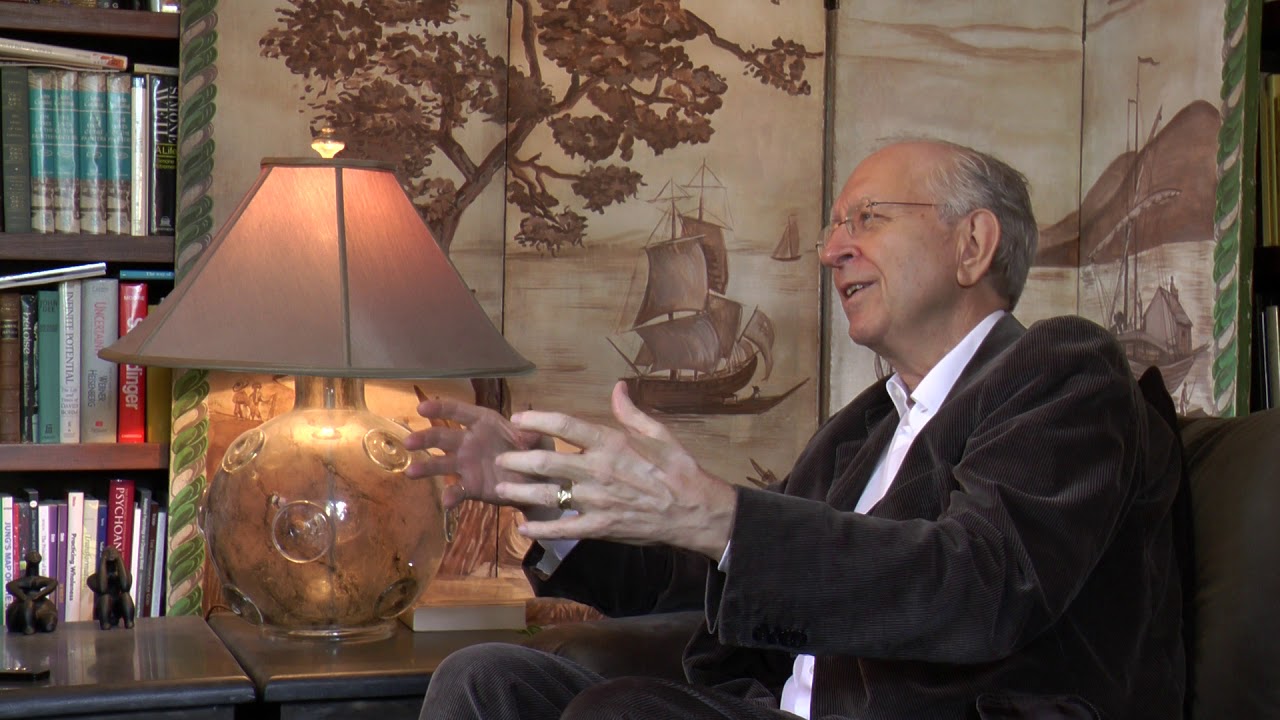
Murray Stein: The Architect of Individuation
If Carl Jung discovered the continent of the unconscious, Murray Stein is the cartographer who drew the map so the rest of us wouldn’t get lost. A senior analyst at the International School of Analytical Psychology in Zurich (ISAP Zurich), Stein is arguably the most influential living Jungian thinker. He serves as a vital bridge between the classical era of Jung’s inner circle and the modern world of clinical practice. While many post-Jungians drifted into mysticism or specialized niches, Stein has remained steadfastly committed to the structural integrity of the psyche. His work is characterized by a lucid, almost architectural understanding of how the components of the self—Ego, Persona, Shadow, Anima/Animus, and Self—fit together. For the contemporary reader, Stein offers the most accessible yet rigorous explanation of what it actually means to become a whole person.
Murray Stein was born in Canada and educated at Yale University and the University of Chicago before training at the C.G. Jung Institute in Zurich. This dual background in theology and clinical psychology gives his work a unique resonance; he understands the soul as both a psychological reality and a spiritual imperative. He is best known for his masterwork, Jung’s Map of the Soul, which has become the standard text for students of analytical psychology worldwide. In this work, Stein de-mystifies Jung. He strips away the esoteric language and presents the psyche as a dynamic, self-regulating system. He explains that the ego is not the master of the house but a fragile island of consciousness floating on a vast ocean of the unconscious. The goal of life, according to Stein, is not to strengthen the island’s walls (which leads to rigidity and neurosis) but to build bridges to the mainland of the Self.
Stein’s most clinically significant contribution, however, is his work on the midlife crisis. In his book In Midlife, Stein reframes this turbulent period not as a disaster but as a necessary “liminal” space—a threshold between two lives. He argues that the first half of life is governed by the Hero archetype, where the goal is to build a strong ego, establish a career, and fit into society (the Persona). But somewhere around age 40, this structure begins to crumble. The values that drove the first half of life—success, money, approval—suddenly feel empty. Stein views this collapse as a “burial” of the old identity. It is a terrifying but fertile period where the soul demands that we retrieve the parts of ourselves we sacrificed to fit in. This is the beginning of true individuation.
For Stein, individuation is not a linear climb to perfection but a circumambulation—a circling around the center. He draws heavily on the imagery of alchemy (specifically the work of Hermes) to describe this process. The psyche must undergo separatio (separation from collective norms) and conjunctio (the union of opposites). Stein’s brilliance lies in his ability to apply these ancient metaphors to modern clinical issues. He helps patients see that their depression or anxiety is often a symptom of being “stuck” in a developmental stage. They are clinging to the values of the morning of life while the afternoon has already arrived. His work gives dignity to the suffering of transition, framing it as a “night sea journey” that leads to rebirth.
In recent years, Stein has turned his attention to the collective psyche, analyzing the political and social upheavals of our time through a Jungian lens. He argues that the world is currently going through a collective “eclipse of God”—a loss of the central organizing myth that holds civilization together. In this vacuum, primitive shadow energies erupt, leading to polarization and violence. Stein’s prescription for the collective is the same as for the individual: we must hold the tension of the opposites. We must resist the urge to project our shadow onto “the other” and instead do the hard work of integrating our own darkness. By doing so, Murray Stein remains the steady hand at the wheel of Jungian psychology, guiding it safely through the storms of the 21st century.
Timeline of Major Works and Life Events
- 1943: Born on September 2 in Canada.
- 1973: Receives his Diploma in Analytical Psychology from the C.G. Jung Institute in Zurich.
- 1983: Publishes In Midlife: A Jungian Perspective, establishing his reputation as an expert on adult development.
- 1998: Publishes Jung’s Map of the Soul: An Introduction, which becomes a global bestseller and standard textbook.
- 2001: Becomes a founding member of the International School of Analytical Psychology (ISAP) in Zurich.
- 2003: Serves as President of the International Association for Analytical Psychology (IAAP).
- 2019: Featured prominently in the BTS album Map of the Soul: Persona, introducing Jungian concepts to a massive global pop culture audience.
- 2020: Publishes The Bible as Dream, continuing his exploration of the intersection between religion and psychology.
Select Bibliography
- Stein, M. (1998). Jung’s Map of the Soul: An Introduction. Open Court.
- Stein, M. (1983). In Midlife: A Jungian Perspective. Spring Publications.
- Stein, M. (2006). The Principle of Individuation. Chiron Publications.
- Stein, M. (1995). Practicing Wholeness. Continuum.
- Stein, M. (Ed.). (1982). Jungian Analysis. Open Court.
- Stein, M. (2019). Map of the Soul – Persona: Our Many Faces. Chiron Publications.



















0 Comments