
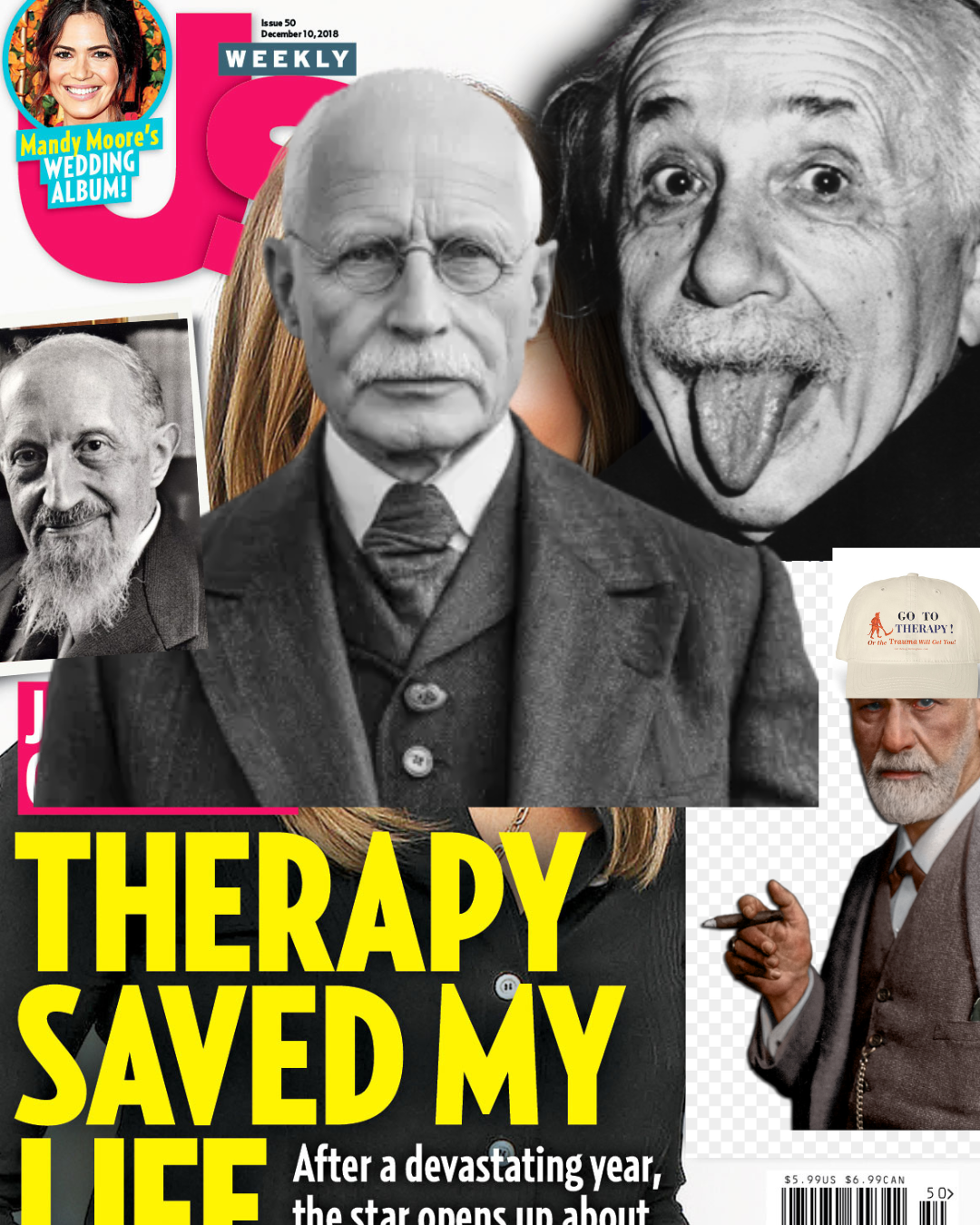
Everyone knows about the divorce. Freud and Jung, Vienna and Zurich, the letters crossing in the January mail of 1913, Freud telling his former crown prince to take his full freedom and spare him the supposed tokens of friendship. The theoretical grounds get taught in every intro Jungian psychology course or Jungian book introduction. Freud held the line on the sexual theory of libido; Jung saw the unconscious as something older and stranger, a sea of inherited myth that no theory of repressed sexuality could drain. Jung had been the gentile heir who was supposed to carry psychoanalysis out of Vienna, and when he walked, the modern soul split into two rival churches, the orderly reductionists and the visionaries, which have been excommunicating each other ever since.
But the Freud fight was only the first one, and honestly not the most interesting. Jung spent the next half century in more or less continuous combat: with a Jewish philosopher who called him a Gnostic in public, with an Italian psychiatrist who thought he was digging in the wrong direction, with two of the greatest physicists alive, one of whom quietly forgot him and one of whom loved him in secret, with a Dominican priest whose friendship he wrecked on a single point of doctrine, and with several men who had been dead for centuries and never got a vote. Then he died, and his students staged a scandal so lurid it makes everything before it look like a faculty meeting.
The Philosopher Who Called Him a Gnostic
In 1952 Martin Buber went after Jung in print, and the attack remains the most serious intellectual challenge anyone ever mounted against analytical psychology. The fight ran through the pages of the German magazine Merkur and then through Buber’s book Eclipse of God, and Buber came with two charges. The first was psychologism: that Jung had taken everything real, God included, and shrunk it to the dimensions of the psyche. The second was older and nastier. Buber called him a modern Gnostic.
For Buber, God is not an experience you have. God is the absolute Thou, met the way you meet another person, in an encounter with something genuinely outside yourself that cannot be absorbed, used, or explained away. Jung’s position ran the other way. We are locked inside the psyche; whatever God may be in himself, we only ever meet the God-image, the archetype at work in us, and the integrated Self is, in practice, indistinguishable from that image. Buber heard a trapdoor closing. If God can only be known inside the mind, then a God outside the mind has been quietly declared irrelevant, and religious life collapses into an elaborate form of self-encounter. He wrote that Jung’s doctrine deals with mysteries without knowing the attitude of faith toward mystery, and he did not mean it kindly. Gnosis, for Buber, was not a historical curiosity but the permanent enemy of faith, and he pushed further, suggesting the whole neo-pagan project carried a hostility to monotheism in general and to Judaism in particular. Individuation, on this reading, is self-deification with good manners, the divine demoted to an It and put to work for psychological self-actualization.
Jung was stung, and his reply is a strange document, because he denies the charge and half confirms it in the same breath. He insisted he was doing empirical psychology, not metaphysics. He described the God-image as a psychic fact whose signature is absolute ascendancy over the will of the subject, and claimed no knowledge either way about what stands behind it. Anyone who has read the Seven Sermons to the Dead can judge how convincing the denial is.
The two men were standing in different worlds. Buber’s whole philosophy lived on what he called the narrow ridge, the concrete meeting of person and person, person and God, with no retreat into systems. Jung’s lived in the descent, alone, into the archetypal dark. The disputation never quite connected because it was a fight about where the soul happens: in the space between two people, or in the depths beneath one. Seventy years later every therapist still picks a side, usually without knowing it.
Picking Fights with the Dead
Jung’s other theological wars were with men who could not fight back. He read the mystics the way a prospector reads a riverbed, and when he found gold he claimed the whole stream. Meister Eckhart, the thirteenth century Dominican, got the fullest treatment. Eckhart preached radical detachment, a letting go so complete that the boundary between the soul and the divine ground dissolves, and he said things from the pulpit that still raise the hair on your arms: “By being created, the soul created God, for he did not exist until the soul was made.” Jung read that and saw his own system wearing a habit. The Godhead behind the creator God became the collective unconscious. The birth of God in the soul became individuation, the ego differentiating itself out of the unconscious. He credited Eckhart with a purely psychological understanding of religion, a relativistic God who depends on human consciousness to become actual, and in doing so drafted a medieval friar into the depth psychology movement six centuries after the man’s death.
The trouble is that Eckhart meant something else. However daring his rhetoric, he was making claims about being, not about the psyche, and his God had reality with or without us. His mysticism also pointed outward, not down. There is a passage where he says that a person caught up in rapture like Saint Paul, on learning that a sick man needed a bit of soup, would do better to leave the rapture and bring the soup. That is not the program of a man lost in his own interior. It is practically a rebuttal, written centuries in advance, of everything Buber accused Jung of.
Jung ran the same operation on Jakob Boehme, the seventeenth century cobbler turned theosophist, taking Boehme’s Ungrund, the abyss that precedes even God, and mapping it onto the Self that precedes the ego. The move had a cost. Locate the origin of good and evil alike inside the divine archetype and the theology is suddenly armed. That weapon sat quietly in Jung’s system for decades before it went off in the hands of a priest he loved.
Assagioli, or Which Direction Do You Dig
Roberto Assagioli is the strangest name on the fight card because he never stopped admiring Jung and never stopped disagreeing with him. An Italian psychiatrist and the founder of Psychosynthesis, he accepted the collective unconscious and the reality of spiritual need, then delivered the most damaging judgment anyone in Jung’s orbit ever made: that Jung had no genuine spiritual realization. On Assagioli’s reading, Jung treated the spirit as material for analysis, one more set of contents. He circled alchemy, mandalas, and Eastern texts, always as metaphors for psychic states, and never once stepped through the door he kept describing. Above the personal and collective unconscious, Assagioli said, there is a Higher Self, a transpersonal reality a person can actually reach, and Jung’s method kept his patients sealed inside their own processing, forever interpreting the map, never entering the country.
The two systems disagree at the level of blueprints. Jung had ego, personal unconscious, collective unconscious. Assagioli built a lower, middle, and higher unconscious, put a witnessing “I” at the center, and set the Higher Self above the roofline. Jung worked in archetypes, the great inherited images of the species; Assagioli worked in subpersonalities, the rebel, the perfectionist, the inner child, the ordinary crowd of selves anyone can name from their own Tuesday. Jung followed the unconscious wherever it went, through dreams and active imagination, on principle without a destination. Assagioli ran drills: disidentification exercises (“I have a mind, but I am not my mind”), guided visualizations, deliberate ascents toward the Self. And they broke completely over the will. Jung distrusted it as an ego construct that should bow to the Self, and warned that training the will, in the second half of life especially, pulls a person away from the roots of their being. Assagioli wrote an entire book called The Act of Will arguing the opposite: we do not have a will, we are will, and the deliberate direction of it toward integration is the definition of health. For good measure he added that the anima was patched together for symmetry with the animus and corresponds to no actual woman, a complaint that has aged rather well.
The real interest lies in what each school thought the other’s method did to patients. Assagioli considered the Jungian path morbid. Down and down into the shadow, session after session, until the patient identifies with the wound, mistakes wallowing for depth, and confuses endless analysis with change. The Jungians returned the favor: those ascending exercises breed inflation and avoidance, people visualizing temples and claiming pure consciousness while their marriages, bank accounts, and grip on reality quietly fall apart. The schools named the difference themselves, the left-hand path and the right, the descent into the dark or the climb toward the light. Both critiques are accurate, which is the uncomfortable part, and the argument is still running in every consulting room where someone has to decide whether this particular patient needs to go down or up.
Two Physicists, Two Strategies
Jung wanted physics. The new century had cracked matter open, and a man building a theory of an objective psyche naturally wanted the objective world’s greatest minds beside him. He got two chances, and they went very differently.
The Einstein connection is real but thin. Around 1909 to 1912, while teaching in Zurich, Einstein occasionally came to dinner with Jung and his chief, Eugen Bleuler. He was working out early relativity and tried to explain it to the psychiatrists across the table. Jung admitted later, in a 1953 letter to the biographer Carl Seelig, that the mathematics lost them, but the idea did its work anyway; he credited those dinners with first setting him thinking about a relativity of time and space and their psychic conditionality, which is to say the seed of synchronicity was planted by Einstein over dinner. Then Einstein left Zurich and the relationship simply stopped. Jung doubted the great man retained any memory of him at all, and observed that one can scarcely imagine a greater contrast than the one between the mathematical and the psychological mentality.
Why no second act? The physicists of that generation had learned to guard the border. The cautionary tale is Wilhelm Reich. In January 1941 Reich, by then deep into his theory of orgone, a cosmic biological life energy, talked his way into Einstein’s house with a device called an orgone accumulator and high hopes of validation. Einstein actually tested the thing, found an ordinary thermal explanation for the temperature difference Reich was calling life energy, and stopped answering his letters. Jung was no Reich. But to a physicist watching psychoanalysts reach for physics, the category looked the same, and Einstein appears to have filed the Zurich mystic in the drawer marked closed.
Wolfgang Pauli is the counterexample, and the terms of the exception are the most telling thing about it. Pauli was one of the founders of quantum mechanics and, after a personal collapse, a patient. He entered analysis with Erna Rosenbaum, one of Jung’s protégés, and went on to correspond with Jung himself for twenty-six years, letters collected in the volume Atom and Archetype. His dreams were an analyst’s inheritance, full of geometry, clocks, and alchemical figures, and Jung mined them for years. Out of the exchange came synchronicity, the acausal connecting principle, and the unus mundus, one world underlying matter and psyche alike. Pauli supplied the physics-grade analogy: psyche and matter as complementary descriptions, wave and particle, each true, never both at once, possibly identical somewhere beyond the reach of experiment.
And yet. In his published physics, across a career at the summit of the field, Pauli never once mentioned Jung, archetypes, or synchronicity. Not a footnote. The mystic lived in the letters; the positivist signed the papers. The most productive scientific friendship Jung ever had survived because the scientist built a wall down the middle of himself and never let his colleagues see the far side of it.
The Priest
The fight with Father Victor White reads like a tragedy, because it began as the closest thing Jung ever had to a theological marriage. White was an English Dominican, a serious theologian formed on Aquinas, and for fifteen years the two men wrote to each other with genuine hope. White wanted to bring analytical psychology into Catholic thought, a synthesis of Thomism and the new science of the soul. Jung wanted a priest who could help him restate the Christian symbols for people who could no longer believe them straight. For a while each thought the other was the missing half.
The rock they hit has a Latin name: privatio boni. In the tradition running from Augustine through Aquinas, evil has no substance of its own. It is a privation, the absence of a good that ought to be present, the way darkness is not a thing but a lack. White was bound to that doctrine by formation and by office. Jung found it unbearable. He had spent his working life on the wards with psychosis, his century had produced two world wars and the camps, and against all of that he insisted that evil is an objective, frightening reality in every single life. To him the doctrine was an accounting trick. Build an all-good God by amputating the dark, and the amputated half does not vanish; it constellates, and its name is Satan. White tried to explain that the privatio was an analysis of being, not a denial of anyone’s suffering. Jung would not move an inch.
Then he published Answer to Job in 1952 and made the disagreement unsurvivable. The book psychoanalyzes God. Yahweh appears as raw power without moral consciousness, a deity who torments a creature morally better than himself and must finally become man in Christ to catch up with his own creation and atone to it. Jung’s standing caveat, that he was tracing the God-image in the psyche and not describing God, did nothing to soften the book anyone actually read. White saw exactly what it was and what it threatened, and in March 1955 he reviewed it in the Dominican journal Blackfriars with a violence that startled even him. He called the book terrible and admitted amazement at his own mercilessness. That was the end. The friendship never recovered, and Jung, wounded, went on calling Answer to Job the best thing he ever wrote. Two men who loved each other’s minds, wrecked on a phrase of medieval Latin.
Rome Blows Hot and Cold
The White affair was personal, but Jung’s relationship with the Catholic Church as an institution was its own long, strange weather system. Rome never could decide what he was. One season he was a heresiarch, a Gnostic corrupting the faithful with a psychologized God; the next he was the rare modern who took the Mass, the sacraments, and the symbols seriously while the Protestant world demythologized itself into an ethics lecture. Catholic reviewers were denouncing Answer to Job in the same years that Catholic clergy were filling his seminars and priests like White were being sent to see what could be used.
The strangest episode came in 1950, when Pius XII proclaimed the Assumption of Mary as dogma. Most of educated Europe shrugged or sneered. Jung was thrilled. He called it the most important religious event since the Reformation, and he wrote to the Pope to say why: by raising Mary bodily into heaven, the Church had, whether it knew it or not, added the feminine to the godhead and turned the Trinity into a quaternity, the fourfold wholeness Jung had been finding in mandalas and alchemical diagrams for thirty years. And the dogma had bubbled up from below, out of decades of popular petitions and Marian visions, which to Jung meant the collective unconscious was moving the Church’s hand. Rome, needless to say, did not adopt the interpretation. The one modern institution still willing to add to the God-image had no interest in being told it was doing depth psychology.
The oscillation did not end with Jung, because it never began with him. The Church has run this cycle for centuries: a mystical, symbolic generation, then a literal, doctrinal correction, then back again. It condemned propositions of Meister Eckhart in 1329 and now publishes him with warm introductions. It held John of the Cross under suspicion and later made him a Doctor of the Church. It anathematized modernism in 1907, opened the windows at Vatican II, and has spent the decades since swinging between the two, each generation rediscovering either the mystics or the manuals and treating the other as the crisis. Jung’s file in Rome simply sits inside that larger rhythm, denounced or half claimed depending on which Church shows up to read him.











0 Comments