
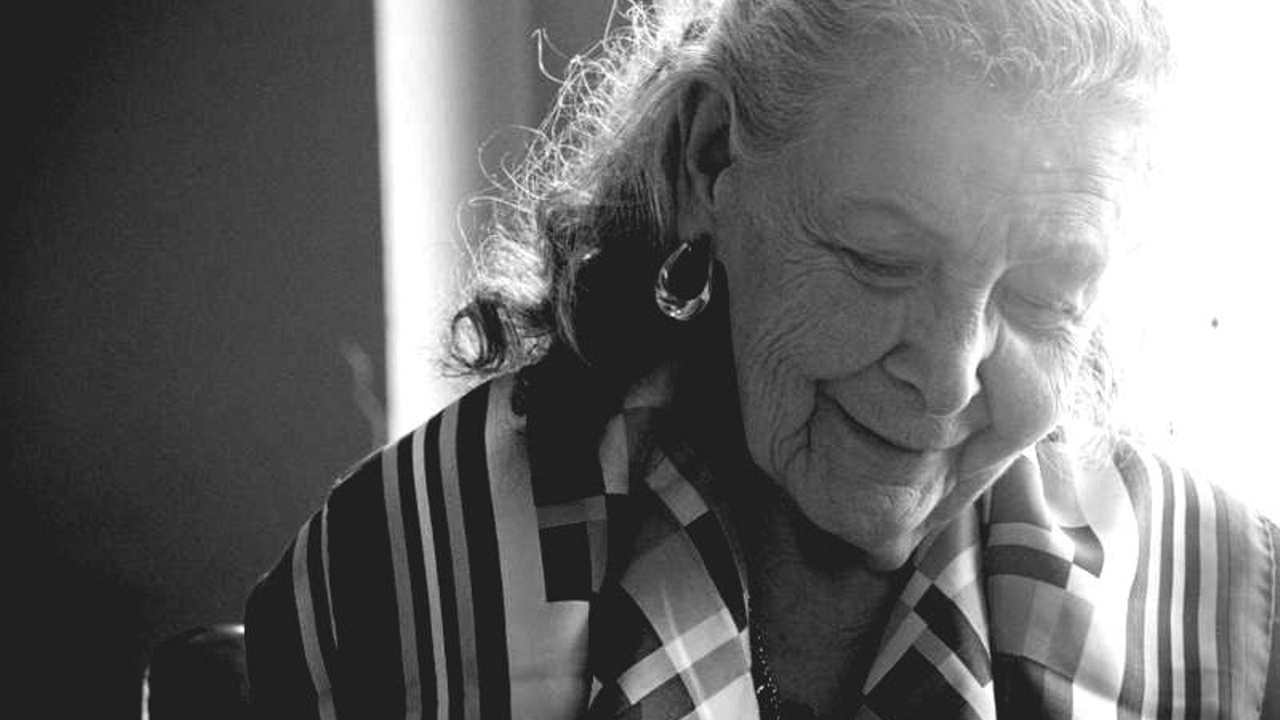
If James Hillman championed the imagination and Murray Stein mapped the structure of the self, Marion Woodman brought the soul down from the clouds and rooted it firmly in the earth of the body. A Canadian Jungian analyst and a visionary in the field of somatic psychology, Woodman argued that in our modern, hyper-intellectual culture, we have lost our connection to the physical vessel that houses us. She famously declared that “matter is spirit trapped,” and her life’s work was dedicated to releasing that spirit. For Woodman, the body is not a machine to be perfected at the gym or subdued by diet; it is the subconscious itself in physical form. Her work is particularly vital for the treatment of addiction, eating disorders, and the pervasive perfectionism that plagues the modern psyche.
Born in 1928 in London, Ontario, Woodman began her career as a high school English and drama teacher. It was not until she suffered a severe physical collapse—a kidney disease and an eating disorder—that she was forced to confront the disconnect between her mind and her body. This crisis led her to Zurich to train at the C.G. Jung Institute, where she began to unravel the psychological roots of physical illness. While Freud saw biology as destiny, Woodman saw biology as biography. She believed that our unwept tears, our swallowed anger, and our repressed creativity eventually manifest as symptoms in the body. This perspective laid the groundwork for modern somatic trauma therapies, anticipating the work of Bessel van der Kolk and Peter Levine by decades.
Woodman’s most profound contribution is her analysis of the “Addiction to Perfection.” In her book of the same name, she diagnoses Western culture with a collective neurosis: the drive to escape the messy, human reality of the body in favor of a pristine, mental ideal. She argues that this drive fuels not only substance abuse but also anorexia, bulimia, and workaholism. The perfectionist is possessed by an internal tyrant who demands absolute control, rejecting the “feminine” values of slowness, receptivity, and chaos. Woodman’s cure for this is not more discipline, but “surrender”—a learning to trust the wisdom of the body. In addiction recovery, this means moving beyond mere abstinence to a true embodiment, where the addict learns to tolerate the sensations of being alive without numbing them.
Central to Woodman’s thought is the concept of Conscious Femininity. This is not about gender, but about a mode of being that values process over product, and feeling over logic. She argued that the patriarchy has not only oppressed women but has “ravaged the soul” of men by forcing them to deny their own inner feminine nature (the Anima). A man cut off from his feminine side becomes rigid, dry, and ultimately brittle. A woman cut off from her feminine ground becomes a “daughter of the father,” driven by masculine power principles but secretly starving for nourishment. Therapy, in Woodman’s model, is the process of the “hieros gamos,” or sacred marriage, where the masculine spirit and the feminine soul are reunited within the individual.
In her later years, Woodman focused on the metaphor of the “chrysalis.” She saw the midlife transition and the encounter with illness not as failures, but as periods of liquefaction—where the old identity dissolves to make way for the new. She taught that we must be willing to sit in the dark, in the messy “goo” of transformation, without rushing to flight. Her work challenges the quick-fix mentality of modern medicine and offers instead a path of deep, slow healing. By listening to the dreams of the body, Marion Woodman taught us that we do not have a soul; we are a soul, and we have a body.
Timeline of Major Works and Life Events
- 1928: Born on August 15 in London, Ontario, Canada.
- 1979: Graduates from the C.G. Jung Institute in Zurich, writing her thesis on the psychology of obesity and anorexia.
- 1980: Publishes The Owl Was a Baker’s Daughter: Obesity, Anorexia Nervosa, and the Repressed Feminine, linking eating disorders to the father complex.
- 1982: Publishes Addiction to Perfection: The Still Unravished Bride, her seminal work on the cultural obsession with control.
- 1985: Publishes The Pregnant Virgin: A Process of Psychological Transformation, exploring the concept of the chrysalis and spiritual pregnancy.
- 1993: Publishes Conscious Femininity, a collection of interviews and essays on the role of the feminine in modern society.
- 1998: Collaborates with Elinor Dickson on Dancing in the Flames, analyzing the archetype of the Black Goddess.
- 2012: Named one of the 100 most spiritually influential living people by Watkins’ Mind Body Spirit magazine.
- 2018: Dies on July 9 in London, Ontario, at the age of 89.
Select Bibliography
- Woodman, M. (1982). Addiction to Perfection: The Still Unravished Bride. Inner City Books.
- Woodman, M. (1980). The Owl Was a Baker’s Daughter. Inner City Books.
- Woodman, M. (1985). The Pregnant Virgin: A Process of Psychological Transformation. Inner City Books.
- Woodman, M. (1993). Conscious Femininity: Interviews with Marion Woodman. Inner City Books.
- Woodman, M. (2000). Bone: Dying into Life. Viking Compass.












0 Comments