
From Freud, Jung, and Adler to the Somatic Fourth Wave
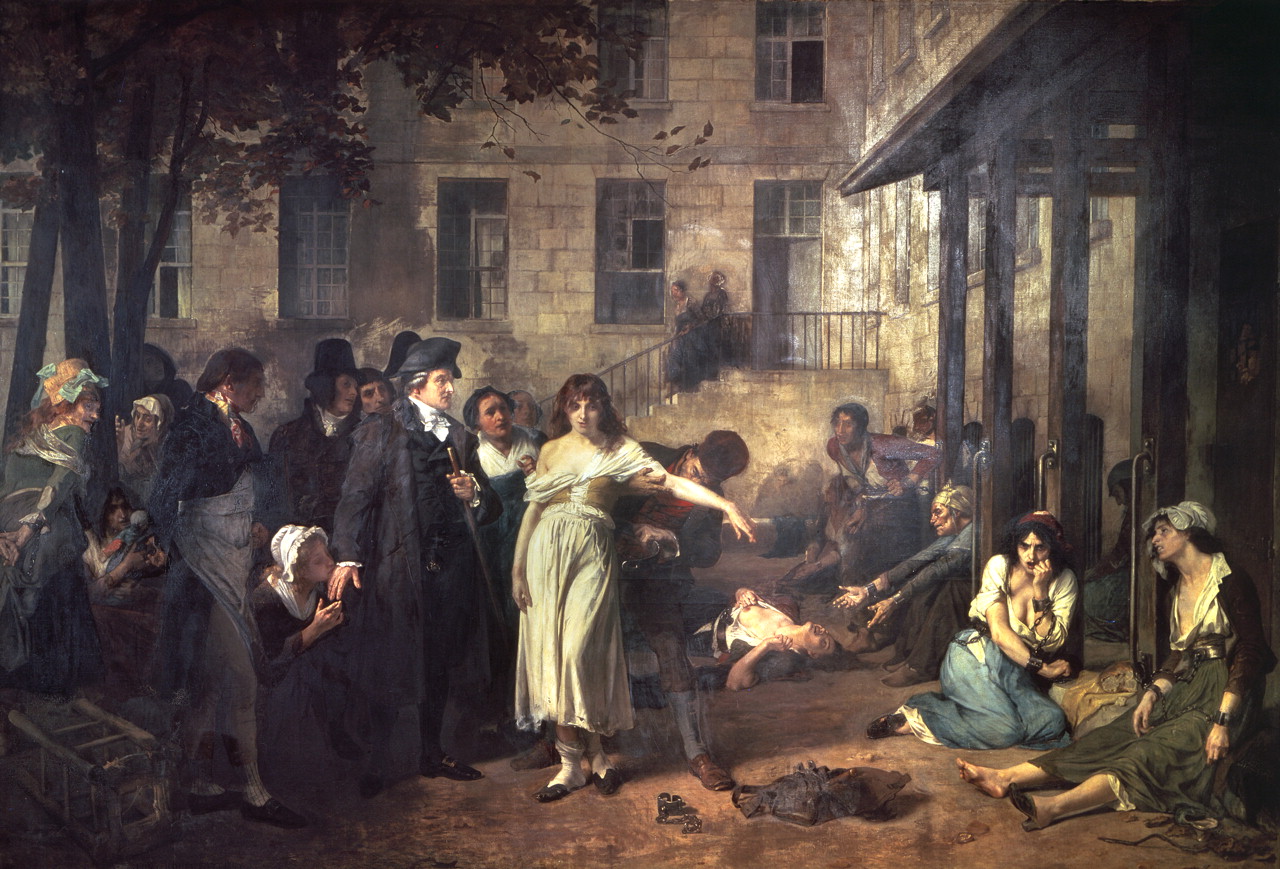
Every school of therapy is a defense structure. It forms to manage an unbearable anxiety, it hardens into doctrine, and it eventually meets the limit of what it was built to avoid looking at. The history of the field is the history of those structures forming and breaking, and the same pattern that governs a single human psyche turns out to govern the institution that claims to heal it.
By Joel Blackstock, LICSW-S | Clinical Director, Taproot Therapy Collective
A Symptom That Means Something
Begin with a woman in a consulting room in Vienna at the close of the nineteenth century. Her arm is paralyzed. No physician can find a lesion, no anatomy explains the deadness in the limb, and the medicine of the age has nothing left to offer her except the suggestion that she is hysterical, which is to say that her suffering is not quite real. Then someone proposes something that will reorganize the entire century to come. He proposes that the symptom is not noise. He proposes that it means something, that the paralysis is a sentence written in a language the body uses when the mind cannot speak, and that if you listen long enough the sentence can be read.
That single move, the insistence that suffering has a meaning and not merely a mechanism, is the seed of everything that follows. It is also the wound the field keeps reopening and resuturing, because the meaning is expensive. Meaning cannot be measured. Meaning cannot be billed in fifteen minute increments. Meaning does not submit to the rating scale, and a profession that wants to be taken seriously by hospitals and insurers and pharmaceutical boards will be under constant pressure to convert meaning back into mechanism so that it can be counted.
This is the tension that runs underneath the whole story, and it is worth naming the lens before we begin. The historian of science Theodore Porter described how professions under external pressure reach for numbers, not because numbers are always truer, but because quantification is a technology of distance. It lets a contested field manufacture the appearance of objectivity and hold suspicion at bay. The anthropologist James C. Scott described how institutions impose legibility on a complex reality, flattening the local craft knowledge he called metis into the standardized categories a bureaucracy can read at a glance. And Wilhelm Reich, who we will meet properly in a moment, described how a person builds rigid armor in the body and character to manage an anxiety they cannot tolerate feeling.
Hold those three ideas together and you have the engine of this history. The patient builds armor. The therapy is invented to soften it. And then the therapy, under pressure to prove itself legible and fundable, builds armor of its own. The biomedical model that came to dominate American mental health is best understood not as a villain and not as a fraud, but as the field’s own character armor, a rigidly held structure that successfully managed the profession’s terror of being seen as unscientific, at the cost of contact with the living person in the room.
What follows is the long version. It runs from the founding fracture of psychoanalysis through the black box of behaviorism, the cognitive revolution, the humanistic revolt, the great re-medicalization of the DSM, the slow collapse of the chemical imbalance story, and the return of the body in what many are now calling the third and fourth waves of therapy. Along the way it names the people who built each structure and, more importantly, the incentives that selected for them.
The Founding Fracture: Freud, Jung, and Adler
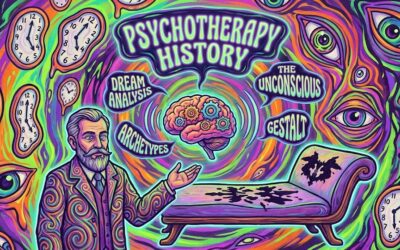
The man listening to the woman with the paralyzed arm was Sigmund Freud, and the discipline he assembled out of those long hours of listening was psychoanalysis. Its founding intuition was that the mind is divided against itself, that a region of the psyche operates outside awareness, and that the symptoms which baffle physicians are compromises, the surface expression of a conflict between a wish and a prohibition. The talking cure was the technology built to make that hidden conflict speakable, and for the first time in the history of medicine a treatment took the patient’s inner life as the actual site of the disease.
It is important to understand why this arose when it did. Nineteenth century medicine had become brilliant at the body and blind to the meaning of suffering. It could describe a paralysis it could not cure and it had no account at all of grief, obsession, dread, or the way a person can be made ill by their own history. Psychoanalysis arose to occupy exactly that vacancy. It was the first systematic attempt to treat the human being as a creature of biography rather than only biology.
And almost immediately it fractured, which tells us something the field has spent a century trying not to learn. Within a decade the founding circle split into three irreconcilable visions of what a person fundamentally is.
The first break came when one of Freud’s most gifted colleagues refused the idea that the deepest human motive is the management of forbidden desire. He proposed instead that the human being is driven by a felt sense of smallness and a striving to overcome it, that we are shaped less by what happened in the nursery and more by the goals we lean toward, and that the cure for suffering is not the excavation of buried wishes but the cultivation of social interest, the capacity to belong to and contribute to a human community. This was Alfred Adler, and the school he founded, Individual Psychology, is the uncredited grandfather of half of what came later. His emphasis on conscious goals, on the way beliefs about oneself organize behavior, prefigures cognitive therapy by fifty years. His insistence on the whole person embedded in a social field prefigures family systems and community mental health. He lost the political war inside the movement and won the long argument quietly, in pieces, under other people’s names.
The second break was deeper and stranger. Freud’s chosen heir, the man he called his crown prince, came to believe that the unconscious is not merely a basement of repressed personal material but an ocean, that beneath the biographical unconscious lies a deeper layer shared by all human beings, populated by the recurring images and patterns he called archetypes. He believed the psyche is fundamentally religious in its structure, that it produces symbols the way the body produces cells, and that healing is not the reduction of the soul to its infantile components but the lifelong process of becoming whole that he named individuation. This was Carl Jung, and his descent into his own unconscious during the years after the break, documented in the extraordinary manuscript later published as the Red Book, generated the foundational insights that still guide depth psychological practice today. Where Freud saw a furnace of drives to be managed, Jung saw a generative intelligence to be listened to. The difference is not a technical disagreement. It is two different cosmologies.
There is a fourth figure who belongs at the origin and is almost always left out, and his absence is itself a structural fact worth noticing. Before Freud had fully assembled his system, a French psychologist was already mapping the way the mind splits under the weight of overwhelming experience, the way traumatic memory becomes lodged outside ordinary consciousness and returns as symptom. This was Pierre Janet, and his account of dissociation arguably described the mechanics of trauma more accurately than Freud’s drive theory ever would. He was eclipsed, his vocabulary absorbed and his name forgotten, and the field would have to rediscover dissociation nearly a century later when it finally turned back toward the way trauma fragments the self. The history of therapy is full of these suppressed alternates, the road not taken that turns out to have been the right one.
So the field is born already broken into three or four. This is the original sin, and it is not a moral failing. It is an epistemological fact. Freud, Jung, and Adler were not arguing about a detail of technique. They were giving incompatible answers to the only question that matters: what is a human being, and what does it mean for one to be healed. A field founded on that disagreement will spend the rest of its life either pretending the disagreement does not exist or building bureaucracies designed to paper over it.
And we should be honest about why psychoanalysis, for all its depth, could not hold the center it had claimed. Its theories could not be falsified, because any objection could be reinterpreted as resistance. Its treatments stretched across years and were available only to those with the time and money to afford them. Its authority flowed downward from the analyst, who could not be contradicted because he alone could see the unconscious. And it could not prove itself to a world that was increasingly demanding proof. The structure that had restored meaning to suffering could not demonstrate that it worked, and into that gap a very different vision came rushing.
The Body’s First Exile: Wilhelm Reich and the Road Not Taken
Before we leave the founders, we have to follow one branch that the family cut off, because it explains the strange shape of the present. One of Freud’s most brilliant younger associates took the theory in a direction the movement could not tolerate. He noticed that repression is not only mental. He noticed that when a person chronically holds back an impulse, the holding back lives in the musculature, in a habitual tightening of the jaw, the diaphragm, the pelvis, the shoulders, until the defense becomes the literal shape of the body. He called this character armor, and he argued that you cannot fully free the psyche without addressing the body that has frozen around its wounds.
This was Wilhelm Reich, and his trajectory is the most revealing tragedy in the field’s history. He carried psychoanalysis down into the body, which is precisely where, as we will see, the most important therapies of the last thirty years would eventually have to go. For this he was expelled. His later work drifted into claims about a cosmic life energy that the science of his day could not support, he emigrated to the United States, he came into conflict with federal regulators, and he died in a federal prison while his books were being burned by order of a court. His student Alexander Lowen would carry the somatic insight forward into bioenergetics, keeping a small flame alive at the margins.
Notice the structure here, because it is the whole thesis in miniature. The insight that trauma and defense are held in the body, the insight that would become central to the somatic and neurological work at the leading edge of trauma treatment today, was available in the 1930s and was violently expelled from the field. It did not return through the front door of academic respectability. It went underground for two generations and came back, slowly, only when the dominant paradigm had so thoroughly failed that the profession had no choice but to go looking in the basement it had sealed shut. The body was the field’s first repressed content, and like all repressed content, it returned.
The Black Box: Behaviorism and the First Wave
While the analysts were arguing about the contents of the unconscious, an entirely different movement was forming in the psychology laboratories of America, and its founding gesture was the exact opposite of Freud’s. Where Freud insisted that the inner life was the real site of the disease, this new movement insisted that the inner life was none of science’s business at all.
Picture a researcher who looks at the whole apparatus of dreams and drives and transference and concludes that it is unverifiable storytelling. You cannot see a wish. You cannot measure a complex. You can only see what an organism does, and what it does can be predicted and controlled by manipulating the environment around it. The mind, on this view, is a black box. Stimulus goes in, behavior comes out, and the contents of the box are a metaphysical distraction. This was John Watson, and the discipline he announced, behaviorism, promised to make psychology a real science by the simple expedient of refusing to look inside the human being.
It worked, in its way, and it produced real tools. Researchers demonstrated that emotional responses could be conditioned, most infamously in a child taught to fear a white rat, and then, more usefully, that fears could be deconditioned, a discovery made by Mary Cover Jones when she helped a frightened child unlearn a phobia through gradual, gentle exposure. B. F. Skinner mapped how consequences shape behavior through reinforcement. And in the middle of the twentieth century a psychiatrist named Joseph Wolpe built the first genuinely systematic behavioral treatment, systematic desensitization, by pairing relaxation with a slow, graded approach to a feared situation so that the nervous system could learn it was safe.
This is the first wave of what would eventually be called behavior therapy, and it arose to solve a real and specific failure of psychoanalysis. Analysis could not prove it worked and could not be delivered briefly to ordinary people. Behaviorism could be tested, measured, and taught, and for certain problems, especially discrete phobias, it produced results that were visible and fast. It traded depth for rigor and accepted the trade gladly.
But the limitation is written into the founding move. By treating the mind as a black box, behaviorism erased the person. It had no language for meaning, for grief, for the difference between a fear of dogs and a life that has lost its point. It could recondition a phobia and stand mute before a human being asking why they should go on living. A psychology that refuses to look inside the box will eventually be confronted by everything that lives there, and the next wave was the box being pried back open.
The Cognitive Revolution: CBT and the Second Wave
By the 1960s a quiet rebellion was forming inside the behavioral camp, led, with some irony, by a man trained as a psychoanalyst. Studying depression, he expected to find the anger turned inward that Freudian theory predicted. Instead he kept finding something simpler and more accessible. His depressed patients were running a continuous stream of distorted, punishing thoughts about themselves, the world, and the future, and these automatic thoughts seemed to drive the feeling rather than merely accompany it. If you could teach a person to catch, examine, and revise the thought, the feeling shifted. This was Aaron Beck, and his approach, cognitive therapy, put the mind back into psychology without surrendering the measurability that behaviorism had won. Working in parallel, Albert Ellis had been arguing along similar lines, that it is not events that disturb us but the rigid beliefs we hold about them.
The fusion of these cognitive methods with the behavioral techniques that came before produced cognitive behavioral therapy, the second wave, and it is no exaggeration to say that CBT became the default operating system of American mental health. It is worth being precise about why it won, because the reasons have very little to do with whether it reaches the deepest layers of human suffering and very much to do with the incentives Theodore Porter described.
CBT is brief. It can be delivered in a fixed number of sessions, which an insurer can authorize and a budget can predict. It is manualized, which means it can be standardized, taught quickly, and studied in controlled trials. It generates numbers, symptom scores that go down over a measurable course of treatment, and those numbers are exactly the kind of mechanical objectivity a contested profession reaches for when it needs to prove its worth to people who control the money. CBT did not conquer the field only because it healed the most people most deeply. It conquered the field because it was the most legible therapy ever invented, the one most perfectly shaped to fit the apparatus of insurance reimbursement and research funding. It won on legibility. This is not a knock on CBT, which helps a great many people with a great many problems. It is an observation about which kind of therapy a quantified system will select for, regardless of depth.
And here Adler gets his quiet revenge, because the core cognitive insight, that beliefs about oneself organize emotional life, was his fifty years earlier, delivered without the laboratory vocabulary that made it fundable in the 1970s.
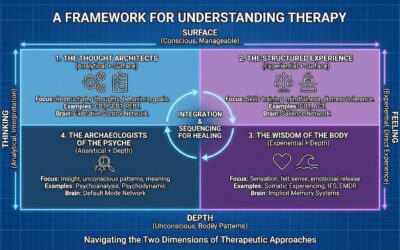
The limitation of CBT is the mirror image of its strength. It is a top-down therapy. It works by recruiting the rational, verbal, executive brain to manage the thoughts and override the feelings. This is genuinely useful for problems that live in the realm of conscious cognition. It runs into a wall with the kind of suffering that does not live there at all. A person whose terror was installed before they had language, whose body floods with alarm for reasons the thinking mind cannot reach, cannot reliably think their way out, because the trauma is not stored as a distorted thought. It is stored in the subcortical structures of the brain and the tissues of the body, below the floor that cognition can stand on. Trying to treat developmental and complex trauma with cognitive restructuring alone is like trying to fix a flooded basement by repainting the upstairs hallway, and the field’s eventual reckoning with this fact is the story of why depth and somatic approaches kept reappearing no matter how dominant CBT became.
The Third Force: Humanistic and Existential Psychology
In the same mid-century moment, a different kind of objection was rising, and it came not from the laboratory but from a sense that both of the reigning powers had lost the human being entirely. To the humanists, psychoanalysis was a determinism that reduced a person to the wreckage of their childhood, and behaviorism was a mechanism that reduced a person to a stimulus-response machine. Both, in their view, were portraits of a human as something to be managed. Both missed the obvious fact that a person is also a center of freedom, meaning, growth, and choice.
The psychologist Abraham Maslow named this movement the third force, positioning it explicitly against the first force of analysis and the second force of behaviorism, and its vision of the person was almost the inverse of both. Carl Rogers built a therapy founded on the radical proposition that human beings have an innate drive toward growth that unfolds on its own when the conditions are right, and that the conditions are not technique but relationship, specifically the therapist’s genuineness, empathy, and unconditional positive regard. Rollo May brought the existential tradition into American therapy, insisting that anxiety is not only a symptom to be eliminated but a feature of being a free creature who must choose in the face of death and meaninglessness. Fritz Perls built Gestalt therapy around the immediate, embodied, present-moment experience rather than the archaeology of the past. And Viktor Frankl, who had survived the camps, founded logotherapy on the conviction that the deepest human need is not pleasure or power but meaning, that a person can endure almost any suffering if it has a why.
The third force arose to restore the dignity and wholeness that the first two had stripped away, and its influence is enormous and almost invisible, because it soaked into the water supply of the entire profession. The emphasis on the therapeutic relationship, which the research would eventually identify as one of the most powerful active ingredients in all of therapy, is largely a humanistic inheritance.
Its limitation was the same limitation that would later marginalize every depth-oriented approach. It could not easily be measured. You cannot manualize unconditional positive regard or run a clean controlled trial on the unfolding of a person toward wholeness. In a research and funding apparatus increasingly built around the standardized and the quantifiable, the third force was pushed steadily toward the academic margins, not because its insights were wrong but because they were illegible to the machine that distributes legitimacy. The humanists understood the person and could not satisfy the apparatus, and the apparatus, as we will now see, was about to take over completely.
The Great Re-Medicalization: DSM-III and the Biomedical Turn
By the early 1970s, American psychiatry was in a state of genuine crisis, and to understand what happened next you have to feel the magnitude of the threat the profession faced. Its dominant paradigm was still broadly psychoanalytic, which meant it could not reliably demonstrate that two psychiatrists looking at the same patient would even arrive at the same diagnosis. Studies kept showing that diagnostic agreement between clinicians was little better than chance. And then came the public humiliation.
A psychologist arranged for a group of healthy volunteers to present themselves at psychiatric hospitals reporting a single vague symptom, a voice saying words like empty and thud, and otherwise behaving completely normally. They were admitted, labeled with serious mental illness, held for an average of weeks, and discharged not as healthy but as being in remission, their ordinary behavior on the ward reinterpreted through the lens of the diagnosis they had been given. This was David Rosenhan’s study, published in 1973 under the title On Being Sane in Insane Places, and it landed like a bomb, because it seemed to prove that psychiatry could not tell the sick from the well. It is worth noting, in the interest of the rigor this subject demands, that the integrity of Rosenhan’s data has since been seriously questioned by the journalist Susannah Cahalan, who found significant evidence that parts of the study may have been fabricated. But the historical effect does not depend on whether the study was sound. The effect was that the profession’s legitimacy was in open question at the exact moment a rising antipsychiatry movement was arguing that mental illness itself was a myth.
This is the pressure that produced the modern diagnostic system, and it is essential to see it as pressure rather than conspiracy. A profession facing an existential threat to its credibility did what Theodore Porter would predict any threatened profession does. It reached for mechanical objectivity. The third edition of the Diagnostic and Statistical Manual, published in 1980 under the leadership of the psychiatrist Robert Spitzer, was a work of strategic genius, and the genius lay in a single decision. Faced with a field that could not agree on what causes mental illness, with analysts and biological psychiatrists and behaviorists each holding incompatible theories of why, Spitzer simply removed the why. The new manual would be atheoretical. It would say nothing about cause. It would define disorders purely by checklists of observable symptoms, so many of the following present for so many weeks, and it would not matter whether you thought the depression came from anger turned inward or a chemical imbalance or learned helplessness. Everyone could use the same codes.
This solved the reliability crisis at a stroke. If diagnosis is a checklist, two clinicians can be trained to count the same way, and agreement shoots up. The historian of science Anne Harrington, in her account of this period, describes how the biological revolution that followed was a narrative constructed to rescue a field in crisis rather than the product of a settled scientific breakthrough, a story the profession told the public and itself about brains and chemicals, told well before the science to support it actually existed. The anthropologist Tanya Luhrmann, who embedded herself for years inside psychiatric training, watched the field split into two armed camps that openly disdained each other, the psychodynamic clinicians who still saw whole human beings with stories and contexts, and the biomedical believers who saw a brain that was essentially a chemical machine, treatable in fifteen minute medication checks. The second camp won, and the DSM became the central document of American mental health, the gatekeeper to insurance, to research funding, to disability, to treatment itself.
But notice the philosophical price, because it is the hinge of the entire story. In removing the why, the DSM-III stripped the diagnosis of meaning. The original insight that started the whole field, that the symptom means something, was formally abandoned. A diagnosis would no longer tell you anything about a person’s history, conflict, or context. It would only tell you which boxes they checked. This was the field, under unbearable pressure to be legible, building its own character armor, a rigid diagnostic structure that successfully managed the profession’s terror of being unscientific by freezing out the one thing that made the work human in the first place. The full structural history of how this happened, and what it cost, is something I have written about at length in the Weird History of Psychotherapy series, but the short version is this: the field traded its soul for a checklist because the checklist was the only thing the system would pay for, and the men who made the trade were not villains. They were rational actors responding to the incentives in front of them. The incentives selected for the checklist. That is always how it works.
The Science That Never Arrived
The biomedical model made a promise to justify the trade. It promised that the abandonment of meaning was temporary, a strategic retreat while neuroscience caught up, and that very soon the checklist categories would be validated by the discovery of the actual biological causes, the broken chemicals and faulty circuits that the right drugs would correct. The 1990s were even declared the Decade of the Brain by presidential proclamation. The chemical imbalance story, especially the idea that depression is caused by a deficit of serotonin, became one of the most successful pieces of public health messaging in history, repeated in doctors’ offices and pharmaceutical advertisements until it was simply common sense.
The science never arrived. This is not a fringe claim, and the evidence has been accumulating from inside mainstream psychiatry itself.
Consider the serotonin story first, because it was the central pillar of the public case for antidepressants. In 2022, a team led by the psychiatrist Joanna Moncrieff published a systematic umbrella review in the journal Molecular Psychiatry, gathering together the major bodies of research on whether depression is actually associated with lowered serotonin. Their conclusion was that there is no consistent evidence supporting the idea that depression is caused by a serotonin deficiency or abnormality. In the interest of accuracy, this review was sharply contested. A group of three dozen researchers published a detailed rebuttal arguing that the methodology was flawed and the conclusions overstated, and the question is genuinely live rather than settled. But even the contestation is revealing, because the striking thing is that defenders of the field largely responded not by producing the missing evidence but by arguing that serious psychiatry had never really believed the serotonin story in the first place, that it was a simplification for the public. A simplification that shaped two generations of prescribing and public understanding turned out to have no solid foundation, and the profession’s reflex was to disown it rather than defend it.
Consider next the single most influential treatment study in the history of psychiatric medication. The STARD trial, funded by the National Institute of Mental Health in the early 2000s, was designed to answer the practical question of how well antidepressants actually work in the real world when you try one after another. Its headline result, that roughly sixty-seven percent of patients reached remission after up to four sequential treatments, became one of the most cited statistics in the field, the empirical bedrock of the claim that the drugs work for most people if you are persistent. In 2023, a reanalysis led by H. Edmund Pigott, working from the original patient-level data and holding to the study’s own pre-registered protocol, found that the true cumulative remission rate was approximately thirty-five percent, roughly half of what had been reported and absorbed into clinical dogma for fifteen years. The gap came from analytic decisions that departed from the original protocol in ways that inflated the apparent success. What makes this devastating rather than merely contested is the response. When the original STARD investigators replied in the American Journal of Psychiatry, they acknowledged the thirty-five percent figure. The foundational evidence for the real-world effectiveness of the field’s primary intervention was overstated by a factor of nearly two, and this was conceded.
Consider the broader pattern of publication. The psychologist Irving Kirsch spent years assembling not only the published antidepressant trials but the unpublished ones obtained through regulatory filings, and found that the picture changed dramatically once the buried negative studies were included, with the drug-placebo difference shrinking to something clinically marginal for all but the most severe depression. A separate analysis in the New England Journal of Medicine documented how selectively the positive trials had been published while the negative ones were quietly shelved, a distortion of the literature that made the drugs look considerably better than the full data supported.
And consider, finally, the verdict from the very top of the biomedical establishment. Thomas Insel, who led the National Institute of Mental Health for thirteen years, announced in 2013 that the agency would be reorienting its research away from the DSM categories entirely, on the grounds that those categories lack validity, that they are based on clusters of symptoms rather than on any underlying biological reality. He later reflected, with remarkable candor, that despite the brilliant neuroscience the field had produced and the billions of dollars spent, he did not think any of it had moved the needle on the things that actually matter, on reducing suffering, on lowering the suicide rate, on helping people get better. The man who ran the biomedical project at the highest level conceded that, on its own terms, it had not delivered.
Step back and the structural picture is clear. The field abandoned meaning in exchange for a promise of biological validation, and the validation did not come. What it produced instead was a system extraordinarily good at one thing, the management of symptoms through medication and brief protocolized therapy, and largely unable to do the thing patients actually wanted, which was to heal. It produced a generation of people who were medicated but not better, diagnosed but not understood, processed through a system that could name their suffering in fifteen minutes and had stopped asking what it meant. The philosophers of the Frankfurt School had a term for the logic at work here, instrumental reason, the kind of thinking that asks only how to manage and control and never what the thing is for. James Scott would recognize the DSM as a legibility project that flattened the irreducible particularity of a human life, the clinician’s hard-won metis, into categories a bureaucracy could read. The system was working exactly as designed. The design was the problem, and the design was not chosen by bad people. It was selected by an apparatus that pays for the legible and starves the meaningful. This is the diagnosis at the center of my Revisioning Psychotherapy work, and it is the soil out of which everything good in contemporary therapy has had to grow.
An Uncomfortable Finding: The Dodo Bird and the Common Factors
Before we follow the field out of the biomedical cul-de-sac, we have to sit with a result that complicates every triumphant story any school of therapy has ever told about itself, because it is the most replicated and least discussed finding in the entire literature.
When researchers compare bona fide therapies against one another, head to head, the differences in outcome are persistently, stubbornly small. The cognitive approach does not reliably beat the psychodynamic, which does not reliably beat the humanistic, across the broad run of common problems. The psychologist who first noticed this in the 1930s, Saul Rosenzweig, borrowed a line from Alice in Wonderland to describe it, the Dodo bird’s verdict that everyone has won and all must have prizes, and decades of subsequent research, gathered most thoroughly by Bruce Wampold, have largely upheld it. What predicts whether therapy works turns out to be less the brand of therapy and more the factors common to all of them, the strength of the relationship between therapist and client, the client’s hope and expectation, the simple fact of a structured, attentive relationship organized around getting better.
This is uncomfortable for everyone. It is uncomfortable for the schools, each of which wants to believe its particular technique is the active ingredient. And it is uncomfortable for the biomedical apparatus, which spent decades and fortunes trying to prove that specific treatments target specific disorders, when the data keep pointing at the relationship the humanists had identified as primary half a century before. The dodo bird verdict does not mean technique is worthless. It means the field’s obsession with proving that its particular method is uniquely effective has been, to a significant degree, a category error, and that the relationship the third force placed at the center may have been the center all along. Hold this finding in mind as we turn to the newest waves, because it is both the strongest reason for humility and the clearest signal of where the real action has always been.
The Return of the Inner Life: Third-Wave Therapies
By the 1980s and 1990s, the clinicians working inside the CBT paradigm were running into its wall every day, and the third wave is what they built when the wall stopped them. The wall was this: standard cognitive therapy worked reasonably well for straightforward depression and anxiety and failed badly for the chronic, complex, recurrent, and severe, for the patients who could not simply dispute their way out of suffering because the suffering was the very ground they stood on. The third wave’s central move was a reversal so simple it took decades to see. Instead of trying to change the content of distressing thoughts, you change a person’s relationship to them.
The first great example came from a psychologist working with the most difficult population in the field, chronically suicidal patients with borderline personality disorder, for whom standard CBT was not only ineffective but sometimes harmful, because telling a person in unbearable pain that their thoughts are distorted reads as one more invalidation. Her solution was a dialectic, a holding together of two truths that seem to contradict, radical acceptance of the person exactly as they are right now alongside a commitment to change, and she wove in mindfulness practices drawn from Zen to teach patients how to observe their internal storms without being swept away. This was Marsha Linehan, and Dialectical Behavior Therapy was the first treatment to make real headway with that population. Its emphasis on acceptance, on tolerating distress rather than immediately fixing it, on relating to inner experience rather than warring with it, became the signature of the wave.
In parallel, a psychologist building on a dense theory of human language arrived at a related conclusion, that much of human suffering comes from the futile struggle to control and eliminate painful internal experience, and that the way out is to stop fighting, to accept the presence of difficult thoughts and feelings while committing to action guided by one’s deepest values. This was Steven Hayes, whose Acceptance and Commitment Therapy reframes the goal of therapy as psychological flexibility rather than symptom reduction, and who was the one to formalize the historical framing of waves, naming the behavioral first, the cognitive second, and this acceptance-and-mindfulness movement the third.
Threaded through all of this was the importation of contemplative practice into clinical psychology, most influentially through Jon Kabat-Zinn, who in the late 1970s adapted Buddhist mindfulness meditation into a secular, standardized program for chronic pain and stress, Mindfulness-Based Stress Reduction, and through the team of Zindel Segal, Mark Williams, and John Teasdale, who built Mindfulness-Based Cognitive Therapy specifically to prevent the relapse of depression by teaching people to recognize and step back from the spirals of rumination before they took hold.
The third wave arose to address what cognitive restructuring could not reach, and it represents a genuine softening of the field’s mechanistic stance, a partial return of the inner life and the body’s felt experience to the center of treatment. But it has two limitations worth naming honestly. It is still, for the most part, a top-down and skills-based enterprise, teaching the conscious mind a better relationship to its contents, which means it still struggles to reach the trauma stored below cognition entirely. And there is a structural critique that the Frankfurt School would have appreciated. When you extract mindfulness from the ethical and metaphysical tradition that gave it meaning and repackage it as a stress reduction technique, you risk turning a path toward liberation into one more tool for helping people tolerate intolerable conditions, a way of managing the symptoms of a sick situation rather than questioning the situation. Critics have called this McMindfulness, and the charge has weight. The borrowing was real and useful, and the instrumentalization was also real, and both things are true at once.
The Body Keeps the Score: The Somatic Fourth Wave
And so the field arrives, by the longest possible road, back at the basement it sealed shut when it expelled Reich in the 1930s and forgot Janet before that. The newest movement in psychotherapy, the one many practitioners are now calling the fourth wave, begins from a recognition that the entire history we have just traced could not fully accommodate. Trauma is not primarily a problem of thought. It is a problem of the body and the deep, ancient, nonverbal structures of the brain, and you cannot reliably reach it from the top down, through language and cognition, because it does not live where language lives.
A word on the label, in the interest of precision. The term fourth wave is emerging rather than codified, and it competes with an older usage in which the fourth force of psychology meant the transpersonal. What is genuinely new and coherent in the current moment is the somatic and neuroscience-informed turn in trauma treatment, the family of approaches that work from the bottom up, and whether or not the field eventually settles on the number, the substance is unmistakable.
Picture a psychiatrist who has spent his career with traumatized patients, watching the talk therapies and the medications manage their symptoms without touching the thing itself, and who concludes from the brain imaging that during a flashback the verbal and reasoning centers of the brain actually go offline while the survival centers light up, which means that in the very moments when trauma is most active, the part of the brain that talk therapy speaks to is not even available. His synthesis of this research, gathered in a book that became one of the most widely read works on trauma ever published, gave the whole movement its rallying cry, that the body keeps the score. This is Bessel van der Kolk, and his role was less to invent a technique than to gather the scattered evidence and the marginalized practitioners into a coherent argument the wider world could finally hear. I have written about what a sequel to that book might include and why the path forward runs through the body, and the practitioners he helped legitimize are the architects of this wave.
There is the psychologist who noticed, almost by accident on a walk, that certain eye movements seemed to loosen the grip of disturbing memories, and who built from that observation a structured, eight-phase protocol that has since accumulated one of the strongest evidence bases of any trauma treatment and is endorsed by major health bodies worldwide for post-traumatic stress. This is Francine Shapiro, and her Eye Movement Desensitization and Reprocessing, EMDR, rests on the model that traumatic memories are stored in a fragmented, unprocessed form and that bilateral stimulation helps the brain digest and integrate what it could not metabolize at the time.
There is the clinician who pushed EMDR’s logic further, discovering that a fixed eye position, rather than a moving one, could connect directly to the subcortical regions where trauma is held, allowing a person to process the felt sense of an experience with minimal intervention from the therapist. This is David Grand, and Brainspotting is the more purely somatic, client-led modality that grew from his work, summarized in the principle that where you look affects how you feel. The neuroscience and phenomenology of how it operates is still being mapped, and for clinicians and clients trying to choose between approaches, the practical comparison of Brainspotting and EMDR is one of the most common questions we field.
There is the researcher who asked why wild animals, who face mortal terror constantly, do not seem to develop PTSD, and concluded that they discharge the enormous survival energy of a life-threatening event through the body, shaking and trembling it off, while humans, who override and suppress that discharge, leave the energy trapped in the nervous system, where it becomes the engine of trauma symptoms. This is Peter Levine, and Somatic Experiencing is his method for gently completing those thwarted survival responses, which informs the somatic trauma mapping we use to track where the nervous system holds what it could not release.
There is the scientist whose theory of the vagus nerve and the autonomic nervous system gave the whole somatic movement its physiological vocabulary, describing how the body unconsciously scans for safety and threat through a process he called neuroception and shifts between states of social connection, mobilized fight or flight, and shutdown collapse. This is Stephen Porges, and Polyvagal Theory, which it should be said remains scientifically debated in its particulars even as it has become clinically indispensable, gave therapists a way to understand and work with a client’s nervous system state directly rather than only their thoughts.
And there is the therapist who found that the psyche is naturally made of parts, distinct sub-personalities that take on protective roles in response to wounding, some of them managers trying to keep life under control, some of them firefighters rushing in to numb pain, some of them exiles carrying the original hurt, all of them organized around a core Self that cannot be damaged and knows how to heal. This is Richard Schwartz, and Internal Family Systems is the parts-based model that has become one of the most beloved frameworks in the field, and which, as I have written elsewhere, maps almost perfectly onto Jung’s much older insights about the autonomous complexes and the shadow. The circle closes. The fourth wave is in many ways the first school’s repressed depths returning in the language of neuroscience.
Standing somewhat apart from the technicians but giving the wave its moral and social voice is the physician who has spent decades arguing that trauma is not a rare catastrophe but a near-universal feature of a culture that severs people from their authentic feeling, and that the epidemic of addiction, chronic illness, and mental suffering cannot be understood apart from the conditions that produce it. This is Gabor Maté, whose work connects the individual nervous system to the social world that wounds it, and who insists, against the whole momentum of the biomedical model, that we ask not what is wrong with you but what happened to you. He is a synthesizer and a popularizer more than a researcher, and his reception in mainstream circles is mixed for exactly that reason, but his framing has reached millions and it carries the wave’s essential reversal: suffering is a meaningful response to real experience, not a malfunction to be silenced.
Now, the honesty this subject demands, because the field’s history is also a history of charismatic certainty outrunning the evidence, and a clinician who has just spent ten thousand words criticizing overstated claims has no business making new ones. The evidence base across the fourth wave is uneven. EMDR is genuinely well-supported. Brainspotting is promising and far less studied, with a thinner research base that its enthusiasts sometimes overstate. Polyvagal Theory is clinically generative and scientifically contested. The somatic field as a whole is vulnerable to the same hype cycle that has burned the profession again and again, the dynamic in which a charismatic founder and a compelling story race ahead of the careful work that would tell us whether and for whom a thing actually works. Research does not invent these methods. Clinical intuition does, and then research has to catch up, and the responsible position is to honor both the intuition that generates and the rigor that verifies, without collapsing into either uncritical adoption or reflexive dismissal. The body-based therapies are, in my clinical experience, reaching layers of trauma that the previous waves could not touch. They are also early, and they deserve the same skeptical scrutiny I have applied to everything else here. Both things are true.
The Pattern Beneath the History
Look back along the whole arc and a single shape emerges, the shape this essay opened by naming. Psychoanalysis formed to manage the unbearable fact that medicine could not see meaning, and it hardened into an unfalsifiable authority that could not prove itself. Behaviorism formed to manage the unbearable fact that the inner life could not be measured, and it hardened into a mechanism that erased the person. Cognitive therapy formed to put the mind back while keeping the rigor, and it hardened into the insurance-friendly default that could not reach the depths. The humanists formed to restore the whole person and were pushed to the margins for being illegible. The biomedical model formed to rescue a profession in existential crisis and hardened into a character armor so rigid it abandoned meaning altogether and waited thirty years for a validation that never came. And the somatic wave formed because all of that left the body, where trauma actually lives, untreated.
Each school is a defense. Each forms to manage an anxiety the previous one could not bear. Each hardens, and the hardening becomes the limitation, and the limitation calls forth the next. This is precisely the pattern Wilhelm Reich described in the individual psyche, the armor that forms to manage what cannot be felt and then becomes the prison, and the deepest insight available from this history is that the pattern is fractal. What is true of the patient is true of the field. The individual builds character armor and the profession builds institutional armor, and the institutional armor of the late twentieth century, the checklist and the rating scale and the chemical imbalance story, was the field doing to itself exactly what the traumatized patient does, freezing into a rigid structure to manage a terror it could not tolerate, the terror of being seen as unscientific, at the cost of contact with living reality.
Theodore Porter explains why the armor took the specific form of numbers, because quantification is what a distrusted profession reaches for to manufacture authority across distance. James Scott explains what the armor destroyed, the irreducible particularity of a human life flattened into a category a bureaucracy can read. The Frankfurt School explains the spirit of it, instrumental reason asking only how to manage and never what suffering is for. And the Jungian James Hillman, surveying the whole enterprise near the end of the century, gave it the title it deserved when he observed that we have had a hundred years of psychotherapy and the world is getting worse, a provocation that was really a question about whether a profession that had reduced the soul to a serviceable mechanism could ever deliver what people actually came to it for. The Jung scholar Sonu Shamdasani has described the long migration of the field from what we might call the architecture of the soul toward the technocratization of care, and that migration is the story this essay has told.
The way forward is not a nostalgic return to the founders, and it is emphatically not a rejection of science, which is the false choice the field’s polarized history keeps offering. The way forward is a richer epistemology, one large enough to hold both the measurable and the meaningful, both the rigor that verifies and the depth that heals, both the episteme of the laboratory and the metis of the consulting room. The dodo bird verdict already told us that the relationship is the ground of all of it. The somatic wave is telling us that the body is the territory the talking cure could never fully enter. And the long, broken, repeating history is telling us that no single school will ever be the whole answer, because each one is a defense, and the only honest practice is the integrative one that draws on the entire lineage without freezing into any part of it.
A Note on How We Practice This in Birmingham
At Taproot Therapy Collective, this history is not academic. It is the reason we refuse to force a person into a single method. Because we are trained across the whole lineage, from depth and Jungian work through EMDR, Brainspotting, and somatic approaches, we can match the therapy to the person and to the layer of the brain where their particular suffering actually lives, rather than to whatever the system happens to reimburse. For some people the work is cognitive and present-focused. For many with complex or developmental trauma, the work has to go below language, into the body and the subcortical structures that talk alone cannot reach. We serve the greater Birmingham area from our Hoover office and provide secure teletherapy across Alabama for those who cannot easily come to us.
If you have spent years managing symptoms without ever feeling that you healed, the history in this essay may explain why, and there is a path forward that takes both the science and the soul seriously.
This article was written by Joel Blackstock, LICSW-S, Clinical Director of Taproot Therapy Collective in Birmingham, Alabama. For deeper explorations of the themes here, see our ongoing writing on the history and philosophy of psychotherapy and the Weird History of Psychotherapy series.














0 Comments