

Updated November 2026 · By Joel Blackstock, LICSW-S
Fritz Perls (1893–1970) was a German-born psychiatrist and psychoanalyst who, with his wife Laura Perls and the writer Paul Goodman, created Gestalt therapy in the 1940s and 1950s. Gestalt therapy works with what a person is sensing, feeling and doing in the present moment, and it turns inner conflicts into live experiments, the best known being the empty chair.
This article makes one argument. Perls’s lasting contribution was a method, not a doctrine. He took psychoanalysis, which explained the patient to the patient, and turned it into experiment: notice what you are doing right now, then speak from the part of you that is doing it. His theory was loose, his persona did real harm, and Gestalt therapy as a school lost ground. The experiment survived. Chairwork was tested and refined by emotion-focused therapy, schema therapy and cognitive therapists, and its logic runs through today’s parts-based therapies.

Who Fritz Perls was
Friedrich Salomon Perls was born in Berlin on July 8, 1893. He served in the trenches in the First World War, qualified in medicine, and in 1926 became assistant to the neurologist Kurt Goldstein in Frankfurt. Goldstein treated the organism as a whole and coined the term self-actualization, which Abraham Maslow later built into his hierarchy of needs. In Frankfurt Perls met Lore Posner, a psychology student with a background in dance who, as Laura Perls, became his wife and co-founder and brought movement and the body into the work.
Perls trained as a psychoanalyst in Berlin and Vienna, and from 1930 Wilhelm Reich supervised his analytic work. Reich’s attention to how defenses live in posture, breath and muscle stayed with him; Reich’s own path is the subject of part three of our weird history of psychotherapy. Jewish and active in anti-fascist circles, the Perlses fled Germany in 1933, reaching South Africa a year later, where they founded a psychoanalytic institute in Johannesburg.
In 1936 Perls presented a paper on “oral resistances,” built largely on Laura’s notes about breastfeeding their children, at the psychoanalytic congress in Marienbad. It met with disapproval, and a brief meeting with Freud went badly. The paper grew into his first book.1 After the war the family moved to New York, where Fritz, Laura and Paul Goodman, an anarchist writer later famous for Growing Up Absurd (1960), produced Gestalt Therapy: Excitement and Growth in the Human Personality (1951) with the psychology professor Ralph Hefferline.2 Goodman drafted the theoretical half from Perls’s notes, drawing on Kurt Lewin’s field theory and on Otto Rank’s emphasis on the here-and-now of the consulting room. In 1952 they opened the New York Institute for Gestalt Therapy.
The partnership came apart. Fritz left New York in 1960 and settled in California; from 1964 to 1969 he lived at the Esalen Institute in Big Sur, where his public workshops made him famous. Laura ran the New York institute for decades. In 1969 Fritz published Gestalt Therapy Verbatim3 and a memoir, In and Out the Garbage Pail,4 and left for Vancouver Island. He died of heart failure in Chicago, after heart surgery, on March 14, 1970.
What “dental aggression” actually meant
Ego, Hunger and Aggression was first published in 1942, while the Perlses were in South Africa, and reissued in London by Allen & Unwin in 1947. Its subtitle, A Revision of Freud’s Theory and Method, announced the ambition.1 Laura wrote at least two of its chapters without credit. The book used eating as its model of how a person takes in the world. Freud’s oral stage centered on sucking and swallowing; Perls pointed out that the infant soon grows teeth, and that food can then be bitten off, chewed, tasted, and either assimilated or spat out. He called this capacity dental aggression.
The metaphor was the point. Experience has to be broken down before it can become part of you, and what is swallowed whole stays foreign. That is introjection, the unexamined “should” carried around undigested. “Aggression” here did not mean hostility. It meant the biting energy a person needs to take hold of the world and make it their own, an idea later Gestalt writers have kept revising rather than abandoning.5
Awareness, contact and unfinished business
Gestalt is German for a form or configuration, and Perls borrowed terms from the Gestalt psychologists Laura had studied with: figure and ground, and the pull of an incomplete form toward closure. When the psychologist Mary Henle compared Perls’s writings with Gestalt psychology in 1978, she concluded that the two approaches have nothing in common.7 Perls used the vocabulary of perception as a metaphor for need. A need becomes figure, organizes attention and action, gets met, and recedes so the next one can form. A need that cannot complete itself, a feeling never expressed or a loss never grieved, stays half-formed in the background: unfinished business.
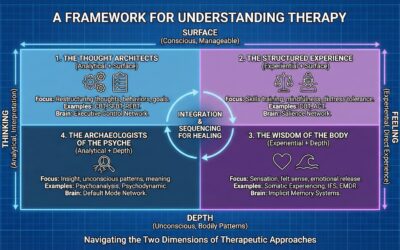
The meeting point between person and world is the contact boundary, and Gestalt theory names the ways people interrupt contact there. Introjection swallows other people’s rules whole. Projection attributes disowned feelings to someone else. Retroflection turns an impulse back on oneself, so anger meant for another becomes self-reproach. Confluence blurs the boundary altogether. Erving and Miriam Polster later added deflection, dodging contact through vagueness or jokes. The diagram below is a common teaching version; the cycle in this form comes from the generation after Perls, notably Joseph Zinker (1977).8

Perls’s own shorthand for the inner critic was the “topdog,” the voice of shoulds, and the “underdog,” which agrees and quietly sabotages;3 later two-chair work put the pair in dialogue.
The last core idea came from Arnold Beisser. In a 1970 essay, “The Paradoxical Theory of Change,” he argued that people change when they become more fully what they already are, not when they strain to become what they are not.9 Japanese Morita therapy rests on a similar paradox; the Gestalt therapist Peter Philippson notes that a 1985 book on Morita therapy by Reynolds lists “the paradoxical futility of deliberate change” among its Gestalt parallels.8 We explore that tradition in our essay on Shoma Morita.
The empty chair, the hot seat and Gloria
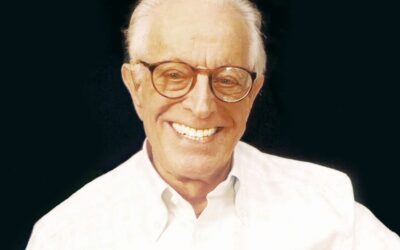
Perls’s method is easiest to see on film. In 1964 the psychologist Everett Shostrom recorded a recently divorced mother, Gloria Szymanski, in separate first sessions with Carl Rogers, Fritz Perls and Albert Ellis. Released in 1965 as Three Approaches to Psychotherapy, the “Gloria films” helped train at least two generations of therapists.6 Rogers reflects and accepts. Perls watches. Early on he catches the mismatch between her words and her face: “You say you’re scared but you’re smiling. How can you be scared and smiling at the same time?” He calls her giggle phony; she gets angry and defends herself, and he offers his hand: “Wonderful. Thank you.” In his commentary afterward Perls did not treat even the anger as a breakthrough: he said her embarrassment was “protected by her brazenness and anger” and that her “phoniness” still had to be worked through.6
That is the technique in miniature: attend to the obvious, especially the body, and turn it into an experiment. The film also shows the cost. Ellis later wrote that Perls was “very nasty to Gloria.” She corresponded with Rogers until her death in 1979. Writing about the filming shortly before she died, she said that what she had needed most was “permission to be me,” and that instead she found herself with Perls “in a vicious circle of game playing.”6
The empty chair follows the same logic. Instead of talking about an absent father, the client speaks to him in an empty chair, then changes seats and answers as him. Perls did not invent the device. Psychodramatists credit Jacob Moreno with the empty chair, and Perls attended psychodrama sessions in New York and acknowledged Moreno’s influence in his memoir. Moreno is said to have told him on a 1969 convention panel, “I don’t mind you stealing my stuff, but you should have stolen all of it.” What Perls did was make the chair famous, through Esalen demonstrations in which one volunteer at a time took the “hot seat” while the audience watched.10
Esalen, the Gestalt prayer and the problem of Perls
Michael Murphy and Dick Price founded Esalen at Big Sur in 1962 to explore what Aldous Huxley called “human potentialities,” and Huxley, whose perennial philosophy we discuss elsewhere, helped them get started. Perls’s five-year residency made Gestalt work one of its signature practices. Jeffrey Kripal subtitled his history of the institute America and the Religion of No Religion, a better description than this page’s earlier claim that West Coast Gestaltists were founding a religion.11
The “Gestalt prayer,” printed in Gestalt Therapy Verbatim, begins: “I do my thing and you do your thing. I am not in this world to live up to your expectations, and you are not in this world to live up to mine.” It ends with the hope that two people might find each other: “If not, it can’t be helped.”3 It spread far beyond therapy and drew answers, among them Walter Tubbs’s one-page “Beyond Perls” (1972), which set off replies in the Journal of Humanistic Psychology over the next three years.12, 13
Read historically, the prayer is a strange product of Gestalt theory. Goodman was a social critic who told young Americans they were right to feel alienated in a society that offered them little meaningful work or community, and in the theory he drafted the self exists only in contact with its environment, other people included. The prayer keeps the individual and drops the society. My reading is that, at Esalen, a theory of the organism in its environment became a creed of private self-sufficiency, sold in workshops to a prosperous generation. The movement split into “East Coast” Gestalt, kept a clinical discipline by the New York and Cleveland institutes under teachers such as Laura Perls and Isadore From, and a California version that became a way of life.
Then there is Perls himself. Gloria recalled that at the end of the filming day he had her cup her hand and flicked his cigarette ash into it. His biographer Martin Shepard called it Fritz’s “neediness paradox”: a man who taught people to own their projections while projecting his own neediness onto others and treating them with contempt for it.6 A method built on confrontation needs a therapist who can be trusted with power, and the hot seat, run as theater, did not always have one.
What survived, and what the evidence says
By most accounts Gestalt therapy peaked in the United States around 1980, then lost ground as cognitive approaches rose; its training lived outside universities and many practitioners distrusted quantitative research. Trials of Gestalt therapy itself remain scarce. One of the better ones randomized 141 adult outpatients with PTSD after a single traumatic event in adulthood to a Gestalt-derived treatment, dialogical exposure therapy, or to cognitive processing therapy. Both groups improved substantially, but cognitive processing therapy did better on symptom and cognition measures at the end of treatment.14
The chair did better than the school. In the late 1970s Leslie Greenberg began studying Gestalt two-chair dialogue with the tools of psychotherapy research,15 work that grew into emotion-focused therapy.16 In a 1995 trial, 34 people with unresolved feelings toward a significant other were randomized to experiential therapy built on empty-chair dialogue or to a psychoeducational group; the chair group improved more on every outcome and kept its gains a year later.17 A 2002 study of 26 clients, many maltreated in childhood, found that those who told the imagined other what they had needed, and then saw that person differently, had better outcomes, and that this process predicted outcome better than the therapeutic alliance.18
Self-criticism has been studied the same way, from a nine-client pilot19 to a 2026 meta-analysis of seven randomized trials of emotion-focused therapy that found a moderate-to-large effect (Hedges’ g of −0.73), which its authors call preliminary.20 A 2026 systematic review found 22 randomized trials of chairwork across depression, PTSD, childhood trauma, OCD, social anxiety and eating disorders, with effects from small to large, but judged most of them at high risk of bias and only two at low risk.21 The honest summary: chairwork is promising, with a growing but uneven trial base; Gestalt therapy as a whole is under-tested.
Chairwork also traveled, into schema therapy and redecision therapy22 and into cognitive behavioural therapy.23 Richard Schwartz built Internal Family Systems out of family therapy and systems theory, and Perls’s empty-chair work and Virginia Satir were among his influences.10 The present-moment emphasis reached other schools by other routes, from the in-session focus of functional analytic psychotherapy to the emotional experiencing at the center of intensive short-term dynamic psychotherapy.
What this looks like in therapy
Most chairwork today is gentler than the Gloria film. A session may begin where Perls began, with something obvious: the client’s breath stops when she mentions her father, or he smiles while describing something painful. Instead of interpreting it, the therapist asks the client to notice it, stay with it, or exaggerate it slightly.
With an inner critic, the client may sit in one chair and speak as the critic, in its actual words, then move and answer as the self being criticized. The aim is not to win; in emotion-focused work the hoped-for shift is a softening in the critic and a clearer sense of what the criticized self needs. With grief or an old injury, the client may speak to a parent or someone who has died, saying what was never said. One process study found that good outcomes went with that emotional shift, voicing the unmet need and seeing the other person differently; the furniture is only the means.18
We do this work in a trauma-informed way, which means changing several things Perls did. The client sets the pace and can stop at any point, and nobody is put on a hot seat. With people who dissociate, or who were harmed by the person they would be addressing, we often slow down, leave the chair empty, work with the body first, or turn toward the frightened part before asking anyone to confront anything. That last move is closer to Internal Family Systems therapy, which asks a part’s permission before working with it instead of dramatizing it.10 Our parts-based therapy in Alabama draws on both traditions. The aim Perls named still holds: stop explaining people to themselves, and give them an experience they can take in and make their own.
If you are in Alabama and this kind of work interests you, whether for an inner critic that never lets up or a conversation that never got to happen, get in touch. We see clients in Hoover and by teletherapy across the state.
References
- Perls, F. S. (1947). Ego, hunger and aggression: A revision of Freud’s theory and method. George Allen & Unwin. (Original work published 1942)
- Perls, F. S., Hefferline, R. F., & Goodman, P. (1951). Gestalt therapy: Excitement and growth in the human personality. Julian Press.
- Perls, F. S. (1969a). Gestalt therapy verbatim. Real People Press.
- Perls, F. S. (1969b). In and out the garbage pail. Real People Press.
- Spagnuolo Lobb, M. (2007). Ego, hunger and aggression: Do we bite in the same way as in the 50s? A contribution to the development of the concept of aggression in Gestalt therapy theory and practice. Gestalt Review, 11(3), 239–243. https://doi.org/10.5325/gestaltreview.11.3.0239
- Martin, J. (2026). The 1965 “Gloria films,” then and now. Journal of the History of the Behavioral Sciences, 62(3), Article e70062. https://doi.org/10.1002/jhbs.70062
- Henle, M. (1978). Gestalt psychology and Gestalt therapy. Journal of the History of the Behavioral Sciences, 14(1), 23–32. https://doi.org/10.1002/1520-6696(197801)14:1<23::AID-JHBS2300140105>3.0.CO;2-Y
- Philippson, P. (2018). Gestalt therapy and Morita therapy. In Gestalt therapy: Roots and branches—Collected papers (pp. 101–110). Routledge. https://doi.org/10.4324/9780429475276-14
- Beisser, A. (1970). The paradoxical theory of change. In J. Fagan & I. L. Shepherd (Eds.), Gestalt therapy now: Theory, techniques, applications (pp. 77–80). Science and Behavior Books.
- Giacomucci, S. (2021). Other experiential approaches similar to psychodrama. In Social work, sociometry, and psychodrama: Experiential approaches for group therapists, community leaders, and social workers (pp. 291–308). Springer. https://doi.org/10.1007/978-981-33-6342-7_15
- Kripal, J. J. (2007). Esalen: America and the religion of no religion. University of Chicago Press.
- Tubbs, W. (1972). Beyond Perls. Journal of Humanistic Psychology, 12(2), 5. https://doi.org/10.1177/002216787201200202
- Horne, D. (1974). Response to Tubbs’ “Beyond Perls.” Journal of Humanistic Psychology, 14(1), 73–75. https://doi.org/10.1177/002216787401400106
- Butollo, W., Karl, R., König, J., & Rosner, R. (2016). A randomized controlled clinical trial of dialogical exposure therapy versus cognitive processing therapy for adult outpatients suffering from PTSD after type I trauma in adulthood. Psychotherapy and Psychosomatics, 85(1), 16–26. https://doi.org/10.1159/000440726
- Greenberg, L. S., & Clarke, K. M. (1979). Differential effects of the two-chair experiment and empathic reflections at a conflict marker. Journal of Counseling Psychology, 26(1), 1–8. https://doi.org/10.1037/0022-0167.26.1.1
- Greenberg, L. S., Rice, L. N., & Elliott, R. (1993). Facilitating emotional change: The moment-by-moment process. Guilford Press.
- Paivio, S. C., & Greenberg, L. S. (1995). Resolving “unfinished business”: Efficacy of experiential therapy using empty-chair dialogue. Journal of Consulting and Clinical Psychology, 63(3), 419–425. https://doi.org/10.1037/0022-006X.63.3.419
- Greenberg, L. S., & Malcolm, W. (2002). Resolving unfinished business: Relating process to outcome. Journal of Consulting and Clinical Psychology, 70(2), 406–416. https://doi.org/10.1037/0022-006X.70.2.406
- Shahar, B., Carlin, E. R., Engle, D. E., Hegde, J., Szepsenwol, O., & Arkowitz, H. (2012). A pilot investigation of emotion-focused two-chair dialogue intervention for self-criticism. Clinical Psychology & Psychotherapy, 19(6), 496–507. https://doi.org/10.1002/cpp.762
- Wang, Y., Douris, C., & Timulak, L. (2026). Effectiveness of emotion-focused therapy for self-criticism: A systematic review and meta-analysis. Clinical Psychology & Psychotherapy, 33(5), Article e70346. https://doi.org/10.1002/cpp.70346
- Ottingerová, L., Halamová, J., & Szitás, D. (2026). Experiential therapies including chairwork: A systematic review of randomized controlled trials. Frontiers in Psychology, 16, Article 1692630. https://doi.org/10.3389/fpsyg.2025.1692630
- Kellogg, S. (2004). Dialogical encounters: Contemporary perspectives on “chairwork” in psychotherapy. Psychotherapy: Theory, Research, Practice, Training, 41(3), 310–320. https://doi.org/10.1037/0033-3204.41.3.310
- Pugh, M. (2017). Chairwork in cognitive behavioural therapy: A narrative review. Cognitive Therapy and Research, 41(1), 16–30. https://doi.org/10.1007/s10608-016-9805-x


















0 Comments