
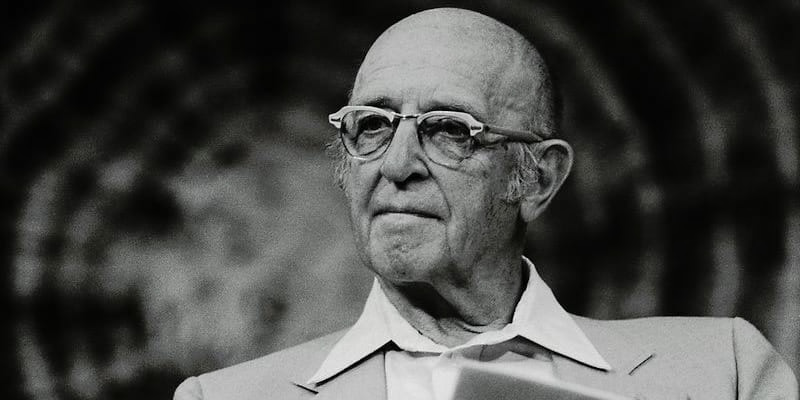
Carl Rogers (1902–1987) was the American psychologist who created person-centered therapy, first called nondirective and then client-centered therapy. Its premise is that people change when a therapist reliably offers three conditions: genuineness, unconditional positive regard and accurate empathy. Rogers framed these as testable hypotheses, and decades of meta-analysis show they predict how well therapy goes.
The popular picture of Rogers is a gentle man who nodded and repeated your last sentence back to you. That picture gets him backwards. Rogers was one of the first therapists to record his sessions and study them, and his central claim was an empirical one: specific qualities of the relationship produce change. The research since then supports that claim in a narrower form than he stated it. The conditions consistently predict better outcomes across most kinds of therapy, which makes person-centered work the foundation of the field rather than its soft option. The evidence that they are enough on their own is weaker.
Who Carl Rogers was
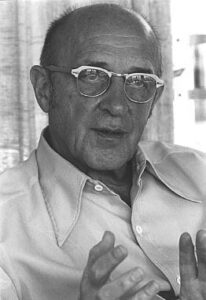
Carl Ransom Rogers was born on January 8, 1902, in Oak Park, Illinois, the fourth of six children in a strict Protestant household. He went to the University of Wisconsin to study agriculture, moved to history and then to religion, and came back from a 1922 trip to Beijing for an international Christian conference with his religious certainties loosened. He graduated in 1924, married Helen Elliott and enrolled at Union Theological Seminary in New York. He did not take a divinity degree. After two years he left for Teachers College, Columbia University, where he did doctoral research on children and finished his PhD in 1931.
Two encounters from those years shaped everything after. As an intern at New York’s Institute for Child Guidance in 1927–28 he watched Alfred Adler relate directly to children and parents, and he later recalled being shocked by how simple it looked next to the institute’s exhaustive Freudian case histories. Then, in 1936, while he was working with troubled children in Rochester, New York, he met Otto Rank. Rogers always credited that encounter with Rank for changing how he thought about therapy, and told his biographer he had become “infected with Rankian ideas.”1 Much of that influence came through social work. Jessie Taft, Rank’s translator and a founder of the Rankian “functional” school of social work at the University of Pennsylvania, had already written The Dynamics of Therapy in a Controlled Relationship (1933). As a clinical social worker, I find it worth remembering that one of psychology’s most influential therapies owes a debt to Otto Rank’s break with Freud and to the caseworkers who carried his ideas into practice.
The rest of the career moved fast. Rogers published The Clinical Treatment of the Problem Child in 1939, took a professorship at Ohio State in 1940 and published Counseling and Psychotherapy in 1942.2 From 1945 to 1957 he ran the counseling center at the University of Chicago and wrote Client-Centered Therapy (1951).3 He was president of the American Psychological Association in 1947, and in 1956 the APA gave him its Distinguished Scientific Contribution Award.4 At the University of Wisconsin (1957–1963) he published On Becoming a Person (1961), still one of his best-known books.5 He then joined the Western Behavioral Sciences Institute in La Jolla, California, and in 1968 he helped found the Center for Studies of the Person there. His later years went to encounter groups, large person-centered workshops and dialogue work with Catholics and Protestants in Belfast, Black and white South Africans, and leaders from 17 nations at a 1985 meeting on Central America in Rust, Austria. He died on February 4, 1987, a few days after surgery following a fall.
What Rogers actually proposed
Rogers’s theory starts from an actualizing tendency, a built-in push toward growth and maintenance that he thought every organism has. Children build a self-concept out of how the people around them respond, and when love and approval come with conditions attached, the child learns what Rogers called conditions of worth: I am acceptable when I am cheerful, successful, not angry. Experiences that contradict the self-concept get distorted or denied. Rogers called the gap between what a person actually experiences and the self they believe they must be incongruence, and he saw anxiety as the felt sign of that gap.6 The idea sits close to Karen Horney’s split between the real self and the idealized self, and to what she called the tyranny of the should.7
His best-known paper, published in 1957, turned that theory into a hypothesis about therapy.8 It lists six conditions, not three. Two people must be in psychological contact. The client is incongruent, vulnerable or anxious. The therapist is congruent in the relationship. The therapist feels unconditional positive regard for the client. The therapist feels an empathic understanding of the client’s internal frame of reference and tries to communicate it. And the client perceives that empathy and regard, at least to a minimal degree. Rogers claimed that no other conditions were necessary and that these, kept up over time, were sufficient. The three therapist conditions became known as the core conditions.
Each is easy to misread. Congruence has an inner side, the therapist’s awareness of what is happening in them, and an outer side, the capacity to give voice to that experience respectfully and transparently.9 It is not a license to disclose every feeling; the point is that the therapist is not putting on a front. Unconditional positive regard means prizing the person without making acceptance contingent on their behavior; it does not mean agreeing with everything they do. Empathy means grasping the client’s experience as they live it, from the inside, and checking whether you have it right.
This was a direct challenge to the two dominant schools. Against the analyst who interprets from a position of expertise, as described in our history of psychoanalytic thought from Freud to the relational models, Rogers put the client’s own frame of reference first. Against the behaviorist program that ran from John Watson to B. F. Skinner, he argued that people are not best understood as objects to be shaped. In 1956 he and Skinner published a joint symposium in Science on the control of human behavior, one of the clearest public statements of that disagreement.10 The name of his method changed with his thinking: nondirective in the 1940s, client-centered by 1951, person-centered later, when he applied the same ideas to education, groups and conflict.
Rogers the researcher
The part of Rogers that the “soft” reputation hides is the scientist. He pioneered the recording of counseling sessions, popularized the word client in place of patient, and conducted landmark research on counseling and psychotherapy.11 At Ohio State, Elias Porter used recordings of Rogers’s sessions to build a system for measuring how directive a counselor was being. At Chicago, Rogers and Rosalind Dymond edited Psychotherapy and Personality Change (1954), a volume of coordinated research studies of client-centered work.12 At Wisconsin he led a large study of psychotherapy with patients diagnosed with schizophrenia, published in 1967 as The Therapeutic Relationship and Its Impact, with Eugene Gendlin, Donald Kiesler and Charles Truax.13
Rogers also put his work in front of a camera. In 1964 the psychologist Everett Shostrom filmed a 31-year-old woman named Gloria Szymanski in first sessions with Rogers, Fritz Perls and Albert Ellis, released in 1965 as Three Approaches to Psychotherapy. The “Gloria films” trained generations of therapists, and Gloria exchanged letters with Rogers and his wife Helen until 1979.14 Set beside Ellis’s session, Rogers’s shows the difference between empathic following and the active disputing of what Ellis then called rational-emotive therapy, now rational emotive behavior therapy.
What the evidence says about the core conditions
The question Rogers posed, whether something common to all good therapy does most of the work, predates him. Saul Rosenzweig argued in 1936 that diverse methods of psychotherapy probably share implicit common factors.15 Rogers’s contribution was to name specific candidates precisely enough to measure. The most systematic recent review is the third interdivisional APA task force on evidence-based therapy relationships, which assembled a separate meta-analysis for each relationship element it examined and concluded that the relationship makes substantial and consistent contributions to outcome independent of the type of treatment.16
The numbers for Rogers’s three conditions all point the same way. Therapist empathy correlated with client outcome at r = .28 across 82 samples and 6,138 clients, a moderate effect that generally held across orientations and presenting problems. Empathy as the client, an observer or the therapist perceived it predicted outcome better than tests of empathic accuracy did.17 Positive regard showed a small positive association with outcome across 64 studies (g = .28), rising to g = .36 when the authors corrected for studies that reused the same samples.18 Congruence correlated with improvement at r = .23 across 21 studies and 1,192 patients.9 For comparison, the therapeutic alliance, one of the most studied variables in psychotherapy research, correlates with outcome at about r = .28 across 295 studies and more than 30,000 patients.19 Bruce Wampold’s review of the common factors reaches the same broad conclusion: factors such as the alliance, empathy and expectations are important for producing the benefits of psychotherapy.20
One of the more striking findings came from outside person-centered therapy entirely. When William Miller trained nine counselors to deliver a behavioral treatment for problem drinking, supervisors’ rankings of how empathic each counselor was predicted about two-thirds of the variance in clients’ drinking six months later, and the effect was still visible two years out. It was a small study, but it was one of the observations that led Miller to develop motivational interviewing, which explicitly draws on Rogers’s conditions.21
These are correlations, and correlations have limits. A client who is improving may experience the therapist as more understanding, and the effects vary a great deal between studies. The test of “sufficient” is different: it asks whether a therapy built mainly on the conditions works as well as more structured ones. A meta-analysis of 31 studies of nondirective supportive therapy for adult depression found it clearly effective against control conditions (g = 0.58) and slightly less effective than other psychotherapies (g = −0.20), a gap that disappeared once the researchers controlled for researcher allegiance.22 The PRaCTICED trial in England then randomized 510 adults with moderate or severe depression to person-centered experiential therapy or cognitive behavioral therapy. Person-centered therapy was non-inferior at six months, but at twelve months the difference favored CBT.23
The honest summary is this: Rogers’s conditions are among the best-supported ingredients in psychotherapy, and therapy in which clients do not experience them tends to go less well. Whether they are enough on their own probably depends on the person and the problem, and the comparative trials suggest that for some people they are not.
Where Rogers falls short
The sharpest criticism came from inside the humanistic movement. In 1982 Rollo May published an open letter to Rogers in the Journal of Humanistic Psychology, pressing him on the problem of evil and on whether the humanistic picture of human nature took destructiveness seriously enough.24 Rogers replied in the same journal, and the exchange is still a useful argument to read before deciding how far to trust the optimism of the person-centered view.25 Anyone who works with trauma, abuse or serious personality pathology sees what May was pointing at.
The second problem is the caricature of his technique. “Reflection of feelings” became a training exercise in paraphrase, and Rogers struggled with it himself. His later formulation treated a reflection as a tentative statement of the therapist’s understanding, offered so that the client can correct it, not as a mirror held up to the client’s words.26 The Gloria films have aged in a similar way: they are now also used to show how not to do therapy, and to ask how three famous older men handled their power over one young woman on camera.14
What this looks like in therapy
In practice, Rogers’s conditions are less a separate technique than the medium every other technique travels through.
Empathy is active work. A good empathic response is a guess about the felt meaning underneath what someone said, offered so they can correct it: “It sounds less like you’re angry at him and more like you’re tired of being the one who holds it together. Is that close?” When the client corrects a wrong guess, the session has usually moved forward.
Conditions of worth show up as rules. People rarely arrive saying they feel unacceptable. They say they should be over it by now, should not need help, should be grateful. Those shoulds are often the old conditions under which they were loved. Therapy makes room to notice whose voice they are in and what has been kept out of awareness to stay acceptable.
Regard is not approval. Accepting the person makes it possible to talk honestly about behavior that is hurting them or someone else, because the conversation no longer threatens their basic worth.
Congruence includes the therapist’s own reactions. Boredom, irritation or protectiveness in the therapist is information about the relationship. Sometimes it is worth saying something about it, carefully; more often it is used privately to understand the client better.
The same frame carries into other methods. Internal Family Systems therapy, EMDR, Brainspotting and somatic work all ask a person to stay with frightening or shameful material in the presence of another person, and that only becomes bearable when the relationship feels safe enough. The relational conditions do not replace those methods; they are what makes them usable. Rogers’s view of the person as the authority on their own experience also links directly to existential therapy, where questions of meaning, choice and authenticity are the work itself.
Rogers’s legacy
A 2002 ranking of eminence based on citations, textbook coverage, surveys and honors placed him sixth among the psychologists of the 20th century.27 In a survey of more than 2,400 North American psychotherapists published in 2009, he was still the top-ranked influence on their practice, two decades after his death.28 His ideas live on in motivational interviewing, in Eugene Gendlin’s focusing, in emotion-focused therapy and in counselling for depression, a form of person-centered experiential therapy approved for England’s public psychological therapy services,23 and in nearly every training program’s first lessons on listening.
The best case for Rogers is not that he was kind. It is that he made a precise, testable claim about what helps people change, and that the evidence has largely borne out the part about the relationship mattering, if not the part about it being enough.
If what you are looking for is a therapist who will take your experience seriously before trying to fix it, our existential therapy and depth-oriented work at Taproot starts from that same ground. You can reach out through our contact page to ask whether one of our therapists in Hoover or by teletherapy in Alabama is a good fit.
References
- Kramer, R. (1995). The birth of client-centered therapy: Carl Rogers, Otto Rank, and “the beyond.” Journal of Humanistic Psychology, 35(4), 54–110. https://doi.org/10.1177/00221678950354005
- Rogers, C. R. (1942). Counseling and psychotherapy: Newer concepts in practice. Houghton Mifflin.
- Rogers, C. R. (1951). Client-centered therapy: Its current practice, implications, and theory. Houghton Mifflin.
- Melton, A. W. (1957). The American Psychological Association Distinguished Scientific Contribution Awards for 1956. American Psychologist, 12(3), 125–133. https://doi.org/10.1037/h0043808
- Rogers, C. R. (1961). On becoming a person: A therapist’s view of psychotherapy. Houghton Mifflin.
- Rogers, C. R. (1959). A theory of therapy, personality, and interpersonal relationships, as developed in the client-centered framework. In S. Koch (Ed.), Psychology: A study of a science: Vol. 3. Formulations of the person and the social context (pp. 184–256). McGraw-Hill.
- Horney, K. (1950). Neurosis and human growth. W. W. Norton.
- Rogers, C. R. (1957). The necessary and sufficient conditions of therapeutic personality change. Journal of Consulting Psychology, 21(2), 95–103. https://doi.org/10.1037/h0045357
- Kolden, G. G., Wang, C.-C., Austin, S. B., Chang, Y., & Klein, M. H. (2018). Congruence/genuineness: A meta-analysis. Psychotherapy, 55(4), 424–433. https://doi.org/10.1037/pst0000162
- Rogers, C. R., & Skinner, B. F. (1956). Some issues concerning the control of human behavior: A symposium. Science, 124(3231), 1057–1066. https://doi.org/10.1126/science.124.3231.1057
- Kirschenbaum, H. (2004). Carl Rogers’s life and work: An assessment on the 100th anniversary of his birth. Journal of Counseling & Development, 82(1), 116–124. https://doi.org/10.1002/j.1556-6678.2004.tb00293.x
- Rogers, C. R., & Dymond, R. F. (Eds.). (1954). Psychotherapy and personality change: Co-ordinated research studies in the client-centered approach. University of Chicago Press.
- Rogers, C. R. (Ed.), Gendlin, E. T., Kiesler, D. J., & Truax, C. B. (1967). The therapeutic relationship and its impact: A study of psychotherapy with schizophrenics. University of Wisconsin Press.
- Martin, J. (2026). The 1965 “Gloria films,” then and now. Journal of the History of the Behavioral Sciences, 62(3), e70062. https://doi.org/10.1002/jhbs.70062
- Rosenzweig, S. (1936). Some implicit common factors in diverse methods of psychotherapy. American Journal of Orthopsychiatry, 6(3), 412–415. https://doi.org/10.1111/j.1939-0025.1936.tb05248.x
- Norcross, J. C., & Lambert, M. J. (2018). Psychotherapy relationships that work III. Psychotherapy, 55(4), 303–315. https://doi.org/10.1037/pst0000193
- Elliott, R., Bohart, A. C., Watson, J. C., & Murphy, D. (2018). Therapist empathy and client outcome: An updated meta-analysis. Psychotherapy, 55(4), 399–410. https://doi.org/10.1037/pst0000175
- Farber, B. A., Suzuki, J. Y., & Lynch, D. A. (2018). Positive regard and psychotherapy outcome: A meta-analytic review. Psychotherapy, 55(4), 411–423. https://doi.org/10.1037/pst0000171
- Flückiger, C., Del Re, A. C., Wampold, B. E., & Horvath, A. O. (2018). The alliance in adult psychotherapy: A meta-analytic synthesis. Psychotherapy, 55(4), 316–340. https://doi.org/10.1037/pst0000172
- Wampold, B. E. (2015). How important are the common factors in psychotherapy? An update. World Psychiatry, 14(3), 270–277. https://doi.org/10.1002/wps.20238
- Miller, W. R., & Rose, G. S. (2009). Toward a theory of motivational interviewing. American Psychologist, 64(6), 527–537. https://doi.org/10.1037/a0016830
- Cuijpers, P., Driessen, E., Hollon, S. D., van Oppen, P., Barth, J., & Andersson, G. (2012). The efficacy of non-directive supportive therapy for adult depression: A meta-analysis. Clinical Psychology Review, 32(4), 280–291. https://doi.org/10.1016/j.cpr.2012.01.003
- Barkham, M., Saxon, D., Hardy, G. E., Bradburn, M., Galloway, D., Wickramasekera, N., Keetharuth, A. D., Bower, P., King, M., Elliott, R., Gabriel, L., Kellett, S., Shaw, S., Wilkinson, T., Connell, J., Harrison, P., Ardern, K., Bishop-Edwards, L., Ashley, K., … Brazier, J. E. (2021). Person-centred experiential therapy versus cognitive behavioural therapy delivered in the English Improving Access to Psychological Therapies service for the treatment of moderate or severe depression (PRaCTICED): A pragmatic, randomised, non-inferiority trial. The Lancet Psychiatry, 8(6), 487–499. https://doi.org/10.1016/S2215-0366(21)00083-3
- May, R. (1982). The problem of evil: An open letter to Carl Rogers. Journal of Humanistic Psychology, 22(3), 10–21. https://doi.org/10.1177/0022167882223003
- Rogers, C. R. (1982). Reply to Rollo May’s letter to Carl Rogers. Journal of Humanistic Psychology, 22(4), 85–89. https://doi.org/10.1177/002216788202200407
- Arnold, K. (2014). Behind the mirror: Reflective listening and its tain in the work of Carl Rogers. The Humanistic Psychologist, 42(4), 354–369. https://doi.org/10.1080/08873267.2014.913247
- Haggbloom, S. J., Warnick, R., Warnick, J. E., Jones, V. K., Yarbrough, G. L., Russell, T. M., Borecky, C. M., McGahhey, R., Powell, J. L., III, Beavers, J., & Monte, E. (2002). The 100 most eminent psychologists of the 20th century. Review of General Psychology, 6(2), 139–152. https://doi.org/10.1037/1089-2680.6.2.139
- Cook, J. M., Biyanova, T., & Coyne, J. C. (2009). Influential psychotherapy figures, authors, and books: An Internet survey of over 2,000 psychotherapists. Psychotherapy: Theory, Research, Practice, Training, 46(1), 42–51. https://doi.org/10.1037/a0015152




















0 Comments