
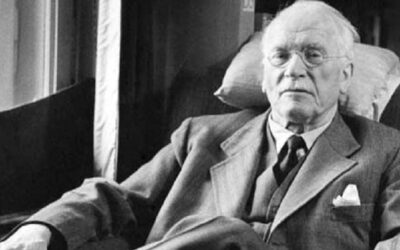
Carl Gustav Jung (1875–1961) was a Swiss psychiatrist who founded analytical psychology. Trained at Zurich’s Burghölzli hospital, he was Sigmund Freud’s leading collaborator from 1906 until their break in 1913. He then built his own psychology around complexes, the collective unconscious, archetypes, introversion and extraversion, and individuation, his word for the lifelong work of becoming a whole person.
Most of what is popular about Jung is doctrine: archetypes as inherited images, people sorted into types, coincidences that mean something. Most of what has lasted is a method. Jung treated dreams, fantasies and symptoms as the psyche’s attempt to correct a one-sided conscious life, and he engaged those images instead of explaining them away. That method can be used without accepting his weakest claims. It also has to be taught alongside his record in the 1930s, which admiring accounts tend to skip.

Jung’s life in brief
Jung was born on 26 July 1875 in Kesswil, on Lake Constance. His father, Paul Jung, was a pastor in the Swiss Reformed Church; his mother, Emilie Preiswerk, came from a Basel family of clergy and scholars. From 1895 he studied medicine at the University of Basel, reading widely on the side in philosophy, theology, spiritualism and psychical research, and he took part in séances.1 His medical dissertation, On the Psychology and Pathology of So-Called Occult Phenomena, analysed the trances of a young medium who was his cousin, Hélène Preiswerk. At the end of 1900 he joined the Burghölzli, the University of Zurich’s psychiatric hospital, as an assistant physician under Eugen Bleuler, and with Bleuler he helped establish the modern diagnostic category of schizophrenia. He married Emma Rauschenbach, with whom he had five children.1
- 1909: leaves the Burghölzli for private practice; honorary degree from Clark University in Massachusetts.
- 1910: becomes the first president of the International Psychoanalytical Association.
- 1913–1914: breaks with Freud and begins the self-experiment he called his “confrontation with the unconscious.”
- 1921: publishes Psychological Types.
- 1933: becomes president of the General Medical Society for Psychotherapy as it is reorganized in Nazi Germany (see below).
- 1943–1944: professor of medical psychology at Basel; gives up the chair after a heart attack.
- 1948: the C. G. Jung Institute in Zurich is founded on 24 April.2
- 1961: dies on 6 June at Küsnacht, on Lake Zurich.
Word association, the complex and Freud
The earlier version of this page credited Jung with introducing the word-association test. He did not invent it. Francis Galton timed his own associations to a prepared list of words and published the results in 1879.3 What Jung and his colleague Franz Riklin did at the Burghölzli was to treat the test’s failures as the data. When a stimulus word touched something charged, the subject hesitated, gave an odd or repeated answer, or could not remember the reply on a second run. Those disturbances clustered around emotionally loaded themes, which Jung called feeling-toned complexes.4 The experiments made him one of the rising names in European psychiatry, and they made him a valuable ally for Freud.1
Jung began collaborating with Freud in 1906, met him in Vienna in March 1907, and soon organized the first psychoanalytic congress and edited the movement’s first journal.1 Their letters, published in 1974, show how quickly the alliance soured.5 In Transformations and Symbols of the Libido (1911–1912), later revised as Symbols of Transformation, Jung widened libido from sexual drive into psychic energy in general and filled the book with mythological parallels. Freud proposed ending their personal relationship in January 1913, and in 1914 Jung withdrew from the psychoanalytic movement and resigned from the University of Zurich.5, 1 Our essay on the biographical and intellectual development of Jung’s psychology follows these years closely.
The confrontation with the unconscious and The Red Book
After the break, Jung experimented on his own imagination. In the winter of 1913 he deliberately gave free rein to fantasy and wrote down what followed in a set of notebooks, the Black Books. When war broke out in 1914 he took several fantasies as precognitions of it and began a manuscript transcribing the main ones with commentary, later recopied in gothic script into a red leather folio illuminated with his own paintings. He worked on this Liber Novus, the Red Book, for sixteen years. It was not published until 7 October 2009, when W. W. Norton issued it in an edition by the historian Sonu Shamdasani; the Black Books followed in 2020.6
The historian of psychiatry Henri Ellenberger called this period a “creative illness” and compared it with the crisis that preceded Freud’s own discoveries.7 Shamdasani’s edition shows that the archetypes, the collective unconscious and individuation took shape in these years, and that Jung later named the technique he had used on himself active imagination.6 The Red Book is best read as the record of a self-experiment, not as scripture. See our guide to understanding Jung’s Red Book and our history of Jung’s search for the bottom of consciousness.
The core ideas, and how well they hold up
The complex. Jung’s most portable idea: a cluster of memory, emotion and image that behaves like a semi-independent personality, breaking into speech, choices and moods. It came out of the association experiments,4 he later built it into a general theory,8 and it maps easily onto the parts language many therapists use today.
The collective unconscious and archetypes. Jung argued that beneath personal memory lies a layer common to all people, organized by archetypes: inherited dispositions to form typical images such as the mother, the hero and the trickster. Here the science is weakest. The Jungian analyst Jean Knox found “irreconcilable tensions” between the different models of the archetype that Jung tried to hold together, above all on whether anything about archetypes is innate.9 Christian Roesler’s review concluded that there is still no firm scientific foundation for the claim that complex symbolic patterns such as the hero myth are transmitted so that every individual has access to them.10 Knox treats archetypes instead as image schemas that emerge in development from bodily experience and relationship, not pictures stored in the genes. That version is defensible; the strong version is not. Our essay on Jung’s shadow and holding the tension of opposites shows how the most clinically useful archetype works in practice.
Psychological types. In Psychological Types (1921) Jung described two attitudes, introversion and extraversion, and four functions: thinking and feeling, which he called rational because they judge, and sensation and intuition, which he called irrational because they perceive.11 He used the scheme mainly to describe one-sidedness, the way a person leans on one function and neglects its opposite. The Myers-Briggs Type Indicator was later built on this scheme, but a review of its psychometrics concluded that its limitations warrant considerable caution about inferences drawn from its four-letter types.12
Individuation. Jung’s name for the lifelong development of the personality toward wholeness. For Jung it changed what psychotherapy was for: no longer only the treatment of illness, but a means for the higher development of the personality.1
Synchronicity. Jung’s term for meaningful coincidence, an outer event that matches an inner state with no causal link. His main essay appeared in 1952 alongside a study by Pauli,8 and included an astrological experiment that Pauli himself questioned. Synchronicity has not been demonstrated as a principle of nature; recent Jungian research asks the more modest question of how therapists work with such experiences.13
The method that outlasts the doctrine
In 1958, introducing an essay he had written in 1916, Jung put the question that runs through his clinical work: “How does one come to terms in practice with the unconscious?”8 His answer had three parts.
Compensation. Jung argued that dreams tend to compensate the conscious attitude, bringing forward what waking life leaves out.8 Someone who lives entirely by duty, for example, may dream of disorder. On this view the psyche is self-regulating, and a symptom or recurring dream carries information about a one-sided life, not only a malfunction.
Amplification. Instead of decoding an image into a fixed meaning, Jung enlarged it, first with the dreamer’s own associations, then with parallels from myth, religion and art. Done badly, this becomes a symbol dictionary. Done well, it shows a person that a private image belongs to a long human conversation about the same predicament.
Active imagination. Jung’s own technique from 1913: staying with an image while awake, letting it move and speak, recording it in writing or paint, and then taking a conscious position toward it. He argued that holding the conscious and unconscious positions together can produce a third, new attitude, which he called the transcendent function.8 He encouraged patients to paint and draw their images, a practice that fed into the later art therapies.1
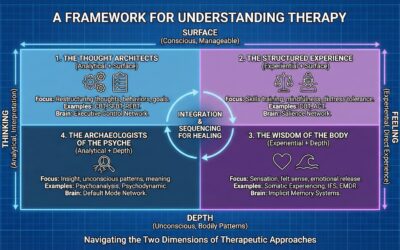
None of these moves requires believing in inherited images or acausal coincidence. A clinician can treat a recurring dream as news about what the dreamer’s waking attitude excludes without settling whether a collective unconscious exists. That is why the method has travelled further than the doctrine, including into body-based work, a shift traced in our piece on how post-Jungian psychotherapy moved from analytical to experiential.
The 1930s: Nazism, antisemitism and race
An honest account of Jung has to include what he did and wrote after Hitler took power. In 1933 the president of the General Medical Society for Psychotherapy, the psychiatrist Ernst Kretschmer, was politically suspect in the eyes of the new regime. The German society was reorganized under Matthias Heinrich Göring, a cousin of Hermann Göring, and Jung became president of the international body and editor of its journal, the Zentralblatt für Psychotherapie. The historian Geoffrey Cocks describes Jung as the patriarch whom German psychotherapists “drafted” for the protection and prestige they hoped his name would bring.14
That year the journal carried a statement endorsing Nazi positions and Mein Kampf. Jung said publicly that he was surprised and disappointed to see his name associated with it, but he stayed on. In 1934 he published “The State of Psychotherapy Today” in the same journal, writing that the “Aryan” unconscious had a greater potential than the Jewish one and that Jews had never created a cultural form of their own.15 His 1936 essay “Wotan” described a nation infected by one possessed man, which reads as a warning, yet it framed the movement as the reawakening of an ancient Germanic god.15 He kept the presidency until around the start of the Second World War (accounts differ between 1939 and 1940), and after the war he denied ever having been antisemitic.
Jungians have argued about this for decades. Working from archival sources, William and Linda Schoenl argue that Jung also wanted to preserve psychotherapy in Germany and advance his own psychology there, that despite some antisemitic statements he “was not anti-Semitic in the way the Nazis were,” and that he grew warier of the Nazis after Gustav Bally criticized him in the Neue Zürcher Zeitung in February 1934.16 The analyst Andrew Samuels concluded that it was Jung’s attempt to build a psychology of nations that brought him “into the same frame as Nazi anti-semitic ideology,” and that “post-Jungians do have reparation to make.”17 The same habit of mind shows in Jung’s writing on race. Farhad Dalal argued in 1988 that Jung’s perception of black people was racist and that those views were woven into the concepts of the collective unconscious and individuation,18 and in 2018 a group of Jungians published an open letter in the British Journal of Psychotherapy on Jung’s writings and theories about “Africans.”19 Our post on the trial of Carl Jung and his legacy weighs both sides; his wartime contacts with American intelligence are a separate question, examined in our post on Jung and the OSS.
The idea that failed worst, morally and scientifically, is the idea that peoples carry inherited psychic characters: the strong archetype doctrine applied to nations and races. The part that survives, close attention to one person’s own images inside a relationship, needs none of it.
What this looks like in therapy
A Jungian-informed session rarely looks like a seminar on mythology. It starts with what the person brings: a dream that will not let go, a recurring image, a reaction out of proportion to its trigger, or a life gone one-sided, all achievement and no rest. The therapist asks what the image is doing and what it might be compensating for, and the person’s own associations come before any mythological parallel. Sometimes the work is active imagination or drawing; sometimes it is noticing traits a person has disowned and keeps finding in other people, the material Jung called the shadow.
Two cautions shape how we use it. First, people with trauma or dissociation can be flooded by deliberate imaginal work, so stabilization comes first. Second, the evidence is real but limited. Roesler’s review of mostly naturalistic studies from Germany and Switzerland reported significant improvements in symptoms, interpersonal problems and personality structure that held for up to six years, with treatments averaging about 90 sessions.20 A later overview by Roesler and Reefschläger described “some empirical support” for Jungian psychotherapy and stressed the need for randomized controlled trials.13 That makes it a serious long-form therapy with promising outcome data, not a proven treatment for any specific condition.
Which books about Jung to trust
Much of what circulates about Jung comes from Memories, Dreams, Reflections, published in English in 1963 as “recorded and edited by Aniela Jaffé.”21 It is not an ordinary autobiography. Most of it was compiled by Jaffé from her conversations with Jung, supplemented by his own memoir of his early years. The interview protocols, published by Princeton University Press in December 2025 as Jung’s Life and Work, show that significant material was withheld and much was edited.22 Shamdasani has traced how the book came to be taken for Jung’s autobiography.23 Our post on the material censored from Memories, Dreams, Reflections goes further.
For a full life, many readers start with Deirdre Bair’s Jung: A Biography (2003).24 Read it with Shamdasani’s critique: Bair saw the Jung papers at the ETH in Zurich but not the family archives, and he points to errors such as dating a patient’s vision to 1901 without evidence.23 For how the psychology itself was made, Shamdasani’s Jung and the Making of Modern Psychology (2003) reconstructs its origins from archival sources.25 Richard Noll’s The Jung Cult (1994) argued that Jung founded a charismatic movement with the trappings of a cult;26 Shamdasani’s Cult Fictions examines the evidence for that claim and rejects it.27
Be wary of popular Jung quotes. The earlier version of this page ended with “The privilege of a lifetime is to become who you truly are,” a line widely attributed to Jung that we could not trace to his published writings, so it has been removed.
If a recurring dream, an image you cannot shake, or the sense that your life has gone one-sided is what brought you to this page, our page on Jungian depth therapy in Hoover describes how we work with that material, and you can contact us with questions.
References
- Shamdasani, S. (n.d.). About Jung. Philemon Foundation. Retrieved November 8, 2026, from https://philemonfoundation.org/about-philemon/about-jung/
- C. G. Jung-Institut Zürich. (n.d.). Geschichte (History of the institute). Retrieved November 8, 2026, from https://junginstitut.ch/uber-uns/Geschichte
- Galton, F. (1879). Psychometric experiments. Brain, 2(2), 149–162. https://doi.org/10.1093/brain/2.2.149
- Jung, C. G. (1973). Experimental researches (L. Stein & D. Riviere, Trans.; The collected works of C. G. Jung, Vol. 2). Princeton University Press.
- McGuire, W. (Ed.). (1974). The Freud/Jung letters: The correspondence between Sigmund Freud and C. G. Jung. Princeton University Press.
- Jung, C. G. (2009). The Red Book: Liber Novus (S. Shamdasani, Ed.; M. Kyburz, J. Peck, & S. Shamdasani, Trans.). W. W. Norton.
- Ellenberger, H. F. (1970). The discovery of the unconscious: The history and evolution of dynamic psychiatry. Basic Books.
- Jung, C. G. (1969). The structure and dynamics of the psyche (2nd ed.; R. F. C. Hull, Trans.; The collected works of C. G. Jung, Vol. 8). Princeton University Press. Includes “The transcendent function” (written 1916, prefatory note 1958), “General aspects of dream psychology” and “Synchronicity: An acausal connecting principle” (1952).
- Knox, J. (2003). Archetype, attachment, analysis: Jungian psychology and the emergent mind. Brunner-Routledge. https://doi.org/10.4324/9780203391525
- Roesler, C. (2012). Are archetypes transmitted more by culture than biology? Questions arising from conceptualizations of the archetype. Journal of Analytical Psychology, 57(2), 223–246. https://doi.org/10.1111/j.1468-5922.2011.01963.x
- Jung, C. G. (1971). Psychological types (H. G. Baynes, Trans., rev. R. F. C. Hull; The collected works of C. G. Jung, Vol. 6). Princeton University Press. (Original work published 1921)
- Pittenger, D. J. (2005). Cautionary comments regarding the Myers-Briggs Type Indicator. Consulting Psychology Journal: Practice and Research, 57(3), 210–221. https://doi.org/10.1037/1065-9293.57.3.210
- Roesler, C., & Reefschläger, G. I. (2022). Jungian psychotherapy, spirituality, and synchronicity: Theory, applications, and evidence base. Psychotherapy, 59(3), 339–350. https://doi.org/10.1037/pst0000402
- Cocks, G. (2018). Psychotherapy in the Third Reich. Routledge. https://doi.org/10.4324/9781351307604
- Jung, C. G. (1970). Civilization in transition (2nd ed.; R. F. C. Hull, Trans.; The collected works of C. G. Jung, Vol. 10). Princeton University Press. Includes “The state of psychotherapy today” (1934), pp. 157–174, and “Wotan” (1936), pp. 179–193.
- Schoenl, W., & Schoenl, L. (2016). Jung’s views of Nazi Germany: The first year and Jung’s transition. Journal of Analytical Psychology, 61(4), 481–496. https://doi.org/10.1111/1468-5922.12238
- Samuels, A. (1992). National psychology, National Socialism, and analytical psychology: Reflections on Jung and anti-semitism, Part II. Journal of Analytical Psychology, 37(2), 127–148. https://doi.org/10.1111/j.1465-5922.1992.00127.x
- Dalal, F. (1988). Jung: A racist. British Journal of Psychotherapy, 4(3), 263–279. https://doi.org/10.1111/j.1752-0118.1988.tb01028.x
- Open letter from a group of Jungians on the question of Jung’s writings on and theories about “Africans.” (2018). British Journal of Psychotherapy, 34(4), 673–678. https://doi.org/10.1111/bjp.12408
- Roesler, C. (2013). Evidence for the effectiveness of Jungian psychotherapy: A review of empirical studies. Behavioral Sciences, 3(4), 562–575. https://doi.org/10.3390/bs3040562
- Jung, C. G. (1963). Memories, dreams, reflections (A. Jaffé, Ed.; R. Winston & C. Winston, Trans.). Pantheon Books.
- Jung, C. G., & Jaffé, A. (2025). Jung’s life and work: Interviews for Memories, Dreams, Reflections with Aniela Jaffé (S. Shamdasani, Ed.). Princeton University Press.
- Shamdasani, S. (2018). Jung stripped bare by his biographers, even. Routledge. (Original work published 2005) https://doi.org/10.4324/9780429476341
- Bair, D. (2003). Jung: A biography. Little, Brown.
- Shamdasani, S. (2003). Jung and the making of modern psychology: The dream of a science. Cambridge University Press. https://doi.org/10.1017/CBO9780511490095
- Noll, R. (1994). The Jung cult: Origins of a charismatic movement. Princeton University Press.
- Shamdasani, S. (2003). Cult fictions: C. G. Jung and the founding of analytical psychology. Routledge. (Original work published 1998) https://doi.org/10.4324/9780203360767











0 Comments