
The Holy Grail of the Unconscious: A Comprehensive Guide to Jung’s Red Book
For nearly a century, the history of psychology contained a massive black hole. We knew that between 1913 and 1930, the Swiss psychiatrist Carl Jung underwent a terrifying and transformative “confrontation with the unconscious.” We knew he recorded his visions, dialogues with internal figures, and prophetic dreams in a large, red leather-bound volume. But almost no one had seen it. It was locked in a Swiss bank vault, a rumor, a ghost.
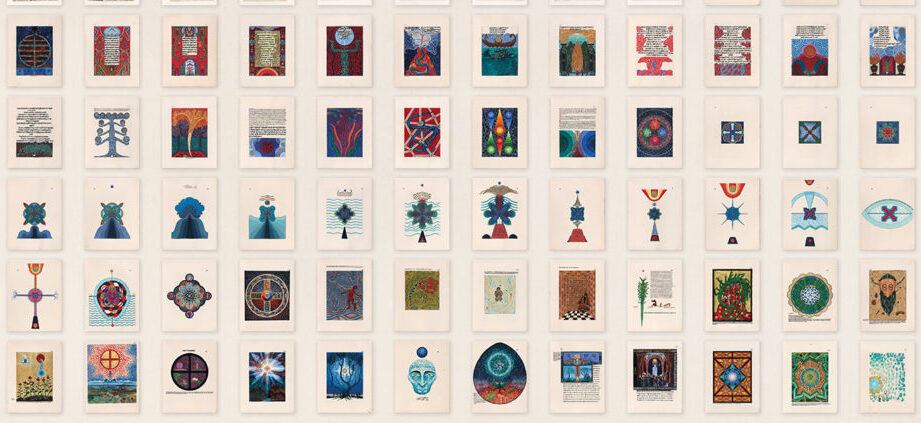
In 2009, thanks to the tireless efforts of historian Sonu Shamdasani, The Red Book (Liber Novus) was finally published. It is not a textbook. It is a work of art, prophecy, and madness, a medieval illuminated manuscript for the modern soul. It reveals that analytical psychology was not born in a sterile clinic, but in a furnace of visions where Jung met gods, demons, and the dead. To understand Jungian psychology without the Red Book is to understand Christianity without the Bible.
The Origins: The Spirit of the Depths
The genesis of The Red Book can be traced to a pivotal fracture in 1913. Jung underwent a dramatic break with his mentor and father-figure, Sigmund Freud. This professional isolation triggered a collapse. Jung began to have waking visions of Europe drowning in blood, a premonition of World War I that he initially mistook for his own impending psychosis. Fearing he was “doing a schizophrenia,” he made the courageous decision not to suppress the madness, but to drop into it.
He distinguished between two forces: the Spirit of This Time (rationality, science, the ego, the persona) and the Spirit of the Depths (myth, soul, eternity, the irrational). The Red Book is the gospel of the Spirit of the Depths. Jung began recording his fantasies first in the “Black Books,” and later transcribed them into the Red Book using calligraphic script and elaborate paintings.
Psychiatric historian Henri Ellenberger later gave this period a clinical name: a “creative illness,” the kind of self-directed breakdown that, survived, becomes the seedbed of an entire body of work. What made Jung’s version of it survivable rather than simply catastrophic was a technique he only later named active imagination, a disciplined state of waking dream in which the ego stays present enough to talk back to what it meets instead of either suppressing the vision or being swept away by it. Jung’s split from Freud is usually told as a story about libido theory, but Liber Novus makes clear it was also the moment Jung lost the professional container that had been managing his own psychological material, and had to build a private one to replace it.
The Structure of the Work
The Liber Novus is divided into three distinct sections, each representing a different stage of Jung’s descent and integration.
1. Liber Primus (The Way of What Is to Come)
This section chronicles the initial descent. Jung encounters the “desert” of his own soul. He realizes that his success in the world (The Spirit of This Time) has left his soul starving. Here, he meets the initial guardians of the unconscious and undergoes the death of his “Heroic Ego.”
2. Liber Secundus (The Images of the Erring)
This is the longest section, filled with a diverse cast of archetypal figures. Jung wanders through various landscapes, forests, deserts, castles, engaging in dialogues with figures that represent different aspects of human history and the collective unconscious. It is a series of trials and initiations, and several of its darkest chapters rarely make it into summaries of the book.
In one, Jung meets a wretched, one-eyed tramp, a former convict with a simple love of cinema that the cultured, serious Jung finds beneath him. Watching the man die in the vision, Jung notices that his own hands are covered in blood and is forced to ask whether it is his brother’s blood on them. The encounter sets up a distinction Jung returned to for the rest of his life, between mere being, the shared, oceanic instinctual life every person is simply born into, and becoming, the harder, lonelier work of individuation that pulls a person out of that collective mass and into a life of their own.
In another, Jung seeks out a desert anchorite named Ammonius, a man who has built his entire identity on reading scripture and starving his instincts, and watches him crack open into a worldly, cynical monk who readmits the pagan and the devilish into his life. Jung himself then turns into a leaf-covered forest daimon he calls the Green Man, a figure of pure, amoral, vegetative growth that terrifies both the anchorite and the devilish Red One, since it belongs to neither of their categories.
The darkest chapter is “The Sacrificial Murder.” Jung comes across the mutilated body of a young girl and is commanded by a veiled figure, later revealed to be his own soul, to cut out her liver and eat it. Ancient Babylonian and Greek tradition treated the liver as the seat of blood and dark passion, what Paracelsus later called the alchemist in the belly, and the act reads as Jung forcing himself to accept his own share of collective human evil rather than standing outside it in innocence.
Shortly after, a swarm of restless dead led by the biblical Ezekiel rushes past on an endless pilgrimage to Jerusalem, and when Jung tries to describe what he is witnessing he is dragged off by the police and locked in a madhouse, diagnosed with religious mania by a psychiatrist who cannot tell mysticism from psychosis. It reads as Jung’s own indictment, decades early, of a diagnostic culture built to pathologize the soul rather than listen to it.
3. Scrutinies
The final section is more philosophical. Jung attempts to integrate the wild visions of the previous years. It culminates in the “Seven Sermons to the Dead,” a Gnostic text where Jung articulates a new cosmology of the Self and the Pleroma.
Key Figures and Archetypes
The Red Book is populated by autonomous figures who speak to Jung with a wisdom and personality distinct from his own. These are not merely “parts of himself” in a reductive sense; they are objective entities of the imaginal realm.
Philemon: The Inner Guru
Perhaps the most important figure is Philemon, a wise old man with the wings of a kingfisher. Philemon was Jung’s inner guru. He taught Jung the crucial lesson of objective psyche: “Thoughts are not things you make; they are things that happen to you.” Philemon represents the archetype of the Wise Old Man and the Mana-Personality.
Salome: The Blind Anima
Often accompanying Philemon/Elijah is a blind, beautiful young woman named Salome. She represents the Anima (the soul or feeling function). Her blindness suggests that the feeling function in Jung (and in the modern patriarchal man) is unconscious and needs guidance. Through his relationship with her, Jung learns that he must serve the feminine principle, not dominate it.
The Red One: The Shadow
Jung encounters a devilish, red-riding figure who taunts him. This is “The Red One,” representing the “joy of life,” instinct, and the Shadow. Jung, the serious Swiss doctor, is repulsed by him but must learn to accept him. This figure teaches that holiness without the devil is sterile.
Izdubar: The Dying God
Jung meets a giant, bull-like hero named Izdubar (reminiscent of Gilgamesh). Izdubar represents the ancient, mythic way of being. Jung realizes that his “science” (the poison of rationality) has lamed this god. He must tend to the dying god, eventually compressing him into the size of an egg to save him. This is a profound metaphor for how we must carry the sacred in a secular age.
The Murder of the Hero
One of the most shocking visions in the book is Jung’s murder of the hero Siegfried. In a dream, Jung and a dark companion ambush the golden hero and shoot him. Jung wakes up weeping with guilt.
The Meaning: This symbolizes the necessary death of the “Heroic Ego”, the 19th-century ideal of will, conquest, and conscious dominance. Jung realized that the attitude of “where there is a will, there is a way” had become dangerous. To enter the new age of psychology, the Hero must die so that the Self (a center greater than the ego) can be born.
The Seven Sermons to the Dead
The climax of the Red Book is a Gnostic text called The Seven Sermons to the Dead. In this section, the “dead” (spirits of the past, ancestors who have not found peace) return to Jung’s house, ringing the bell and demanding knowledge. Speaking in the voice of the Gnostic teacher Basilides, Jung delivers sermons on the nature of the Pleroma (the void/fullness), the god Abraxas (who unites good and evil), and the path of individuation.
This section confirms James Hillman’s radical view that psychology is ultimately a way of “caring for the dead.” We are not just healing our own childhoods; we are answering the unresolved questions of our ancestors. For a deeper analysis of this collaboration between the living and the dead, read our review of Lament of the Dead by Hillman and Shamdasani.
The New Ethic: What Abraxas Demands of the Living
Uniting good and evil in a single god is not only theology, it is a moral position, and Jung’s contemporary interpreters have started reading Liber Novus as the first draft of an entire ethics rather than a private vision. Christine Maillard, the French Jung scholar who translated the Red Book into French, argues that the individuated person described across these pages lives by a “new ethic” that breaks openly with codified, collective morality, and that Jung reaches again and again for the figure of Christ to make the point: not a savior to imitate, but the prototype of someone who broke with the values of his own community in order to found new ones. Maillard calls the resulting bind a conflict of duties, the same tension explored on this site as the ego-Self axis: the individuated person is caught between what the group demands and what the inner voice of the Self demands, and cannot resolve it by simply choosing the group.
Philosopher Giovanni Colacicchi, in Psychology as Ethics: Reading Jung with Kant, Nietzsche and Aristotle, traces the same demand to three older sources at once. Jung takes Kant’s consciousness of duty and turns it into a duty to become conscious in the first place. He takes Nietzsche’s case for a morality that stands beyond the herd and applies it to a single case history rather than an entire culture. And he takes Aristotle’s old insistence on balancing reason against passion and reads it as a description of what a well-integrated shadow actually looks like in practice.
The clearest statement of what this costs the rest of us came from Jung’s own student Erich Neumann, whose 1949 book Depth Psychology and a New Ethic scandalized Jung’s own Zurich circle when it appeared. Neumann’s argument, in short: the old ethic that demands moral purity from every individual does not eliminate evil, it only relocates it, projecting a person’s or a nation’s own unrecognized darkness onto a convenient scapegoat. The new ethic he calls for asks people to take conscious ownership of their own shadow instead, which is, in somewhat less alarming language, exactly what the Sacrificial Murder chapter of Liber Novus had already demanded of Jung two decades earlier.
How to Read The Red Book
Do not read The Red Book as a theory. Read it as a dream. It operates on the level of the symbolic life.
1. Visual Analysis and Mandalas
The book is filled with Mandalas, circular images representing the wholeness of the Self. Jung painted these when he felt fragmented; the act of painting the circle held his psyche together. Pay attention to the colors. As we explore in the psychology of color, the shift from dark chaos to golden order in the images tracks the movement of healing.
2. Active Imagination
The Red Book is the ultimate case study of Active Imagination. Jung did not just watch his fantasies; he entered them. When a figure appeared, he spoke to it. When a landscape emerged, he walked through it. This is the method we use in clinical practice today: engaging the unconscious as a partner rather than an object.
New Scholarship: Dante, Kabbalah, and the Return of the Gods
The academic conversation around Liber Novus has not stood still since 2009, and four recent threads are worth knowing if the book has already hooked you.
Analytical psychologist Tommaso Priviero, in Of Fire and Form: Jung, Dante, and the Making of the Red Book (2023), makes the case that Jung’s sixteen-year private engagement with Dante’s Commedia gave Liber Novus its actual shape, not a stray allusion but a structural template. Priviero’s evidence includes a striking detail from the Black Books themselves: Toni Wolff, Jung’s longtime collaborator, once transcribed for him the inscription over the gates of Dante’s Hell, “the highest wisdom, and the primal love,” and Priviero reads Philemon as Jung’s own answer to Dante’s guide Virgil, a figure leading not toward doctrine but toward love as the actual engine of the descent.
Sanford Drob, whose Reading the Red Book has gone through a revised Routledge edition, reads the same descent through Lurianic Kabbalah’s myth of the shattering of the vessels, in which divine light falls into matter as scattered sparks that must be painstakingly gathered and restored. Drob treats Jung’s fragmented visions and their slow reintegration as a psychological retelling of that myth, and reads Abraxas, the god who is “both the sun and the eternal sucking gorge of emptiness,” as a working demonstration of Hegel’s union of opposites rather than a purely Gnostic curiosity.
A third line of scholarship goes further back than Kabbalah. Computer scientist and Neoplatonist Bruce MacLennan argues that what Jung called active imagination is functionally identical to theurgy, the ritual “god-work” the third-century philosopher Iamblichus described in his own writings on how to invoke and converse with divine beings rather than merely imagining them. When Philemon told Jung things Jung insisted he had not consciously thought of, MacLennan hears an echo of Iamblichus’s own claim to be dictated to by an inner guide, which reframes the Red Book less as a psychological diary and more as a working grimoire that happens to have been written by a psychiatrist.
Finally, an ongoing Eranos symposium series edited by Murray Stein and Thomas Arzt, Jung’s Red Book for Our Time, argues that the anxieties Jung faced on the eve of the First World War, a fragmenting worldview, a discredited establishment, a mind flooded with more information than meaning, describe the present moment about as well as they described 1913. The editors treat Liber Novus as one link in what Jung called the aurea catena, the golden chain of transmitted spiritual wisdom, and argue that the same willingness to descend into the depths that produced this book is the only real answer to a culture drowning in connection and starved of meaning.
Legacy: A Book for the Future
Jung believed the Red Book was too strange for his contemporaries. He was right. But for us, living in a time of “meta-crisis” and meaninglessness, it is essential. It shows that the way out of chaos is not to impose order, but to find the meaning hidden within the chaos.
The Red Book teaches us that every life is a myth. We are not just biological accidents; we are characters in a divine drama. To heal is to find the script. It connects the personal suffering of the individual to the Gnostic pursuit of divine knowledge, reminding us that the “God within” is the ultimate goal of all therapy.
None of the scholarship above changes that verdict. It only confirms it from more directions than Jung himself could have anticipated, Dantean, Kabbalistic, Neoplatonic, and now a whole postmodern generation reaching for the same red door.
Bibliography
- Jung, C. G. (2009). The Red Book: Liber Novus. Ed. Sonu Shamdasani. W. W. Norton & Company.
- Shamdasani, S. (2012). C. G. Jung: A Biography in Books. W. W. Norton & Company.
- Hillman, J., & Shamdasani, S. (2013). Lament of the Dead: Psychology After Jung’s Red Book. W. W. Norton & Company.
- Stein, M., & Arzt, T. (2016). Jung’s Red Book for Our Time. Chiron Publications.
- Hoeller, S. A. (2019). The Gnosis of C.G. Jung. Quest Books.
- Maillard, C. (2018). Le Livre Rouge (1914-1930) de Carl Gustav Jung: individuation et discours sur l’éthique. Cahiers jungiens de psychanalyse, 147.
- Colacicchi, G. (2020). Psychology as Ethics: Reading Jung with Kant, Nietzsche and Aristotle. Routledge.
- Neumann, E. (1949). Depth Psychology and a New Ethic.
- Priviero, T. (2023). Of Fire and Form: Jung, Dante, and the Making of the Red Book. Routledge.
- Drob, S. L. (2022). Reading the Red Book: An Interpretive Guide to C. G. Jung’s Liber Novus (2nd ed.). Routledge.
- MacLennan, B. (2020). Theurgy as a Contemporary Practice: The Example of Jung’s Red Book. In J. F. Finamore & M. Nyvlt (Eds.), Plato in Late Antiquity, the Middle Ages and Modern Times. Prometheus Trust Press.










0 Comments