
The ego-Self axis is the living connection between the ego, the center of conscious identity, and the Self, Jung’s word for the whole psyche. Edward F. Edinger built Ego and Archetype (1972) around it. In his account the ego keeps swinging between inflation, when it identifies with the Self, and alienation, when it is cut off from it. Individuation is the work of making that swing conscious.
That model is more clinical than its religious vocabulary suggests. Edinger’s point is that grandiosity and worthlessness are not opposite problems that need opposite fixes. They are two failures of one relationship. Someone who feels like a god on Monday and like nothing on Thursday does not need more self-esteem or less. They need a steadier connection to something larger than the ego, one that neither feeds the inflation nor confirms the collapse. Read this way, individuation stops being a spiritual destination. It becomes something a therapist can watch over months, as the swings get smaller and more conscious.
Who Edward Edinger was
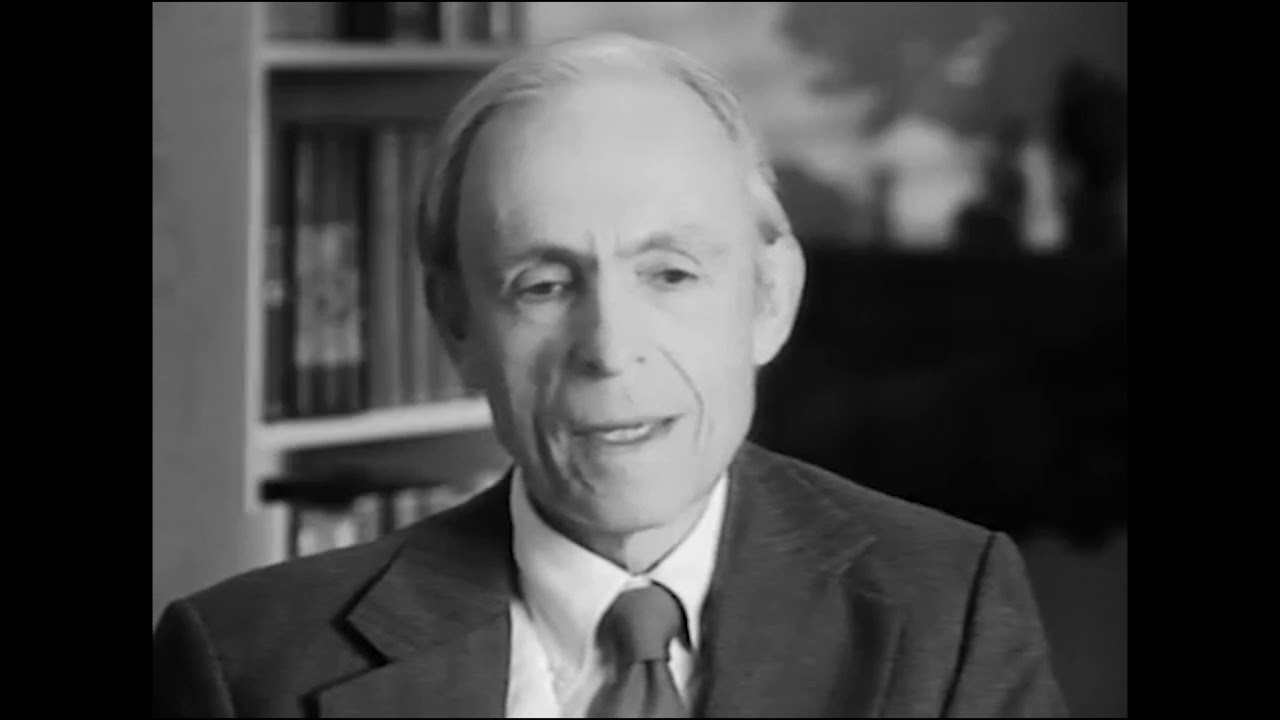
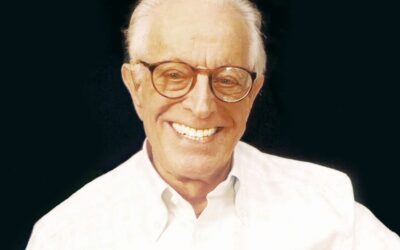
Edward F. Edinger was born in Cedar Rapids, Iowa, on December 13, 1922, and died at his home in Los Angeles on July 17, 1998. He took a bachelor’s degree in chemistry at Indiana University and his medical degree at Yale in 1946, then served as a physician in the U.S. Army Medical Corps, including time in Panama. In New York in 1951 he began analysis with M. Esther Harding, an analyst who had worked with Jung himself; her own contribution is the subject of our piece on Esther Harding and the feminine in depth psychology.
He worked as a supervising psychiatrist at Rockland State Hospital in Orangeburg, New York. In 1979 he moved to Los Angeles, where he practiced for his last nineteen years and became a senior analyst at the C.G. Jung Institute of Los Angeles. The timeline below corrects dates that an earlier version of this page got wrong. The C.G. Jung Foundation, for example, was founded in 1962, not 1954.
| Year | Event |
|---|---|
| 1922 | Born December 13 in Cedar Rapids, Iowa |
| 1946 | M.D., Yale School of Medicine |
| 1951 | Begins analysis with M. Esther Harding in New York |
| 1960 | Publishes “The Ego-Self Paradox” in the Journal of Analytical Psychology |
| 1962 | C.G. Jung Foundation for Analytical Psychology founded in Manhattan; Edinger is a founding member of it and of the C.G. Jung Institute of New York |
| 1968 to 1979 | President of the C.G. Jung Institute of New York |
| 1972 | Ego and Archetype |
| 1979 | Moves to Los Angeles |
| 1984 | The Creation of Consciousness |
| 1985 | Anatomy of the Psyche |
| 1996 | The New God-Image |
| 1998 | Dies July 17 in Los Angeles, aged 75 |
Edinger was a classical Jungian, and the label matters. This page’s old title called his work “archetypal psychology,” which is the name of a different school: the movement James Hillman started in the early 1970s, which relativizes the ego and describes the psyche as many images rather than one center. Edinger went the other way. He kept Jung’s Self at the center and read scripture, Greek myth, Moby-Dick, Goethe’s Faust and Shakespeare as evidence about the ego’s relation to it. Lee Bailey’s entry in the Encyclopedia of Psychology and Religion calls him “a preeminent classical Jungian analyst.”1 Daryl Sharp, who published him at Inner City Books, put his reputation more plainly: “For those who find Jung himself tough going, Edinger has been the pre-eminent interpreter for more than forty years.”2
What the ego-Self axis is
Jung used two words that are easy to blur. The ego is the center of consciousness, the “I” that remembers, decides and answers to a name. The Self is the center and the totality of the whole psyche, conscious and unconscious, the source of the dreams and impulses the ego did not author. As Leslie Johannes summarizes the first part of Ego and Archetype, Edinger began from Jung’s account of individuation and from a developmental claim he drew from two later analysts.3 From Erich Neumann he took the picture of an original state “prior to the birth of ego consciousness,” imaged as the uroboros, the snake eating its own tail; our post on Erich Neumann and the origins of consciousness covers that model. From Michael Fordham he took the clinical postulate, based on observation of infants and children, that the Self is “the original totality prior to the ego,” a line of thought traced in our piece on Michael Fordham’s developmental analytical psychology. Edinger’s own compressed version, as Johannes quotes it: “The Self is born, but the ego is made; and in the beginning, all is Self.”3
If the ego is made out of the Self, it can go wrong in two directions. It can fail to separate and stay identified with the whole. Or it can separate so completely that it loses touch with its source. The ego-Self axis names the connection that lets the ego be distinct from the Self and still in relationship with it. The phrase itself is usually credited to Neumann. What Edinger added was a working account of how that connection forms, breaks and is repaired over a lifetime. He had already published a paper titled “The Ego-Self Paradox” in the Journal of Analytical Psychology in 1960, twelve years before the book.45
Inflation, alienation and the cycle between them
Inflation is the ego’s identification with the Self. A person, or a whole culture, behaves as if the ego were the center of everything: entitled, limitless, exempt from ordinary rules, or carrying a mission nobody else can see. Edinger drew on a large body of myth and scripture to show how this state is lived out and how much suffering it causes.
Alienation is the opposite failure, the ego cut off from the Self. Johannes, following Edinger, calls it a “deadening, painful, sometimes torturous state.”3 In a consulting room it looks like what most people would call depression or shame: flatness, self-contempt, the sense of having no right to take up space. Edinger’s turn is to show that alienation often follows inflation. When the ego has been merged with the Self, separation becomes necessary, and that separation is often lived as a fall.
Together the two states make a cycle: inflation, a fall into alienation, a reconnection that restores the axis, and then, because life keeps moving, a fresh inflation at a new level. Johannes describes it as a “spiral or repeating circular process” of ego-Self separation and ego-Self union.3 Two things follow from this.
First, the swing is normal. Edinger treated inflation and alienation as part of development, not as diseases, although people can get stuck at either pole. Second, individuation is not a third state you reach after the other two, as the earlier version of this page implied. It is the cycle itself made conscious, and it does not finish. In the last part of the book Edinger writes that “individuation is never truly complete,” so each temporary wholeness has to be opened again “in order for life to go on.”3
That leads to the practical point. If grandiosity and worthlessness sit on one axis, treating them as opposite problems misfires. Puncture the grandiosity with criticism and you tend to push the person toward the alienated pole. Rescue the worthlessness with praise and you can feed the next inflation. Edinger points instead to the relationship itself: the ego learning to experience something larger than itself without becoming it or being flattened by it. In the second part of the book that work is carried by symbols, the images from dreams and religious tradition that hold more than the ego can explain. Edinger warned that such an image “will not be changed by rational exhortation.”3
What the model says about depression and trauma, and what it does not
The old version of this page said that for Edinger “trauma is fundamentally a rupture in the Ego-Self Axis.” That overstates him. Ego and Archetype is a book about development and religious experience, and it does not present itself as a theory of trauma. Applying the axis to trauma is a later clinical reading. An influential Jungian account of trauma is Donald Kalsched’s The Inner World of Trauma (1996), which describes archetypal defenses, organized in what he calls a self-care system, that form around trauma to protect the personal spirit.6 Our post on Donald Kalsched and archetypal defenses in trauma covers that model.
Still, his two poles line up with two bodies of research.
The first concerns the alienated pole. A meta-analysis of 108 studies with 22,411 participants found that shame, the sense that the whole self is bad, correlated with depressive symptoms at r = .43, more strongly than guilt over specific acts at r = .28. Shame about how one is seen by others ran higher still, at r = .56.7 A separate meta-analysis of 25 studies of people exposed to trauma found a moderate association between shame and PTSD symptoms, r = .49.8 Both are correlations, and neither shows that shame causes depression or PTSD. But Edinger’s alienated ego, cut off from any felt sense that its existence is acceptable, is a close description of chronic shame from the inside.
The second concerns the swing. An influential review of research on pathological narcissism argued that grandiosity and vulnerability should be treated as two broad themes of one problem, not as two separate types of person.9 In one study, clinicians and clinical psychology faculty identified 143 people who fit a grandiose or a vulnerable profile and rated whether each had ever shown traits of the other variant. The results supported the idea that people fluctuate between the two, most clearly for vulnerable episodes in people identified as grandiose.10 That rests on clinicians’ ratings, not on following people over time, so it is suggestive rather than settled. Current Jungian writers use the axis in the same way: a 2021 paper in the Journal of Analytical Psychology argues that narcissistic defenses in couples can either rigidify or disrupt the ego-Self axis, blocking the dialogue between ego and Self.11
None of this tests the ego-Self axis itself. It remains a clinical metaphor, not a construct that has been measured and validated. Its value is that it predicts a pattern clinicians see all the time and gives both poles a single explanation.
What this looks like in therapy
In practice the cycle shows up as a rhythm more than a diagnosis. A person carries a project, a relationship or a role as if everything depended on them and ordinary limits did not apply. Then something punctures it: a failure, a criticism, an illness, or plain exhaustion. The collapse that follows is out of proportion to the event, because what fell was not a plan but an identification. “I don’t need anyone” turns into “I am nothing,” and both sentences come from the same person, sometimes in the same month.
A therapist working from Edinger’s model does a few specific things.
- Names the cycle, not only the current pole. In the alienated state it helps to see that the despair belongs to a pattern with a history and a direction, not to a final verdict on the person’s worth.
- Does not argue with alienation. Reassurance works much like the “rational exhortation” that, in Edinger’s account, does not change a living symbol. The work is to find where acceptance can actually be felt: in the therapy relationship, in a dream image that carries more dignity than the person can grant themselves, in the body’s response when they are genuinely met.
- Relativizes inflation without humiliating it. Inflation usually carries something real, an energy or a calling, that the ego has claimed as its own. The aim is to return that energy to its proper size and source, not to shame the person for having felt it, which only sets up the next fall.
- Works with the poles as parts. The grandiose position and the worthless one often behave like distinct parts of the personality, each with its own history. Parts-based methods give a practical way to talk with each without letting either run the session.
Two cautions. Inflation in Edinger’s sense is a psychological attitude, not a diagnosis. A sustained elevated mood with much less need for sleep, racing thoughts or reckless spending can be a hypomanic or manic episode, and that calls for a psychiatric evaluation, not a symbolic reading. And alienation that has hardened into persistent depression deserves the same care any depression does. Depth work can run alongside that care but should not replace it; our page on depression treatment in Hoover describes how we approach it.
On evidence, the research base for Jungian therapy is small. Christian Roesler’s 2013 review gathered outcome studies, mostly from Germany and Switzerland, that reported lasting improvements in symptoms and interpersonal problems after an average of about 90 sessions.12 Those studies were naturalistic or retrospective rather than randomized trials, so the review’s conclusion that Jungian therapy can be called “empirically proven” is stronger than the designs support. Edinger’s model is best used as a way of understanding what is happening, alongside treatments with stronger evidence when symptoms call for them.
Later work: alchemy and the God-image
After Ego and Archetype, Edinger spent much of his career on the two subjects Jung returned to late in life: alchemy and the transformation of the image of God. Anatomy of the Psyche: Alchemical Symbolism in Psychotherapy (Open Court, 1985) reads the operations of the alchemists, with Latin names such as solutio (dissolving) and coagulatio (making solid), as pictures of the kinds of change people go through in psychotherapy.13 The earlier version of this page added that suffering is “a chemical process of the soul refining itself,” a slogan for which no source could be found. Read as a clinician, the book is most useful as a vocabulary of images for recognizing what kind of change someone is going through.
On religion, The Creation of Consciousness: Jung’s Myth for Modern Man (Inner City Books, 1984) presents Jung’s psychology as a new myth whose central task is the creation of consciousness.14 The same Toronto press later published The Middle Passage (1993) by James Hollis, whose psychology of the self we cover separately. Transformation of the God-Image (1992) is a commentary on Jung’s Answer to Job, and Encounter with the Self reads William Blake’s illustrations of the Book of Job. The New God-Image (Chiron, 1996), edited by Dianne Cordic and Charles Yates from lectures Edinger gave in Los Angeles in 1991, works through Jung’s letters on the evolution of the Western God-image.15 Those letters reached English readers in the two-volume edition edited by Aniela Jaffé and the analyst Gerhard Adler.
An earlier version of this page reduced all of this to the unsourced slogan that the “New God-Image” is “the Conscious Self.” The subtitle of his first book is a better guide: Individuation and the Religious Function of the Psyche. For therapy, the point is that questions about meaning are not side issues to refer elsewhere. In Edinger’s frame they are the axis itself. For a first book, start with Ego and Archetype; its opening part, on inflation and alienation, is the clearest statement of the model.
If the swing between “I can do anything” and “I am nothing” is familiar, it is worth talking through with someone who takes both sides of it seriously. Our page on Jungian depth therapy in Hoover explains how that work runs, and you can reach us through the contact page.
References
- Bailey, L. W. (2020). Edinger, Edward. In D. A. Leeming (Ed.), Encyclopedia of psychology and religion (pp. 746–749). Springer. https://doi.org/10.1007/978-3-030-24348-7_9058
- Sharp, D. (n.d.). In memoriam: Edward F. Edinger, 1922–1998. A personal tribute. Inner City Books. https://innercitybooks.net/in-memoriam-edward-edinger/
- Johannes, L. (2017). Ego and archetype, by Edward Edinger. Journal of Sandplay Therapy, 26(2). https://doi.org/10.61711/jst.2017.26.2s.574
- Edinger, E. F. (1960). The ego-Self paradox. Journal of Analytical Psychology, 5(1), 3–18. https://doi.org/10.1111/j.1465-5922.1960.00003.x
- Edinger, E. F. (1972). Ego and archetype: Individuation and the religious function of the psyche. G. P. Putnam’s Sons for the C. G. Jung Foundation for Analytical Psychology.
- Kalsched, D. (1996). The inner world of trauma: Archetypal defenses of the personal spirit. Routledge.
- Kim, S., Thibodeau, R., & Jorgensen, R. S. (2011). Shame, guilt, and depressive symptoms: A meta-analytic review. Psychological Bulletin, 137(1), 68–96. https://doi.org/10.1037/a0021466
- López-Castro, T., Saraiya, T., Zumberg-Smith, K., & Dambreville, N. (2019). Association between shame and posttraumatic stress disorder: A meta-analysis. Journal of Traumatic Stress, 32(4), 484–495. https://doi.org/10.1002/jts.22411
- Pincus, A. L., & Lukowitsky, M. R. (2010). Pathological narcissism and narcissistic personality disorder. Annual Review of Clinical Psychology, 6, 421–446. https://doi.org/10.1146/annurev.clinpsy.121208.131215
- Gore, W. L., & Widiger, T. A. (2016). Fluctuation between grandiose and vulnerable narcissism. Personality Disorders: Theory, Research, and Treatment, 7(4), 363–371. https://doi.org/10.1037/per0000181
- Nørby, K. (2021). In search of the Self à deux: The narcissistic collusion and impeded individuation. Journal of Analytical Psychology, 66(1), 49–69. https://doi.org/10.1111/1468-5922.12656
- Roesler, C. (2013). Evidence for the effectiveness of Jungian psychotherapy: A review of empirical studies. Behavioral Sciences, 3(4), 562–575. https://doi.org/10.3390/bs3040562
- Edinger, E. F. (1985). Anatomy of the psyche: Alchemical symbolism in psychotherapy. Open Court.
- Edinger, E. F. (1984). The creation of consciousness: Jung’s myth for modern man. Inner City Books.
- Edinger, E. F. (1996). The new God-image: A study of Jung’s key letters concerning the evolution of the Western God-image (D. D. Cordic & C. Yates, Eds.). Chiron Publications.


















0 Comments