
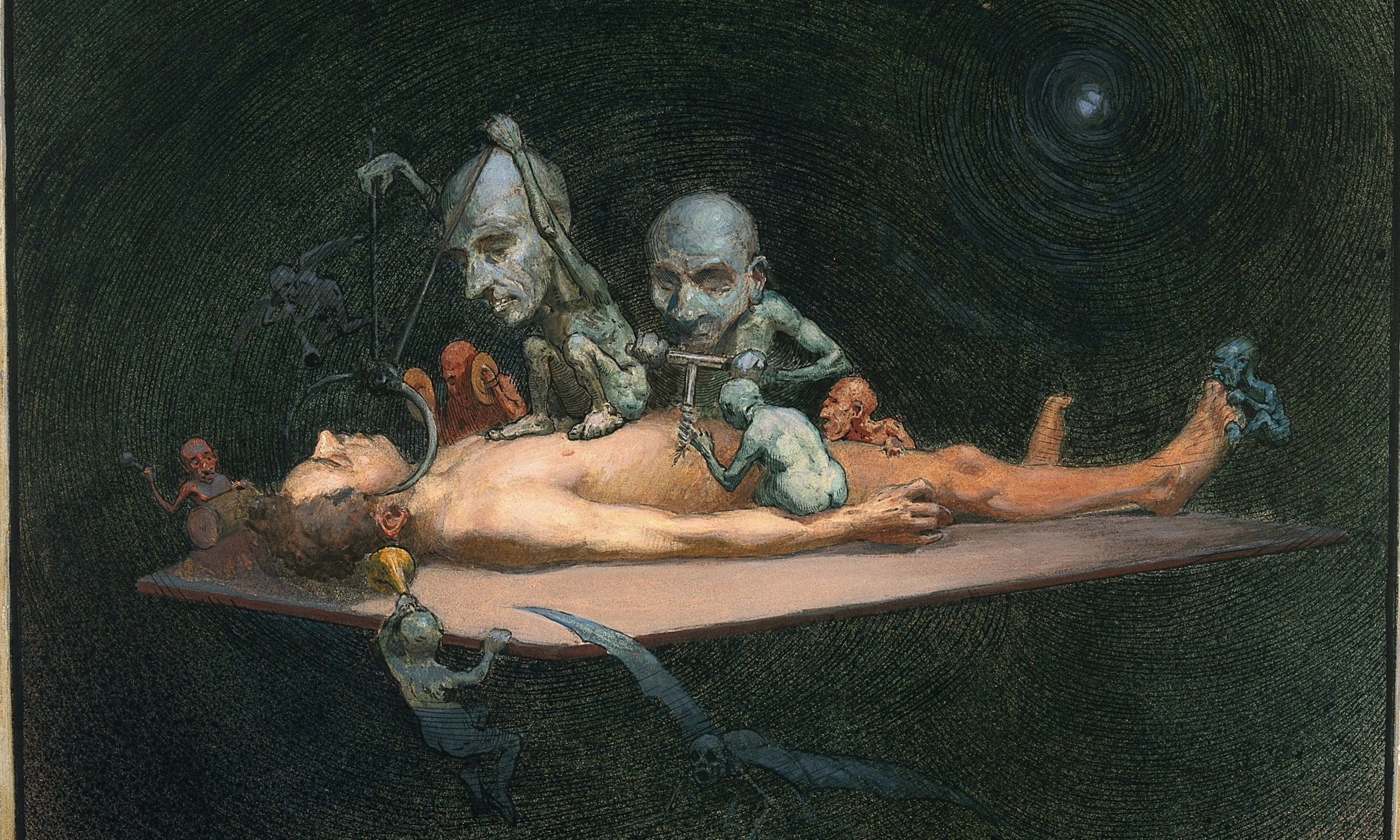
In 1927, a French novelist wrote a letter to the most famous doctor in Vienna. Romain Rolland had won the Nobel Prize in Literature. He had spent years studying the Indian mystic Ramakrishna, and he wanted to tell Sigmund Freud that psychoanalysis had missed something. The true source of religious feeling, Rolland argued, was not dogma and not the fear of a punishing father. It was a spontaneous sensation he called the oceanic feeling: a sense of eternity, of limitlessness, of an unbroken bond between the self and everything outside it.
Freud took the letter seriously. He opened Civilization and Its Discontents with it. Then he did what his entire intellectual formation required him to do. He explained the ocean away. The oceanic feeling, he wrote, was a residue of infancy, a leftover trace of the newborn at the breast who cannot yet tell where its own body ends and the mother begins. The mystic’s eternity was a memory of milk. Case closed.
Except the case never closed. The question Rolland put to Freud is the question every school of psychology has been forced to answer, usually against its will: where does consciousness actually come from? The Zimbabwean novelist Dambudzo Marechera called it the head of the stream, the place where all of man’s questions begin. Every founder of modern psychology went looking for that headwater. Each one found something different, and what each one found tells you less about the brain than about what that thinker could and could not allow himself to believe. A century later, the strangest development in neuroscience is that the mystics Freud dismissed and the depth psychologists the universities exiled are both being vindicated, in mathematics, in brainstem anatomy, and in the consulting room.
This is the history of that search.
William James and the River That Falls from Somewhere Else
Before Freud’s structural model, before the couch, there was a Harvard physician turned philosopher who gave the field its founding metaphor. William James published The Principles of Psychology in 1890, and in it he demolished the reigning picture of the mind as a chain of discrete ideas clicking together like beads. Consciousness, James wrote, does not come chopped up in bits. It flows. He named it the stream of consciousness, and the name stuck so completely that we forget someone had to invent it.
James noticed things in that stream that his contemporaries walked past. Every clear thought, he observed, is surrounded by a fringe, a halo of relations and half-formed anticipations. Each idea carries the dying echo of where it came from and the dawning sense of where it is going. The mind is not a slideshow. It is a river with a current.
A river has a source, and this is where James became dangerous to polite science. In an 1898 lecture at Harvard, he took on the assumption underneath all materialist psychology: that the brain produces consciousness the way a kettle produces steam. James pointed out that production is not the only relationship physics offers. There are also transmissive functions. A prism does not generate light. It receives light that already exists and bends it into a particular spectrum. The keys of an organ do not create wind. They release it, note by note.
Perhaps, James suggested, the brain is a prism. Perhaps consciousness is not manufactured inside the skull but filtered through it, a vast field narrowed down to the thin band of awareness a biological organism can use. Brain damage would then disrupt the receiver, not destroy the broadcast. Static on a radio does not disprove the signal.
By 1904 he had pushed further. In a paper bluntly titled Does Consciousness Exist, James denied that consciousness was a substance at all. Underneath the split between mind and matter, he proposed one primal stuff, which he called pure experience. The same moment of experience counts as a thought when you trace it through a person’s biography and as a thing when you trace it through the physical world. Mind and matter are not two materials. They are two filing systems.
For James, then, the head of the stream lay outside the organism entirely. Consciousness falls into us like rain from a larger weather system. And because James was a pragmatist, he insisted the question mattered practically. If the brain produces consciousness, death is annihilation and human dignity is a chemical accident. If the brain transmits it, death might be the removal of the lens. He considered that a live, forced, and momentous choice, and he refused to let physiology make it by default.
Freud and the Pull of the Inorganic
Freud went the other direction. Where James looked outward to a universal field, Freud looked down, into the body, and kept digging until he hit something that was not alive.
His formation explains the route. Freud trained in the Vienna of Hermann von Helmholtz’s physiology, a school built on the oath that no forces operate in the organism except physical and chemical ones. Whatever consciousness was, it had to be biology or it was nothing. So when Freud built his mature structural model in the early 1920s, consciousness came out looking small. It is not the essence of the mind. It is a surface phenomenon, a thin perceptual membrane he called the Pcpt.-Cs. system, stretched across the boundary between the organism and the world like the rind on a fruit. Its job is defensive: receive stimuli, take the impact, pass the traces downward into the dark.
The dark is the id, and the id is the real headwater in Freud’s map. It is the inherited reservoir of drive, present from birth, illogical, asocial, and, in Freud’s striking observation, timeless. Nothing in the unconscious is chronologically arranged. Time alters nothing there. The ego, the part of us that feels like a self, develops out of the id the way callus develops on a hand, through friction with reality. Freud compared the ego to a rider trying to steer a horse whose strength is not his own.
Then the First World War broke his model open. Freud watched shell-shocked veterans return in nightmares, night after night, to the exact trench they should have wanted to forget. He watched traumatized children stage their pain in play, and patients wreck the same relationship in the same way for decades. If the psyche runs on the pleasure principle, none of this should happen. In Beyond the Pleasure Principle, published in 1920, Freud followed the logic of repetition to its coldest conclusion. Drives, he decided, are conservative. They seek to restore an earlier state of things. And since all living matter arose from inanimate matter, the earliest state of any organism is the state of not being alive. The aim of all life, he wrote, is death.
He called the tendency the death drive, and its endpoint the Nirvana principle: the reduction of all tension, all excitation, all disturbance to zero. The scale of the claim is easy to miss. Asked where the stream of consciousness begins, Freud answered that its deepest current runs backward, toward a stillness before life. The oceanic feeling that Rolland praised and the Godhead the mystics sought were, for Freud, the same undertow wearing better clothes: the ego’s longing to stop being an ego, which he could only read as the organism’s longing to stop being an organism.
The diagnosis was consistent, and it was structural, not personal. Freud’s materialism was the price of admission to scientific respectability in his era, and he paid it in full. The cost was that an entire register of human experience, the register the contemplative traditions had mapped for three thousand years, got filed under pathology.
Jung, Meister Eckhart, and the God Who Needed a Soul
Freud’s heir apparent refused to pay that price, and the refusal cost him the inheritance.
Carl Jung agreed with Freud that the ego is not the source of the psyche. He disagreed about what lies beneath it. Beneath the personal unconscious, the basement of an individual’s forgotten and repressed material, Jung found what he came to call the collective unconscious: an inherited, structural layer of the psyche common to the species, organized around primordial patterns he named archetypes. Archetypes are to the mind what organs are to the body, evolutionary formations laid down over deep time. The ego, in Jung’s map, is not the owner of the psyche. It is a late settlement on the coast of a very old ocean, and the ocean has intentions.
The organizing center of that ocean Jung called the Self, the archetype of wholeness that contains conscious and unconscious, light and shadow. The task of a human life, which he named individuation, is the ego’s slow, negotiated relationship with that larger center. Consciousness, on this view, is not a defensive membrane. It is what the unconscious grows in order to see itself.
Jung knew he was not the first person to draw this map. Six centuries earlier, a Dominican friar had preached it from church pulpits in the vernacular German of ordinary parishioners, and had been tried by the Inquisition for it. Meister Eckhart, born around 1260, a professor of theology at Paris and one of the great administrative minds of his order, made a distinction that still reads like a live wire. There is God, the creator, the person to whom prayers are addressed. And behind God there is the Godhead, the Gottheit: a formless, nameless, silent desert of pure divinity, of forms formless, of beings beingless, prior to every attribute and every act. The Godhead does not know itself. In that absolute unity there is no other to know. Consciousness begins, Eckhart preached, when the Godhead wells over, when the Father notices himself and speaks the Son, the Word, into the soul. And the soul that empties itself completely, that achieves the poverty of spirit Eckhart called Gelassenheit, letting-be, becomes the stable where that birth happens.
Eckhart said something even stranger, and Jung never got over it. The soul, Eckhart declared, created God, for God did not exist until the soul was made. Jung read that sentence as a stroke of psychological genius arriving five hundred years early. Translate the theology into empirical terms and the map aligns point for point: the Godhead is the undifferentiated collective unconscious, the formless potential prior to any ego. The birth of the Son in the soul is the emergence of consciousness out of that ground. The numinous power that floods a person in religious experience does not descend from a metaphysical heaven. It rises, an eruption of energy from archetypal depths, and the God-image is relative to the soul that carries it.
The two maps of the return trip could not differ more. Where Freud saw the longing for oneness as the death drive in disguise, Jung saw the ego’s conscious reunion with its source as the crown of development, not regression but completion. Same river. Same current toward the source. One man read it as an undertow. The other read it as the way home.
Buber’s Objection: The Source Is Not Inside You
There was a third position, and it came from a philosopher who thought both Freud and Jung had made the same mistake.
Martin Buber, the Jewish philosopher and translator of Hasidic tales, spent years compiling the testimonies of mystics across every tradition, Sufi, Orthodox, Gnostic, pagan, into a volume called Ecstatic Confessions. He knew the terrain. And in 1923 he published I and Thou, a short book with a thesis that undercuts the entire inward search: consciousness does not originate inside anyone. It originates between.
Buber distinguished two primary ways of meeting the world. In the I-It mode, I experience things: I measure, categorize, use. In the I-Thou mode, I encounter a presence, whole and unrepeatable, whether that presence is a person, a tree, or God, whom Buber called the Eternal Thou. And the relation comes first. An infant reaches for its mother long before it possesses an ego that could decide to reach. We are not selves who subsequently enter relationships. We are precipitated out of relationship the way a crystal precipitates out of solution. In the beginning, Buber wrote, is relation.
This put him on a collision course with Jung, and the collision happened in public in the 1950s. Buber’s charge was precise. By interpreting God as a content of the psyche, an archetype, an image, an internal fact, Jung had sealed the human being inside a monologue. If the Thou you encounter is finally a projection of your own depths, you are alone in a hall of mirrors, talking to your own shadow. Buber accused Jung of wrapping a cloak around God’s head and shoving him under a bench. Jung answered that as an empiricist he could only speak of the God-image, the phenomenon as it appears in the psyche, and could make no claims beyond it. Buber found the modesty more damning than the offense.
For clinicians, the stakes of that quarrel were never academic. A soul is never sick alone, Buber insisted. There is always a betweenness, a situation between it and another existing being. Healing does not happen through analysis of one’s own archetypes in solitude. It happens in meeting. That conviction flowed directly into Carl Rogers and the person-centered tradition, and it is the philosophical ancestor of everything the field now calls relational: the two-person psychology, the therapeutic alliance research, the co-regulation literature. Buber got there first, and he got there from mysticism, not from outcome data.
His near-contemporary Martin Heidegger reached a parallel conclusion from a different direction. In Being and Time, and later in seminars he gave to Swiss psychiatrists at Zollikon, Heidegger refused the word consciousness altogether. The human being is not a capsule of psychic contents governed by hydraulic pressures, and he said so, at length, about Freud specifically. We are Dasein, being-there, always already outside ourselves in a meaningful world. Awareness happens in what he called the Lichtung, the clearing, the open space in a forest where light gets in and things become visible. The head of the stream is not a reservoir inside the skull. It is the openness in which any stream can appear at all.
By mid-century, then, the field held four incompatible maps. The source of consciousness was a universal field filtered through the brain (James), a biological abyss pulling toward the inorganic (Freud), a collective psyche identical with the mystics’ Godhead (Jung), or no interior location at all, but the between and the clearing (Buber, Heidegger). The institutional history of psychology since then has largely been the story of pretending the question was settled, or worse, that it was not worth asking. What no one predicted was where the answer would start to come from.
The Predictive Brain: Karl Friston and the Mathematics of the Ego
The most influential theoretical framework in contemporary neuroscience did not come from the study of consciousness at all. It came from thermodynamics.
Karl Friston, a British neuroscientist at University College London and one of the most cited scientists alive, developed the Free Energy Principle as an answer to a deceptively simple question: how does any living system keep itself from dissolving? Entropy pulls everything toward disorder. An organism persists by resisting that pull, and Friston’s mathematics show that resisting it is formally equivalent to minimizing surprise, the gap between what the organism expects and what its senses report.
The implications rewrote perception. The brain, on this account, is not a passive receiver assembling a picture from incoming data. It is a hierarchical prediction machine, ceaselessly generating top-down models of the world and the body, comparing those models against sensory input, and revising only when the errors demand it. What you experience is not the world. It is your brain’s running best guess, corrected by the world. The neuroscientist Anil Seth gave the idea its unforgettable name: perception is a controlled hallucination, hallucination because it is generated from the inside, controlled because reality keeps grading the homework. When we agree on our hallucinations, Seth notes, we call it reality.
And the self? In predictive processing, the ego is not a little observer in a Cartesian theater. It is a model like any other: a high-precision prior the brain maintains about its own states, wrapped in a statistical boundary Friston calls a Markov blanket, the mathematical membrane that separates a self-organizing system from everything it is not.
That single move quietly rehabilitates a century of dismissed experience. If the ego is a model, the ego can be relaxed. Deep meditation, psychedelics, moments of aesthetic arrest, and certain kinds of prayer all appear to do exactly that: turn down the precision on the self-model, loosen the high-level priors, let the Markov blanket go slack. The subjective report of that state, across every tradition and every century, is the same. Boundarylessness. Unity. Eternity. The oceanic feeling. Eckhart’s Gelassenheit, the letting-be that empties the soul, reads today like a first-person phenomenology of prior relaxation, written seven hundred years before the mathematics existed. Freud was right that the state is developmentally ancient. He was wrong that ancient means pathological. The same framework explains trauma from the other side: overwhelming experience shatters the high-level priors that made the world predictable, and recovery is the slow reconstruction of a model a person can live inside. Rigidity of priors and dissolution of priors are the two poles of the same machinery, and the clinic sees both every week.
Mark Solms and the Hidden Spring: The Id Was Conscious All Along
The second reversal is anatomical, and it is the one that would have staggered Freud most.
Mark Solms is a South African neuropsychologist and psychoanalyst, the field’s leading translator between the couch and the scanner, and the editor of the revised standard edition of Freud’s complete works. In The Hidden Spring, he assembled the clinical evidence for a claim that inverts a century of cortical dogma. Consciousness does not live in the cerebral cortex. Children born with hydranencephaly, missing the cortex entirely, are not vegetative. They smile at caregivers, they show preference and displeasure, they play. Meanwhile, damage to roughly two cubic millimeters of the upper brainstem, in the reticular activating system and the periaqueductal gray, abolishes consciousness completely. The great wrinkled hemispheres we photograph and celebrate are not the fountain. The fountain is a structure the size of a fingertip, hundreds of millions of years old, and what it produces first is not thought. It is feeling.
Solms’s formulation deserves to be quoted in every training program: we are not thinking machines that feel. We are feeling machines that think. Affect is the foundational form of consciousness, the raw sense of how it is going for the organism, and it plugs directly into Friston’s mathematics. Rising prediction error, unmet need, mounting entropy is felt as unpleasure. Resolved uncertainty and satisfied need are felt as pleasure. Feeling is what free energy is like from the inside. It exists because an organism that did not care about its own states would not keep having them.
Building on the affective neuroscience of Jaak Panksepp, who mapped seven distinct emotional command systems in the mammalian brainstem, seeking, lust, care, play, fear, rage, and the panic-grief of separation, Solms then performed the great inversion. Freud’s id, the ancient drive-based core, is not unconscious. It is the conscious part of us, the feeling part, the part that is always switched on. Freud’s ego, the cortical apparatus of memory and prediction, is in itself unconscious, a vast automated modeling machine that lights up only when the brainstem’s feelings irrigate it. Freud had the architecture right and the lighting backward.
Read clinically, this is a mandate. The patient with chronic anxiety or intractable depression is not harboring faulty cognitions that a worksheet will correct from the top down. Their conscious, affective core is signaling, in the only language it has, that the cortical models built to meet its needs are failing. Psychotherapy, in Solms’s synthesis, is the process by which a feeling id and a predicting ego renegotiate their contract, and it explains from first principles why the somatic and experiential therapies, the ones that start from the body and the felt sense rather than the narrative, so often reach what argument cannot. The brainstem does not speak in propositions. It never did.
The Speculative Edge: Tononi, Hoffman, and the Return of the Godhead
At the far boundary of the field, the mathematics has begun to sound like theology, to the considerable discomfort of the mathematicians.
Giulio Tononi’s Integrated Information Theory, developed with Christof Koch, starts not from neurons but from axioms about experience itself: that it exists intrinsically, that it is structured, specific, unified, and definite. From those axioms it derives a measurable quantity, phi, the amount of information a system generates as an integrated whole beyond the sum of its parts. The theory explains real anatomy: why the massively interconnected cortex sustains experience while the cerebellum, with more neurons wired in isolated feed-forward loops, does not, and why phi collapses under anesthesia. But the theory’s honest implication is that anything with phi above zero has some flicker of interiority. That is a mathematically precise panpsychism, and it provoked an open letter from over a hundred researchers in 2023 calling the theory pseudoscience. The vehemence of the reaction is itself historical data. The field’s founders exiled the mystical on principle; their successors are now deriving it from axioms and recoiling from their own results.
Donald Hoffman, a cognitive scientist at UC Irvine, arrives at an even stranger station by way of evolutionary game theory. His simulations support a theorem he calls Fitness Beats Truth: natural selection does not favor organisms that perceive reality accurately. It favors organisms that perceive a useful interface, the way a desktop icon usefully hides the transistors. Space, time, and physical objects, Hoffman argues, are that interface, a species-specific headset, and beneath it reality consists of interacting conscious agents all the way down. Whatever one makes of the ontology, and the objections are serious, the resonance is impossible to miss. James’s pure experience, Jung’s unus mundus, the one world where psyche and matter are not yet two, and Eckhart’s Godhead prior to every form are all recognizable in a theory published with proofs.
What This Means in the Consulting Room
I am a therapist, not a metaphysician, and I hold the speculative material loosely. But after two decades of sitting with people in trauma work, I no longer think the history rehearsed above is an academic story. It is a description of what happens in the room.
The person across from me is not a broken mechanism awaiting reprogramming. They are a predictive system whose models were built under conditions, often brutal ones, that no longer obtain, and whose feeling core keeps sounding an alarm the models cannot answer. The rigid priors are real; you can watch them defend themselves. The affective spring underneath is real; the somatic therapies reach it daily. And the relational field is real in exactly the sense Buber meant. When the priors finally soften, they soften between two people, in an encounter no worksheet contains, and what surfaces in those moments, the sense of ground, of contact with something larger and older than the presenting problem, is not a regression to the breast. It is the oldest layer of consciousness becoming audible again.
The founders each found a real headwater. James found the field. Freud found the body and its terrible conservatism. Jung found the archetypal deep. Buber found the between. The mystics found all of it first and paid for the trespass. The institutions that professionalized psychology spent a century forcing a choice among these maps, and the demand for the choice, not any of the maps, was the error. The stream has more than one source, and the evidence now arriving from mathematics, from brainstem anatomy, and from the phenomenology of the clinic suggests they were surveying the same country from different ridgelines.
Rolland was right about the ocean. Freud was right about the depth of the current. It took a hundred years and a great deal of unnecessary suffering for the field to discover it could keep both letters.
Taproot Therapy Collective practices depth-oriented and somatic trauma therapy in Birmingham, Alabama, integrating Jungian psychotherapy, brainspotting, and brain-based approaches with the clinical traditions discussed above.








0 Comments