

The Neuroscientist Who Proposed That Consciousness Is the Brain’s Model of Its Own Attention
By The Clinical Team at GetTherapyBirmingham.com
You know exactly where your arm is right now, even with your eyes closed. This automatic knowledge comes from what neuroscientists call the body schema, an internal model the brain constructs of the body’s position, boundary, and movement. But what if the brain constructs a similar model of something else, something far more abstract and fundamentally central to our existence: its own internal allocation of attention? According to neuroscientist Michael Graziano, Professor of Psychology and Neuroscience at Princeton University, this is precisely what occurs. This internal attention schema serves as the foundation of conscious awareness. At Taproot Therapy Collective in Birmingham, Alabama, our clinical directors utilize these advanced neurological frameworks to help clients identify and untangle deep-seated structural splits where conscious awareness and physiological attention have drifted into profound conflict.
Graziano’s Attention Schema Theory (AST) offers a mechanistic, scientifically testable account of how the brain comes to believe, with absolute cognitive certainty, that it has consciousness. The theory does not try to explain how physical, wet organic tissue magically generates a mysterious inner glow of subjective experience—the classic hard problem of consciousness. Instead, it asks a different, highly pragmatic question: How does an information-processing device come to claim, with unshakeable conviction, that it possesses a nonphysical inner essence? For anyone seeking to understand the deep mechanisms of the mind and its clinical disorders, AST provides a practical framework grounded in evolutionary biology. For individuals seeking psychiatric stabilization or trauma counseling in Hoover, Vestavia Hills, or Pelham, this model helps de-pathologize severe symptoms by grounding mental processes in known neural tracking systems.
From Body Schema to Attention Schema
Graziano’s pioneering work on consciousness grew directly from his earlier laboratory research tracking how the brain monitors the physical space surrounding the body. He discovered that specific populations of bimodal neurons in the primate brain fire actively when objects approach distinct regions of the skin, forming an integrated neural network that encodes peripersonal space—the immediate protective bubble of safety surrounding us. This research led naturally to broader systemic questions regarding how the brain constructs internal models to track its own complex computations.
The body schema stands as a classic example of this type of necessary internal modeling. The brain maintains a simplified, continuously updated, data-rich representation of the body’s physical configuration. This schema is not just a passive archival file, but an active predictive model used to anticipate the sensory consequences of physical movement and coordinate complex motor action. You can instantly feel where your arm is located because the brain is constantly modeling its position. If the body schema is disrupted, an individual can lose the sense of ownership over their own limbs, or experience phantom appendages where no physical tissue exists.
Graziano realized that this exact same modeling principle could explain the nature of attention. Attention is the brain’s evolutionary process of enhancing certain data signals at the expense of others—a fierce internal competition in which specific inputs win processing resources while alternative data streams lose. This signal enhancement is absolutely crucial for survival, given that the brain lacks the metabolic capacity to deeply process every single piece of sensory information it receives simultaneously. However, the mechanical process of attention itself is entirely invisible to internal introspection. We cannot directly perceive the data-routing calculations or the neuronal competition that constitutes our attention.
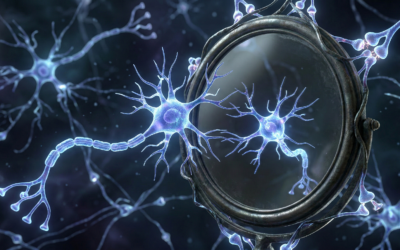
What we can introspectively report is something else entirely: awareness, the subjective, nonphysical sense of grasping or mentally possessing an item or thought. Graziano proposes that awareness is the brain’s schematic model of attention. Just as the body schema serves as a simplified model of the physical body, the attention schema serves as a simplified, descriptive model of the process of attention. And just as we experience the operations of the body schema as a felt sense of active embodiment rather than as a series of complex neuronal computations, we experience the attention schema as a mysterious, subjective inner consciousness.
How the Attention Schema Creates Consciousness
The operational mechanics of the theory follow a specific logical loop. Consider looking at an apple. Your visual system constructs a highly detailed, data-heavy model of that apple’s color, shape, and spatial location. Simultaneously, your brain’s attentional mechanisms enhance the apple’s neural representation, actively suppressing competing background information in the room. But to efficiently manage and predict its own behavior, the brain must also construct a simplified model of this active attention process. That model—the attention schema—represents the basic fact that a central entity (the self) is currently grasping an object (the apple) through an intangible inner capability (represented schematically as subjective awareness).
The attention schema is necessarily incomplete and deeply simplified, as all biological internal models must be to conserve metabolic energy. It represents the mechanics of attention not as a complex array of lateral inhibition, feedback loops, and cortical signal boosts, but as an ethereal, nonphysical essence—an inner experience that possesses no material properties yet somehow empowers you to know, react to, and later remember the apple. When you report having a subjective, conscious experience of that apple, you are directly accessing your internal attention schema and reporting its structural contents. The perceived mystery of consciousness is an inevitable illusion generated by a highly functional, simplified internal data model reporting on its own processing states.
Social Cognition and the Evolution of Consciousness
A distinctive, highly valuable feature of Graziano’s theory is its clear emphasis on social cognition. He argues that the attention schema did not evolve primarily to support internal self-awareness, but rather as a survival tool for understanding and predicting other minds. In social, deeply collaborative species, it is a matter of life and death to model what other organisms are currently attending to. This capacity allows for the immediate prediction of their impending behaviors. If you can compute exactly what a predator or a rival is attending to in the immediate landscape, you can accurately deduce what that organism will do next.
The brain therefore evolved dedicated, specialized cortical machinery to compute other people’s attentional states, actively attributing an invisible quality of awareness to external entities. This exact same social machinery, Graziano suggests, was eventually turned inward and applied to the self. When you attribute consciousness to yourself, you are utilizing the exact same social-perceptual system that attributes consciousness to your peers. Self-awareness is social cognition turned inward.
This evolutionary framing has profound implications for understanding developmental and clinical conditions. Deficits in tracking other people’s mental and attentional states, such as those observed in autism spectrum conditions, likely involve the exact same specialized neural systems that construct the internal model of self-awareness. Furthermore, severe pathologies of self-awareness, such as those that manifest during profound clinical dissociation or complex psychiatric conditions, can be understood as functional disruptions or informational errors operating within the attention schema itself.
Attention and Awareness Can Dissociate
One of the primary scientific strengths of AST is that it predicts a phenomenon that empirical research has consistently confirmed: attention and awareness can come entirely apart. If awareness were simply identical to the act of attention, they would always remain perfectly coupled. But if awareness functions as an internal model of attention, the model can sometimes become desynchronized or inaccurate, representing attention when it is entirely absent, or failing to represent active attention when it is currently occurring.
Clear evidence for this clinical dissociation emerges from multiple neurological and psychological sources:
- Blindsight Phenomena: In patients presenting with classical blindsight following localized damage to the primary visual cortex, individuals can actively attend to, track, and avoid visual stimuli in their environment while maintaining a complete, absolute lack of conscious awareness of those objects. The mechanical attention is present, but the internal model of that attention has been broken.
- Change and Inattentional Blindness: In standard change blindness experiments, individuals fail to notice massive, obvious adjustments to their immediate visual environment because their attention schema fails to update its internal representation appropriately, despite eye-tracking data showing their physical gaze passed directly over the alteration.
- Altered and Meditative States: During deep meditation and certain altered states of consciousness, individuals can cultivate a state of spacious, generalized awareness that exists entirely devoid of focused, narrow attention on a single object.
These explicit dissociations make complete sense when viewed through the lens of AST. The attention schema is an internal model, and like all biological models, it can be wrong. Sometimes you experience the persistent subjective feeling that you are aware of an environment when your underlying attention has actually transitioned elsewhere, leading to errors in unconscious processing of attended information.
Implications for Artificial Consciousness
Graziano has argued extensively that AST provides a highly concrete, actionable engineering roadmap for building true artificial consciousness. If consciousness is not a supernatural fluid but an information-processing system that constructs specific internal models—including a simplified attention schema—then there is no structural reason it cannot be implemented within advanced synthetic architectures. A machine designed to maintain an active, predictive model of its own internal attention, attribute qualities of awareness to itself and its operators, and use that data map to guide its downstream behavioral choices would, under AST, genuinely be conscious in the exact same functional sense that humans are.
This perspective fundamentally shifts how we think about the future of AI. If AST is correct, consciousness is not a magical property restricted to carbon-based biological brains. It is a functional property that emerges naturally from the right kind of information routing. Whether current large language models or robotic systems possess this specific internal loop is a separate question, but the theory removes any unbridgeable barrier to synthetic awareness.
Clinical Implications for Trauma and Nervous System Healing
For clinicians working daily with the psychological fallout of severe trauma, profound dissociation, and chronic disorders of awareness, AST offers essential, refreshing operational perspectives.
Severe dissociative experiences can be conceptualized as structural errors or systematic disconnections operating within the attention schema. When a trauma survivor reports feeling completely detached from their body, their identity, or their immediate physical surroundings, this does not mean their brain has stopped processing data. The physical attention is still occurring at a subcortical level, and sensory information is being gathered, but the internal schema that would normally represent this process as an owned, subjective experience has been intentionally decoupled by the brain to protect the self from overwhelming flooding. The brain is processing the world, but it has suspended the model that says *I am experiencing this world*.
Chronic hypervigilance and clinical anxiety can be understood as an attention schema that has become rigidly locked into a predictive distortion. In an anxious system, the attention schema persistently represents attention as being directed entirely toward a critical environmental threat, even when actual physical attention has moved to a safe stimulus. The unremitting sense of impending doom that characterizes chronic anxiety disorders reflects an internal model of attention that is structurally stuck in threat-detection mode, continuously misreporting the system’s active processing states.
Through this framework, mindfulness practices reveal their true utility as targeted exercises in attention schema calibration and maintenance. By deliberately, non-judgmentally observing what the physical attention is doing from moment to moment, a practitioner is actively training and refining their attention schema, restoring its predictive accuracy and functional flexibility. This neural retraining explains why consistent mindfulness is associated with such rapid improvements in emotional regulation and a corresponding reduction in toxic cognitive rumination.
Advanced, neuro-experiential trauma modalities like Brainspotting and EMDR work by directly engaging the subcortical visual and orienting systems that link physical attention, conscious awareness, and deep bodily sensation. Because eye position and ocular movements are bound to the brain’s internal attention-routing networks, manipulating the gaze allows a skilled clinician to access the midbrain structures where trauma patterns are locked. This intervention updates the attention schema in real time, safely clearing old survival loops and facilitating deep, lasting trauma processing across our Central Alabama communities.
Selected Publications
Graziano, M. S. A. (2013). Consciousness and the Social Brain. Oxford University Press.
Graziano, M. S. A. (2019). Rethinking Consciousness: A Scientific Theory of Subjective Experience. W. W. Norton.
Graziano, M. S. A., & Kastner, S. (2011). Human consciousness and its relationship to social neuroscience: A novel hypothesis. Cognitive Neuroscience, 2(2), 98-113.
Webb, T. W., & Graziano, M. S. A. (2015). The attention schema theory: A mechanistic account of subjective awareness. Frontiers in Psychology, 6, 500.
Graziano, M. S. A. (2017). The attention schema theory: A foundation for engineering artificial consciousness. Frontiers in Robotics and AI, 4, 60.
Bibliography
Academic Resources
- Graziano Lab at Princeton: https://grazianolab.princeton.edu/
- Wikipedia on Attention Schema Theory: https://en.wikipedia.org/wiki/Attention_schema_theory
- Michael Graziano Google Scholar: https://scholar.google.com/citations?user=klLCU8YAAAAJ
Related Resources
- Brain World Interview with Michael Graziano: https://brainworldmagazine.com/consciousness-dr-michael-graziano-attention-schema-theory/
- Princeton Neuroscience Institute: https://pni.princeton.edu/
Interested in how modern neuroscience research informs clinical trauma therapy? Contact Taproot Therapy Collective today to learn about our advanced, brain-based approaches to psychological recovery and sustainable somatic health.









0 Comments