
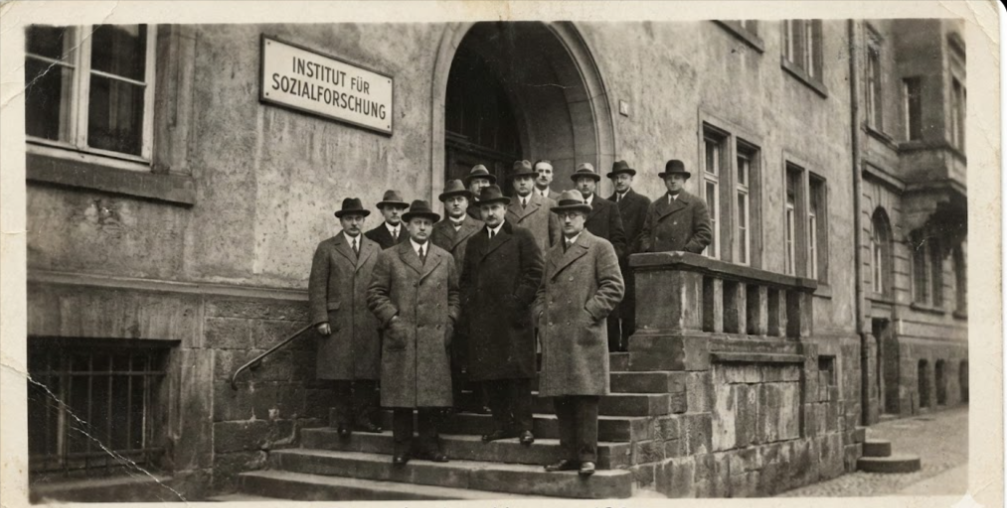
The Frankfurt School and the Architecture of Modern Trauma
How a group of exiled German-Jewish intellectuals transformed our understanding of psychology, society, and the spaces we inhabit.The Caesura of the Twentieth Century
The intellectual landscape of the twentieth century was forged in the crucible of unprecedented historical rupture. The Great War had shattered the illusion of continuous progress; the rise of fascism demonstrated that "civilization" could produce its own negation; and the Holocaust revealed that modernity's most "advanced" nation was capable of industrialized murder on an unimaginable scale.
Within this context, a specific constellation of thinkers, principally associated with the Institute for Social Research in Frankfurt, sought to articulate the nature of a world that had seemingly lost the capacity to communicate experience or preserve the meaning of reality itself. What came to be known as the Frankfurt School was never a "school" in the traditional sense. It had no unified doctrine, no catechism, no agreed-upon methodology.
What bound its members together was a shared project: the synthesis of Marxist social theory with Freudian psychoanalysis, pursued in the shadow of catastrophe.
Their influence on psychotherapy has been both direct, through Erich Fromm's clinical institutes and Theodor Adorno's studies of the authoritarian personality, and indirect, shaping our very conceptualization of trauma, alienation, and the relationship between individual suffering and social structure.
Philosophical Foundations: Hegel, Marx, Freud, and Heidegger
The Frankfurt School drew on a complex genealogy of influences that shaped their distinctive approach to psychology and society. Georg Wilhelm Friedrich Hegel's dialectical method provided the philosophical scaffolding, his insight that consciousness develops through contradiction and negation, that what appears stable and self-evident is in fact the product of historical struggle. But where Hegel saw the dialectic culminating in reconciliation and the realization of Spirit, the Frankfurt thinkers found only "negative dialectics," contradictions that refused resolution, wounds that would not heal.
Karl Marx's critique of political economy provided the analysis of how material conditions shape consciousness. Yet the failure of revolutionary movements in Western Europe, the persistence of capitalism despite its contradictions, and the rise of fascism in Germany forced a rethinking of Marx's predictions.
Sigmund Freud's psychoanalysis provided the missing element: a theory of how social structures become internalized, how external domination becomes self-domination, how individuals come to desire their own subjugation. The Institute's project was to historicize Freud, to show that the psychic structures he described were not timeless biological givens but products of specific social arrangements.
Martin Heidegger's phenomenology influenced the Frankfurt School more ambivalently. Heidegger's analysis of "Being-in-the-world" and his critique of technological "enframing" resonated with their diagnosis of modern alienation. Yet Heidegger's embrace of National Socialism cast a permanent shadow, prompting thinkers like Adorno to subject Heideggerian appeals to "rootedness" and "authenticity" to withering critique.
Other influences shaped specific thinkers. Max Weber's analysis of rationalization—the "iron cage" of bureaucratic modernity—informed the concept of "instrumental reason," while Edmund Husserl's phenomenology influenced empirical studies of working-class consciousness.
The Core Thinkers: Horkheimer, Adorno, Fromm, & Marcuse
Max Horkheimer and the Redirection of the Institute
The Institute for Social Research was founded in Frankfurt in 1923. Its transformation began when Max Horkheimer assumed the directorship in 1930. Horkheimer recognized that the failure of revolutionary movements could not be explained by material conditions alone. Something was happening at the level of consciousness and subjectivity. Under his direction, the Institute developed "interdisciplinary materialism," bringing together philosophy, sociology, economics, and psychology in a unified critique of modern society.
Theodor W. Adorno and the Damaged Life
If Horkheimer provided the administrative vision, Theodor Adorno supplied much of the theoretical brilliance. Adorno's direct contribution to psychology came through the monumental study The Authoritarian Personality (1950), which helped develop the "F-scale" (F for Fascist) to measure authoritarian tendencies stemming from repressive childhood experiences. Adorno's concept of the "damaged life"—"Wrong life cannot be lived rightly"—captures the understanding that within a fundamentally damaged society, even our most private experiences are contaminated.
Erich Fromm and the Social Determination of Character
No member had a more direct clinical impact than Erich Fromm. It was Fromm who first attempted a systematic synthesis of Marx and Freud. He developed the concept of "social character," the way a society socializes its members to accept specific structures.
Fromm argued that the "normal" personality in capitalist society was itself a pathology—a "marketing orientation" where individuals experience themselves as commodities. In 1941, he published Escape from Freedom, explaining why people willingly surrender their autonomy to authoritarian leaders. His central chapter, "Psychology of Nazism," offered a psychoanalytic explanation for fascism that remains urgently relevant today.
Herbert Marcuse and the Liberation of Instinct
If Fromm softened Freud, Herbert Marcuse radicalized him. In Eros and Civilization, Marcuse accepted Freud's dark vision of civilization founded on repressed instincts, but rejected that such repression was eternally necessary. Marcuse argued that capitalism imposed "surplus repression." The "performance principle" demanded not just the postponement of gratification, but the systematic suppression of human creativity.
The therapeutic implications were profound: where neo-Freudians sought to help patients "adjust" to society, Marcuse argued that therapy should aim at "de-adaptation." True mental health required liberation from the status quo, an idea that fueled the 1960s anti-psychiatry movement.
Walter Benjamin and Hannah Arendt
Walter Benjamin and the Wound of Modernity
Walter Benjamin occupies a peculiar position. Never a formal Institute member, his tragic suicide fleeing the Nazis in 1940 imbued his fragmentary oeuvre with profound weight. Benjamin’s philosophical investigations into modernity, technology, and the human sensorium anticipated clinical trauma concepts decades before they were formally codified.
In "On Some Motifs in Baudelaire," Benjamin adapted Freud's neurological concepts to his own "shock theory." He argued that in the modern city, "shock has become the norm." The individual must constantly "parry" shocks, creating a "pathogenic wound" caused by the speed and complexity of modern machinery. Benjamin distinguished between Erfahrung (meaningfully integrated experience) and Erlebnis (mere lived-through occurrence). Modern life is increasingly characterized by Erlebnis—shocks registered but not digested. This perfectly describes the structure of traumatic memory as understood by contemporary neuroscience.
Hannah Arendt: The Space of Appearance
Hannah Arendt's relationship to the Frankfurt School was marked by intellectual affinity and significant disagreement. She shared their preoccupation with the unprecedented domination of totalitarianism. In The Origins of Totalitarianism (1951), she explored how atomization and "loneliness" created conditions for authoritarian movements.
Her phenomenology of loneliness has direct relevance to contemporary mental health. The epidemic of loneliness today, exacerbated by digital isolation, confirms her diagnosis that the loss of a genuine public realm produces profound psychological devastation. Arendt distinguished between labor, work, and action in The Human Condition, warning that modern society was reducing all human activity to endless cycles of production and consumption ("labor"), threatening our capacity for genuine freedom.
Architecture, the Culture Industry, and Violence
Architecture and the Recovery of the Public Realm
Hannah Arendt's philosophy heavily influenced critical architectural theory, particularly through the work of Kenneth Frampton. Frampton used Arendt's distinctions to argue that modern architecture had lost its capacity to create a public realm because it collapsed "work" into "labor," treating buildings as disposable commodities rather than durable objects of meaning.
The late Leon Krier utilized Arendtian categories to critique Modernist urbanism. He believed the functional zoning promoted by CIAM led to "soulless cities" and the loss of community. Krier idealized the Greek polis as a structured public space where free individuals could interact. Modern urban planning, in his view, destroyed these spaces, replacing them with anonymous highways and strip malls that exacerbate psychic alienation.
The Culture Industry and the Manufacture of Consent
In Dialectic of Enlightenment, Adorno and Horkheimer argued that mass culture functions as a factory producing standardized cultural goods to manipulate society into docility. The culture industry creates "false psychological needs" that lock consumers into cycles of desire, suppressing true psychological needs for freedom and genuine happiness.
This analysis anticipated our current debates about screen addiction and algorithmic content delivery. When algorithms maximize engagement by triggering emotional reactions, the culture industry's colonization of consciousness reaches depths the Frankfurt School only theorized. Human consciousness has become raw material to be extracted and sold.
Wars and Movies: The Aestheticization of Violence
Modern industrial society produces "wars and movies" as two sides of the same coin. Benjamin noted that the "optimists" of his time took wars for movies, failing to distinguish technologically manufactured slaughter from its cinematic representation. This aestheticization of politics turns the horror of war into a spectacle to be consumed, leading to collective desensitization and vicarious trauma.
Modern Trauma, Clinical Practice, and the Administered World
Instrumental Rationality and the Administered World
The Frankfurt School’s critique of "instrumental rationality"—which calculates means without evaluating moral ends—is highly relevant to modern healthcare. The "administered world" processes human beings according to standardized protocols that ignore their particular suffering. The reduction of complex human suffering to diagnostic codes, and the subordination of clinical judgment to algorithmic insurance protocols, represent the colonization of healing by instrumental rationality.
The Later Generations: Habermas and Honneth
The second generation, dominated by Jürgen Habermas, sought to salvage emancipatory potential through "communicative action"—rational discourse oriented toward mutual understanding. Habermas's concept of the "ideal speech situation" heavily influenced models of therapeutic communication.
Axel Honneth, of the third generation, centers his work on "recognition." Honneth distinguishes three spheres of recognition: love, rights, and solidarity. Injury in any of these spheres produces distinctive psychological damage (shame, disrespect, denigration). This framework explains why trauma is not merely about overwhelming events, but about violated expectations and denied humanity.
The Digital Reproduction of Trauma
Clinical Data on Modern Alienation: Recent epidemiological data indicates that over 60% of young adults report pervasive, chronic loneliness. Furthermore, marginalized groups, including Black and Hispanic youth, report up to a 40% increase in digital-media induced traumatic stress compared to previous decades. The structural isolation Arendt warned about has become a measurable public health crisis.
The transition from the "shell-shocked man" of the Great War to the "digital dissociation" of the 21st century reveals the predictive power of Benjamin's shock theory. The "space of appearance" is colonized by virtual spaces where presentation is replaced by performance. The correlation between social media use and anxiety confirms the diagnosis that the culture industry damages consciousness.
The Ongoing Relevance for Psychotherapy
For clinicians, the Frankfurt School offers crucial insights:
- Contextual Suffering: Individual trauma must be understood within larger social pathology.
- Beyond Adaptation: "Adjustment" to a sick society is not mental health. Therapy should preserve the capacity for critique and genuine connection.
- Systemic Critique: The structures of contemporary healthcare are themselves symptoms of the instrumental rationality that damages human life.
The therapy room remains one of the few remaining spaces where sustained attention, genuine dialogue, and the slow work of meaning-making remain possible.
Bibliography & Further Reading
Joel Blackstock, LICSW-S, is the Clinical Director of Taproot Therapy Collective in Hoover, Alabama. He specializes in complex trauma treatment and writes at GetTherapyBirmingham.com.
Primary Texts:
- Adorno, T.W., et al. The Authoritarian Personality. Harper, 1950.
- Adorno, T.W. Minima Moralia: Reflections on a Damaged Life. Verso, 1974.
- Adorno, T.W. & Horkheimer, M. Dialectic of Enlightenment. Stanford UP, 2002.
- Benjamin, W. Illuminations: Essays and Reflections. Schocken Books, 1968.
- Fromm, E. Escape from Freedom (1941), The Sane Society (1955).
- Habermas, J. The Theory of Communicative Action. Beacon Press, 1984.
- Honneth, A. The Struggle for Recognition. MIT Press, 1995.
- Marcuse, H. Eros and Civilization (1955), One-Dimensional Man (1964).
- Arendt, H. The Origins of Totalitarianism (1951), The Human Condition (1958).
- Frampton, K. Modern Architecture: A Critical History. Thames & Hudson, 2020.















0 Comments