
Jung told an interviewer in 1936 that in analysis he and the patient turn together toward the two-million-year-old man that lives in all of us. He meant it almost literally. The psyche is not a blank slate scribbled on by childhood; it is an ancient, evolved organ with its own expectations, built for a world of small bands, kin, ritual, predators, and firelight, and it keeps running that ancient program inside our cities and screens. The post-Jungian psychiatrist Anthony Stevens spent his career making that claim scientifically respectable, arguing that archetypes are not mystical entities floating in the ether but evolved biological structures, the psychological equivalent of the innate releasing mechanisms that ethologists like Lorenz and Tinbergen found in animals. An infant does not learn to expect a mother; the expectation is wired in, waiting for the environment to answer it.
If Stevens is right, there should be a fossil record. Bones preserve the evolution of the body. What preserves the evolution of the mind? The answer is language. Every word we now use for the inner life began as a word for something physical, because the interior world had no vocabulary of its own and had to borrow one from the body, the fence, the field, and the road home. Trace our psychological words back through Latin, Greek, Old Norse, and the reconstructed Proto-Indo-European spoken on the Eurasian steppe six thousand years ago, and you can watch the human interior being built, layer by layer, out of physical experience. Etymology is cognitive archaeology, and the dig site runs straight through the therapy office.
Why Talking Heals: The Evolutionary Anthropology of the Therapeutic Alliance
Begin with the strangest fact about psychotherapy, so familiar we forget how strange it is: talking to another person, in itself, regulates the nervous system. Why should sound waves do that? Evolutionary anthropology has an answer, and it starts with fur.
Primates hold their societies together by grooming. Picking through a companion’s coat releases endorphins, cements alliances, and enforces the reciprocity that group life runs on. But grooming is one-on-one and time-expensive; some baboon populations spend a fifth of their waking hours at it, which is close to the ecological ceiling. The anthropologist Robin Dunbar argued in Grooming, Gossip and the Evolution of Language that when hominid groups grew toward roughly 150 members, the figure now known as Dunbar’s number, grooming everyone by hand became mathematically impossible. It would have consumed nearly half the day. The workaround was vocal grooming: language. Talk lets you bond with several allies at once, hands free, and its first cargo was not toolmaking instructions but social information. Who is reliable, who cheated, who is grieving. Language evolved for gossip, and the grammar still shows it, since every sentence wants a who and a what they did.
Two other pieces complete the picture. Michael Tomasello’s developmental research locates the human difference in joint intentionality, our species’ unique drive to share attention and intentions, visible in an infant pointing at a bird just to share the seeing of it. And the cognitive archaeologist Steven Mithen argues that the explosion of art, religion, and complex language around fifty thousand years ago happened when previously walled-off intelligences, social, technical, naturalistic, became fluid and could flow into each other. Cognitive fluidity is what makes metaphor possible at all. It is the capacity to say that fear is a narrow place, that the self is a garden, that grief is a weight. Without it there is no symbol, no myth, no poetry, and no psychotherapy.
Put the three together and the therapeutic alliance stops looking like a modern invention. A therapy session is joint attention directed at one person’s inner life, conducted through vocal grooming, using the metaphor-making machinery of cognitive fluidity. It works because it is the most refined version of the oldest bonding technology our lineage possesses. The research consistently finding that the relationship itself predicts outcomes better than the brand of therapy is not an embarrassment to the field. It is evolutionary psychology confirming what the anthropology predicted.
Original Participation: The Anthropology of Consciousness Itself
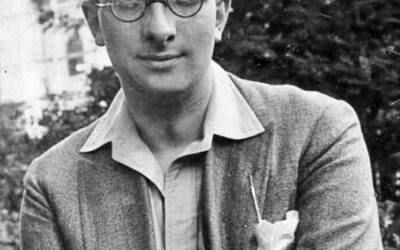
There is one more theorist needed before the words themselves, and he is the strangest of the group: the philologist Owen Barfield, the “first and last Inkling,” whom C.S. Lewis called the wisest of his teachers. Barfield noticed something in the history of meaning that most linguists step around. When you trace old words, you never find a purely material meaning that later gets a spiritual sense bolted on. You find unity first and division later. The Greek pneuma and the Latin spiritus did not mean wind, and also breath, and also spirit, as three definitions in a dictionary. They meant one undivided thing. It is our anachronism to imagine an ancient poet cleverly using breath as a metaphor for soul. For that speaker, breath and soul had not yet come apart.
Barfield called that early condition original participation: a consciousness immersed in a living world, where inner states and outer phenomena were continuous, where a grove could be angry and the wind could be a spirit because the membrane between psyche and world had not yet hardened. What we call the modern mind, the detached observer looking out at dead matter, he saw as a later development, necessary for science and for the birth of the individual ego, but purchased at the price of exile. Jung mapped the same territory from the clinical side. When he wrote, in his commentary on The Secret of the Golden Flower, that “the gods have become diseases,” he meant that the presences ancient people met in the world did not vanish with disenchantment. They moved indoors. Zeus no longer rules Olympus; he produces symptoms in the consulting room.
Hold Barfield and Jung together and the etymologies that follow become legible. They are not curiosities. They are the strata of that long migration of the gods from the landscape into the psyche, and every one of them lands on a problem therapists still treat.
The Garden and the Guard: *gher-, Ego Boundaries, and Jung’s Temenos
One prehistoric root, reconstructed as *gher-, meant to grasp or enclose. From it English inherited yard, garden, girdle, orchard, and kindergarten, and Slavic got grad, the walled city in Stalingrad. A sibling root for watching and protecting split into a famous doublet: the native English ward and the Norman French guard, the same word run through two histories, since French speakers turned the Germanic w into gu, which is also why William becomes Guillaume. Yard, garden, ward, and guard are four surviving fossils of a single archetypal act: drawing a boundary around cultivated space and standing watch on it.
For Stevens, this is exactly what an archetype looks like in the lexicon. In the environment of evolutionary adaptedness, the enclosure was not a metaphor. It was the difference between the crop and the wilderness, the sleeping child and the predator. Natural selection built humans who compulsively make enclosures, and when cognitive fluidity arrived, the enclosure schema flowed inward and became the architecture of the self. That is why every school of therapy, whatever its theory, ends up talking about boundaries, containment, and defenses. The ego is a geard. Trauma is a breach in the fence.
Jung knew this so well that he reached for the same image in Greek. He called the protected analytic space a temenos, the ancient word for the sacred precinct walled off around a temple, the ground where ordinary rules are suspended so that transformation can occur. And his term persona, the social mask, comes from the Latin name for the actor’s mask, plausibly from per sonare, to sound through. The persona is the outward face of the enclosure, the gate through which the inner voice sounds into the social world. A healthy psyche, in this vocabulary, is a garden with a working gate and a guard who knows when to stand down. A traumatized one is either a garden with the fence torn open or a fortress in which nothing grows.
Anxiety Means Choking, Anger Means Grief: *angh- and the Archaic Body
The root *angh- meant tight, narrow, painfully constricted. The Online Etymology Dictionary’s entry on the root shows its descendants fanning out across the whole Indo-European world: Latin angere, to choke or squeeze, which yields anxiety and anguish, the latter arriving through an Old French word for a choking sensation. Angina, the crushing tightness of the chest. German Angst. Even hangnail, originally angnaegl, a painfully tight nail. Greek, Sanskrit, and Armenian all carry cognates. Across five thousand years and half a continent, fear is a narrow place.
The steppe pastoralists who spoke this root had no neuroscience, but they had bodies, and the body’s fear response has not changed: the throat closes, the chest binds, the breath goes shallow. The word anxiety is not a metaphor for that experience. It is a clinical observation, six millennia old, of sympathetic nervous system arousal, recorded by people practicing original participation, for whom the choking and the dread were one event. Every somatic therapist who asks a client where they feel the fear in their body is reversing the historical process, walking the abstraction back down into the sensation where the word was born.
The most clinically loaded fossil in the family is anger. It entered English from the Old Norse angr, and for its first two centuries it did not mean rage. It meant distress, grief, sorrow, affliction. Old Norse built tender compounds on it, angr-lyndi for low spirits, angr-lauss for free of care. Only in the fourteenth century did the meaning harden into wrath. The history of the word contains, in miniature, one of the core insights of emotion-focused and trauma therapy: anger is a secondary emotion, armor grown over grief and fear. The therapeutic movement from a client’s rage back down to the sorrow beneath it retraces, in one session, a semantic journey the English language took three centuries to make in the other direction. The old meaning is still in the word, the way the wound is still under the armor.
Hysteria and the Wandering Womb: How Cultures Decide Whose Suffering Is Real
Some etymologies flatter us. This one indicts. Hysteria descends from the Greek hystera, womb, and it preserves several thousand years of a culture projecting psychological suffering onto the female body. The oldest layer is the wandering womb doctrine of Greek medicine, endorsed by Plato, which held that a dissatisfied uterus could detach and roam the body, pressing on organs and producing suffocation, fainting, mutism, and emotional excess. McGill’s history of the diagnosis follows the sorry succession of paradigms: fumigation to lure the organ back into place, Galen’s retained female seed, the medieval reframe of the same presentations as demonic possession, which sent traumatized women to exorcists and to worse, and the Victorian catch-all in which hysteria meant, roughly, an inconvenient woman.
Read anthropologically, hysteria is a case study in how a culture’s cosmology determines what counts as illness. The same suffering woman is, in successive centuries, a victim of a migrating organ, a vessel of demons, a degenerate nervous system, and finally, with Charcot and Freud, a trauma survivor whose body is speaking what she cannot say. The symptoms barely changed. The interpretive frame did. Jung would call each frame a projection, the culture’s shadow cast onto the bodies of women, and the history is a standing warning to our own era: our diagnostic categories are also a cosmology, and some of them will look to our descendants the way the wandering womb looks to us.
Panic, Phobia, and the Daimon: When the Gods Became Diseases
Panic comes from Pan, the goat-legged god of the wild, who caused sudden, contagious, reasonless terror in flocks and in travelers crossing lonely country. Phobia comes from Phobos, fear personified, who rode into battle beside his father Ares. These are not dead metaphors. They are Barfield’s original participation caught in amber: for the archaic mind, overwhelming autonomic arousal without a visible cause was not an internal malfunction but an external presence, a god met in the wilderness. Anyone who has had a panic attack, the terror arriving from nowhere, autonomous, bigger than the self, will concede the phenomenology is exact. The attack still feels like a visitation. Only the address of the visitor has changed, which is precisely what Jung meant by the gods becoming diseases.
The word demon carries the same history in reverse. Greek daimon originally meant a guiding spirit or apportioner of fate, the inner voice Socrates consulted before every decision, and only later Christian translation flattened it into a malignant entity. James Hillman spent The Soul’s Code trying to recover the older sense, the daimon as the acorn of individual destiny, the calling that pathologizes us when ignored. A depth psychotherapy that treats symptoms as meaningful is, etymologically speaking, re-paganizing the demon: asking what the presence wants rather than simply casting it out.
Monster, Monument, Memory: *men- and the Prospective Symptom
The root *men-, to think or remember, gives us mind, mental, memory, and mnemonic. Through its Latin causative monere, to warn or remind, it also gives us monitor, monument, and monster. A monument is literally a thing that reminds. A monster, in the original sense of monstrum, was not a creature but an omen, an unnatural event read as a warning from the gods. The three words are siblings: thought, memorial, and warning grown from a single stem.
This etymology contains a treatment philosophy, and it is Jung’s. He insisted that symptoms have a prospective function, that the unconscious is not merely a basement of repressed material but an intelligence trying to correct the conscious attitude. The flashback, the nightmare, the phobia, the intrusive image: these are the psyche’s monsters in the strict Latin sense, warnings erected by a mind determined that the organism never blunder into the original injury again. Trauma survivors build internal monuments, rigid avoidances and defenses that commemorate the wound. The therapeutic task is not to demolish the monument or slay the monster but to read the inscription, honor the warning, and then release the memory from active duty into ordinary history.
Symbol and Devil: The Transcendent Function and the Shadow
Here is the pairing that sits closest to the center of Jungian thought, hiding in plain sight in two ordinary words. The Greek symbolon was a physical object: a tablet or bone or coin broken in half between two parties to a pact, each keeping a fragment, so that years later the pieces could be fitted together as proof of the bond. Symbol comes from syn, together, and ballein, to throw. A symbol is that which is thrown together.
The devil is the same verb pointed the other way. Diabolos joins dia, apart, to ballein: the one who throws apart. In the Greek courtroom the diabolos was the slanderer who divided people with accusation, and when the Hebrew scriptures were translated into Greek, the translators chose this word for the satan, originally not a cosmic fiend but a legal adversary, the prosecuting voice in the divine court. Centuries of translation and theological need condensed the courtroom accuser into an absolute enemy, which Jung read as the grandest shadow projection in Western history: everything a culture throws apart from itself, personified and exiled.
For Jung, the symbol was not decoration but function. His transcendent function is the psyche’s capacity to hold two opposed positions until a third thing, a living symbol, emerges that unites them. Healing, in analytical psychology, is literally symbolic: the throwing together of what has been thrown apart. And trauma is diabolical in the exact etymological sense, a force that shatters the timeline of a life, splits the personality into parts that cannot speak to one another, and severs the survivor from community. Narrative therapy, parts work, active imagination, and Jungian integration are different dialects for the same act: finding the broken halves of the symbolon and fitting them until they interlock and the person can recognize their life as one continuous story.
Therapon and the Wounded Healer: The Anthropology of the Clinical Role
The word therapy descends from the Greek therapeia, service, care, attendance. Behind it stands the Homeric therapon: not a physician but an attendant and companion in arms, the squire who stood beside a warrior and shared the weight of the battle. Patroclus was therapon to Achilles. This is the anthropological root of the clinical role, and it corrects the modern fantasy of the therapist as detached technician. In traditional healing systems the world over, from shamanic initiation to the Greek cult of Asclepius, the healer earns the office by having been wounded and having made the descent themselves, the pattern Jung named the wounded healer after the centaur Chiron, teacher of physicians, who could heal others but not his own wound. The etymology and the anthropology agree: healing is not a procedure performed on a patient but a companionship in ordeal.
Even the goal has a fossil. Heal, health, and whole descend from a single root, *kailo-, whole and uninjured, which also produced holy and hallow. In the oldest layer of the language there was no seam between physical recovery, psychological integration, and the sacred. To be healed was to be made whole, and wholeness was holy. Jung’s word for the lifelong movement toward wholeness was individuation, and he regarded it as the psyche’s native telos, the thing the two-million-year-old self is trying to do whether or not anyone helps it. The English language had quietly agreed for a thousand years.
Nostalgia: The Disease of the Uprooted
One last word, because it documents the collision Stevens built his whole framework on: the mismatch between the ancient psyche and the modern world. Nostalgia was coined in 1688 by a medical student named Johannes Hofer to name a mysterious and sometimes fatal illness among Swiss mercenaries serving far from their mountains. He welded nostos, homecoming, the organizing longing of the entire Odyssey, to algos, pain, the root in neuralgia and analgesic. NPR’s history of the word lists the symptoms Hofer recorded, fatigue, anxiety, palpitations, fevers, which lifted when the soldiers went home. For two centuries medicine treated it as a physical disease; the Saturday Evening Post’s account notes that Union army physicians in the Civil War diagnosed thousands of cases, some fatal, and that the reliable cure was discharge and the journey home.
Evolutionary psychology reads this history without surprise. A psyche built for a lifelong embeddedness in one band, one landscape, one web of kin, was being mass-transplanted by the armies and economies of early modernity, and it was getting sick in the way an organ gets sick when removed from its body. Hofer was documenting frustrated archetypal intent, Stevens’ phrase for what happens when the environment fails to answer the psyche’s evolved expectations. Only in the twentieth century did nostalgia migrate from space to time, from a place you could still travel to into a past no door opens onto, at which point it became universal, because in a world of relentless change everyone is now a mercenary far from a homeland that no longer exists. That so many clients arrive in therapy homesick for something they cannot name is not a poetic flourish. It is the two-million-year-old patient reporting the same symptom Hofer’s soldiers reported, with the geography removed.
Final Participation: Therapy as the Way Back In
Barfield did not think the exile was the end of the story. He believed the disenchantment of the world, the hardening of the observing ego out of the old participatory unity, was a necessary stage, because only a separated self can freely choose to reconnect. He called the further shore final participation: consciousness that keeps the individuated modern ego but voluntarily re-enters the living relationship with the world through imagination, knowing now that it is doing so. That is as good a description of the goal of depth psychotherapy as anyone has written. The client does not dissolve back into the unconscious, and does not stay barricaded in the onlooker’s tower. They learn to move between the garden and the wild with the gate in their own hands.
The words were keeping the map the whole time. Anxiety remembers that fear is a narrowing and healing a widening. Anger remembers the grief under the armor. Monster remembers that symptoms are warnings. Symbol remembers that wholeness is made by throwing broken things back together, and devil remembers what it costs to throw them apart. Therapon remembers that the healer is a companion in the battle, and whole remembers that it once meant holy. Six thousand years of speakers, none of them psychologists, encoded a depth psychology into the language by simply paying attention to their bodies and their world. Therapy, done well, is applied philology. It teaches people to hear what their own words have been telling them all along, and to follow the oldest word of all, nostos, home.










0 Comments