
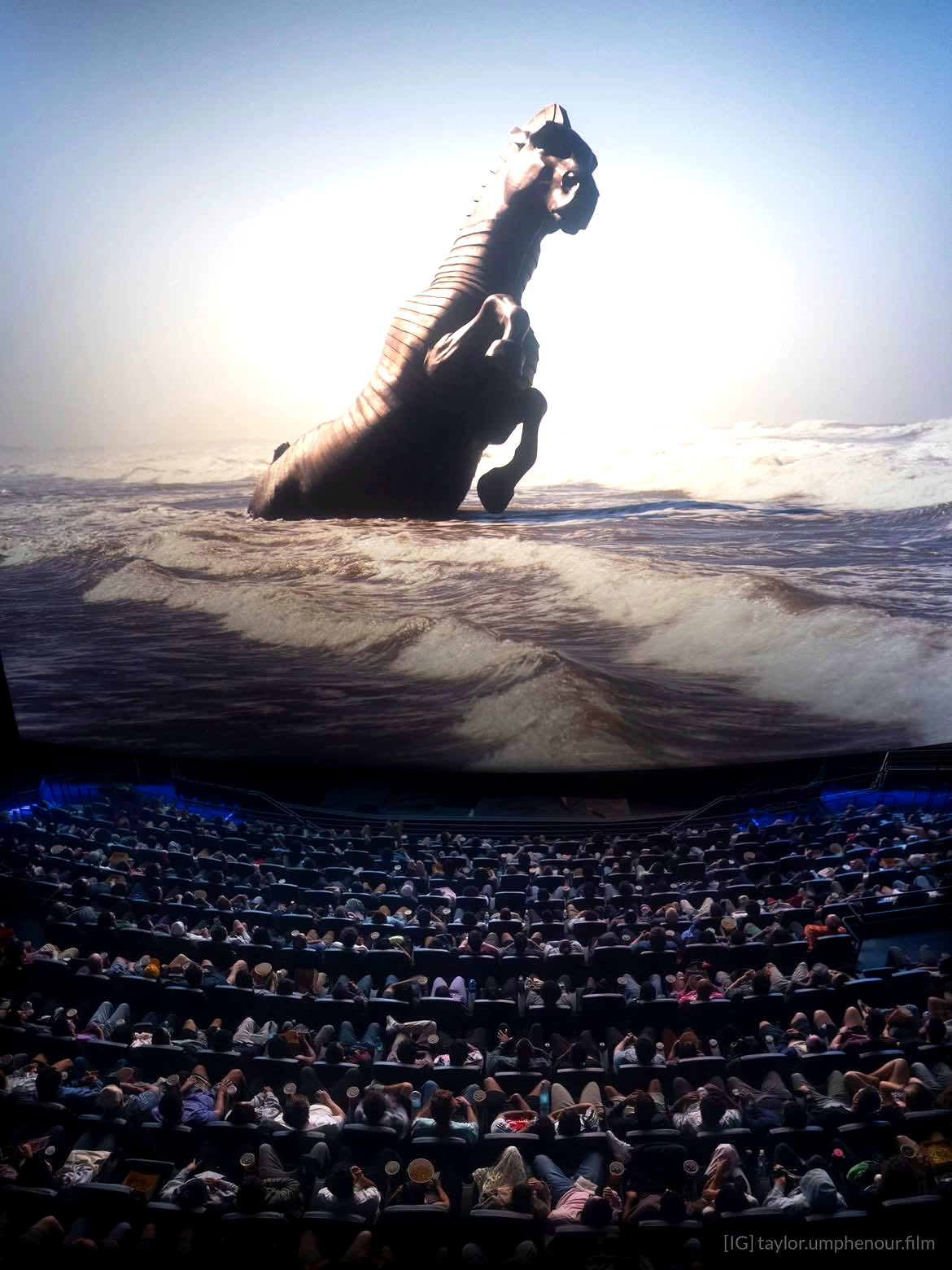
There is a moment near the end of Christopher Nolan’s new adaptation of The Odyssey when Matt Damon’s Odysseus finally stands in his own hall, the suitors dead around him, his wife in front of him, and nothing happens inside him. No recognition scene. No secret of the marriage bed. No joy. He has come home and there is no home in him to come home to. The film ends with the king and queen of Ithaca sailing away from Ithaca, and the audience sits in the dark with the strange feeling that the most famous homecoming in Western literature has just been revealed as a failure.
Whether you find that ending devastating or evasive depends on what you think the Odyssey was ever for. And that question, it turns out, is a psychological one before it is a literary one.
I want to walk through what Nolan changed, because the changes are not random. They form a coherent theory of the psyche, one that every trauma therapist will recognize immediately, because it is our theory. Nolan has made a film about moral injury, dissociation, survivor guilt, and the impossibility of return. He has taken a three thousand year old poem and run it through the diagnostic framework of the early twenty-first century. In doing so he has produced something genuinely moving and clinically literate. He has also, I think, amputated the part of the myth that made it medicine rather than mirror, and the difference between medicine and mirror is worth understanding, because it is the difference between a therapy that describes suffering and a therapy that transforms it.
What the Original Actually Was
Before we can see what Nolan removed, we have to see what was there. The Odyssey was never a book in the sense we mean. It was a performance, sung aloud by professional bards to audiences who could not read, composed in the eighth or seventh century BCE but set in the Bronze Age world of the Trojan War some four centuries earlier. Two scholars in the early twentieth century, Milman Parry and Albert Lord, demonstrated that its repeated epithets and formulaic scenes are the fingerprints of oral composition, the mnemonic architecture that let a singer hold twelve thousand lines in living memory and improvise within them night after night.
This matters psychologically. An oral epic is not private reading. It is communal ritual. The audience gathered in a hall, ate together, and listened together to a story about a man trying to get back to a hall where people eat together. The poem enacted the very thing it described. It was, in the most literal sense, a container, and containment is the first principle of every trauma treatment ever devised.
The world inside the poem is what scholars call an enchanted cosmos. Gods walk the earth in disguise. The sea has a personality and a grudge. A goddess can pour beauty over a man’s shoulders the way a stylist works before a press conference. Nothing in this world is merely material. Everything is animated, intentional, watching. The Greeks who heard this poem were sailors and colonists pushing out into a Mediterranean that killed them regularly, and the monsters of the poem, the man-eating giants, the narcotic lotus, the singing rocks, are the anxieties of real maritime peoples given face and name.
The poem runs on three load-bearing concepts. Nostos is homecoming, and not just the arrival but the whole arc of return, the song of it. Kleos is glory, the immortal fame that survives you in story. Metis is cunning, the wily, improvisational, fundamentally verbal intelligence that lets a man survive what strength cannot. And beneath all three sits xenia, the sacred law of hospitality, the reciprocal obligation between host and stranger that Zeus himself enforces. Feed the stranger before you ask his name. The god you turn away from your door may be a god.
Every one of these concepts has a psychological function, and every one of them gets transformed or deleted in Nolan’s version.
The Trickster Goes Missing
The single largest change in the film is the character of Odysseus himself. Homer’s Odysseus is a liar, a charmer, a boaster, a seducer, a teller of tall tales so elaborate that the poem itself invites you to doubt him. His defining episode is the Cyclops cave, where he saves his men not with a sword but with a pun, telling the monster his name is Nobody, so that when the blinded giant screams for help, he screams that Nobody is killing him, and his brothers shrug and go back to sleep. It is the oldest joke in Western literature and it is also a profound statement about survival through the strategic annihilation of identity. To live, Odysseus becomes no one.
And then, sailing away, he cannot stand it. He shouts his real name across the water, claiming his kleos, and in doing so hands Poseidon the address for the curse that will kill every man on his ships. The whole tragedy of the poem is compressed into that boast. The trickster’s gift and the trickster’s wound are the same thing.
Nolan cuts all of it. There is no Nobody trick, no boast, no pun. Damon’s Odysseus shoots an arrow, runs, and is grateful to be alive. He is stoic, physical, guilt-ridden, and almost entirely humorless, another entry in Nolan’s long gallery of tortured men wrestling with their pasts, the amnesiac of Memento, the widowed thief of Inception, Oppenheimer staring into the fire he made. The critic and translator Daniel Mendelsohn observed that Nolan essentially remade Odysseus in his own image, and the classicist Armand D’Angour went further, saying there is little Homeric and nothing Hellenic in the result.
From a depth psychological standpoint, the loss of the trickster is not a stylistic choice. It is a theoretical one. There is a figure that appears in the mythology of nearly every culture on earth, the coyote, the raven, the crossroads god, the shape-shifter who survives by wit and lies and boundary violations, and the analytic tradition has understood this figure as an image of the psyche’s own capacity for creative adaptation, the part of us that gets out of the locked room by becoming something else. Jung wrote about the trickster as a carrier of transformation precisely because he is not respectable, not consistent, not sincere. The trickster is how the psyche survives what cannot be survived directly.
Trauma clinicians see the trickster every day, though we rarely call him that. The client who dissociated through years of abuse by becoming Nobody, by going somewhere else, by telling the story sideways. The survivor whose gallows humor is the last rope bridge over the abyss. These are not defenses to be bulldozed. They are metis. They kept someone alive. A treatment that begins by pathologizing the trickster, by demanding the client be earnest, literal, and consistent before the work begins, repeats the amputation Nolan performed on Odysseus. Something in the film’s hero has already been killed before the movie starts, and it is the very faculty the original poem existed to celebrate.
Athena as Flashback
Nolan’s boldest revision, and his most clinically interesting one, is Athena. In Homer, the grey-eyed goddess is Odysseus’s patron, a fully external divine person who disguises him, coaches his son, and stands beside him in the final battle. In the film, Zendaya’s Athena has no powers, touches nothing, and is visible only to Odysseus. The film eventually reveals why she wears the face she wears. She has the face of a Trojan girl Odysseus watched die during the sack of the city, in the same moments he desecrated the goddess’s own statue. Athena is not a god. She is a symptom. She is the intrusive image of his guilt, personified, following him across the sea. Jung observed that our neurosis become our gods. Here PTSD has become the god.
As a portrait of post-traumatic phenomenology, this is remarkably accurate. Intrusive imagery does personify. The moral injury literature, which grew out of work with combat veterans, describes exactly this haunting by the specific face of the specific person, the way one image comes to stand for the whole unmetabolized event, the way the psyche assigns it a voice and an agenda. Nolan has essentially filmed a flashback with a screenplay, and when his Athena tells the despairing Odysseus to read the book of nature, to take the thunder itself as sign enough, the film gives us a man negotiating with his own dissociated conscience. Any EMDR or Brainspotting clinician will recognize the structure. The unprocessed image runs the show from behind the eyes.
James Hillman argued that the modern habit of converting gods into psychological mechanisms, of saying Athena is really just guilt, Aphrodite is really just libido, Poseidon is really just the unconscious, is not a neutral translation. It is a demotion. It relocates all reality inside the human skull and leaves the world dead. The Greeks did not experience Athena as a projection of Odysseus’s mind. They experienced Odysseus’s mind as something Athena could enter. Wisdom arrived. Courage descended. The self was porous, visited, accompanied.
The clinical implication is not trivial. A client who understands their intrusive images only as malfunctions, as bad code to be debugged, is in a very different relationship to their inner life than a client who can approach those same images as figures with something to say. This is the entire premise of parts work, of Internal Family Systems, of active imagination, of every psychotherapy that treats the psyche as inhabited rather than broken. When we ask a client to turn toward the image, to let it speak, to ask what it wants and what it protects, we are practicing something closer to the old theology than the new neurology, and the treatments work partly because the psyche seems to prefer being addressed as a someone rather than repaired as a something.
Nolan’s Athena is a symptom. Homer’s Athena is a relationship. The distance between those two is the distance between insight and healing.
Xenia and the Stranger at the Door
The moral engine of the original poem is hospitality. The Trojan War begins because Paris violates it, stealing his host’s wife. The suitors deserve death because they violate it, devouring a household that cannot refuse them. The Cyclops is a monster because he violates it, eating his guests, though the poem is honest enough to note that Odysseus violated it first, helping himself to the giant’s stores before the giant ever came home. And running under all of it is the doctrine the Greeks called theoxenia, the belief that any stranger might be a god in disguise, which meant that every act of hospitality was performed under conditions of sacred uncertainty. You feed the beggar because you cannot know who the beggar is.
Nolan keeps the concept, renaming it Zeus’s Law, and then builds his entire modern allegory on its collapse. His world is one where everyone knows the law and no one follows it, where the suitors mock the idea of divine punishment because they already feel like gods, and where Odysseus himself broke hospitality at the deepest possible level when he hid killers inside a gift. The film draws a straight line from the Trojan Horse to a closed and paranoid world, a Mediterranean of hardened borders and armed suspicion, where no one can tell the traveler from the invader anymore and so everyone treats every traveler as an invader. Reviewers have read this, correctly I think, as commentary on our own moment, on demagogues who harvest fear at the border, on societies that have forgotten how to metabolize the stranger.
This is the film’s strongest insight, and it is strong precisely because xenia was always a psychological law before it was a social one. The stranger at the gate is also the stranger inside. Every therapist knows the client who runs their inner world like a militarized border, where any unfamiliar feeling is treated as an invasion, where grief and anger and need are refused at the door because the last time something was let in, it burned the city down. Trauma converts the whole psyche into Nolan’s Mediterranean. Hypervigilance is simply xenia’s collapse turned inward. The work of therapy, in this light, is the slow restoration of guest-friendship with one’s own experience, the rebuilding of a temenos threshold where what arrives can be fed and questioned rather than attacked on sight. You feed the beggar because you cannot know who the beggar is. The intrusive memory, the shameful impulse, the exiled child part. Any stranger might be a god in disguise.
Nolan diagnoses the collapse brilliantly. What he does not film is the repair.
Circe, Calypso, and the Two Islands
The women of the poem receive the film’s most deliberate rewriting, and here Nolan is genuinely correcting something rather than merely modernizing it. Homer’s Circe and Calypso are enchantress figures, threats to the homecoming, the anxieties of a male maritime culture given beautiful and dangerous form. Nolan splits them into two entirely different psychological propositions.
His Circe, played by Samantha Morton, is a woman alone in the wild whose home is stormed by desperate armed men, and the film makes plain what she is defending herself against. Her transformation of the crew into pigs becomes an act of self-protection and, more pointedly, of revelation. She tells Odysseus she did not curse the men at all. She only made visible on the outside the appetite that was already inside. As a clinical image this is nearly perfect. It is what crisis does. It does not create character. It reveals it.
His Calypso, played by Charlize Theron, becomes something even more surprising, not a captor but a container. Her island is where the shattered soldier finally stops running, surrenders control, and lets the repressed memories surface at a rate he can survive. Nolan has, in effect, turned Calypso’s island into a treatment setting, a liminal space of incubation before re-entry. The ancients had a word for this kind of healing sleep in a sacred enclosure. They practiced dream incubation in the temples of Asclepius, lying down in the god’s precinct to be visited and repaired. The film’s Calypso sequence is an Asclepian temple with a love story attached, and it reflects something every somatic and depth-oriented clinician knows in their hands, that traumatic material cannot be forced up on schedule, that the psyche opens in safety and only in safety, and that what looks from the outside like being stalled, like seven years lost on an island, is sometimes the nervous system doing the slowest and most necessary work of a life.
Penelope fares worse. Anne Hathaway plays her besieged intelligence beautifully, but the film thins her, and it cuts the scene that three thousand years of readers have understood as the true climax of the epic, the test of the marriage bed. In Homer, Penelope does not fall into her husband’s arms. She tests him. She orders the servants to move the bed outside the bedchamber, and Odysseus erupts, because he built that bed himself around a living olive tree rooted in the earth, and no one could move it without cutting the living thing at its center. Only then does she believe him, because only her husband could know that the marriage has a secret root.
The Jungian tradition has a name for what that image carries. The coniunctio, the union of opposites, the re-membering of what was severed. The bed built on a living tree is one of the great images in world literature of a bond that is not a possession or an arrangement but a growth, something with roots below the visible floor of the house. Nolan deletes it, and the deletion is consistent with his thesis. In his film the marriage cannot be re-rooted because the man’s interior has been salted. But it means the film has no image of repair at all, and a story of trauma with no image of repair is a very particular kind of story. It is a case study. It is not yet a myth.
The Descent
Both versions send Odysseus to the land of the dead, and the difference in what he finds there is the difference between the two works in miniature. Homer’s underworld journey, the nekyia, is a consultation. Odysseus goes down to gain what cannot be gained above, the prophecy of Tiresias, the truth from his mother’s shade, the hard wisdom of Achilles, who tells him from the far side of glory that he would rather be a living slave than a dead king. The descent has a function. You go down to come back changed, carrying something.
Jung took the word nekyia directly from this episode to describe the psyche’s necessary descents, the depressions and disintegrations that are not malfunctions but journeys, undertaken because something essential lives only in the dark. The entire architecture of depth psychotherapy rests on this Homeric premise, that the way home runs through the underworld, not around it.
Nolan’s underworld is an indictment. His Odysseus meets the ordinary dead of his own war, the men spent as material, and the film’s dead have no prophecy to give, only the accounting of what his tactics cost. It is a moral injury underworld, and it is honest. But no one in it hands him anything to carry back up. He descends and receives only the bill.
The Poem That Does Not Survive
And yet here is the strange and complicating truth. Antiquity did not entirely believe its own ending either.
The Odyssey was never the last word on Odysseus. It belonged to a constellation of epics the ancients called the Epic Cycle, poems that covered everything Homer left out, the judgment of Paris, the death of Achilles, the sack of the city, the disastrous returns of the other kings. Nearly all of them are lost. We know them through a late summary attributed to a scholar named Proclus and a handful of quoted lines. The final poem in the cycle, a short epic in two books called the Telegony, credited to Eugammon of Cyrene and surviving in nothing but a paragraph, told what happened after the reunion. What happened is that Odysseus left.
According to the summary, he performed the sacrifices Tiresias prescribed and then sailed away anyway, to Thesprotia on the mainland, where he married its queen while Penelope still lived, fathered another son, and led another army into another war. He came back to Ithaca only when the queen died. And then the ending, which is one of the most quietly devastating inventions in ancient literature. Telegonus, the son Odysseus fathered on Circe’s island and never met, grows up and sails out to find his father. He lands on Ithaca without knowing whose island it is and raids it for provisions, exactly as his father once raided the coasts of strangers. Odysseus comes down to the shore to fight off the raiders and is killed by his own son, who runs him through with a spear tipped with the barb of a stingray. Death came from the sea after all, just as the prophecy promised, and it came wearing the face of the child he left behind in the years he could never account for. The war does not end with the man who fought it. It sails home a generation later, armed, carrying half his blood and all of his consequences, and neither father nor son recognizes the other until the wound is already made. Clinicians have spent the last forty years building a literature on the intergenerational transmission of trauma, and the sixth century BCE got there first in a single image.
Madeline Miller’s Circe draws its final movement directly from the Telegony, the unknown son, the stingray barb, the death on the shore, but her masterstroke is the choice of witness. The report on Odysseus’s last years arrives secondhand, through Telemachus, who comes to Circe’s island carrying what he saw. The Odyssey itself opens with what scholars call the Telemachy, four books of a son searching for the father he cannot remember. Miller closes the tradition with that same son testifying about the father he cannot forget. Her Telemachus describes a king who came home from twenty years of war and could not stop fighting it, the suspicion that hardened into paranoia, the rages that fell on servants and islanders, the plots he saw in every corner, the war retold and retold at the fire while the household learned to walk quietly around him, and his own unhealed horror at the killings his father ordered him to carry out on the day of the homecoming. It is a portrait of untreated combat trauma rendered through the eyes of the veteran’s child, which is precisely where such portraits are usually taken, and Miller’s Telemachus does the thing the children of such households so often do. When the goddess arrives offering him his father’s kind of glory, he refuses the inheritance.
Miller could write that portrait with such precision because clinicians had already taken it. In the 1990s a psychiatrist at a Boston VA clinic, listening year after year to Vietnam combat veterans, began to notice that his patients were describing, without knowing it, the plot of Homer. The raiding that continues after the war is over, because the body knows no other economy. The reach for oblivion in the lotus. The berserk risk-taking that gets the crew killed. The inability to trust any hall, any host, any welcome. Jonathan Shay’s Odysseus in America read the epic as a coded manual of the homecoming soldier, and his earlier work with the Iliad gave the field the very term, moral injury, that has quietly organized this entire essay. So when Nolan’s ship sails away from Ithaca in the final frames, he is not imposing a modern despair on an ancient poem. He is filming the Telegony, whether he knows it or not. The tradition always contained both stories. The Odyssey is the treatment poem. The Telegony is the relapse poem. And it is worth sitting for a moment with the fact that the one the singers kept alive in ten thousand firelit performances, the one that survived, was the treatment.
There is one more thing in the lost material, and it may be the most valuable thing in it. The prophecy Tiresias gives in the underworld does not stop at the slaughter of the suitors. He tells Odysseus that afterward he must take a well-cut oar on his shoulder and walk inland, away from the sea, through country after country, until he meets a traveler who looks at the oar and calls it a winnowing fan, a tool for separating grain from chaff. There, in the place where the instrument of his entire catastrophe is mistaken for an instrument of harvest, he is to plant the oar in the earth, make his peace with Poseidon, and go home to a gentle old age. Read clinically, this is a complete treatment plan, and a startlingly sophisticated one. Carry the object of your trauma deliberately out of every context that gives it its terrible meaning. Walk with it until the world no longer recognizes it, until the thing that steered you through hell can be seen, by innocent eyes, as something that makes bread. Then plant it, ritually, in ground the sea cannot reach, and reconcile with the god of the deep rather than spending your life avoiding him. Exposure, recontextualization, the slow reconsolidation of a memory into a new frame, and a closing ritual of reconciliation with the unconscious itself. The oldest surviving prescription in Western literature for what to do with a war once it is over, and it is walking therapy.
The Telegony’s summary says he performed the rites and left anyway, and perhaps that is the most honest note in the whole tradition. Prescriptions are not cures. The relapse poem exists because relapse exists. But the prescription was written all the same, inside the treatment poem, in the underworld, at the exact bottom of the descent, which is where such things are always found.
The Ending, and Why It Matters Clinically
So we arrive back at that final image, the hollow hall, the confession of futility, the ship sailing away from Ithaca. Nolan refuses the poem’s ending on principle. Homer gives us slaughter and then, astonishingly, enforced peace, the cycle of vengeance halted by divine decree, the marriage re-founded on its living root, the father embraced, the island restored. Nolan, working in the shadow of his own Oppenheimer, gives us the Trojan Horse as the first weapon of mass destruction and its inventor as the first man to learn that some victories cannot be come home from. The war was for shipping lanes. The rescue of Helen was propaganda. The hero is a delivery system for grief.
I do not want to dismiss this ending, because it tells a truth that the field of psychology took a very long time to honor. There are homecomings that fail. There are veterans, and survivors of every kind of war a life can contain, who reach the doorway of their old lives and find that the person who left is not the person who arrived, and that no amount of welcome can bridge it unaided. The research on moral injury exists because clinicians finally listened to people saying exactly what Damon’s Odysseus says in that hall. Nolan has made a two hundred and fifty million dollar IMAX film about the thing our clients whisper in session, and the cultural value of that is real. I have long argued that it is cinema that is that safe way that America can be shown its own shadow, have its darkest parts brought to light projected across celluloid.
But I keep returning to what the original poem knew that the film does not, which is that the story of the return is itself part of the return. The Greek word nostos meant both the homecoming and the song of the homecoming. Odysseus does not simply travel home. He narrates himself home, telling his story at the Phaeacian court for four full books of the poem, weeping at his own tale, being witnessed by strangers who owe him nothing and give him everything, and it is only after the telling, only after the story has been received, that they carry him to Ithaca in his sleep. The poem is not naive about trauma. The poem is a theory of trauma treatment. Containment, witness, narrative, and only then return. The bards singing the Odyssey in those firelit halls were not distracting their audiences from the wars of their age. They were metabolizing them, communally, in rhythm, the way bodies metabolize anything, together and over time.
That is the medicine the film declines to offer, and I suspect it declines for an honest reason. Nolan does not believe in the container anymore, not the gods, not the ritual, not the hall. His enchanted cosmos collapsed somewhere over Hiroshima, and he has been filming the wreckage with great integrity ever since. The result is a mirror of extraordinary polish held up to the traumatized modern face.
But people do not come to therapy for a mirror. They come, whether they would use these words or not, for the older thing. A threshold where the stranger is fed before he is questioned. A descent that returns something. A witness for the telling. A bed with a living root. The myths encoded these functions because human nervous systems require them, and they require them now, in Birmingham, in 2026, exactly as they did on the “wine-dark sea”. When the trickster is welcomed instead of amputated, when the story is finally told all the way through to someone who stays, homecomings that looked impossible begin to occur.
Nolan filmed the wound with more honesty than Hollywood has ever managed. The wine-dark sea is still out there. The question the old poem asks is not whether you will be lost at sea. Nearly everyone is, one way or another. The question is whether there is a hall somewhere with a fire lit, where someone will feed you before they ask your name, and stay long enough to hear the whole song.













0 Comments