
Updated November 2026 · By Joel Blackstock, LICSW-S
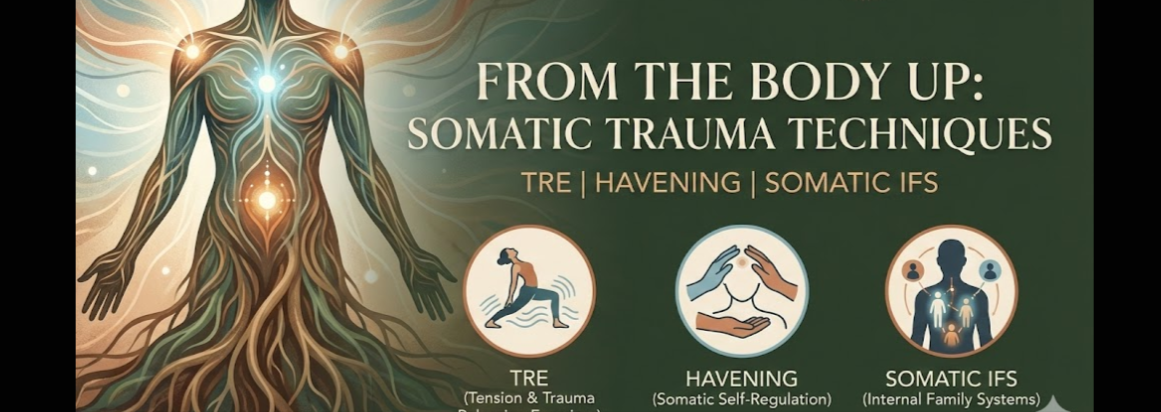
The somatic exercises most often suggested for trauma at home are Tension and Trauma Releasing Exercises (TRE), self-havening touch, and body-focused parts work drawn from Somatic Internal Family Systems. Done gently and in short sittings, they can help turn down arousal between therapy sessions. The research behind them is early, small or, for Somatic IFS, missing, and none of them is a substitute for trauma therapy.
That last sentence is the argument of this page. These practices are regulation skills, not trauma treatment. What they can train is the capacity to notice your body getting activated, bring it down a notch, and come back. That is a real and useful skill. The bigger promises attached to them, that shaking discharges stored stress hormones or that stroking your arms permanently erases the charge of a memory, are not supported by the evidence, and believing them can lead people to push too hard on their own. Below is what each technique involves, what the studies show, who should skip it, and how the same ideas are used more safely inside therapy.
What body-up work can and cannot do
A common line in somatic self-help is that talk therapy only reaches the thinking brain, while trauma sits in the amygdala and brainstem, out of reach of words. The experience behind the line is real. You can understand exactly why your chest tightens at a raised voice and still feel it tighten. But the conclusion does not follow. The treatments with the strongest evidence for PTSD are talking treatments with a trauma focus, such as cognitive processing therapy and prolonged exposure, along with EMDR. A 2020 systematic review of 114 randomized trials found robust, clinically important effects for those approaches.1
Where body-up practices earn their place is regulation. Daniel Siegel’s term for the band of arousal in which a person can think, feel and stay present at the same time is the window of tolerance.2 Trauma tends to narrow that window, so ordinary stress tips people into hyperarousal (racing heart, panic, rage) or hypoarousal (numbness, fog, shutdown). Home practices aimed at the body give you a few ways to widen it again: slowing the breath, using touch, letting muscles work and then rest, or noticing where something sits in your body instead of arguing with it. Our guide to how trauma is stored differently in different types of memory explains why the body can keep reacting after the story makes sense.
A note on vocabulary. Much of this field borrows from Stephen Porges’s polyvagal theory, with its “ventral vagal” safety and “dorsal vagal” shutdown. The practical idea that small cues of safety matter is useful, and it is the subject of our post on glimmers and nervous system regulation. The theory’s physiology is another matter. The psychophysiologist Paul Grossman has argued that each of its five basic premises is either untenable or highly implausible.3 You do not need the theory to use the practices.
Before you start: who should go slowly, or not at all
Turning attention toward the body is not neutral. In a mixed-methods study of Western Buddhist meditators, Jared Lindahl, Willoughby Britton and colleagues catalogued 59 kinds of meditation-related experience, many of them rarely reported, in domains that included bodily sensation and the sense of self. Some were welcome. Others were distressing, and that distress ranged from mild and brief to severe and lasting.4 David Treleaven makes the same point about trauma survivors: inward attention can bring up flashbacks or dissociation instead of calm, and the answer is to adapt the practice, not to push through it.5
Talk to a professional before trying these practices at home if any of the following applies to you.
- You dissociate. If you lose time, feel unreal, go numb or “leave your body” under stress, body-focused practice can take you further away instead of bringing you back. Start with a clinician. Our page on dissociation therapy in Hoover describes what that work involves.
- You have a seizure disorder, including functional (non-epileptic) seizures, or a movement disorder. TRE deliberately produces involuntary shaking. Ask your neurologist first.
- You are pregnant, have had recent surgery, or have an injury or joint problem in the hips, knees, back or neck. TRE involves sustained standing leg work and lying on your back with the knees dropped open. Check with your doctor or physical therapist.
- You are in crisis or have active psychotic symptoms. Get direct support first.
- The trauma is recent, or you are still living with the person or situation that hurt you. Safety comes before processing.
We found no research-based list of contraindications for any of these methods, and practitioner guidance varies. Treat the list above as clinical caution, not a complete rulebook. Give yourself three stop rules for any home practice. Stop if your distress climbs past about 6 on a 0 to 10 scale. Stop if you start to feel far away or unreal. Stop if anything hurts. Then orient: open your eyes, name five things you can see, and feel your feet on the floor. If you are in danger or thinking about suicide, call or text 988, or use our list of crisis resources in Birmingham.
TRE: shaking after mild muscle fatigue
Tension and Trauma Releasing Exercises were developed by David Berceli, who set them out in a 2005 book.6 The method is a sequence of seven stretching exercises meant to work and tire the muscles of the legs and hips. Six are done standing. The last is done lying on your back with the soles of the feet together and the knees dropped out toward the floor, and that is where many people begin to tremble, usually in the legs first.7 Berceli calls these neurogenic tremors and describes them as a natural reflex that people learn to suppress.
The rationale offered for TRE leans on two images. The first is the prey animal that shakes after escaping a predator, an image popularized by Peter Levine’s Waking the Tiger.8 It is an evocative observation, but it has not been tested as an account of how humans recover from trauma. The second is the psoas, the deep hip flexor that runs from the lower spine to the top of the thigh bone. Popular somatic writing calls it the “muscle of the soul” and the main muscle of fight or flight, and says that tremoring discharges stored stress hormones. None of those claims has anatomical or physiological evidence behind it. Stress hormones are not stored in muscle waiting to be shaken loose, and the fight-or-flight response involves the whole body, not one muscle. The Danish researchers who later tested TRE note that its mechanism has not been scientifically demonstrated.7
A plainer account is enough. Brief muscle fatigue followed by rest, in a predictable sequence you control and can stop at any moment, lets you feel your body do something involuntary and then settle. For someone whose body has come to feel like a source of danger, that experience can matter.
What the evidence shows. A 2026 scoping review by Linda Roos and colleagues found 22 studies of TRE, mostly in stress- and trauma-exposed groups. It reported possible benefits for mood, anxiety-related sleep problems and cognition, and noted that the study designs were not consistently rigorous.9 The individual studies bear that out. Berceli’s own 2014 pilot taught the method to 21 staff at an SOS Children’s Village in Cape Town, with no control group, and found that self-rated quality of life improved.10 The Danish MS Society ran a nine-person pilot7 and then a randomized trial with 28 people with multiple sclerosis. In the trial, TRE did not beat usual care on fatigue, the main outcome, until the researchers adjusted for differences between the groups; they also reported less spasticity and pain, and called for more research.11 That is a fair summary of the whole literature: promising, small, and not yet a treatment for PTSD.
If you try it. Learn TRE from a certified provider, in person or online, before practicing alone. Keep early tremoring short. Even in the Danish pilot, home practice was capped at 15 minutes of tremoring, and a few minutes is a sensible start.7 TRE home-practice guides commonly give two ways to stop: straighten your legs and flex your feet, or roll onto your side. Small changes in the angle of your knees change how strong the tremor is, and guides differ on which way to move them, which is one more reason to learn with a provider. The shaking should feel mild and painless. Afterward, rest for a few minutes and stand up slowly. Some people feel tired, tearful or sleepy afterward. If you feel worse for more than a day, or spacey and disconnected, stop and talk to a clinician.
Self-havening: soothing touch with a distraction task
Havening was developed by Ronald Ruden, a New York physician, and is set out in his book When the Past Is Always Present, published by Routledge in 2011.12 The self-applied version is simple. You bring a mildly upsetting memory or feeling to mind and rate it from 0 to 10. Then you use slow, comforting strokes at roughly one per second: crossing your arms and stroking from the shoulders down to the elbows, sliding your palms against each other as if washing your hands, or stroking your face from the forehead toward the jaw. While you do this, you occupy your mind with something neutral, most often imagining climbing a staircase while counting the steps aloud, or humming a familiar tune. Then you rate the feeling again and repeat if the number is still high.
Ruden’s explanation is far more ambitious than the method. He proposes that traumatic memories are held in place by extra AMPA-type glutamate receptors in the amygdala, and that the touch sets off a cascade, which he describes in terms of electromagnetic fields and calcium waves inside neurons, that strips those receptors away. He calls this depotentiation and presents it as removing the emotional charge for good. In his own paper it is framed as hypothesis and speculation.13 Proponents also say that havening touch generates slow delta waves, the rhythm of deep sleep.14 We found no published study showing this in people. The first EEG study of havening touch, by Alexander Sumich and colleagues in 2022, reported increased beta and reduced gamma activity; its abstract does not mention delta at all.15
What the evidence shows. The studies are few and small. A 2015 study gave a single session to 30 healthcare professionals who said depression or anxiety was affecting their work. Among the 27 who completed follow-up, depression, anxiety and work-functioning scores were lower a week and two months later, but there was no control group.16 Sumich’s study of 24 people found that distress fell more in sessions that included the touch than in sessions that did not, though both groups improved.15 A 2023 waitlist-controlled trial of 125 trauma-exposed people reported very large gains in self-rated resilience. It was posted as a preprint, Ruden was a co-author, and participants knew whether they were being treated.17 In a randomized trial after total joint replacement, also with Ruden as a co-author, havening did not reduce pain or opioid use.18 When a 2025 viewpoint in the New Zealand Medical Journal promoted Ruden’s theory, a group of clinicians replied in 2026 under the title “A novel theory of trauma offers new hype about Havening.”14,19
The touch itself may be doing something simpler. In a 2021 randomized trial, Aljoscha Dreisoerner and colleagues put 159 young adults through a standard laboratory stressor. Those who received a hug, or who used self-soothing touch such as a hand on the chest, had lower cortisol responses than controls, although they did not report feeling less stressed.20 A 2026 trial in 78 chronically stressed young adults found that two weeks of self-soothing touch lowered momentary stress about as much as brief meditation did.21 That is a modest, believable finding: comforting touch can take the edge off. It does not require, or prove, anything about erasing memories.
If you try it. Use self-havening for everyday spikes: a tense email, a jolt of anxiety before a meeting, a bad night. Do not use it alone to go after your worst memory. If a round leaves you more upset than when you started, stop and orient to the room.
Somatic IFS: finding where a part shows up in the body
Internal Family Systems, developed by the family therapist Richard Schwartz, describes the mind as a system of parts.22 Managers try to keep pain from surfacing by planning, controlling and criticizing. Firefighters react once pain breaks through, with numbing, bingeing, dissociating or rage. Exiles are the younger, wounded parts that both kinds of protector are guarding. Susan McConnell, a senior IFS trainer who has taught the model since 1997, carried it into the body in Somatic Internal Family Systems Therapy (2020). The book is organized around five practices: somatic awareness, conscious breathing, radical resonance, mindful movement and attuned touch.23 Our overview of how Internal Family Systems developed covers the model’s history.
The simplest home version is a body check-in. When a strong reaction shows up, pause and ask where you feel it, what size, shape or temperature it has, and whether it seems to have an age. Then ask what it is afraid would happen if it stopped doing its job. This move, from the story to the felt texture of the body, has a long lineage. It echoes the “felt sense” that the philosopher and psychotherapist Eugene Gendlin taught in Focusing.24
Conscious breathing, the second of McConnell’s practices, has the strongest evidence of the home practices described here, though that evidence concerns breathing exercises in general, not Somatic IFS or trauma treatment. A 2023 meta-analysis of randomized trials found that breathwork was associated with small-to-medium reductions in self-reported stress, anxiety and depression, and warned that most of the studies carried a moderate risk of bias.25 A slow, unhurried exhale is a reasonable place to start.
Two cautions. First, a parts map is a metaphor, not a diagnosis. It can be useful to wonder whether a clenched jaw belongs to a manager working overtime, but recurring headaches, stomach pain or chest tightness need a medical evaluation before anyone treats them as psychological. Second, keep home practice to getting to know your protective parts. IFS clinicians generally advise doing exile work, and the “unburdening” the model describes, with a trained therapist, because that is where the oldest pain lives. We found no controlled trials of Somatic IFS itself. For standard IFS, an uncontrolled pilot of 17 adults with PTSD and multiple childhood traumas reported large symptom reductions.26 A 2026 randomized trial in 60 adults with PTSD then compared an online group program based on IFS with a matched nature-based stress-reduction program. PTSD symptoms fell in both groups, with no significant difference between them.27
A gentler first week
The point of a first week is to learn your own signals, not to release anything. Rate your distress from 0 to 10 before and after each practice, and keep sittings short.
- Days 1 and 2: orient and breathe. Sit somewhere comfortable with your eyes open. Look slowly around the room and name what you see. Then take a few slow breaths with a longer exhale. Notice anything that eases, even slightly.
- Days 3 and 4: self-havening for something mild. Pick a low-level annoyance, around 3 out of 10. Try a few minutes of arm or palm strokes with the staircase count, then rate it again.
- Days 5 and 6: a body check-in. When you notice tension, ask where it is and what it is like. Do not try to change it. Write down what you notice.
- Day 7: decide about TRE. If the first six days went well and none of the cautions above apply, look for a certified provider to learn TRE with, rather than starting from a written description.
If any of this leaves you feeling worse, more numb or less present, treat that as information, not failure. It usually means the practice needs to be slower, more outward-focused, or done with someone else in the room.
What this looks like in therapy
In a therapist’s office the same ingredients are used with more structure and more attention to pacing. Two ideas from Peter Levine’s Somatic Experiencing do much of the work. Titration means touching a small piece of distress at a time rather than the whole memory. Pendulation means moving attention back and forth between a place in the body that feels activated and one that feels neutral or steady, so that the nervous system learns it can go up and come back down.28 A therapist also watches for what you may not notice yourself: a glazed look, a held breath, a sudden politeness that means a protective part has stepped in.
Somatic Experiencing has more research than the home methods above, though still not much. A randomized trial of 63 people with PTSD found that 15 weekly sessions reduced symptoms compared with a waitlist, and a 2021 scoping review called the evidence promising but of mixed quality.29,30 In practice, body-based work is often combined with treatments that have stronger evidence, such as EMDR, or with parts work, rather than offered alone. Our guide to how the different types of therapy fit together explains how those pieces combine, and our essay on somatic archeology looks at what it means to treat the body as carrying history.
Trauma therapy with a somatic emphasis generally moves in phases. It begins with history and stabilization: what happened, what helps, what tips you out of your window, and whether dissociation is part of the picture. Early sessions often look like the first-week practices above, done together, with the therapist adjusting the pace in real time. Work on traumatic memories comes later, once there is enough steadiness to hold it. At Taproot Therapy Collective in Hoover, our clinicians combine somatic approaches with EMDR, Brainspotting, parts work and depth psychotherapy, and we see clients in person in Hoover and by teletherapy elsewhere in Alabama.
If you have tried these practices and your body still braces long after your mind has caught up, or if they stir up more than you can settle on your own, that is a good reason to work with someone. You can read about somatic therapy at Taproot in Birmingham, or contact us to ask whether it fits what you are dealing with. No technique comes with a guarantee, and a good first conversation should be honest about that.
References
- Lewis, C., Roberts, N. P., Andrew, M., Starling, E., & Bisson, J. I. (2020). Psychological therapies for post-traumatic stress disorder in adults: Systematic review and meta-analysis. European Journal of Psychotraumatology, 11(1), 1729633. https://doi.org/10.1080/20008198.2020.1729633
- Siegel, D. J. (1999). The developing mind: Toward a neurobiology of interpersonal experience. Guilford Press.
- Grossman, P. (2023). Fundamental challenges and likely refutations of the five basic premises of the polyvagal theory. Biological Psychology, 180, 108589. https://doi.org/10.1016/j.biopsycho.2023.108589
- Lindahl, J. R., Fisher, N. E., Cooper, D. J., Rosen, R. K., & Britton, W. B. (2017). The varieties of contemplative experience: A mixed-methods study of meditation-related challenges in Western Buddhists. PLOS ONE, 12(5), e0176239. https://doi.org/10.1371/journal.pone.0176239
- Treleaven, D. A. (2018). Trauma-sensitive mindfulness: Practices for safe and transformative healing. W. W. Norton.
- Berceli, D. (2005). Trauma releasing exercises (TRE): A revolutionary new method for stress/trauma recovery. BookSurge.
- Lynning, M., Svane, C., Westergaard, K., Bergien, S. O., Gunnersen, S. R., & Skovgaard, L. (2021). Tension and trauma releasing exercises for people with multiple sclerosis: An exploratory pilot study. Journal of Traditional and Complementary Medicine, 11(5), 383–389. https://doi.org/10.1016/j.jtcme.2021.02.003
- Levine, P. A., with Frederick, A. (1997). Waking the tiger: Healing trauma. North Atlantic Books.
- Roos, L. A. J., van Niekerk, K., & Tönsing, K. M. (2026). Trauma releasing exercises as a treatment technique: A scoping review. Occupational Therapy in Health Care. Advance online publication. https://doi.org/10.1080/07380577.2026.2726931
- Berceli, D., Salmon, M., Bonifas, R., & Ndefo, N. (2014). Effects of self-induced unclassified therapeutic tremors on quality of life among non-professional caregivers: A pilot study. Global Advances in Health and Medicine, 3(5), 45–48. https://doi.org/10.7453/gahmj.2014.032
- Skovgaard, L., Trénel, P., Hanehøj, K., & Lynning, M. (2025). Tension and trauma releasing exercises for people with multiple sclerosis: A randomized controlled trial. Advances in Mind-Body Medicine, 39(1), 4–12. PubMed: https://pubmed.ncbi.nlm.nih.gov/40064004/
- Ruden, R. A. (2011). When the past is always present: Emotional traumatization, causes, and cures. Routledge. https://doi.org/10.4324/9780203859971
- Ruden, R. A. (2019). Harnessing electroceuticals to treat disorders arising from traumatic stress: Theoretical considerations using a psychosensory model. Explore, 15(3), 222–229. https://doi.org/10.1016/j.explore.2018.05.005
- Youngson, R. (2025). A novel theory of trauma offers new treatment possibilities. New Zealand Medical Journal, 138(1623), 95–104. https://doi.org/10.26635/6965.6955
- Sumich, A. L., Heym, N., Sarkar, M., Burgess, T., French, J., Hatch, L. M., & Hunter, K. A. (2022). The power of touch: The effects of havening touch on subjective distress, mood, brain function, and psychological health. Psychology & Neuroscience, 15(4), 332–346. https://doi.org/10.1037/pne0000288
- Thandi, G., Tom, D., Gould, M., McKenna, P., & Greenberg, N. (2015). Impact of a single-session of havening. Health Science Journal, 9(5), Article 1. https://kclpure.kcl.ac.uk/ws/files/44380308/impact_of_a_singlesession_of_havening.pdf
- Hodgson, K. L., Carmi, L. H., Ruden, R. A., Carmi, M. A., & Cameron, D. (2023). Augmenting resilience to trauma: A parallel-group controlled trial of a psychosensory intervention (Preprint). PsyArXiv. https://doi.org/10.31234/osf.io/7jm2s
- Cizmic, Z., Edusei, E., Anoushiravani, A. A., Zuckerman, J. D., Ruden, R. A., & Schwarzkopf, R. (2018). The effect of psychosensory therapy on short-term outcomes of total joint arthroplasty: A randomized controlled trial. Orthopedics, 41(6), e848–e853. https://doi.org/10.3928/01477447-20181010-04
- Jeram Patel, G., Wake, K., Schimanski, I., Skirrow, P., & Every-Palmer, S. (2026). A novel theory of trauma offers new hype about Havening: Reply to Youngson. New Zealand Medical Journal, 139(1635), 111–113. https://doi.org/10.26635/6965.7519
- Dreisoerner, A., Junker, N. M., Schlotz, W., Heimrich, J., Bloemeke, S., Ditzen, B., & van Dick, R. (2021). Self-soothing touch and being hugged reduce cortisol responses to stress: A randomized controlled trial on stress, physical touch, and social identity. Comprehensive Psychoneuroendocrinology, 8, 100091. https://doi.org/10.1016/j.cpnec.2021.100091
- Maier, F., Luttenberger, I., Dreisoerner, A., & Szaszkó, B. (2026). Self-soothing touch reduces momentary stress, fatigue, and loneliness comparable to brief meditation: A randomised controlled trial. Stress and Health, 42(1), e70145. https://doi.org/10.1002/smi.70145
- Schwartz, R. C. (1995). Internal family systems therapy. Guilford Press.
- McConnell, S. (2020). Somatic internal family systems therapy: Awareness, breath, resonance, movement, and touch in practice. North Atlantic Books.
- Gendlin, E. T. (1978). Focusing. Everest House.
- Fincham, G. W., Strauss, C., Montero-Marin, J., & Cavanagh, K. (2023). Effect of breathwork on stress and mental health: A meta-analysis of randomised-controlled trials. Scientific Reports, 13, 432. https://doi.org/10.1038/s41598-022-27247-y
- Hodgdon, H. B., Anderson, F. G., Southwell, E., Hrubec, W., & Schwartz, R. (2022). Internal Family Systems (IFS) therapy for posttraumatic stress disorder (PTSD) among survivors of multiple childhood trauma: A pilot effectiveness study. Journal of Aggression, Maltreatment & Trauma, 31(1), 22–43. https://doi.org/10.1080/10926771.2021.2013375
- Joss, D., Comeau, A., Chevannes, R., Parry, G., Rea, H. S., Barria, J., Bumpus, C., Rector, A., Rajan, A., Rosansky, J., Rice, F. K., Ward, M. C., Tobiasz Veltz, L., Ally, D., Rosenberg, L. G., Sweezy, M., Lovas, D., & Schuman-Olivier, Z. (2026). A randomized controlled trial of an online group-based internal family systems treatment for posttraumatic stress disorder: The Program for Alleviating and Resolving Trauma and Stress (PARTS) study. Psychological Trauma: Theory, Research, Practice, and Policy. Advance online publication. https://doi.org/10.1037/tra0002089
- Payne, P., Levine, P. A., & Crane-Godreau, M. A. (2015). Somatic experiencing: Using interoception and proprioception as core elements of trauma therapy. Frontiers in Psychology, 6, 93. https://doi.org/10.3389/fpsyg.2015.00093
- Brom, D., Stokar, Y., Lawi, C., Nuriel-Porat, V., Ziv, Y., Lerner, K., & Ross, G. (2017). Somatic experiencing for posttraumatic stress disorder: A randomized controlled outcome study. Journal of Traumatic Stress, 30(3), 304–312. https://doi.org/10.1002/jts.22189
- Kuhfuß, M., Maldei, T., Hetmanek, A., & Baumann, N. (2021). Somatic experiencing: Effectiveness and key factors of a body-oriented trauma therapy: A scoping literature review. European Journal of Psychotraumatology, 12(1), 1929023. https://doi.org/10.1080/20008198.2021.1929023


















0 Comments