

Changing Images of Man is a 319-page policy report issued in May 1974 by the Center for the Study of Social Policy at Stanford Research Institute, prepared for the Charles F. Kettering Foundation by a team led by O. W. Markley and Willis Harman. It argued that industrial society’s working picture of human nature, which it called the “image of man,” no longer fit reality and would have to change.1
The report’s forecasts matter less than one psychological claim it makes. A culture’s image of the human works like a family’s unspoken verdict on a child: mostly outside awareness, it tells people what they are, what they may want, and what counts as failure. Those images are not dreamed up by philosophers. They come largely from how a society makes its living. So a client’s self-image is partly a private copy of a public, economically shaped picture, and one thing therapy can do is make that copy visible enough to revise.
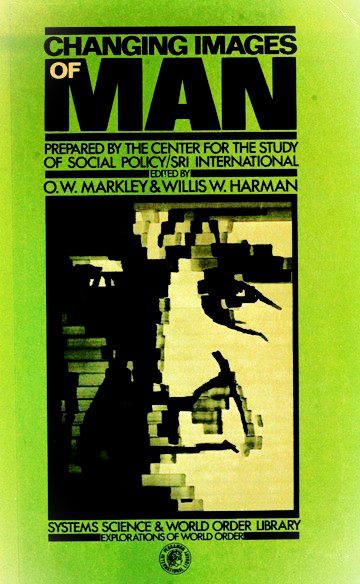
What the report actually said
Library catalogs list the report as SRI Policy Research Report No. 4, prepared for the Kettering Foundation, a private foundation, under contract URH(489)-2150.1 The staff and consultants credited were Joseph Campbell, Duane Elgin, Willis Harman, Arthur Hastings, O. W. Markley, Floyd Matson, Brendan O’Regan and Leslie Schneider. The report also names an advisory panel of René Dubos, Henry Margenau, Margaret Mead and Sir Geoffrey Vickers. The report is sometimes described as Campbell’s. It was not. Markley was project director, and Harman, who directed the center, provided overall guidance. The acknowledgments leave Campbell off the core research staff and credit him and Floyd Matson with “major contributions,” mainly to the chapter on historical images of humankind.2
The report defines an image of man as the set of assumptions held about the human being’s origin, nature, abilities and characteristics, relationships with others, and place in the universe. The definition covers what a person is and what a person ought to be. The authors add that for most people these assumptions sit beneath conscious awareness, and that only once they are brought into awareness can an image “be examined carefully and with perspective, to be retained, discarded, or changed.”2 Its stated aims were to show how present society had been shaped by the myths and images beneath it, to explore the deficiencies of current images and identify what future images would need, and to find “high-leverage” activities that could help new images and new policies emerge.
The chapters follow that plan. A historical survey traces formative images of “man-in-the-universe.” A chapter titled “Economic Man: Servant to Industrial Metaphors” argues, in a section titled “The Poverty of Our Abundance,” that an image born under scarcity no longer fits an affluent society. A further chapter covers science, from physics to consciousness research and parapsychology. The core chapter lists six characteristics an adequate image of humankind would need, among them a holistic sense of perspective, an ecological ethic and a self-realization ethic. The two ethics are meant to check each other. Concern for the whole restrains a selfish version of self-realization, and the value placed on personal growth restrains a collectivist version of ecology.
The last chapters ask whether such an “evolutionary transformationalist” image could become dominant, and what the transition might cost. The report warns that a mismatch between existing institutions and a new cultural paradigm could bring serious social disruption, economic decline and even institutional collapse, and it argues for a minimally disruptive transition. In 1982 Pergamon Press published the text, essentially unchanged, as a 255-page book in its Systems Science and World Order Library, edited by Markley and Harman.2
The report does use Campbell’s monomyth: a table in its sixth chapter sets his stages of separation, initiation and return beside stages of cultural revitalization, scientific revolution and change in psychotherapy as versions of one “cycle of transformation.”2 But it has no hero’s-journey model of society with named stages such as a “Call to Transformation” or a “Descent into Chaos.” It has no sequence running from “Homo Faber” to a “Homo Integralis.” There are no chapters on Marshall McLuhan, Victor Turner or digital networks. Those sections were later embroidery, and they are gone.
Who made it, and what surrounded it
Stanford Research Institute was created by Stanford’s trustees in 1946, formally separated from the university in 1970, and renamed SRI International in 1977. The same institute housed remote-viewing experiments run by the researchers Harold Puthoff and Russell Targ beginning in 1972, with CIA involvement. That work fed into what was consolidated in 1991 as the Stargate Project, which was shut down in 1995 after an evaluation by the American Institutes for Research found no demonstrated intelligence value. The Changing Images report had a different sponsor and a different team, but it was not walled off from that work. Its chapter on science cites personal communications from Puthoff in 1972 and 1973 and describes a Puthoff–Targ experiment on telepathy, “if substantiated,” as a “watershed experiment” that “appears to provide clear evidence of universal telepathic capacity.”2 Nothing in the report’s acknowledgments or funding history ties the study to the intelligence agencies that paid for remote viewing.
Willis Harman (1918–1997) was a Stanford-trained electrical engineer who joined Stanford’s faculty in 1952 and worked as a senior social scientist at SRI from 1967 to 1984. Before that he had been first author of a 1966 pilot study in which 27 professionally employed men took LSD or mescaline in structured sessions designed to test creative problem-solving.3 He later became president of the Institute of Noetic Sciences, co-founded in 1973 by the Apollo 14 astronaut Edgar Mitchell, and held that post until his death. None of this was hidden.
The report was reviewed in the open futures literature, not passed around as a secret: in Futures by the systems theorist Erich Jantsch in 1975 and, for the Pergamon edition, by Christopher Dede in 1982.4, 5
The conspiracy reading, and what it gets right
The report’s second life began in 1980. That year Marilyn Ferguson’s bestseller The Aquarian Conspiracy described a leaderless network of people working toward a change in consciousness.6 The LaRouche movement answered with a special report on the “Aquarian Conspiracy” in its magazine Executive Intelligence Review on May 13, 1980, including an article on the SRI study.7 In a 1996 retrospective the magazine summed up the movement’s 1980 campaign pamphlet: the Aquarians meant to rob people of “man’s inner sense of true human identity” and replace it with an artificial “pseudo soul.” The same piece claimed that Harman had the SRI report “reworked into a popularized form” and published under Ferguson’s name.8 Websites still present the report as a blueprint for engineered social change, often beside claims that SRI belongs to a network run from London’s Tavistock Institute. The Pergamon edition gets the same treatment because Robert Maxwell owned the house in 1982, though Pergamon was a mainstream scientific publisher, later sold to Elsevier, and a systems-science series is a thin thread to hang a plot on.
Documented: the authors wanted the culture’s image of the human to change, said so in print, and listed activities that might speed the change. A private foundation paid for the study. Harman had taken part in psychedelic research, SRI separately ran remote-viewing research with intelligence funding, and the report cited SRI’s parapsychology work with enthusiasm. Not documented: that the report was a directive, that any agency acted on it, or that it produced the New Age movement. The counterculture it described was roughly a decade old when it was written. The causal story runs the other way. The report was a reaction to cultural change already under way, and its final chapter frames the task as how “to facilitate a non-catastrophic transition when the dynamics for transformation are already there.”2
Still, the conspiracy readers have noticed something real, even if they misread it. A policy report that treats a population’s self-image as something to be influenced from above raises a fair question: who gets to decide what people should believe about themselves? The authors’ intentions were benign, but shaping a public’s picture of itself through leverage points is also what advertising does. That worry is psychological, and it is better answered by understanding how images of the human actually take hold than by hunting for a cabal.
Jung: images that live below awareness
The report’s claim that assumptions about human nature sit beneath awareness is a depth-psychological claim, and Jung had already worked out a vocabulary for it. In “Archetypes of the Collective Unconscious” he borrowed the anthropologist Lucien Lévy-Bruhl’s term représentations collectives for the symbolic figures a culture shares. In his essay on the mother archetype he drew a distinction that matters here: what is inherited is a form, not a representation. He compared the archetype to the axial system of a crystal, which preforms a crystal’s structure although it has no material existence of its own.9
Read that way, the need for a picture of what a human being is may be universal. People need to know whether they matter, where they belong and what they are for. The picture that answers the need is supplied by history: the faithful servant, the citizen-soldier, the self-made man, the optimized worker. The form persists. The content gets filled in by the culture’s daily life, and by whoever organizes it. (For a longer treatment of how shared images now spread through networks, see this piece on the digital collective unconscious.)
Jung made a version of the report’s diagnosis in The Undiscovered Self, first published in German in 1957 as Gegenwart und Zukunft. He argued that the scientific habit of describing people by averages, joined to the power of the mass state, teaches individuals to regard themselves as interchangeable units, and that people who see themselves this way are easy recruits for mass movements.10 The SRI authors described “economic man” from the outside, as a policy problem. Jung described what it is like to carry that image inside oneself.
Where the images come from: the material base
Here the report pulls in two directions. It says plainly that a society’s image and its social environment shape each other. But its strategy treats the image as the place to push: change the image, and policy and institutions will follow.2 Marx put the arrow the other way in 1859: “It is not the consciousness of men that determines their existence, but their social existence that determines their consciousness.”11 The report’s own chapter on economic man concedes much of his point. It opens with John Kenneth Galbraith’s line that “the imperatives of technology and organization, not the images of ideology,” determine the shape of economic society, and it traces the image to the industrial revolution, when the laborer became “an objectified and standardized component of the production process.”2 “Economic man” did not win because someone argued for him. He arrived with the factory, the wage and the market, and the image followed the arrangement.
Erich Fromm is the bridge between the two traditions, because he took both Freud and Marx seriously. In Escape from Freedom (1941) he introduced the idea of social character: the core of character shared by most members of a group, formed by their common way of life, which leads people to want to do what their economic system needs them to do.12 In Man for Himself (1947) he described the marketing orientation, in which a person experiences himself as a commodity whose worth depends on whether he sells.13 That is economic man as a self-image, felt from the inside. It is the same territory as this site’s essay on how money shapes mind and body.
The empirical record supports the broad point and cuts against the strong versions. Markus and Kitayama’s influential 1991 review argued that independent and interdependent construals of the self shape cognition, emotion and motivation across cultures.14 A 2016 study of 7,279 adults in 55 cultural groups across 33 nations found the simple East–West contrast too crude. Models of selfhood varied with individualism and collectivism, with religious heritage, and with national socioeconomic development.15 That last variable is the historical-materialist point in survey form, though the data are correlational. A meta-analysis of 753 effect sizes from 259 samples found that materialist values and beliefs correlated with lower well-being, around r = −.19. The links were strongest for negative self-appraisals and risky health and consumer behavior, and they appeared to run through poorly met psychological needs.16
The quick-nudge version of the idea has fared badly. A 2006 paper reported that brief reminders of money made people less helpful and more inclined to work alone.17 Later high-powered attempts to replicate related money-priming effects found essentially nothing (weighted d = 0.03), and one such effect was found by only 1 of 36 labs in the Many Labs project.18 A follow-up analysis concluded that the money-priming literature shows signs of selection bias.19 The priming failures do not show how images of the human take hold, only that a passing cue is not how. That is bad news for anyone hoping for “high-leverage” shortcuts to a new self-image, and some reassurance for anyone afraid of them.
What this looks like in therapy
Nobody walks into a session and says their image of man is economic man. They say they are behind. They say they have not earned rest. They say something is wrong with their wiring, which borrows the biomedical picture of a person as a faulty machine, a picture this site questions in revisioning psychotherapy beyond the biomedical model. These are borrowed images, held below awareness in just the way the SRI authors described. Usually they are experienced as plain facts about the self. The authors saw the link to therapy themselves: they listed “clinical data from psychotherapy indicating the life-shaping effect of an individual’s self-image” among their indications that images shape behavior.2
The clinical work tends to move through a few steps, not always in order. First comes naming the image: in this person’s world, what is a human being supposed to be? Then comes finding where it came from, in a parent’s fear, a workplace’s metrics, a church’s ideal, or a town’s economy, and noticing who benefits when the person believes it. Then comes separating the need underneath from the costume it wears. The need to matter is real and probably universal. The equation of mattering with output is local and historical. Finally, the person tries out a different account of themselves in actual life, not only in conversation.
There is some evidence, still thin, that revising the story a person tells about themselves tracks real change. In one longitudinal study, 47 adults wrote personal narratives before starting psychotherapy and after each session, across 12 assessment points. Themes of agency in their stories increased over time, and the rise in agency came before improvements in mental health, not after.20 One small study of people already in therapy shows timing, not cause. A broader review of narrative identity research finds that life stories featuring agency, and redemptive meaning drawn from hardship, go with better mental health and well-being. The authors are clear that the causal direction is not settled.21 The related question of where people locate control over their lives is taken up in this piece on locus of control in trauma therapy.
The materialist correction belongs in the room too. Insight does not pay rent. If a client’s job really is precarious, their sense that they are only worth what they produce is not a delusion. It is an accurate reading of their conditions, wrongly taken as a fact about their soul. Therapy can loosen that identification without pretending the conditions are not real. Images of the human also do another job: terror management theory describes how cultural pictures of a worthwhile person help buffer anxiety about death, which is one reason people defend their self-image so hard. And the therapist carries an image as well, whether that is the diagnostic manual’s picture of a person or the market’s picture of a client as a consumer of services. Jungian therapy and existential therapy both start from the assumption that the clinician should know which image they are bringing.
What holds up fifty years later
What follows is interpretation, not documented fact. Three things in the report hold up. Images of the human mostly work outside awareness. Economic man was always too thin a picture to live inside. And pairing self-realization with an ecological ethic is still a decent clinical rule of thumb: growth that ignores relationship turns into self-absorption, and belonging that ignores the self turns into conformity.
Two things do not hold up. The first is the strategy’s causal bet. The report knew influence ran both ways, but it treated consciousness as the lever and institutions as the load, and the evidence reviewed above, thin as it is, fits better with images that follow the arrangements people live inside. The second is the authors’ hope that a new image would displace the market’s image instead of being sold by it. Self-actualization became a product category, and archetypes became branding tools, as this site’s piece on archetypes in brand psychology shows from the marketer’s side. The image meant to replace economic man was absorbed by him. That is the strongest argument for the materialist reading, and a good reason to do the work person by person instead of by policy.
If you notice that the way you judge yourself sounds more like a performance review than a description of a person, that is worth exploring with someone. Our existential therapy work in Hoover is built for questions about meaning and self-image, and you can reach us through the contact page.
References
- Center for the Study of Social Policy. (1974). Changing images of man (Policy Research Report No. 4; prepared for the Charles F. Kettering Foundation, Contract URH(489)-2150). Stanford Research Institute.
- Markley, O. W., & Harman, W. W. (Eds.). (1982). Changing images of man. Pergamon Press.
- Harman, W. W., McKim, R. H., Mogar, R. E., Fadiman, J., & Stolaroff, M. J. (1966). Psychedelic agents in creative problem-solving: A pilot study. Psychological Reports, 19(1), 211–227. https://doi.org/10.2466/pr0.1966.19.1.211
- Jantsch, E. (1975). Changing images of man. Futures, 7(3), 245–254. https://doi.org/10.1016/0016-3287(75)90070-1
- Dede, C. (1982). Changing images of man. Futures, 14(6), 568–569. https://doi.org/10.1016/0016-3287(82)90047-7
- Ferguson, M. (1980). The Aquarian conspiracy: Personal and social transformation in the 1980s. J. P. Tarcher.
- Executive Intelligence Review. (1980, May 13). Stanford Institute’s “images of man.” Executive Intelligence Review, 7(18).
- Wolfe, L. (1996, January 12). The Tavistock roots of the “Aquarian Conspiracy.” Executive Intelligence Review, 23(3), 23–27.
- Jung, C. G. (1969). The archetypes and the collective unconscious (R. F. C. Hull, Trans.; 2nd ed., Collected Works Vol. 9, Pt. 1). Princeton University Press.
- Jung, C. G. (1958). The undiscovered self (R. F. C. Hull, Trans.). Little, Brown.
- Marx, K. (1977). A contribution to the critique of political economy (S. W. Ryazanskaya, Trans.). Progress Publishers. (Original work published 1859)
- Fromm, E. (1941). Escape from freedom. Farrar & Rinehart.
- Fromm, E. (1947). Man for himself: An inquiry into the psychology of ethics. Rinehart.
- Markus, H. R., & Kitayama, S. (1991). Culture and the self: Implications for cognition, emotion, and motivation. Psychological Review, 98(2), 224–253. https://doi.org/10.1037/0033-295X.98.2.224
- Vignoles, V. L., Owe, E., Becker, M., Smith, P. B., Easterbrook, M. J., Brown, R., González, R., Didier, N., Carrasco, D., Cadena, M. P., Lay, S., Schwartz, S. J., Des Rosiers, S. E., Villamar, J. A., Gavreliuc, A., Zinkeng, M., Kreuzbauer, R., Baguma, P., Martin, M., . . . Bond, M. H. (2016). Beyond the “east–west” dichotomy: Global variation in cultural models of selfhood. Journal of Experimental Psychology: General, 145(8), 966–1000. https://doi.org/10.1037/xge0000175
- Dittmar, H., Bond, R., Hurst, M., & Kasser, T. (2014). The relationship between materialism and personal well-being: A meta-analysis. Journal of Personality and Social Psychology, 107(5), 879–924. https://doi.org/10.1037/a0037409
- Vohs, K. D., Mead, N. L., & Goode, M. R. (2006). The psychological consequences of money. Science, 314(5802), 1154–1156. https://doi.org/10.1126/science.1132491
- Rohrer, D., Pashler, H., & Harris, C. R. (2015). Do subtle reminders of money change people’s political views? Journal of Experimental Psychology: General, 144(4), e73–e85. https://doi.org/10.1037/xge0000058
- Vadillo, M. A., Hardwicke, T. E., & Shanks, D. R. (2016). Selection bias, vote counting, and money-priming effects: A comment on Rohrer, Pashler, and Harris (2015) and Vohs (2015). Journal of Experimental Psychology: General, 145(5), 655–663. https://doi.org/10.1037/xge0000157
- Adler, J. M. (2012). Living into the story: Agency and coherence in a longitudinal study of narrative identity development and mental health over the course of psychotherapy. Journal of Personality and Social Psychology, 102(2), 367–389. https://doi.org/10.1037/a0025289
- McAdams, D. P., & McLean, K. C. (2013). Narrative identity. Current Directions in Psychological Science, 22(3), 233–238. https://doi.org/10.1177/0963721413475622





















0 Comments