
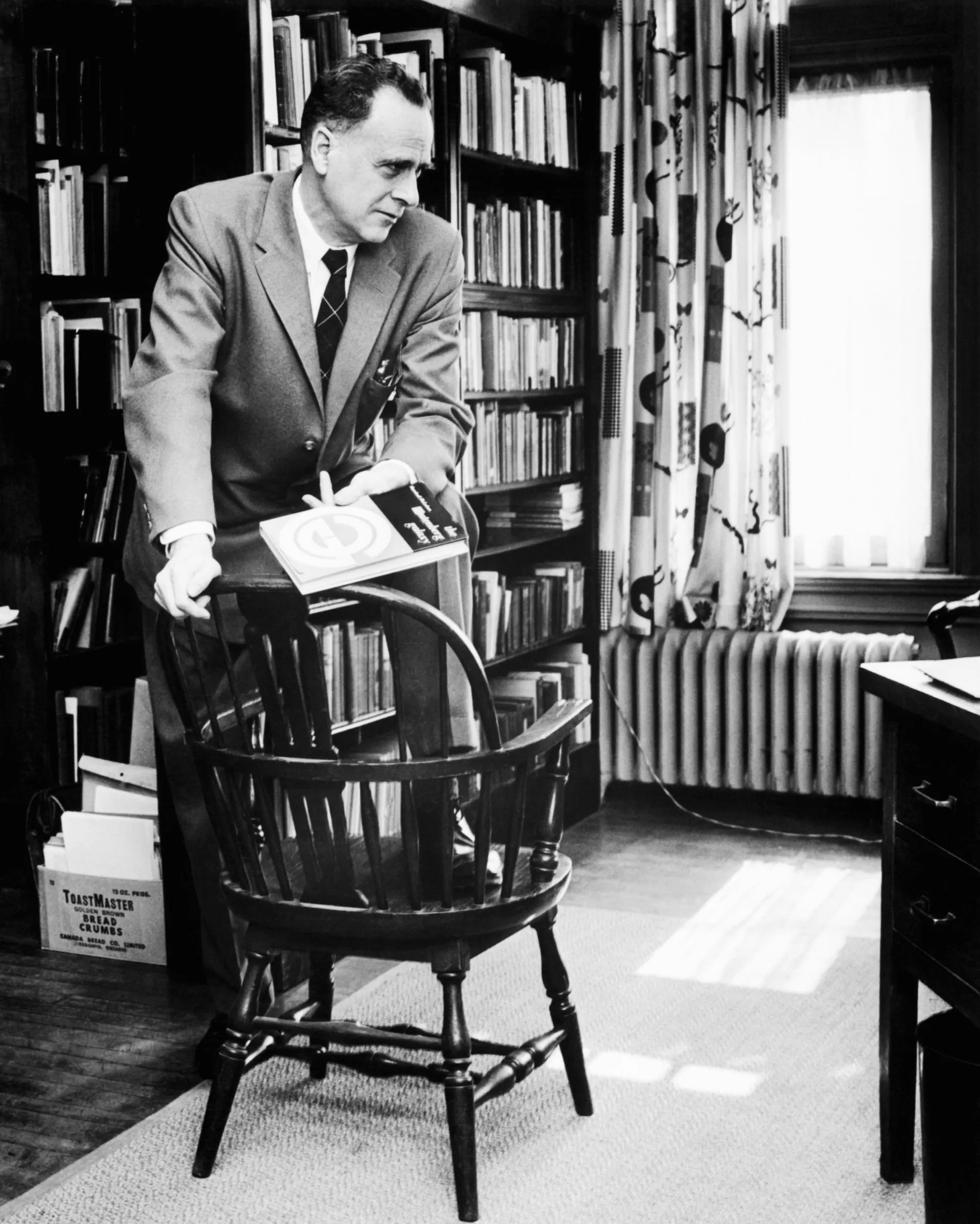
“The medium is the message” is Marshall McLuhan’s claim, made in Understanding Media (1964), that the deepest effect of any technology is the change it makes in the scale, pace and pattern of human life, not the content it carries.1 The railway mattered because of the cities it built, not the freight. A phone matters because of how it reorganizes attention, whatever you read on it.
Read as psychology, McLuhan’s idea is a theory of numbness. Every new medium extends one of our senses and floods it, and we adapt by going numb to the very thing that is changing us. That is why the form of a person’s days, the feed, the alert, the news loop that never ends, can shape mood and attention more than anything they consciously take in. It is also why therapy has to pay attention to the form of a life and not only to its stories.
What “the medium is the message” means
McLuhan’s own gloss, in the first chapter of Understanding Media, is plain: “the personal and social consequences of any medium—that is, of any extension of ourselves—result from the new scale that is introduced into our affairs by each extension of ourselves, or by any new technology.”1 The “message” of any medium, he wrote, “is the change of scale or pace or pattern that it introduces into human affairs.” Electric light is his purest case, a medium with no content at all: it hardly matters whether it is used “for brain surgery or night baseball.”
Two further moves finish the idea. First, “the ‘content’ of any medium is always another medium”: speech is the content of writing, and a novel or a play is the content of a film. Second, content works as a decoy. In his most quoted image, content “is like the juicy piece of meat carried by the burglar to distract the watchdog of the mind.” He was arguing against views like that of RCA’s David Sarnoff, who, accepting an honorary degree from Notre Dame, said that “the products of modern science are not in themselves good or bad; it is the way they are used that determines their value.” Nothing in that statement, McLuhan replied, “will bear scrutiny, for it ignores the nature of the medium,” and later in the chapter he calls the conventional view, that how media are used is what counts, “the numb stance of the technological idiot.”1
In his vocabulary, hot media, such as radio, film or a photograph, extend one sense in “high definition” and leave the audience little to fill in. Cool media, such as the telephone, ordinary speech or the grainy television picture of the 1960s, give less and demand more participation.1 The “global village,” his phrase from the early 1960s, named a world wired by electric media into something like a single village again: intimate, involved, tribal.2 Later, McLuhan and his son Eric condensed the method into the tetrad, four questions to ask of any technology: what does it enhance, what does it make obsolete, what older thing does it retrieve, and what does it flip into when pushed to its limit?3 The title of his best-selling 1967 book with the designer Quentin Fiore, The Medium Is the Massage, began as a typesetter’s error that, according to Eric McLuhan, his father chose to keep.45
Who Marshall McLuhan was
Herbert Marshall McLuhan was born in Edmonton, Alberta, on July 21, 1911, and grew up in Winnipeg.26 After a BA and an MA in English at the University of Manitoba he went to Trinity Hall, Cambridge, in 1934, where I. A. Richards and F. R. Leavis taught what he later called “the training of perception.” Reading G. K. Chesterton drew him toward Catholicism, and he was received into the Church in 1937.
He taught at the University of Wisconsin from 1936 to 1937 and at Saint Louis University from 1937 to 1944, while finishing a Cambridge doctorate on the Elizabethan writer Thomas Nashe and the history of the verbal arts. In St. Louis he tutored and befriended a young Jesuit, Walter J. Ong, who went on to write Orality and Literacy (1982).7 Our piece on Walter Ong’s work on orality and literacy follows that thread. After two years at Assumption College in Windsor, Ontario, he joined St. Michael’s College at the University of Toronto in 1946 and stayed there. His first book, The Mechanical Bride (1951), read magazine ads and comic strips as the “folklore of industrial man,” the territory of our article on the psychology of advertising.8
In Toronto he absorbed the work of a colleague, the economic historian Harold Innis, who studied how media of communication bias a society toward space or toward time. McLuhan later called The Gutenberg Galaxy (1962) “a footnote to the observations of Innis on the subject of the psychic and social consequences, first of writing and then of printing.”910 In 1963 the university created the Centre for Culture and Technology with McLuhan as director, partly to keep him from leaving. Understanding Media made him famous the next year. He held the Albert Schweitzer Chair in the Humanities at Fordham University in 1967–68, and played himself in Woody Allen’s Annie Hall (1977), appearing suddenly in a movie line to silence a pompous professor: “You know nothing of my work.”26 A stroke in September 1979 took much of his ability to speak. He died in his sleep in Toronto on December 31, 1980, and Laws of Media, the tetrad book written with Eric, was published in 1988.3
The psychological core: Narcissus as narcosis
The chapter that matters most to a clinician is the fourth, “The Gadget Lover: Narcissus as Narcosis.” McLuhan reads the myth against its usual moral: Narcissus did not fall in love with himself. He “mistook his own reflection in the water for another person,” and “this extension of himself by mirror numbed his perceptions until he became the servomechanism of his own extended or repeated image.” The nymph Echo called to him in vain. “He was numb. He had adapted to his extension of himself and had become a closed system.”1 McLuhan ties the name itself to narcosis, numbness.
The mechanism he borrowed from stress medicine. He cites the medical researchers Hans Selye, author of The Stress of Life (1956), and Adolphe Jonas.11 On their account, McLuhan writes, every extension of ourselves is an “autoamputation”: under “the physical stress of superstimulation of various kinds, the central nervous system acts to protect itself by a strategy of amputation or isolation of the offending organ, sense, or function.” Discussing nuclear deterrence, he puts it more bluntly: “numbness is the result of any prolonged terror,” and “the price of eternal vigilance is indifference.”1
Anyone who works with trauma will recognize the sequence: overload, then shutdown. A nervous system that cannot escape a threat, or cannot even find where it is coming from, protects itself by going flat. Clinicians call the extreme forms emotional numbing and dissociation, and they are a large part of what we treat in therapy for dissociation and numbing. McLuhan’s physiology is dated and his method was metaphor, not experiment, but the shape of the argument holds. It explains why the effects of a medium are so hard to see. The part of us being changed is the part that has gone quiet.
This, not a loose parallel between the global village and the collective unconscious, is the real link to depth psychology. McLuhan ends his first chapter by quoting C. G. Jung: “Every Roman was surrounded by slaves. The slave and his psychology flooded ancient Italy, and every Roman became inwardly, and of course unwittingly, a slave…. No one can shield himself from such an influence.”112 McLuhan used the passage to argue that our senses and their technical extensions “configure the awareness and experience of each one of us.” The environment we live inside gets into us below the level of opinion. That conviction is the working premise of Jungian depth therapy, which treats a symptom as information about the world a person has absorbed, not only as a fault in the person.
Who builds the medium: the materialist correction
Notice what Jung’s environment was, though: a social order of masters and slaves, built by people with interests. McLuhan tended to skip that step, and his critics noticed. In Television: Technology and Cultural Form (1974) the Welsh critic Raymond Williams called McLuhan’s theory a technological determinism. If the medium is the cause, Williams objected, then everything people ordinarily call history is reduced to an effect.13 Williams argued instead that technologies are developed and steered by social needs and power. Television settled into home broadcasting, he argued, because it fit what he called “mobile privatisation,” a way of life at once mobile and centered on the private household.14
A historical-materialist reading keeps McLuhan’s question, what does this form do to us, and adds Williams’s: who built this form, and for what? Many of the most used apps on a phone are paid for by advertising, which means they are paid for by attention, and their forms follow: the feed with no bottom, the red badge, the autoplay. Neil Postman, who founded New York University’s graduate program in media ecology in 1971, turned McLuhan’s insight into a moral argument in Amusing Ourselves to Death (1985): television did not just carry news and politics, it remade them as entertainment.15 Our pages on Neil Postman’s media criticism and Adam Curtis’s documentaries about power and the managed self carry that line further, and popular culture got there too: Hideo Kojima’s Metal Gear Solid 2 (2001) ends with an artificial intelligence explaining that in a flood of digital information, power lies in deciding what context people receive.
This matters clinically. A person who calls themselves weak for not putting the phone down is partly losing an unfair fight with a product designed to be hard to put down. Seeing that does not remove responsibility; it turns shame into strategy.
What the research supports, and what it does not
McLuhan predicted enormous effects. Careful studies mostly find small ones, and some famous findings about screens have held up poorly.
- Screen time and well-being. Across three datasets covering 355,358 adolescents, the association between digital technology use and well-being was negative but small, explaining at most 0.4 percent of the variation.16 Jean Twenge, Jonathan Haidt and colleagues replied that the authors’ analytic choices shrank the estimates and that other analyses of the same data found practically important differences, especially for social media use among girls, so the size of the effect is still disputed.17
- Media multitasking. A 2009 study reported that heavy media multitaskers filtered distractions less well.18 Two replications and a meta-analysis of 39 effect sizes found a weak association that turned nonsignificant after correcting for small-study effects.19
- The “brain drain” effect. A 2017 paper reported that the mere presence of your smartphone reduces available cognitive capacity.20 A 2024 set of meta-analyses, pooling 56 results from about 7,100 participants, found a pooled effect only for working memory, null effects elsewhere, and generally poor statistical power.21
- Interruptions. In one experiment, 221 participants reported more inattention and hyperactivity during a week with notifications on and the phone in reach than during a week with alerts off and the phone put away.22 It is one self-report study, but it tests form directly: the same people and the same phones, with the interruptions turned up or down.
- Self-knowledge. A meta-analysis of 106 effect sizes found that self-reported media use correlates only moderately with logged use, and that scales of “problematic” use track the logs even less well.23 People are poor witnesses to their own media habits, which is at least consistent with McLuhan’s point that we notice our media least.
The honest summary: “screen time” counted as a lump of hours predicts little. Narrower questions about specific features of form, such as notifications, turn up modest effects in a handful of studies. McLuhan is best read as a source of good questions, not findings.
When trauma arrives through the medium
Some of the most suggestive evidence for McLuhan in mental health research comes from studies of collective trauma. After the 2013 Boston Marathon bombings, Alison Holman and colleagues surveyed representative samples in Boston, New York and the rest of the country. Adjusting for mental health measured before the attack, six or more hours a day of bombing-related media in the following week was associated with higher acute stress than having been directly exposed to the bombings.24 In a six-month follow-up, people who had seen more graphic, bloody images reported more posttraumatic stress symptoms, more fear of future terrorism and more trouble functioning.25 These are correlational studies, and distressed people may seek out more coverage. The two findings also pull in different directions. The 2014 result is about form, the sheer hours of coverage; the 2020 result is about content, what people actually saw. McLuhan’s slogan predicts the first better than the second, a reminder that content is never only a decoy.
Psychiatry draws a deliberate line here. As Pai and colleagues quote the manual, the DSM-5 criterion for repeated or extreme exposure to the details of trauma “does not apply to exposure through electronic media, television, movies or pictures unless it is work-related.”2627 So a person whose only contact with a disaster came through the news does not meet the manual’s definition of trauma exposure and cannot be diagnosed with PTSD on that basis, while someone who reviews disturbing images for a living can be. Two things are true at once: the line protects the meaning of the diagnosis, and distress that comes through a screen is still real and worth treating. Clinically, the sequence McLuhan named is a familiar one: alarm for days, then a flatness that passes for being fine.
What this looks like in therapy
McLuhan’s practical lesson for a therapist is to ask about form as well as content. Alongside “what happened?” we ask where the phone sleeps, what comes in first each morning, which alerts are on, and how and when bad news usually arrives. A person with panic attacks may turn out to start each day with a burst of headlines before getting out of bed. A person who says they feel nothing may end each night with two hours of scrolling that works like a sedative.
We also watch the body. Some people find they hold their breath or slump while scrolling, and catching that shift is a skill that can be practiced. The tetrad works as a reflective exercise: ask of a habit what McLuhan asked of a technology. What does it give me more of, what does it push out, what older need does it bring back, and what does it turn into when I overdo it? Existential therapists in the line of Rollo May would add that the scroll is often a flight from the anxiety of an empty hour, and that the anxiety carries information about what a life is missing.
Therapy is itself a medium, and its form is part of what it offers: the same time each week, one person’s undivided attention, no feed. If the medium were the whole message, therapy by video might be expected to fall short. The evidence so far says it does not. A 2021 meta-analysis found that video-delivered psychotherapy produced substantial improvements and differed negligibly from in-person treatment, with the largest gains when cognitive behavioral therapy was used and when anxiety, depression or PTSD was the target. The pooled improvement shrank by about half after adjustment for possible publication bias.28 The medium shapes the work, but a relationship can travel through a screen, which is why we offer hybrid teletherapy and in-person therapy across Alabama.
If your days feel run by a device or by the news, or you have noticed a numbness you cannot explain, it can help to look at the form of your life with someone trained to notice it. You can contact Taproot Therapy Collective about therapy in Hoover or by teletherapy.
References
- McLuhan, M. (1964). Understanding media: The extensions of man. McGraw-Hill.
- Marshall McLuhan. (2026). In Wikipedia. Retrieved November 8, 2026, from https://en.wikipedia.org/wiki/Marshall_McLuhan
- McLuhan, M., & McLuhan, E. (1988). Laws of media: The new science. University of Toronto Press.
- McLuhan, M., & Fiore, Q. (1967). The medium is the massage: An inventory of effects. Bantam Books.
- McLuhan, E. (n.d.). Commonly asked questions (and answers). The Estate of Marshall McLuhan. Retrieved November 8, 2026, from https://www.marshallmcluhan.com/common-questions/
- Gordon, W. T. (2002). Biography. The Estate of Marshall McLuhan. Retrieved November 8, 2026, from https://www.marshallmcluhan.com/biography/
- Ong, W. J. (1982). Orality and literacy: The technologizing of the word. Methuen.
- McLuhan, M. (1951). The mechanical bride: Folklore of industrial man. Vanguard Press.
- Innis, H. A. (1964). The bias of communication (M. McLuhan, Intro.). University of Toronto Press. (Original work published 1951)
- McLuhan, M. (1962). The Gutenberg galaxy: The making of typographic man. University of Toronto Press.
- Selye, H. (1956). The stress of life. McGraw-Hill.
- Jung, C. G. (1928). Contributions to analytical psychology (H. G. Baynes & C. F. Baynes, Trans.). Kegan Paul, Trench, Trubner.
- Williams, R. (1974). Television: Technology and cultural form. Fontana.
- Ericson, S. (2024). Raymond Williams (1974) Television: Technology and cultural form. In S. Bengtsson, S. Ericson, & F. Stiernstedt (Eds.), Classics in media theory (pp. 166–182). Routledge. https://doi.org/10.4324/9781003432272-13
- Postman, N. (1985). Amusing ourselves to death: Public discourse in the age of show business. Viking.
- Orben, A., & Przybylski, A. K. (2019). The association between adolescent well-being and digital technology use. Nature Human Behaviour, 3(2), 173–182. https://doi.org/10.1038/s41562-018-0506-1
- Twenge, J. M., Haidt, J., Joiner, T. E., & Campbell, W. K. (2020). Underestimating digital media harm. Nature Human Behaviour, 4(4), 346–348. https://doi.org/10.1038/s41562-020-0839-4
- Ophir, E., Nass, C., & Wagner, A. D. (2009). Cognitive control in media multitaskers. Proceedings of the National Academy of Sciences, 106(37), 15583–15587. https://doi.org/10.1073/pnas.0903620106
- Wiradhany, W., & Nieuwenstein, M. R. (2017). Cognitive control in media multitaskers: Two replication studies and a meta-analysis. Attention, Perception, & Psychophysics, 79(8), 2620–2641. https://doi.org/10.3758/s13414-017-1408-4
- Ward, A. F., Duke, K., Gneezy, A., & Bos, M. W. (2017). Brain drain: The mere presence of one’s own smartphone reduces available cognitive capacity. Journal of the Association for Consumer Research, 2(2), 140–154. https://doi.org/10.1086/691462
- Parry, D. A. (2024). Does the mere presence of a smartphone impact cognitive performance? A meta-analysis of the “brain drain effect.” Media Psychology, 27(5), 737–762. https://doi.org/10.1080/15213269.2023.2286647
- Kushlev, K., Proulx, J., & Dunn, E. W. (2016). “Silence your phones”: Smartphone notifications increase inattention and hyperactivity symptoms. In Proceedings of the 2016 CHI Conference on Human Factors in Computing Systems (pp. 1011–1020). Association for Computing Machinery. https://doi.org/10.1145/2858036.2858359
- Parry, D. A., Davidson, B. I., Sewall, C. J. R., Fisher, J. T., Mieczkowski, H., & Quintana, D. S. (2021). A systematic review and meta-analysis of discrepancies between logged and self-reported digital media use. Nature Human Behaviour, 5(11), 1535–1547. https://doi.org/10.1038/s41562-021-01117-5
- Holman, E. A., Garfin, D. R., & Silver, R. C. (2014). Media’s role in broadcasting acute stress following the Boston Marathon bombings. Proceedings of the National Academy of Sciences, 111(1), 93–98. https://doi.org/10.1073/pnas.1316265110
- Holman, E. A., Garfin, D. R., Lubens, P., & Silver, R. C. (2020). Media exposure to collective trauma, mental health, and functioning: Does it matter what you see? Clinical Psychological Science, 8(1), 111–124. https://doi.org/10.1177/2167702619858300
- American Psychiatric Association. (2013). Diagnostic and statistical manual of mental disorders (5th ed.). https://doi.org/10.1176/appi.books.9780890425596
- Pai, A., Suris, A. M., & North, C. S. (2017). Posttraumatic stress disorder in the DSM-5: Controversy, change, and conceptual considerations. Behavioral Sciences, 7(1), Article 7. https://doi.org/10.3390/bs7010007
- Fernandez, E., Woldgabreal, Y., Day, A., Pham, T., Gleich, B., & Aboujaoude, E. (2021). Live psychotherapy by video versus in-person: A meta-analysis of efficacy and its relationship to types and targets of treatment. Clinical Psychology & Psychotherapy, 28(6), 1535–1549. https://doi.org/10.1002/cpp.2594




















0 Comments