

“Perhaps all the dragons in our lives are princesses who are only waiting to see us act, just once, with beauty and courage. Perhaps everything that frightens us is, in its deepest essence, something helpless that wants our love.”
– Rainer Maria Rilke
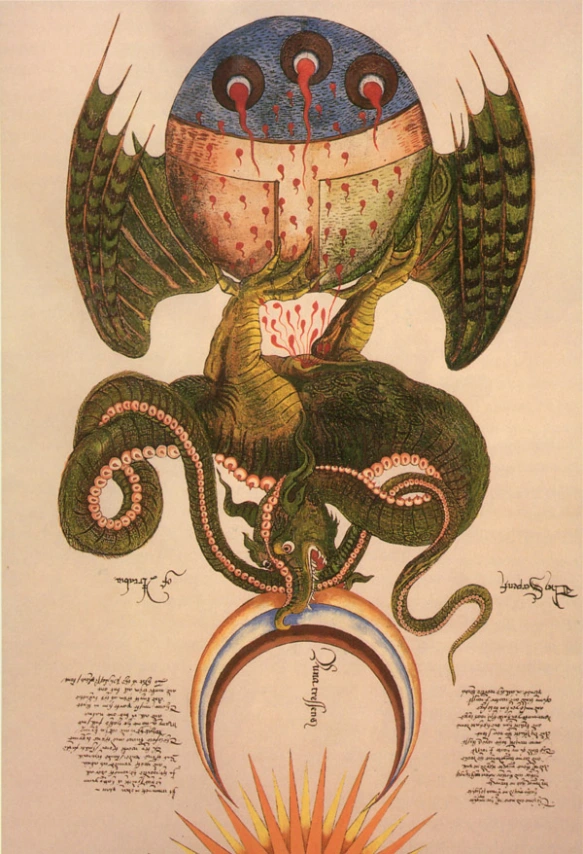
Dragons have captivated the human imagination since time immemorial. These mythical beasts appear in the folklore and legends of cultures across the globe, from the fire-breathing dragons of medieval European lore to the wise and benevolent dragons revered in the East. While dragons may vary in form and nature between traditions, they share an enduring power to evoke wonder, terror, and mystery.
But why do dragons continue to enchant us in the modern age? What is it about these fantastic creatures that strikes such a deep chord within the human psyche? In this podcast, we will explore the rich symbolism and psychological significance of dragons, drawing on the insights of comparative mythology, Jungian depth psychology, and contemporary pop culture analysis. We will discover how dragons serve as potent archetypes of unconscious energies, as catalysts of psychological transformation, and as mirrors for the hero’s journey we each must undertake to achieve self-realization.
Whether you see dragons as fearsome monsters to be conquered or as majestic beings guarding the treasures of the soul, join us on a quest into the hidden realms of myth and psyche as we uncover the timeless wisdom these creatures have to offer. Let us dare to face our own inner dragons and unlock the power they hold for personal growth and creative awakening. The journey awaits!
The Dragon as Shadow
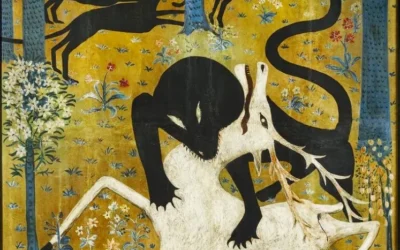
In Jungian psychology, the dragon often represents the Shadow – the repressed, unconscious aspects of the psyche that the ego perceives as undesirable or threatening. The Shadow contains the disowned parts of the self, the instinctual drives, primal emotions, and undeveloped potentials that we hide from ourselves and others.
Like the dragon hoarding treasure in its cave, the Shadow guards the riches of the unconscious – the untapped creativity, power, and wisdom that lie dormant within us. Confronting the dragon-Shadow is a daunting task, as it requires facing our deepest fears and integrating the rejected aspects of our being. Yet this confrontation is essential for psychological growth and wholeness.
As James, one of the podcast participants, noted: “When you get so connected and fight and work through all these things that you’ve come to therapy for, it’s getting kind of comfortable with not necessarily your alternate self, but you know, that shadow aspect of you.” Engaging with the dragon-Shadow allows us to sit with the paradox and tension of opposite parts of ourselves, ultimately leading to a more integrated, whole sense of self.
The Hero’s Dragon Quest
The hero’s journey to confront and integrate the dragon-Shadow is a universal motif found in mythologies worldwide. In the Epic of Gilgamesh, one of the oldest known heroic narratives, Gilgamesh must overcome the dragon-like monster Humbaba to gain access to the sacred Cedar Forest, a symbol of divine knowledge and immortality.
Similarly, in the ancient Greek myth of Perseus, the hero must slay the serpentine Medusa, whose gaze turns men to stone – a metaphor for the paralyzing power of the unintegrated Shadow. In Arthurian legend, Sir Lancelot’s ultimate quest is to heal the Fisher King and restore the Wasteland, a blighted realm that mirrors Lancelot’s own wounded psyche.
The hero’s dragon quest typically involves several key stages:
- The Call to Adventure: The hero, often living an ordinary life, receives a summons to leave the familiar world and venture into the unknown.
- Crossing the Threshold: The hero passes from the realm of the known into the dragon’s domain, the uncharted territory of the unconscious.
- Confronting the Dragon: The hero faces the dragon-Shadow in a battle that tests their courage, skill, and resolve. This ordeal represents the ego’s struggle to overcome fear and reclaim disowned parts of the self.
- Seizing the Treasure: If victorious, the hero claims the dragon’s hoard – the repressed energies and potentials of the unconscious. This is the true prize, rather than mere material wealth.
- The Return: The hero emerges from the dragon’s realm transformed, bringing the treasure of newfound wisdom and self-knowledge back to the ordinary world. This represents the integration of conscious and unconscious, the achievement of a more whole and authentic Self.
By understanding our own dragon quest through the lens of myth and archetype, we can find the courage to face our Shadow, claim our hidden treasures, and undertake the lifelong journey of growth and self-discovery.
Dragons East and West: Differing Views of the Ego
The role of dragons in Eastern and Western mythologies reflects fundamental differences in how these cultures view the ego and its relationship to the unconscious psyche.
In Western traditions, dragons are often portrayed as malevolent creatures that must be slain by the heroic ego. This adversarial relationship mirrors the Western emphasis on individual will, self-assertion, and the subjugation of nature. The ego is valorized as the center of identity, the dragon-slaying hero who must vanquish the chaotic forces of the unconscious to establish order and assert control.
In contrast, Eastern traditions tend to depict dragons as benevolent, awe-inspiring creatures associated with natural forces, divine wisdom, and the harmonious interplay of opposites. In Taoism, dragons symbolize the dynamic balance of yin and yang, the cyclical dance of light and shadow, creation and destruction. The Eastern perspective emphasizes the importance of aligning the ego with the natural flow of the Tao, the “way” of the cosmos.
This non-dualistic worldview recognizes the dragon not as an enemy to be conquered, but as an integral part of the Self to be honored and embraced. By attuning to the dragon’s wisdom, one can tap into the generative power of the unconscious and achieve a state of psychic wholeness and harmony. The Eastern path to self-realization involves transcending the limited ego and awakening to the interconnectedness of all being.
As Alice, another podcast participant, observed: “In the East… there’s more of like a kind of masculine overtone to like how the West usually kind of frames dragons. And then the East, I think that the difference is how we handle the ego – that’s like why it comes out differently in art.” The Western tendency to assert control and permanence contrasts with the Eastern acceptance of cyclical change and the need for balance.
Modern Dragons: Gateways to Transformation
In contemporary literature and popular culture, dragons continue to serve as potent symbols of transformation, personal power, and the confrontation with the shadow. From Tolkien’s Smaug to Martin’s Targaryen dragons in A Song of Ice and Fire, these mythic beasts challenge heroes to overcome their fears, claim their destiny, and redefine their identity.
Encountering the dragon in dreams, visions, or creative works can signal a call to growth and change. By engaging with dragon energy through active imagination, artistic expression, or embodied practices, we can access the transformative power of the unconscious and integrate disowned aspects of the self.
The immense popularity of dragon-centric series like Game of Thrones points to the enduring psychological resonance of these creatures. As the podcast discussion highlighted, the dragons in Game of Thrones are compelling as symbols of power, but also as untamable forces of nature that resist human control. Their story arc mirrors the dangers of unbridled ego and the need for balance and restraint.
Whether in Game of Thrones, The Hobbit, or How to Train Your Dragon, modern dragon tales continue to explore timeless themes of facing fears, claiming personal power, and growing into wholeness. As long as dragons endure in our collective imagination, they will have much to teach us about our own psyches and the human condition.
Kundalini and the Serpent Power
The serpentine imagery associated with dragons also appears in spiritual traditions like Kundalini yoga, where the coiled serpent at the base of the spine represents latent creative energy waiting to be awakened. As Alice explained in the podcast:
“In Kundalini yoga… Kundalini energy is represented by a snake, a serpent. It’s coiled in the base, seen as this extra-dimensional energy that’s not literally coiled in the base of your spine, but it sits, it rests there in the energy body… When you release it, it rises up the spine and into the pineal gland and activates the pineal gland. And then the energy starts flowing back.”
This serpent power is linked to heightened consciousness, spiritual awakening, and the integration of opposing forces within the self. The Kundalini serpent’s journey up the spine parallels the dragon’s transformative role as an agent of wholeness and self-realization.
The activation of the pineal gland, the “third eye” associated with intuition and higher perception, further connects serpent and dragon symbolism to the development of wisdom and the transcendence of ordinary consciousness. By embracing the serpentine dragon energy within, we can tap into the vast creative potential of the unconscious and unite the opposing forces of our being.
Summary
Dragons are endlessly fascinating creatures that have captured the human imagination for millennia. More than mere symbols of power or destruction, these mythical beasts serve as psychic guides, beckoning us to embark on the hero’s journey into the uncharted depths of our own being.
By studying dragon mythology through the lens of Jungian psychology, we uncover timeless wisdom about the nature of the Self and the path to wholeness. Dragons challenge us to confront our shadows, integrate our fragmented selves, and unleash the creative potential that lies dormant within.
In a world that often feels fractured and uncertain, the dragon’s call to adventure is more urgent than ever. We are all called to be heroes of our own lives, to venture beyond the familiar and comfortable in search of deeper meaning and purpose. The treasure we seek is not fame, fortune, or worldly power, but the gold of self-knowledge, the elixir of inner peace, and the gift of our authentic being.
So let us heed the dragon’s roar, summon our courage, and step boldly into the unknown. Let us slay our inner demons and befriend our hidden angels. And let us emerge from the dragon’s cave transformed, bearing the light of wisdom to illuminate the world.
The journey is long and perilous, but the rewards are beyond measure. For in facing our dragons, we discover our true selves – and in embracing our shadows, we find the path to light. May the mythic wisdom of these majestic creatures guide us on our quest for self-realization, now and always.
References
- Campbell, J. (2008). The hero with a thousand faces. New World Library.
- Jung, C. G. (1964). Man and his symbols. Dell.
- Jung, C. G. (1980). The archetypes and the collective unconscious. Princeton University Press.
- Martin, G. R. R. (1996). A Game of Thrones. Bantam Books.
- Miller, D. (2017). Dragons: Myths and legends. Flame Tree Publishing.
- Neumann, E. (2015). The Great Mother: An analysis of the archetype. Princeton University Press.
- Rowland, S. (2012). The ecocritical psyche: Literature, evolutionary complexity and Jung. Routledge.
- Segal, R. A. (1999). Theorizing about myth. University of Massachusetts Press.
- Von Franz, M. L. (1995). Shadow and evil in fairy tales. Shambhala Publications.
- Walker, S. F. (2002). Jung and the Jungians on myth. Routledge.










0 Comments