
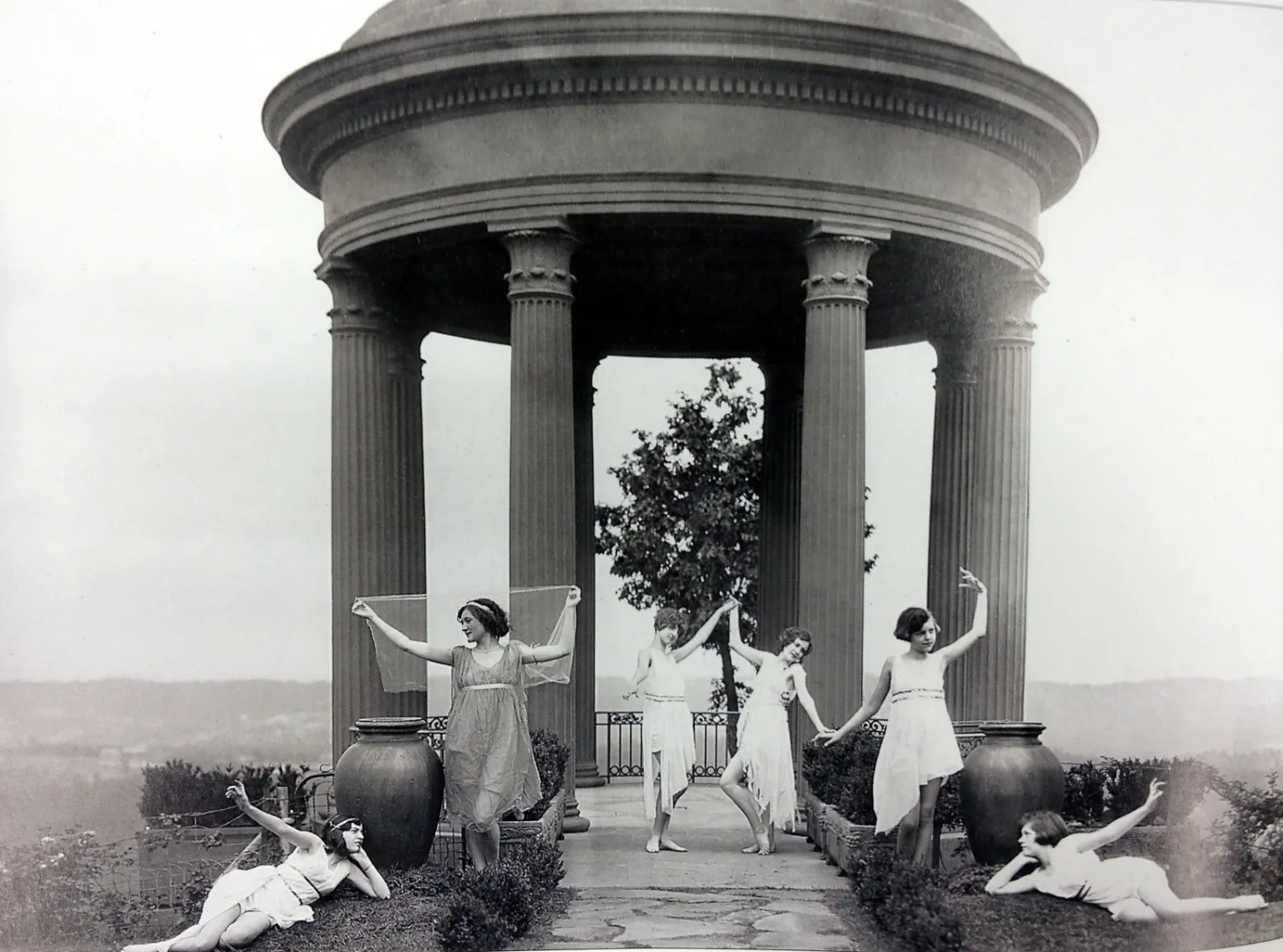
George Battey Ward (1867 to 1940) was mayor of Birmingham from 1905 to 1908 and president of its city commission from 1913 to 1917. After voters rejected him, he built Vestavia, a round sandstone house modelled on Rome’s Temple of Vesta, on Shades Mountain. The city of Vestavia Hills takes its name from it. Psychologically, his life shows how a hunger for order and lasting monuments can grow out of chaos, public humiliation and the fear of death.
Key takeaways
- George B. Ward was mayor of Birmingham from 1905 to 1908 and president of the city commission from 1913 to 1917, a City Beautiful reformer obsessed with order.
- After losing the 1917 election to a candidate backed by the anti-Catholic True Americans, Ward withdrew to Shades Mountain and built Vestavia, a round house modelled on Rome’s Temple of Vesta.
- The Sibyl Temple, built in 1929 as a garden pavilion, was moved to U.S. 31 in 1976 and is now the emblem of Vestavia Hills.
- Ward’s life illustrates how early danger, public humiliation and death anxiety can drive a lifelong need for control and for monuments that outlast us.
What is the Sibyl Temple in Vestavia Hills?
Drive up U.S. Highway 31 in Vestavia Hills and you pass a small domed Roman temple on a rock outcrop above the traffic. This is the Sibyl Temple, the city’s emblem and the marker at its northern gateway. Ward built it in 1929 as a garden pavilion on his estate, modelled on the Temple of the Sibyl at Tivoli, a hill town east of Rome.6
The temple has stood beside the highway only since 1976, when it was moved from the grounds of Ward’s house to the outcrop now called Sibyl Temple Park.6 A story often repeated in Vestavia holds that Ward hoped to rest beneath it for good. No burial ever took place there, and the empty little temple works as a memorial anyway: the last visible piece of a man who tried to set the order and grandeur of ancient Rome on top of an iron town. To read the psychology of Vestavia Hills, a suburb that still prizes order, achievement and appearances, it helps to know the whole life of the man it is named after.
Ward’s early life in Birmingham, 1867 to 1900
Ward was born in Atlanta on March 1, 1867, and came to Birmingham as a small child in 1871, the year the city was founded. His parents, George R. and Margaret Ward, ran the Relay House hotel together with his grandparents William and Jane Ketchum.1 The Relay House stood near the railroad crossing that was the reason for Birmingham’s existence, and it was one of the first places where the new town’s speculators, railroad men and travellers ate and slept.5 His mother hosted social events there and was a founding member of the Episcopal Church of the Advent, which tied the family to the town’s small Episcopal elite.1
Growing up inside a frontier hotel meant growing up inside the boom itself. Birmingham went from cornfield to industrial city in two decades, with all the noise, money, violence and dirt that implies. A boy raised in that lobby saw daily what happens to a place that grows faster than its institutions, and the adult Ward spent his public life trying to give the city the institutions it lacked.
He attended the Powell School until he was sixteen and then went to work as a runner for Charles Linn’s National Bank of Birmingham. Later he studied at the preparatory school of Cumberland University in Lebanon, Tennessee, and on his return the bank promoted him, eventually to paying teller.1
What happened at the Hawes riot of 1888?
On December 8, 1888, a mob rushed the Jefferson County Courthouse intending to lynch Richard Hawes, a railroad engineer accused of murdering his wife and two young daughters. The sheriff’s deputies fired into the crowd and several men were killed. Ward, then twenty-one, was in the crowd, and a bullet narrowly missed him.1 The night became part of the city’s dark folklore, one of the scenes that give Birmingham its Southern Gothic reputation.
No document records what Ward felt that night. It is fair, though, to notice what followed: a young man who had seen a crowd become a killing mob, and armed authority answer it with gunfire, went on to build a career out of public order, sanitation, policing and civic beauty. Trauma clinicians know that a near miss of this kind often lives on in the body as vigilance, a felt need to keep the world under control, long after the memory itself has been told and retold. The site’s account of what post-traumatic stress feels like describes the pattern.
Banker and alderman
In 1899 Ward won a seat on the Birmingham Board of Aldermen but resigned after a few months to manage a bank in Sheffield, in north Alabama. He returned to the National Bank of Birmingham in 1900, left a year later to form an investment company with John M. Caldwell, and was elected alderman again, this time for a four-year term representing the city’s second ward.1

Mayor Ward and the City Beautiful
Ward first ran for mayor in 1903 against the incumbent, Mel Drennen, charging that Drennen was building a political machine out of city employees and running deficits without delivering services. He lost. When Drennen retired, Ward ran again, won the 1905 primary and took office on May 4, 1905, for a two-year term. In 1907 he won re-election easily against Frank P. O’Brien, whom he cast as a front for liquor and gambling interests.12
As mayor of Birmingham, Ward governed like a careful banker with a reformer’s conscience. He codified and published the city’s municipal code for the first time, mailed a copy of the sanitation laws to every household, created the post of city comptroller, published the city’s balance in the newspapers every month and set up a building inspection department. He enlarged the police force, bought new fire equipment, pushed sewer construction and tried to help the city schools keep pace with a fast-growing student body.1 He enforced saloon rules strictly and then, in 1907, campaigned for the referendum that brought local prohibition to Jefferson County.
Ward was an admirer of the City Beautiful movement, the American reform current, launched by the white plaster “White City” of Chicago’s 1893 World’s Columbian Exposition, which held that grand civic architecture, parks and clean streets would make better citizens.3 In Birmingham that meant clean-up days to tidy the downtown, pressure on utilities to bury their overhead wires, and a large expansion of public parkland, including the purchase of 100 acres at Green Springs that is now George Ward Park. He also had the “Keep Off the Grass” signs taken down so that people would actually use the parks.1
Ward’s dealings with the Birmingham Railway, Light and Power Company, which ran the streetcars and electric lines, followed the same logic. He preferred short-term franchises with high fees, which kept the utilities answerable to the city and paid for public works.1 The streetcar network that Ward bargained with is the subject of a separate history of Birmingham’s lost streetcar system.
The 1907 coup and the commission years
In 1907 the Alabama Legislature passed a municipal code that separated the mayor’s executive powers from the aldermen’s legislative ones. Ward supported it on condition that it take effect only after his term. In August 1907, while he was on a six-week tour of Europe, the aldermen voted 10 to 7 to reorganize as a city council under John L. Parker as president and acting mayor. Parker reassigned every committee and left Ward’s allies in charge mainly of cemeteries.1
Ward refused to recognize the new council. With the police on his side, he kept calling meetings of the old Board of Aldermen. Parker sued and the Alabama Supreme Court gave the council control of the city.12 For a man who equated legitimate authority with civic safety, losing power by a manoeuvre staged in his absence was a deep humiliation.
In 1910 he ran for sheriff of Jefferson County, spent heavily, expected to win, and lost badly to Walter McAdory. He announced he was finished with politics. The same year, the “Greater Birmingham” annexation of January 1910 folded the surrounding industrial towns and suburbs into the city, lifting the 1910 census count above 130,000 and bringing in a large new electorate of working-class voters.25
Progressive reform pulled him back. In 1913 he ran for president of the new Birmingham City Commission and defeated the Socialist candidate, the poet Clement Wood, taking office on November 13, 1913.1 The job was mostly a fight over money. Birmingham’s tax collections were among the lowest of any American city its size, the annexed towns had brought their debts with them, and the legislature allowed only a referendum on a modest tax rise, which failed in 1915. Departments were cut, school fees were charged, police and fire staff were reduced by a third and the zoo was closed. Unable to fund a city, Ward turned to citizens instead: the public works department helped volunteers plant gardens on vacant lots, a City Beautiful campaign that drew national press attention.12
The 1917 election and the True Americans
Ward’s opponent in 1917 was Nathaniel Barrett, an East Lake physician backed by the True Americans, a secret anti-Catholic society that flourished in Birmingham in the late 1910s and prepared the ground for the revived Ku Klux Klan’s power in the city in the 1920s.4 Barrett’s campaign smeared Ward, an Episcopalian, as part of a supposed Roman Catholic conspiracy. Ward denounced the True Americans openly, and his campaign even used a secretly filmed exposé against them.1
He carried the old central city, but the annexed suburbs voted overwhelmingly for Barrett, and Ward lost.12 The voters brought in by the expansion he had backed ended his public career. It was the second time the city had pushed him out, and this time by a sectarian movement whose bigotry he had named in public.
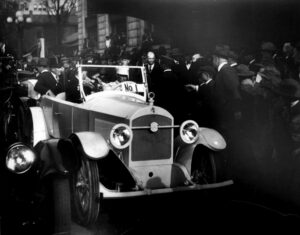
He made one more public appearance of note. When President Warren G. Harding visited Birmingham in October 1921 for the city’s fiftieth anniversary, Ward rode in the lead car alongside Frank McQueen, an African American barber, the two of them representing the “Pioneers of 1871” who had lived in Birmingham since its founding.1 In the segregated South of 1921, a former mayor sharing the lead car with a Black pioneer was a visible statement about who belonged to the city’s story.
Why did Ward build a Roman temple on Shades Mountain?
In 1923 Ward bought a twenty-acre parcel on the ridge of Shades Mountain, then a quiet wooded crest above the smoke of the city, where a few wealthy families had begun to build estates along a road first cut in 1916.6 There, by 1925, he finished Vestavia. The house was modelled on the circular Temple of Vesta in Rome, the shrine of the goddess of the hearth whose sacred flame stood for the safety of the city.16 Round temples of this kind, called tholoi, were what tourists of the period knew as “Vesta’s temples”: the best preserved, beside the Tiber, was long called the Temple of Vesta and is now identified as the Temple of Hercules Victor.
Vestavia was a two-and-a-half-storey house of dark pink sandstone, ringed by twenty massive white Doric columns carrying a carved entablature. Around it Ward laid out gardens with fountains, statuary and peacocks, and at the edge of the grounds he later placed the smaller domed Sibyl Temple.6
The choice of Vesta matters. Vesta was the goddess of the hearth, and her temple held the fire that Romans believed kept their city alive. Ward had spent his life trying to protect a city that twice turned him out. On the mountain he built a hearth for it anyway, a civic temple that was also a private home, looking down on Birmingham from above. The fascination with Rome as a model of order and of collapse runs through Western imagination, as a piece on ancient Rome as a therapy case study traces.
The same year Ward bought his land, 1923, Carl Jung began building his stone tower at Bollingen on Lake Zurich. Jung later wrote that the tower gave a concrete form to his inner life, and he kept adding to it for decades as his psyche changed.10 Read alongside Jung’s account of his Bollingen stone, Vestavia looks less like an eccentric folly and more like the outer image of an inner world: a sanctuary of order, beauty and permanence for a man whose public world had been disorderly, ugly and unstable.

Life at Vestavia
From 1925 until his death, Ward lived at Vestavia as a host and a showman. His garden parties, with dancers in togas and servers dressed as Roman soldiers, became famous in Birmingham society.1 The house sat beside the main highway between Birmingham and Montgomery, and it quickly became a landmark and something of a tourist stop.6
The household staff who served in those costumes worked inside the racial order of the Jim Crow South, where domestic service fell overwhelmingly to Black workers. That detail belongs in any honest portrait. Ward could ride beside Frank McQueen in 1921 and still stage his household on the racial hierarchy of the Jim Crow South: the classical fantasy and the social order of his time ran together.
The Roman ideal Ward admired was as much moral as architectural. Educated Americans of his generation read Roman history as a lesson in civic duty, self-command and the danger of decadence, the line that runs back to the Stoic emperor described in Marcus Aurelius and his Meditations. Ward lived that ideal as theatre. He could not command the city any longer, but on his own twenty acres he could arrange every column, path and peacock exactly as he wished.
Ward was not the only Birmingham man to build a private world above the city. His neighbours on the ridges included the developers who laid out Mountain Brook, and the history of that suburb, told in the story of the Jemison family and Mountain Brook, shows the same wish to leave the furnace district behind for green and ordered hills.
The Sibyl Temple and Ward’s death
In 1929 Ward added the Sibyl Temple, a small round domed pavilion patterned on the ancient temple at Tivoli traditionally linked with the Tiburtine Sibyl, the prophetess of the Roman hill town.6 It was ornamental, a garden gazebo that framed the view from the estate. The pairing is telling: Vesta’s hearth for the house, and a sibyl, a seer who foretold the fate of cities, for the lookout over Birmingham.
Ward died in 1940.1 Whatever he hoped for his own resting place, the Sibyl Temple was never a tomb. Its power in local memory comes from the story people tell about it: that the old mayor wanted to stay on the mountain forever, watching the city below. A story like that survives because it says something true about the man, even where the paperwork is silent.

What happened to Vestavia after Ward died?
After Ward’s death the estate was bought by the developer Charles Byrd, who in 1946 began building a planned community of about 1,000 homes on the mountain and named it Vestavia Hills after the house. The new suburb was incorporated as a city on November 8, 1950.6
The house itself served for a time as a tearoom and reception hall.7 Its kitchen is remembered for one thing above all: orange rolls, a sweet citrus roll that Birmingham families still bake for holidays, long after the dining room closed. Their survival is the subject of the psychology of orange rolls, a meditation on why a pastry can outlast a temple.
Vestavia Hills Baptist Church then bought the house, and for several years the congregation worshipped inside Ward’s temple to the Roman hearth goddess. The architectural historian Margaret Grubiak has studied this unlikely conversion, framing the move from Roman temple to Baptist sanctuary in terms of sin and transformation in Southern Baptist culture.7
The 1971 demolition and what survives
In 1971 the church demolished a large portion of the round house to make way for a bigger building. A central portion of Ward’s original structure was kept and now forms part of the modern church.67 The loss of the colonnade came two years after the city’s other great architectural loss of the period, the 1969 demolition of Terminal Station, a pattern explored in the psychology of destroying what we love most.
The Sibyl Temple was spared. The local garden club had it moved in 1976 to a prominent outcrop nearer the highway, where it became the gateway landmark of Vestavia Hills.67 Today it plays the role that the iron Vulcan statue plays for Birmingham proper: a civic image people photograph, put on logos and argue over, much as described in the site’s history of the Vulcan statue as Birmingham’s psyche.
A psychological portrait of George Ward
Ward was a man of contradictions. He was a progressive who trusted strong executive authority; a lover of parks who removed “Keep Off the Grass” signs yet wanted every yard tidy; a defender of Catholic employees and a Black pioneer’s place in the parade who still staffed his house on Jim Crow lines; a man who loved his city and, in the end, preferred to watch it from a mountaintop.
Several threads run through the life. The first is order as protection. A boy raised in a boomtown hotel and a young man who stood in a crowd under gunfire would have every reason to feel that disorder is dangerous. Ward’s municipal code, comptroller, monthly accounts and clean-up days were good government, and they were also a way of making a frightening world predictable.
The second is humiliation and withdrawal. Twice the city took power from him, once by a council manoeuvre while he was abroad and once by a sectarian campaign. Each time he left. After 1917 he did not try again; he built a world where no vote could remove him.
The third is the wish to outlast death. The cultural anthropologist Ernest Becker argued in The Denial of Death (1973) that much human striving is an “immortality project”: we pour ourselves into works, causes and buildings that promise to survive us, because the plain fact of mortality is too much to hold.8 Becker’s thesis, explored further in Ernest Becker’s The Denial of Death, fits Ward closely: a temple to the eternal flame, built by a man who had lost his public role and was entering old age.
Social psychologists have tested Becker’s idea for decades under the name terror management theory. A 2010 meta-analysis of 277 experiments found that reminding people of their own death reliably strengthens their attachment to their cultural worldview and their need for self-esteem, with a moderate overall effect.11 Researchers summarizing thirty years of the work describe culture, status and lasting achievements as buffers people build against death anxiety.12 Vestavia was Ward’s buffer in stone.
What does George Ward’s story offer therapy?
Few clients build Roman temples, but many live Ward’s pattern on a smaller scale. We see it in people whose need for control began in a chaotic or frightening childhood, in high achievers whose worth rests on how their home, work or family looks from outside, and in people who respond to rejection by withdrawing into a carefully arranged private world where nothing can hurt them. A suburb like Vestavia Hills, named for one man’s monument, is full of quieter versions of the same striving, and our trauma counselling in Vestavia Hills often begins there.
At Taproot, a therapist working with this pattern starts by treating the need for order as a protector, not a flaw. In parts work, the part that keeps everything spotless and planned is usually guarding an earlier, frightened part. In body-based trauma work such as Brainspotting, ETT and EMDR, the therapist helps the client locate where an old moment of danger, a near miss like Ward’s in 1888, is still held in the nervous system, so that it can be processed and the vigilance can ease. Jungian work looks at the images a person builds their life around, their own temples and columns, and asks what they are trying to keep alive.
Existential therapy names the deepest layer directly. Irvin Yalom, in Staring at the Sun (2008), describes how facing death openly, instead of fleeing it through monuments and frantic achievement, can make life more vivid, and how people live on less through their buildings than through what he calls “rippling”, the influence they pass on to others.9 The site’s profile of Irvin Yalom’s existential psychotherapy sets out that approach.
Ward’s real legacy is less the vanished colonnade than the parks, the honest accounts and the city name that have rippled on for a century. At Taproot we work with people who are carrying their own version of his burden, the fear underneath the need for control and the wish to be remembered, through existential therapy in Birmingham and the depth and trauma approaches described above.
Frequently asked questions
Who was George Ward of Vestavia Hills?
George Battey Ward (1867 to 1940) was a Birmingham banker and politician who served as mayor from 1905 to 1908 and as president of the city commission from 1913 to 1917. After leaving politics he built Vestavia, a Roman-style house on Shades Mountain completed in 1925. The suburb of Vestavia Hills, incorporated in 1950, is named after his estate.
Was the Sibyl Temple built as George Ward’s tomb?
No. George Ward built the Sibyl Temple in 1929 as a domed garden pavilion on his Vestavia estate, modelled on the Temple of the Sibyl at Tivoli near Rome. Local stories say he hoped to rest on the mountain, but no burial took place there. The garden club moved the temple to its current outcrop on U.S. Highway 31 in 1976.
Does any of George Ward’s Vestavia house still exist?
Yes, in part. Vestavia Hills Baptist Church bought Ward’s round sandstone house and worshipped in it for several years. In 1971 the church demolished a large portion of it to build a bigger sanctuary, but a central portion of the original structure was kept and is part of the modern church building.
Why is it called Vestavia Hills?
Vestavia Hills is named after Vestavia, the estate George B. Ward built in the 1920s on Shades Mountain. Ward named the house for Vesta, the Roman goddess of the hearth, because it was modelled on her circular temple in Rome. Developer Charles Byrd later used the name for the subdivision that became the city.
What did George Ward do as mayor of Birmingham?
As mayor, George Ward published Birmingham’s first municipal code, mailed sanitation laws to every household, created a city comptroller, reported city finances monthly, enlarged the police and fire services, held clean-up days and bought 100 acres at Green Springs, now George Ward Park, in the spirit of the City Beautiful movement.
Related reading
- The Anima of the Great Gatsby and the Animus of History
- The Heaviest Corner on Earth: What Birmingham’s Skyline Reveals About Imposter Syndrome
- William Morris: Weaving the Threads of Myth into Design
- The Innocent Archetype: Exploring Purity and Victimhood
- A Critical History of the Diagnostic and Statistical Manual of Mental Disorders
- Highway 280 Psychology: How Birmingham’s Bypass Infrastructure Created Isolation
References
- LaMonte, E. S. (1974). George B. Ward: Birmingham’s urban statesman. Birmingham Public Library.
- Harris, C. V. (1977). Political power in Birmingham, 1871-1921. University of Tennessee Press.
- Wilson, W. H. (1989). The City Beautiful movement. Johns Hopkins University Press.
- Feldman, G. (1999). Politics, society, and the Klan in Alabama, 1915-1949. University of Alabama Press.
- Atkins, L. R. (1981). The valley and the hills: An illustrated history of Birmingham and Jefferson County. Windsor Publications.
- Wilson, C. M. (2011). Vestavia Hills. In Encyclopedia of Alabama. Alabama Humanities Alliance. https://encyclopediaofalabama.org/article/vestavia-hills/
- Grubiak, M. M. (2021). From Roman temple to Baptist church: Sin and transformation in Southern Baptist culture. Buildings & Landscapes: Journal of the Vernacular Architecture Forum, 28(2), 45-70. https://doi.org/10.5749/buildland.28.2.0045
- Becker, E. (1973). The denial of death. Free Press.
- Yalom, I. D. (2008). Staring at the sun: Overcoming the terror of death. Jossey-Bass.
- Jung, C. G. (1963). Memories, dreams, reflections (A. Jaffé, Ed.; R. Winston & C. Winston, Trans.). Pantheon Books.
- Burke, B. L., Martens, A., & Faucher, E. H. (2010). Two decades of terror management theory: A meta-analysis of mortality salience research. Personality and Social Psychology Review, 14(2), 155-195. https://doi.org/10.1177/1088868309352321
- Pyszczynski, T., Solomon, S., & Greenberg, J. (2015). Thirty years of terror management theory: From genesis to revelation. Advances in Experimental Social Psychology, 52, 1-70. https://doi.org/10.1016/bs.aesp.2015.03.001

















0 Comments